Lessons from Donald Redelmeier and Daniel Kahneman · for dermatology practices
Length Fades. Design the Ending.
In a Toronto hospital in 1994 and 1995, Donald Redelmeier, Joel Katz and Daniel Kahneman randomly gave 682 colonoscopy patients either the usual ending or a gentler last few minutes. The patients with the gentler ending remembered the whole procedure as less unpleasant. Your clinic can design how every visit ends: estimates and planned explanations early, a calm and clear close, and a goodbye that never rushes.
What you’ll take away
- The problem
- Most visits end however the schedule allows: a quick “all set,” a vague next step, sometimes a bill as the last word. Yet the last minutes are one of the moments patients remember.
- What to remember
- A better last few minutes can improve how the whole visit is remembered. So design the ending on purpose.
- What to do differently
- Raise estimates and planned explanations early. Close the room with a calm recap and the next step in writing. Say goodbye without rushing. Change the words and the order, never the procedure.
30-Second Summary
- A gentler ending changed the memory of the whole procedure. In a Toronto trial of 682 colonoscopy patients, those given a milder last few minutes remembered the entire procedure as about 10 percent less unpleasant.1
- Memory keeps snapshots, not a stopwatch. Patients’ memories of painful procedures followed the worst moment and the last few minutes, and length counted for little.2, 3
- Service researchers turned it into advice. Richard Chase and Sriram Dasu put “finish strong” first among their service principles, and dealing with the unpleasant parts early second.4
- In your clinic, design the last minute. Raise estimates and planned explanations early, close the room with a calm recap and the next step in writing, and say goodbye without rushing. Change the words and the order, never the procedure.
The Problem
What Goes Wrong When Nobody Plans the Last Minutes
Picture the end of an uncomfortable procedure. The work is done. The last step comes, the instrument comes out, someone says “All set,” and the patient heads for the door.
Nobody planned how those last minutes would feel. They are whatever the work left behind.
Those minutes count for more than they seem. In 1996, Donald Redelmeier and Daniel Kahneman studied patients in Toronto having colonoscopy or lithotripsy, a treatment that breaks up kidney stones. Patients rated their pain as it happened, then judged afterward how painful the whole thing had been.2
What they remembered followed two moments: the worst pain, and the pain in the last three minutes. Length made little difference to how bad a procedure was remembered.2
Nobody here is careless. The ending just isn’t anyone’s job. So the part of a visit that nobody designs is one of the two moments that patients’ memories followed.
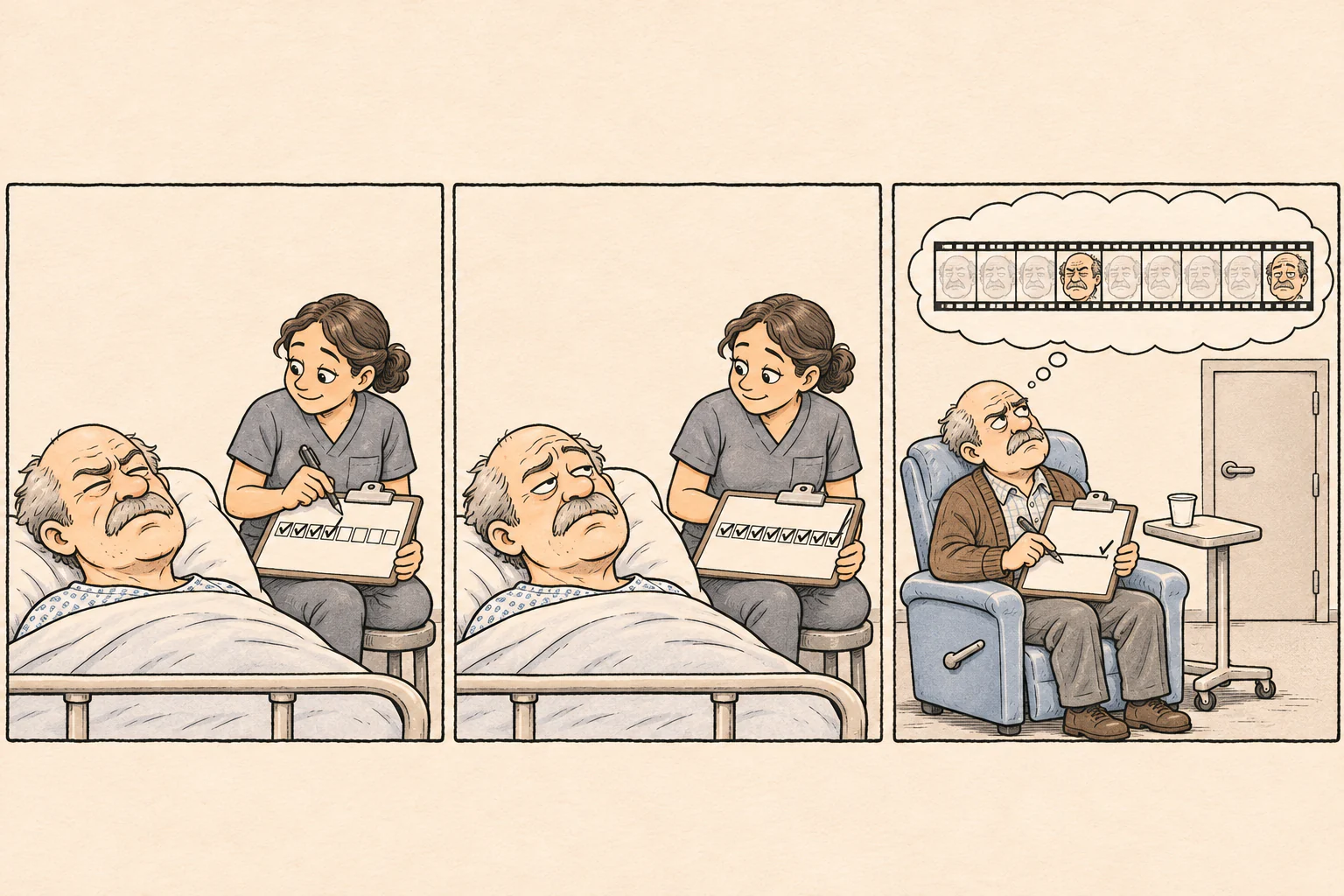
The usual ending. 1 · The worst moment, rated as it happens. 2 · The last minutes are rated too. Nobody planned them, and they are still uncomfortable. 3 · Looking back, two snapshots stand out: the worst moment and the last one. How long it lasted barely registers.2, 3
The Exceptional Solution
Redelmeier and Kahneman’s Answer: A Gentler Ending
If memory follows the last minutes, could a gentler ending change how a whole procedure is remembered? Redelmeier, Kahneman and their colleague Joel Katz tested it. From November 1994 to December 1995, they enrolled 682 colonoscopy outpatients at a Toronto hospital.1
Here is how the test worked:
Decide at the end. Each patient got a sealed envelope at the start of the procedure. It was opened only at the final stage, and it chose the usual ending or a gentler one.1
Make the last minutes milder. In the gentler ending, the tip of the scope rested in the rectum for up to three minutes before it came out, with no suction, no inflation and no added anesthetic.1
Keep the test fair. Patients were never told which group they were in, and staff were asked to keep their behavior the same.1
Ask the memory. Patients rated their pain every minute, from 0 to 10. Afterward, once the sedation had worn off, they marked how unpleasant the whole procedure had been on a 10 cm line, a separate rating made from memory.1
The ending got gentler. Pain in the last three minutes averaged 1.7 out of 10 with the gentler ending, against 2.5 with the usual one.1
And the memory followed. Patients with the gentler ending remembered the whole procedure as about 10 percent less unpleasant: 4.4 against 4.9 on the 10 cm line. When they ranked it among eight unpleasant experiences, they ranked it as less unpleasant too.1
The authors suggested that physicians might use “special gentleness and care at the end of an aversive procedure.”1
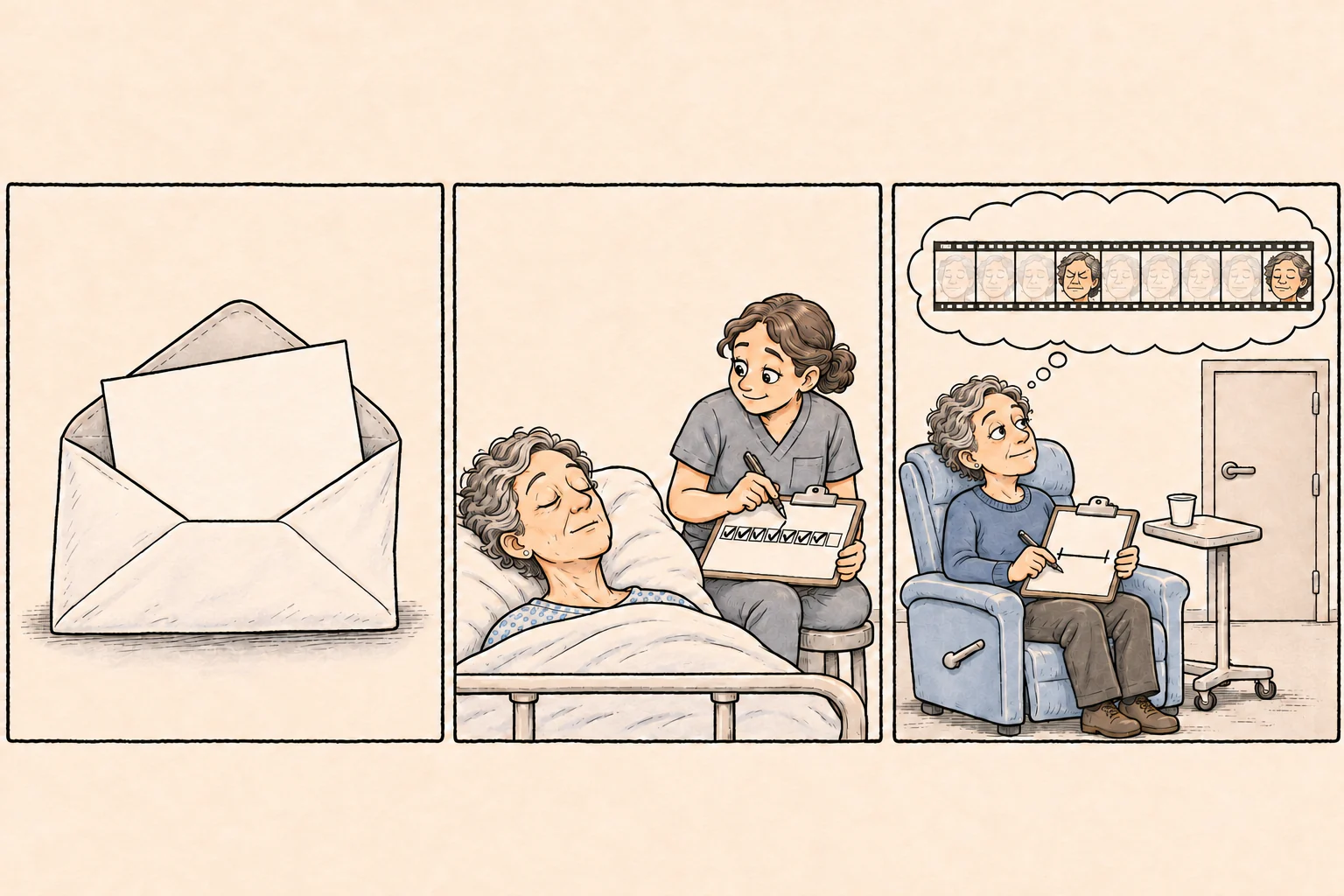
The gentler ending. 1 · At the final stage, a sealed envelope picks the ending, and the patient never knows which. 2 · The scope rests for up to three minutes, with no suction and no inflation, and the last minutes feel milder. 3 · Rated later from memory, the worst moment is still there, but the last snapshot is calmer.1
The ProblemA colonoscopy reaches its final stage. The work is nearly done, and the last minutes will be whatever the work leaves.
The Mediocre ApproachThe usual ending: stop when the work stops
Action
Finish and withdraw.
- The scope comes out when the work is done
- Nobody plans how the last minutes feel
Poor outcome
Remembered as worse.
- Pain in the last three minutes averaged 2.5 out of 101
- Remembered unpleasantness: 4.9 on a 10 cm line
The Exceptional ApproachThe Toronto answer: a gentler ending
Action
Make the last minutes milder.
- The scope rests for up to three minutes before it comes out1
- No suction, no inflation, no added anesthetic
Exceptional outcome
Remembered as less unpleasant.
- Pain in the last three minutes averaged 1.7 out of 101
- Remembered unpleasantness: 4.4 on a 10 cm line
What Set the Toronto Test Apart
The idea wasn’t kindness in general. It was a precise change, aimed at one moment:
One moment, on purpose. The envelope stayed sealed until the last stage, and only the ending changed.1
Measured minute by minute. Pain ratings every minute showed a gentler finish: 1.7 out of 10, against 2.5.1
Judged by memory. The test that mattered was how patients remembered the whole procedure afterward.1
In our first picture, nobody planned the last minutes. The Toronto team designed the ending, and the memory of the whole procedure followed it.
The Same Idea, in Service
In 2001, Richard Chase and Sriram Dasu turned behavioral research into advice for service businesses in the Harvard Business Review. First on their list of five principles: “finish strong,” because the ending is the part customers carry away with them. Second: “get the bad experiences out of the way early.”4
Put the two together and you have the shape of a designed visit: the hard parts early, and an ending that is the calmest, clearest part.
The mechanism
Why It Works
Why would a few gentler minutes change the memory of a whole procedure? Because memory doesn’t replay a visit minute by minute. Looking back, people judge an experience by a few moments, as if from snapshots.3
Tap or click a card to see why it works.
-
Memory keeps snapshots.
Not a stopwatch.3
Why it works
- Length barely registers. When volunteers judged film clips afterward, how long a clip ran made little difference.3
- A few moments stand in for the whole. Their judgments looked like a weighted average of “snapshots.”3
- The same in real procedures. A longer procedure did not stand out as worse in memory.2
-
The worst moment leaves a mark.
It’s one of the snapshots.2
Why it works
- The peak counts. Patients’ memories of total pain after colonoscopy and lithotripsy tracked their worst pain.2
- Across many studies, too. When researchers pooled the studies, the most intense moment tracked later judgments at least as closely as the ending did.5, 6
- Plan it, too. The hardest moment of a dermatology visit is usually clinical, so it belongs to the clinician.
-
The ending is the last snapshot.
It colors the whole.1
Why it works
- The last minutes count. In 1996, memory tracked the pain of the last three minutes, too.2
- Change the end, change the memory. In Toronto, only the last few minutes changed, and patients remembered the whole procedure as less unpleasant.1
- The same with a screening test. A nonpainful last step lowered how much pain women recalled after a Pap test.7
-
Hard parts first.
Deal with them early.4
Why it works
- End strong. Chase and Dasu’s first service principle is to close well, because the ending is what customers carry away.4
- Early, not last. Their second principle is to handle the unpleasant parts early.4
- In a clinic, estimates and planned explanations come before the close, so the last thing a patient hears is the plan.
The evidence
The Evidence, and Where Else It Works
The Toronto trial is the clearest test.1 The same pattern turns up elsewhere: after a screening test,7 in mothers’ memories of childbirth,8 and across many pooled studies.5, 6 Flip each card for the result and the lesson to take home.
Tap or click a card to flip it.
-
About 10% less unpleasant, as patients remembered the whole colonoscopy, when the last few minutes were gentler
- The change: Only the last few minutes were made milder.
- The memory: The whole procedure, rated afterward from memory.
Exceptional results1
4.9 → 4.4 remembered unpleasantness, 10 cm line: usual vs gentler
- Pain in the last few minutes averaged 1.7 out of 10, against 2.5 with the usual ending.
- Among eight unpleasant experiences, they rated the procedure as less bad too.
Valuable lesson: Make the last minutes the gentlest part of the visit.
Source: Redelmeier et al., Pain 2003 · evidence row 1
-
1.5 vs 2.0 recalled pain out of 5 after a Pap test that ended with a nonpainful step, against the usual ending
- The change: A nonpainful step added at the end.
- The memory: How much pain women recalled afterward.
Exceptional results7
2.02 → 1.50 recalled pain out of 5, usual vs gentle last step
- A year later, women given the gentle last step said they were more willing to have the test again.
Valuable lesson: Let the visit end on a step that doesn’t hurt.
Source: Yen et al., Pain 2023 · evidence row 7
-
Peak + end what mothers’ memories of labor pain leaned toward, two days and two months after giving birth
- The experience: Labor, however long it lasted.
- The memory: Leaned toward the worst pain and the pain at the end.
Exceptional results8
Peak + end what the memory of labor pain leaned toward
- How long labor lasted made little difference.
Valuable lesson: Ask about the hardest moment and the last one, not how long it took.
-
Near zero how closely an experience’s length tracked people’s later judgments of it, across many pooled studies
- The length: How long the experience lasted.
- The judgment: How people rated it afterward.
Near zero how closely length tracked later judgments
- The overall feel of the experience, its worst moment and its ending each tracked those judgments far more closely.
Valuable lesson: Plan the whole visit, its worst moment and its ending, not its length.
Source: Alaybek et al., corrected 2024 (posted tables) · evidence row 5 · evidence row 6
Your dermatology clinic
Bringing It Home to Your Dermatology Clinic
Your clinic ends dozens of visits a day: a biopsy, a freeze, an excision, a skin check. Most of them end twice, once in the exam room and once at the front desk. Each ending is either designed or left to whatever the schedule allows.
Find your endings: for each kind of visit, ask what the last minute looks like now: who is there, what is said, and what the patient carries out the door. Give each ending an owner. The nurse closes the room; the front desk closes the visit.
Hard parts early: estimates, balances and copays belong at check-in or before the procedure, never as the last thing a patient hears. So does any explanation the clinician has planned to give ahead, such as what to expect during a procedure. The clinician decides when to share clinical news and when to give care.
Close the room: once the patient is comfortable and ready, before standing, the nurse gives a short, calm recap in wording the clinician has approved: what was done, what happens next, when to expect an update and who will call. The next step goes home in writing, with warning signs and the clinic’s number.
No rush at the door: at checkout, look up, use the patient’s name, confirm the next date and ask one question: “Is anything unclear before you go?”
Plan the worst moment, too: the hardest moment of a dermatology visit is usually clinical, so it belongs to the clinician: a clear word before the sting, and a check-in during it.
Gentle, never longer: change the words, the order and the attention at the end of a visit, never the procedure. Nobody lengthens a procedure, delays removing an instrument or adds discomfort to shape a memory, and the procedure, the treatment and the aftercare stay with the clinician.
Here’s how that plays out in two everyday moments. Each one starts with the problem, follows the mediocre approach to its outcome, then rewinds to the same moment for the exceptional approach: an ending someone designed.
Example One: The Last Minute After the Freeze
- The Problem
The dermatologist has just frozen three warts on eight-year-old Theo’s hand and is heading to the next room. Theo is teary, his mom has his jacket ready, and the nurse is the one who will close the visit.
 Dermatologist:All done, Theo. That was the last one.Theo (thinking):It still stings.Nurse (thinking):Room four is waiting.
The treatment is over. The visit isn’t. The freeze is done, and the last minute of the visit hasn’t happened yet. - The Mediocre ApproachThe action
 Nurse:You’re all set! Instructions are in the bag.Mom (thinking):Do I put anything on it?
Out the door on the sting. The sheet goes in a bag, and the last thing Theo feels in the clinic is a hurry. - The Mediocre ApproachThe poor outcome
 Theo:I’m not going in there!Mom:He’s dreaded this all week.Nurse (thinking):And we’re behind again.
Three weeks later. The next visit starts with a standoff in the doorway, and the room runs late before anything has begun. Rewind. Same patient, same moment, same problem. This time, someone designs the ending.
- The Exceptional ApproachThe action: design the ending
 Nurse:The hard part’s over. Let’s take a breath.Nurse:The doctor’s sheet: what to expect, when to call.Theo (thinking):Okay. That’s done.
Close the room, then open the door. The nurse lets Theo settle, then goes over the doctor’s aftercare sheet with his mom, unhurried. - The Exceptional ApproachThe exceptional outcome
 Theo:Last time it stung, then it was okay.Dermatologist:Thanks for telling me. Let’s take a look first.
Three weeks later. Theo walks in calmer, and the dermatologist hears from him first, before she decides what comes next.
Example OneAt a glance
The ProblemThe dermatologist has just frozen three warts on an eight-year-old’s hand and gone to the next room. He’s teary, his mom has his jacket ready, and the next room is waiting.
The Mediocre ApproachOut the door on the sting
Action
Hurry them out.
- “You’re all set! Instructions are in the bag”
- Shown out while he’s still crying
Poor outcome
A standoff next time.
- Three weeks later, he won’t go into the room
- The next visit starts late
The Exceptional ApproachA designed ending: settle, then explain
Action
Close the room first.
- “The hard part’s over. Let’s take a breath”
- The doctor’s aftercare sheet, gone over with his mom, unhurried
Exceptional outcome
He comes back calmer.
- Three weeks later, he walks in calmer and tells the doctor how it went
- He is heard before any decision about more treatment
Example Two: The Bill as the Last Word
- The Problem
At check-in for an excision on his forearm, the front desk sees that today’s estimate shows a balance due. Nobody has mentioned it to the patient yet.
 Patient:Morning. Here for my excision.Front desk (thinking):A balance due today, and he doesn’t know.
Caught before the procedure. He hasn’t been told, and there’s time to talk it through before anything starts. - The Mediocre ApproachThe action
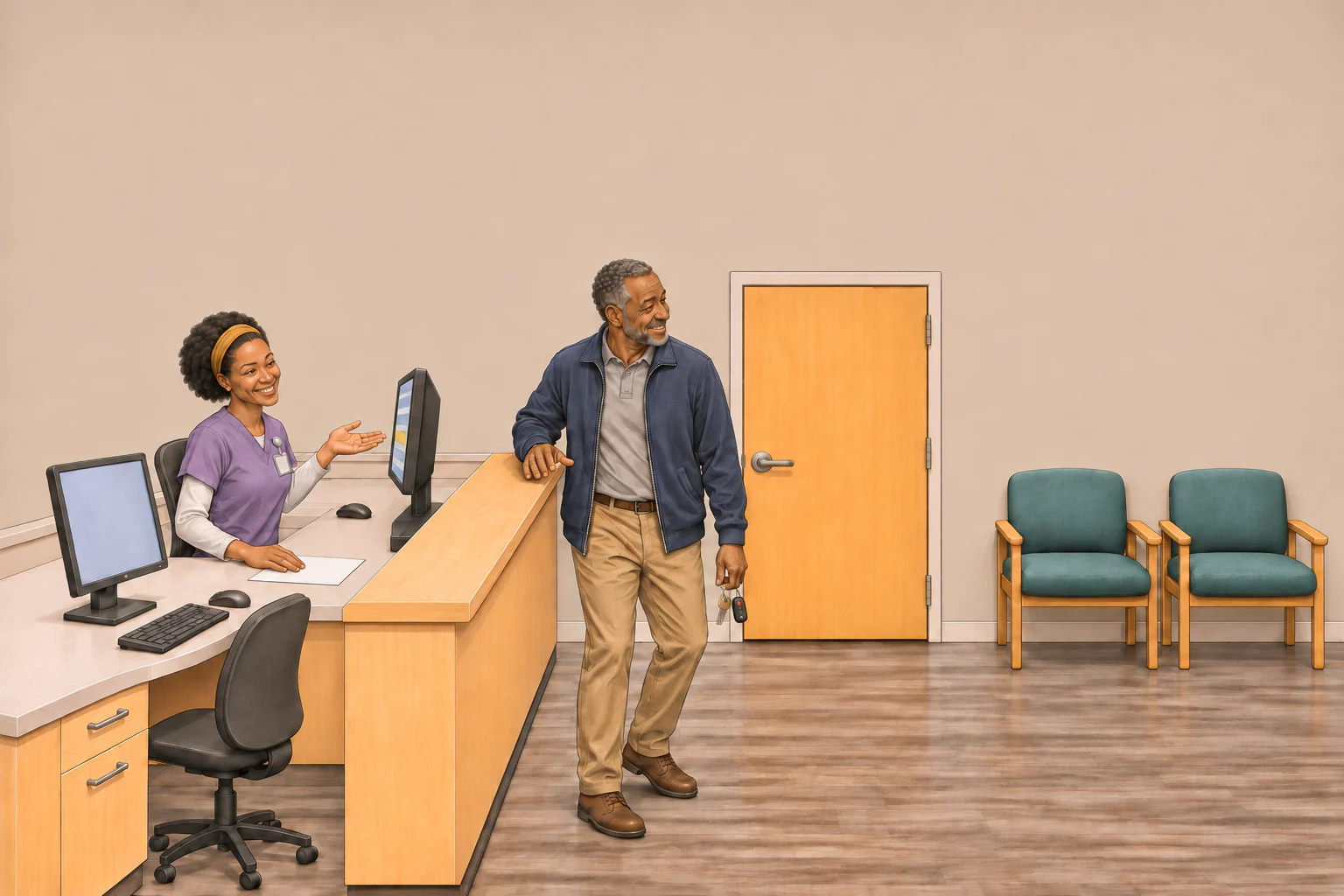 Front desk (thinking):He’s nervous enough. Checkout can bring it up.Front desk:You’re all checked in. Have a seat.
Saved for the door. The estimate waits for checkout, the last stop of the visit. - The Mediocre ApproachThe poor outcome
 Checkout:There’s a balance due today.Patient:Nobody told me about this!Patient (thinking):So that’s how today ends.
The last word is the bill. The excision went smoothly, and the visit ends on a surprise, with a line forming behind him. Rewind. Same patient, same moment, same problem. This time, someone designs the ending.
- The Exceptional ApproachThe action: design the ending
 Front desk:Before we start: your estimate shows a balance today.Patient:Glad I know now, not after.
The hard part, first. The front desk raises the estimate at check-in, while there’s still time for questions. - The Exceptional ApproachThe exceptional outcome
 Checkout:Mr. Okafor, here’s the follow-up your doctor planned. Anything unclear?Patient:Nope. That was easy.
The last word is the next step. Checkout confirms what was agreed, books the follow-up his doctor planned, and he leaves with the date in hand.
Example TwoAt a glance
The ProblemAt check-in for an excision, the front desk sees a balance due today on the estimate. Nobody has told the patient yet.
The Mediocre ApproachSave it for the door
Action
Leave it for checkout.
- “You’re all checked in. Have a seat”
- The estimate waits for the last stop
Poor outcome
The visit ends on a surprise.
- On his way out, he hears about the balance
- The last word of a smooth visit is the bill
The Exceptional ApproachHard parts first, then a clear close
Action
Raise it at check-in.
- “Before we start: your estimate shows a balance today”
- His questions answered before the procedure, by billing if needed
Exceptional outcome
The visit ends on the next step.
- Checkout confirms what was agreed and books the follow-up his doctor planned
- He leaves with the next date in writing
Your clinic
More Endings to Design in a Clinic
Same pattern every time: the hard part early, a named person who closes, and a last minute that is calm and clear.
| The visit | Who designs the ending | How the visit ends |
|---|---|---|
| After a skin check: the clinician finds a spot that needs a biopsy | The clinician explains the biopsy and the plan | On when to expect an update and who will call |
| After Mohs surgery: the surgeon has finished the surgery and the dressing is on | The nurse, from the surgeon’s written instructions | Seated upright, the dressing and pain plan gone over slowly, then walked to checkout, not pointed there |
| Booking surgery: a Mohs date is booked at checkout | The scheduler, from the clinician’s order | The date in writing, with the arrival time and how long to plan for, and the best number for a reminder |
| After a long wait: a full skin check starts late | The clinician acknowledges the wait once, at the start | The last two minutes are a clear summary of findings and next steps, not a rushed exit |
| End of a procedure day: the team huddles at closing | The practice manager asks two questions about each procedure visit, with no patient names | What was the hardest moment for the patient, and what was the last thing they heard from us? One change for tomorrow |
Adapt the words and owners to your team. Clinical content comes from the clinician. Between Mohs stages the patient is waiting, not leaving: the visit’s ending comes only after the surgeon has finished.
Your move
Try It Today
Estimates early. A calm, clear close. No rush at the door.
Try it for one week, with one kind of visit. It costs a minute of attention, not a budget.
- Pick one visit. Biopsies, freezes or excisions: something your team ends many times a day.
- Watch the last minute. Ask the team what happens now: who is in the room, what is said, and what the patient carries out the door.
- Move the estimate. Raise any estimate or balance privately at check-in, before the procedure.
- Close the room. The clinician approves a short recap and a written next step. The nurse gives both before the patient stands.
- Slow the door. At checkout, look up, use the patient’s name, confirm the next date and ask, “Is anything unclear before you go?”
- Ask two questions on Friday. At the huddle, with no patient names: what was the hardest moment for patients this week, and what was the last thing they heard from us? Change one thing.
Anything urgent still goes straight to the clinician. Never lengthen a procedure or add discomfort to shape a memory.
Length fades. The ending stays. Design it on purpose.
Explore the Evidence
18 sources · what each source is, what it found, what it supports here, and its limits
This chapter’s lesson rests on one randomized trial, read in full: Redelmeier, Katz and Kahneman’s colonoscopy study (reference 1). Its data come from one Toronto hospital in 1994 and 1995, with the sedation and practice of that era, so it is a historical test of an idea, not current colonoscopy practice or dermatology evidence. Kahneman, who first described the idea, is a co-author. The gentler ending in that trial was a physical change to the procedure: the scope rested for up to three minutes before removal, and the procedure ran about 0.8 minutes longer on average (27.6 against 26.8 minutes). Nothing in this chapter asks a clinic to do that. The clinic version changes words, order, attention and written instructions. That is a different mechanism from the trial’s, borrowed by analogy, and it has not been tested as a replacement for the trial’s physical change. Three outcomes are kept apart on this page. Remembered discomfort is how unpleasant people later rated an experience (references 1 and 7). Stated willingness is whether people said they would do it again (references 7 and 18). Observed return is whether patients actually came back: in reference 1, 53% of the gentler-ending group and 48% of the usual group returned for colonoscopy over a median of 5.3 years, a difference that was not statistically significant. Only after adjustment for three clinical features were the odds of return higher (odds ratio 1.41), which does not mean 41% more patients returned. That is why the chapter teaches the memory finding and makes no promise that patients will come back. The pooled figures come from a 2022 meta-analysis by Alaybek and colleagues as corrected by its authors in January 2024 (references 5, 6 and 10). The numbers used are the corrected values in the authors’ posted supplement Tables S5 and S4, read from their public repository; the printed corrigendum itself was not read, and the analysis was not rerun. The original abstract’s r = .581 is historical and is not used as a current estimate. In the corrected figures, the overall average of an experience tracked later judgments at least as closely as the peak or the end, the peak at least as closely as the end, and judgments and decisions based on an experience followed peak and end less closely than summary ratings did. In the Toronto trial’s own correlations, too, average pain tracked memory most closely, and pain at the end no more closely than pain at the start. Several studies found a small end effect or none: small gifts (reference 12), whole days (reference 13), a virtual-reality film (reference 14), vacations (reference 15), meals (reference 16) and everyday pain recall (reference 11). So the chapter teaches the ending together with the worst moment and the whole visit, never as the only thing that counts. Many sources were read as abstracts only; their limits are in each row. This page uses only a scoped subset of a larger research package, accepted claim by claim by an independent reviewer; other material in that package was not used. No source here tested any of these ideas in a dermatology clinic. The two clinic examples, the extra ideas and the one-week experiment are illustrations of the mechanism with fictional people, not observed events or tested interventions, and no improvement in satisfaction, adherence, safety or efficiency is claimed for them. The two comic strips in the story illustrate the 1996 finding and the 1994 to 1995 trial with fictional patients and an unnamed study staff member in an invented, unbranded room. They show the measurements and the sealed envelope, not the procedure itself, its technique or who did what: the trial report does not say which staff member opened the envelopes, so no one is drawn opening one, and the picture of a staff member with a rating sheet is not a claim about who recorded the scores. The film strip in each thought cloud is an editorial picture of the snapshot idea, not a figure from either paper. Status shows how each source was read: FULL (full text), ABS (abstract), DATA (the authors’ posted data files) or REC (a bibliographic record).
| Source | Type and context | Key finding | What it supports here | Material limitation |
|---|---|---|---|---|
| [1] · FULLRedelmeier DA, Katz J, Kahneman D. Memories of colonoscopy: a randomized trial. Pain 2003 | Randomized controlled trial 682 consecutive colonoscopy outpatients (medically stable, mentally competent, English-speaking; 733 approached) at one Toronto hospital, 7 November 1994 to 12 December 1995; published 2003 | Gentler ending (scope tip held at rest inside the rectum, for as long as 3 minutes before removal, with no suction, no inflation and no extra anaesthetic; envelope assigned at the start, unsealed only at the last stage; patients never told their group): final-3-minute pain 1.7 vs 2.5 of 10 (P < 0.001); no statistically significant difference in initial, middle or worst pain; duration 27.6 vs 26.8 minutes (P > 0.20). Remembered total discomfort 4.4 vs 4.9 on a 10 cm scale (P = 0.006), about 10% lower in relative terms; rank among eight unpleasant experiences 4.1 vs 4.6 (8 = worst, P = 0.002); similar after adjustment. Return for repeat colonoscopy over a median 5.3 years: 53% vs 48%, not statistically significant (P > 0.20); adjusted for prior colonoscopy, indication and abnormal findings, odds of return 41% higher (95% CI 2% to 96%, P = 0.038; odds ratio 1.41). Patients who ranked colonoscopy worst returned less often than those who ranked it best (45% vs 64%). Memory correlated with average pain r = 0.56, peak 0.44, mid 0.40, final 0.33 and initial 0.32; duration r = 0.10 | The solution and its comparison, the payoff, mechanism card 3, results card 1, the summary, the dek and the clinic’s “gentle, never longer” line | Historical data from one hospital, colonoscopy with the sedation of that era; not current colonoscopy practice or dermatology evidence; Kahneman is a co-author, so the trial is not independent of the idea’s originator. The gentler ending added up to 3 minutes and about 0.8 minutes on average. About 10% is relative (4.4 vs 4.9), not percentage points, and is a remembered-discomfort rating taken after sedation wore off, not satisfaction or complications. The raw return difference was not statistically significant; the odds ratio of 1.41 appears only after adjustment for three predictors chosen by stepwise regression and does not mean 41% more patients returned. A subgroup analysis found 43% vs 32% return among patients otherwise unlikely to return and 72% vs 71% (no significant difference, not proof of no effect) among likely returners; the authors’ estimate of one additional return per nine treated patients belongs only to that subgroup. The 45% vs 64% link between memory and return is an association within the trial, not a randomized effect of changing memory. The memory correlations are within-trial associations, not causal weights: on them alone, the ending carried no more weight than the beginning, so its importance rests on the randomized comparison. The authors call the study a proof of concept, note that significant return differences appeared only after controlling for clinical features, that memories are not the only factor in behavior, that repeat colonoscopy is not always needed, and that they did not know what each patient was told afterward. Their suggestion of gentleness at the end was aimed especially at awake patients with no previous procedure and no abnormal findings, and they named an ethical tension with patient autonomy; it is not an approved clinic protocol |
| [2] · ABSRedelmeier DA, Kahneman D. Patients’ memories of painful medical treatments. Pain 1996 | Observational study Toronto patients during colonoscopy (154) and lithotripsy (133), with pain recorded as it happened and judged afterward | Judgments of total pain correlated strongly with the worst pain (P < 0.005) and with pain in the last 3 minutes (P < 0.005); a long procedure was not, for its length, recalled as especially unpleasant | The problem, the summary and mechanism cards 1, 2 and 3 | Read as the abstract only; correlations, not a test of changing anything; co-authored by the idea’s originator; not a universal claim that length never matters |
| [3] · ABSFredrickson BL, Kahneman D. Duration neglect in retrospective evaluations of affective episodes. J Pers Soc Psychol 1993 | Laboratory experiments University volunteers (32 and 96) rating pleasant and aversive film clips as they watched and afterward | Clip length had small effects on later judgments, smaller still when judged from memory; judgments looked like a weighted average of “snapshots” | The summary, why it works and mechanism card 1 | Read as the abstract only; film clips in a laboratory, not clinic visits; the size of the effect does not transfer to a clinic |
| [4] · ABSChase RB, Dasu S. Want to perfect your company’s service? Use behavioral science. Harv Bus Rev 2001 | Management article (practitioner framework) Harvard Business Review, read through its PubMed abstract | Five service principles, here paraphrased: “finish strong,” because the ending is what customers carry away; deal with the unpleasant parts early; spread out the pleasant parts and bundle the unpleasant ones; let customers make choices that build their commitment; keep to familiar rituals | The summary, the service translation in section 2 and mechanism card 4 | Advice, not a test; abstract only, because the article body is paywalled and was not read; “finish strong” is the authors’ advice, not a proven ranking of every moment of a visit |
| [5] · DATAAlaybek B, et al. Peak-End Rule Meta-Analysis: June 2023 Update (corrigendum materials). Open Science Framework | Meta-analysis correction materials The meta-analysis authors’ own posted files for the January 2024 corrigendum to their 2022 synthesis: recoded data, sign-reversal rules keyed to experience and outcome valence, updated supplement tables and analysis outputs | Corrected estimates in posted supplement Table S5 (unipolar scales; correlation with later summary judgments): overall average .60 (.55 to .65, 97 samples); peak and end averaged .54 (.44 to .62, 25); peak .51 (.46 to .56, 85); end .44 (.39 to .48, 95); trough .39 (22); beginning .36 (44); trend .08 (−.02 to .18, 20); duration .04 (−.00 to .08, 36). In the 58 samples reporting peak, end and average together (Table S4): average .60, peak .50, end .47. Peak and end tracked judgments and decisions based on an experience less closely (peak .33, end .28) than summary ratings of it (peak .55, end .48). A December 2023 sensitivity file that drops every sign-reversed effect changed 37 moderator estimates by −0.003 to +0.103, with five outside the original confidence interval | Mechanism card 2 and results card 4 | Repository evidence: the posted files were read, the analysis was not rerun, and the printed corrigendum was not read (the publisher page returned HTTP 403), so this is not printed-paper verification, and it is unconfirmed which printed row replaces the original abstract’s r = .581, which is historical and not a current estimate. The authors’ posted Table 2 output differs from posted Table S5 (combined peak-end row 0.568; peak-end average .5349 against .54; trend .0988 against .08); the two are kept distinct. Correlations across heterogeneous pooled samples (high heterogeneity), not effects of changing a clinic moment; no formal peak-versus-end test was seen, and sample sizes differ by predictor. The decision category includes judgments and preferences, not only observed behavior, and uses few samples. The sensitivity file checks only the authors’ own comparison, not the raw-data coding or the inquirers’ preferred analysis. According to the independent reviewer’s reading of publisher-indexed text, not the complete printed corrigendum, the researchers who raised the coding issue disagree with the new coding |
| [6] · DATAAlaybek B, et al. Peak-End Meta-Analysis Online Supplement (original 2022). Open Science Framework | Original meta-analysis supplement The authors’ 2022 online supplement, used as the before-correction comparison and for outcome definitions | Original Table S5 values: average .61, peak and end averaged .58, peak .53, end .46, trough .43, beginning .40, trend .11, duration .00; original Table S4 (58 matched samples): peak .53, end .50, average .62. The order of the estimates is unchanged by the correction. Judgment and decision outcomes are defined to include “decisions associated with the past experiences and future preferences” | The before-and-after comparison behind mechanism card 2 and results card 4 | A supplement, not the paper; superseded in coding by the 2024 correction; the paper’s main Table 2 is not in it |
| [7] · ABSYen HK, et al. Adding a nonpainful end to reduce pain recollection of Pap smear screening: a randomized controlled trial. Pain 2023 | Randomized controlled trial Women aged 30 to 70 at a cervical screening center in Taiwan; 266 analyzed by intention to treat | A nonpainful step added at the end lowered recalled pain (1.50 vs 2.02 out of 5; 2.12 vs 3.12 out of 10) and raised stated willingness, at one year, to repeat Pap testing (adjusted beta 2.11, P < 0.001) | Mechanism card 3 and results card 2 | Read as the abstract only; the nonpainful step is not described, so it cannot be copied as a protocol; willingness is adjusted and is a stated intention, not observed return or completed screening |
| [8] · ABSChajut E, Caspi A, Chen R, Hod M, Ariely D. In pain thou shalt bring forth children: the peak-and-end rule in recall of labor pain. Psychol Sci 2014 | Observational study Mothers at an Israeli medical center, asked about labor pain 2 days and 2 months after birth | Remembered labor pain leaned toward the average of the worst pain and the pain at the end, and how long labor lasted mattered little; comparing labors that ended with or without an epidural supported the end effect; for mothers who had given birth before, the effect was weaker at 2 months | Results card 3 | Read as the abstract only; the sample size is not in the abstract; labor, not a clinic visit or a dermatology intervention; co-author Dan Ariely has had other work questioned, though not this paper as far as checked |
| [9] · FULLArmitage RC. Prolonging medical procedures to exploit the peak-end rule: an ethical analysis. J Eval Clin Pract 2025 | Ethical analysis Peer-reviewed normative analysis by one author (University of Nottingham), published 28 August 2025 | Argues that prolonging painful procedures to exploit the peak-end rule without telling patients fails to respect autonomy and may violate non-maleficence; notes it is unclear whether the effect persists if patients are fully informed; also says prolonging appears to meet the tests of beneficence and justice | The clinic’s “gentle, never longer” line. A 2025 ethical analysis argues that prolonging a painful procedure for this effect, without telling patients, fails to respect their autonomy. | A normative argument, not an empirical result, a consensus or legal guidance; the beneficence and justice point is the author’s, reported here without endorsement; reducing peak pain with pain relief is a separate route that he says needs its own analysis |
| [10] · RECCrossref record: Corrigendum to “All’s well that ends (and peaks) well?” Organ Behav Hum Decis Process 2024 | Bibliographic record Publisher-deposited Crossref metadata for the correction | A corrigendum to the 2022 meta-analysis, by the same eight authors, was published in January 2024 (volume 180, article 104278) and is linked as an erratum to the 2022 article | Kept for the record; not cited in the chapter text: it dates the correction behind references 5 and 6 | Metadata only, with no correction text or numbers; the publisher’s correction page returned HTTP 403 and its text was not read |
| [11] · ABSSchneider S, Stone AA, Schwartz JE, Broderick JE. Peak and end effects in patients’ daily recall of pain and fatigue. J Pain 2011 | Within-person diary study 97 US rheumatology patients rating pain and fatigue several times a day for 28 days | Peak and end pain had a small effect on daily recall of pain and none on fatigue, with large differences between people; the effects were unlikely to bias end-of-day ratings much | Kept for the record; not cited in the chapter text: a limit, showing the end effect can be small in everyday symptoms | Read as the abstract only; chronic symptoms, not single visits; a small effect is not proof of no effect |
| [12] · FULLMah EY, Bernstein DM. No peak-end rule for simple positive experiences observed in children and adults. J Appl Res Mem Cogn 2019 | Replication experiments Three experiments with 988 people aged 2 to 97; the first was pre-registered midway through data collection, the later ones in advance | No peak-end effect for small positive gifts in preschoolers, school-age children, younger adults or older adults; the authors argue the original study was underpowered | Kept for the record; not cited in the chapter text: counterevidence | Candy and toys, simple positive events; it tested whether a lesser gift after a better one lowers satisfaction, not whether a pleasant extra at the end improves memory, and it does not show that clinic giveaways never help |
| [13] · ABSMiron-Shatz T. Evaluating multiepisode events: boundary conditions for the peak-end rule. Emotion 2009 | Large survey About 2,435 people in the United States (810), France (820) and Denmark (805) reconstructing the previous day | Whole days were judged by their average feeling, and ends were ignored; lows, and occasionally peaks, also counted | Kept for the record; not cited in the chapter text: counterevidence | Read as the abstract only; days are multi-episode events, not single visits; “ignored ends” is this study’s result, not a universal absence of an end effect |
| [14] · FULLStrijbosch W, et al. From experience to memory: on the robustness of the peak-and-end-rule for complex, heterogeneous experiences. Front Psychol 2019 | Laboratory experiment 40 Dutch university students watching one reconstructed 14-minute virtual-reality film, with memory regressed on per-segment ratings | For remembered emotional valence, the peak predicted best right after the film (41.9% of variance) and the average predicted best one week later (46.2%); the end was not statistically significant at either time. The paper also describes two studies not opened here: Geng and colleagues (2013) found that peaks, ends and peak-ends predicted remembered vacation valence after one day and three weeks but not after seven weeks, and a 2008 meta-analysis by Cojuharenco and Ryvkin found that average scores often move closely with the peak, end and peak-end scores, more so for varied experiences | Kept for the record; not cited in the chapter text: counterevidence | One VR film and a small student sample; valence results only, and the arousal findings differ; a non-significant end is not proof of no effect at all. The Geng and the Cojuharenco and Ryvkin findings are secondary descriptions by these authors; the primary papers were not opened. The authors conclude the rule cannot be generalized to more ecologically valid episodes |
| [15] · ABSKemp S, Burt CDB, Furneaux L. A test of the peak-end rule with extended autobiographical events. Mem Cognit 2008 | Diary study 49 New Zealand students reporting by daily text message during a vacation of about a week | Peak and end together did not predict remembered happiness especially well; duration had no effect | Kept for the record; not cited in the chapter text: counterevidence | Read as the abstract only; a small student sample; not a universal disproof of peak or end influence |
| [16] · ABSRode E, Rozin P, Durlach P. Experienced and remembered pleasure for meals. Appetite 2007 | Studies of real and imagined meals US university participants; two real meals and one imagined meal | Remembered pleasure showed duration neglect but no peak, first-dish or last-dish effects, with weak evidence that rising patterns are preferred | Kept for the record; not cited in the chapter text: counterevidence | Read as the abstract only; meals, not procedures; does not transfer to all pleasant service experiences |
| [17] · ABSWu HE, et al. Three-step versus two-step irradiance schedule for pain control during ALA-PDT of facial acne. Lasers Surg Med 2022 | Randomized comparative study (dermatology) Moderate to severe facial acne treated with aminolevulinic acid photodynamic therapy at one center in Shenyang; 90 randomized, 87 completed | A three-step light schedule derived from the peak-end rule lowered pain recorded 30 minutes after each session (1.61 vs 3.14) with similar effectiveness (88.64% vs 88.37%) | Kept for the record; not cited in the chapter text: the one dermatology trial found | Read as the abstract only; a clinical treatment change decided by clinicians, not a front-desk or conversation change; the abstract does not separate a gentler ending from lower overall intensity |
| [18] · ABSScheveneels S, Dibbets P, Hommerich Z, Van Den Bergh O. Applying the peak-end rule to improve exposure outcomes in fear and anxiety. Cogn Emot 2026 | Small experiment 36 spider-fearful volunteers in the Netherlands and Belgium, virtual-reality exposure; published online 17 March 2026 | Ending the exposure at low fear improved retrospective ratings and willingness to repeat it, and reduced avoidance | Kept for the record; not cited in the chapter text: current research use of the idea | Read as the abstract only; the authors call the support preliminary; ratings and willingness, not actual clinical adherence |
References
- Redelmeier DA, Katz J, Kahneman D. Memories of colonoscopy: a randomized trial. Pain. 2003;104(1–2):187–194. doi.org/10.1016/S0304-3959(03)00003-4 · full text (Stanford SPARQ)
- Redelmeier DA, Kahneman D. Patients’ memories of painful medical treatments: real-time and retrospective evaluations of two minimally invasive procedures. Pain. 1996;66(1):3–8. doi.org/10.1016/0304-3959(96)02994-6 · PubMed 8857625
- Fredrickson BL, Kahneman D. Duration neglect in retrospective evaluations of affective episodes. J Pers Soc Psychol. 1993;65(1):45–55. doi.org/10.1037/0022-3514.65.1.45 · PubMed 8355141
- Chase RB, Dasu S. Want to perfect your company’s service? Use behavioral science. Harv Bus Rev. 2001;79(6):78–84, 147. PubMed 11408979
- Alaybek B, et al. Peak-End Rule Meta-Analysis, folder “June 2023 Update”: description of files, online supplement tables for the corrigendum, analysis outputs, sign-reversal rules (July to August 2023) and a no-reversed-sign comparison (29 December 2023). Open Science Framework, project 74tph. Accessed 10 November 2026. osf.io/74tph
- Alaybek B, et al. Peak-End Meta-Analysis Online Supplement (original 2022 supplement, uploaded 27 March 2022). Open Science Framework, project 74tph. Accessed 10 November 2026. osf.io/download/7rk92
- Yen HK, Cheng SY, Chiu KN, Huang CC, Yu JY, Chiang CH; NTUH Pap Study Group. Adding a nonpainful end to reduce pain recollection of Pap smear screening: a randomized controlled trial. Pain. 2023;164(8):1709–1717. doi.org/10.1097/j.pain.0000000000002897 · PubMed 37043729
- Chajut E, Caspi A, Chen R, Hod M, Ariely D. In pain thou shalt bring forth children: the peak-and-end rule in recall of labor pain. Psychol Sci. 2014;25(12):2266–2271. doi.org/10.1177/0956797614551004 · PubMed 25298293
- Armitage RC. Prolonging medical procedures to exploit the peak-end rule: an ethical analysis. J Eval Clin Pract. 2025;31(6):e70264. doi.org/10.1111/jep.70264 · PMC12392854
- Crossref. Metadata record for DOI 10.1016/j.obhdp.2023.104278: Corrigendum to “All’s well that ends (and peaks) well?” Organ Behav Hum Decis Process. 2024;180:104278. Retrieved 10 November 2026. api.crossref.org
- Schneider S, Stone AA, Schwartz JE, Broderick JE. Peak and end effects in patients’ daily recall of pain and fatigue: a within-subjects analysis. J Pain. 2011;12(2):228–235. doi.org/10.1016/j.jpain.2010.07.001 · PubMed 20817615
- Mah EY, Bernstein DM. No peak-end rule for simple positive experiences observed in children and adults. J Appl Res Mem Cogn. 2019;8:337–346. author copy (PDF)
- Miron-Shatz T. Evaluating multiepisode events: boundary conditions for the peak-end rule. Emotion. 2009;9(2):206–213. doi.org/10.1037/a0015295 · PubMed 19348533
- Strijbosch W, Mitas O, van Gisbergen M, Doicaru M, Gelissen J, Bastiaansen M. From experience to memory: on the robustness of the peak-and-end-rule for complex, heterogeneous experiences. Front Psychol. 2019;10:1705. doi.org/10.3389/fpsyg.2019.01705 · frontiersin.org
- Kemp S, Burt CDB, Furneaux L. A test of the peak-end rule with extended autobiographical events. Mem Cognit. 2008;36(1):132–138. doi.org/10.3758/MC.36.1.132 · PubMed 18323069
- Rode E, Rozin P, Durlach P. Experienced and remembered pleasure for meals: duration neglect but minimal peak, end (recency) or primacy effects. Appetite. 2007;49(1):18–29. doi.org/10.1016/j.appet.2006.09.006 · PubMed 17459522
- Wu HE, Liu YB, Cui L, Xu GJ, Sun XD. Three-step irradiance schedule versus two-step irradiance schedule for pain control during topical 5-aminolevulinic acid-photodynamic therapy of facial acne in Chinese patients: a prospective randomized comparative study. Lasers Surg Med. 2022;54(2):224–229. doi.org/10.1002/lsm.23464 · PubMed 34368971
- Scheveneels S, Dibbets P, Hommerich Z, Van Den Bergh O. Applying the peak-end rule to improve exposure outcomes in fear and anxiety. Cogn Emot. Published online 17 March 2026. doi.org/10.1080/02699931.2026.2644243 · PubMed 41845189
Explore the evidence · Try it today · Read the Peak-End Rule Daily Brief · More lessons from The Exceptional Private Practice