Lessons from Chick-fil-A · for dermatology practices
“My Pleasure” Is a Promise. Build What Keeps It.
Chick-fil-A’s founder asked his restaurants to answer every thank-you with “my pleasure.” Then the company built what stands behind the two words: a few named behaviors, local hospitality leaders, bosses who said it first, feedback every month, and staff who carried the tray to the table. Your clinic can back its warm words the same way.
What you’ll take away
- The problem
- A warm phrase with nothing behind it sounds like a script, and patients learn that a kind reply does not mean help is coming.
- What to remember
- “My pleasure” is a promise. Build what keeps it: a few named behaviors, the right people, leaders who go first, a regular check, and a deed behind the words.
- What to do differently
- Spell out the welcome for the moments that matter. Pair every warm reply with a deed, a name or a time. Have physicians and managers go first, and ask patients each month if you did what you said.
30-Second Summary
- A warm phrase is a promise, and asking for it isn’t enough. Chick-fil-A’s founder, Truett Cathy, heard a sincere “my pleasure” at a high-end hotel and asked his company to answer thanks the same way.1, 2 Its former marketing chief recalled him repeating the request at national meetings for three years.3
- So the company built the welcome like a recipe. A small set of hospitality behaviors became standards, as fixed as the two pickles on a sandwich.3, 4 A staff member who worked under Dan Cathy, the founder’s son, recalled learning four: eye contact, a smile, a friendly tone and “my pleasure.”5
- Then it staffed, modeled and checked the welcome. Each restaurant needed a hospitality leader, Dan Cathy said the words himself, and customer feedback came back every month, restaurant by restaurant.3, 4 Staff backed the words with deeds: carrying trays to tables, pulling out chairs, meeting diners at their cars with umbrellas in the rain.6
- Customers score the experience high. In the 2026 American Customer Satisfaction Index, Chick-fil-A scored 83 out of 100, the top score among chicken restaurants, against a fast-food average of 79.7
- In your clinic: spell out the welcome for the moments that matter, pair every warm reply with a deed, a name or a time, have physicians and managers go first, and ask patients each month whether they got what they were promised.
The Problem
What Goes Wrong When Warm Words Have Nothing Behind Them
Picture a fast-food counter at the lunch rush. A new sign by the register tells the crew what to say when a guest says thank you: “My pleasure.”
A mother steps up with a toddler on her hip. Her tray is loaded: two meals, two drinks, a stack of napkins. “Thank you,” she says. “My pleasure,” says the cashier, his eyes already on the next order.
She looks at the tray, then at the tables across the room. She shifts the toddler, takes the tray in one hand and goes slowly. The words said welcome. Nothing else did.
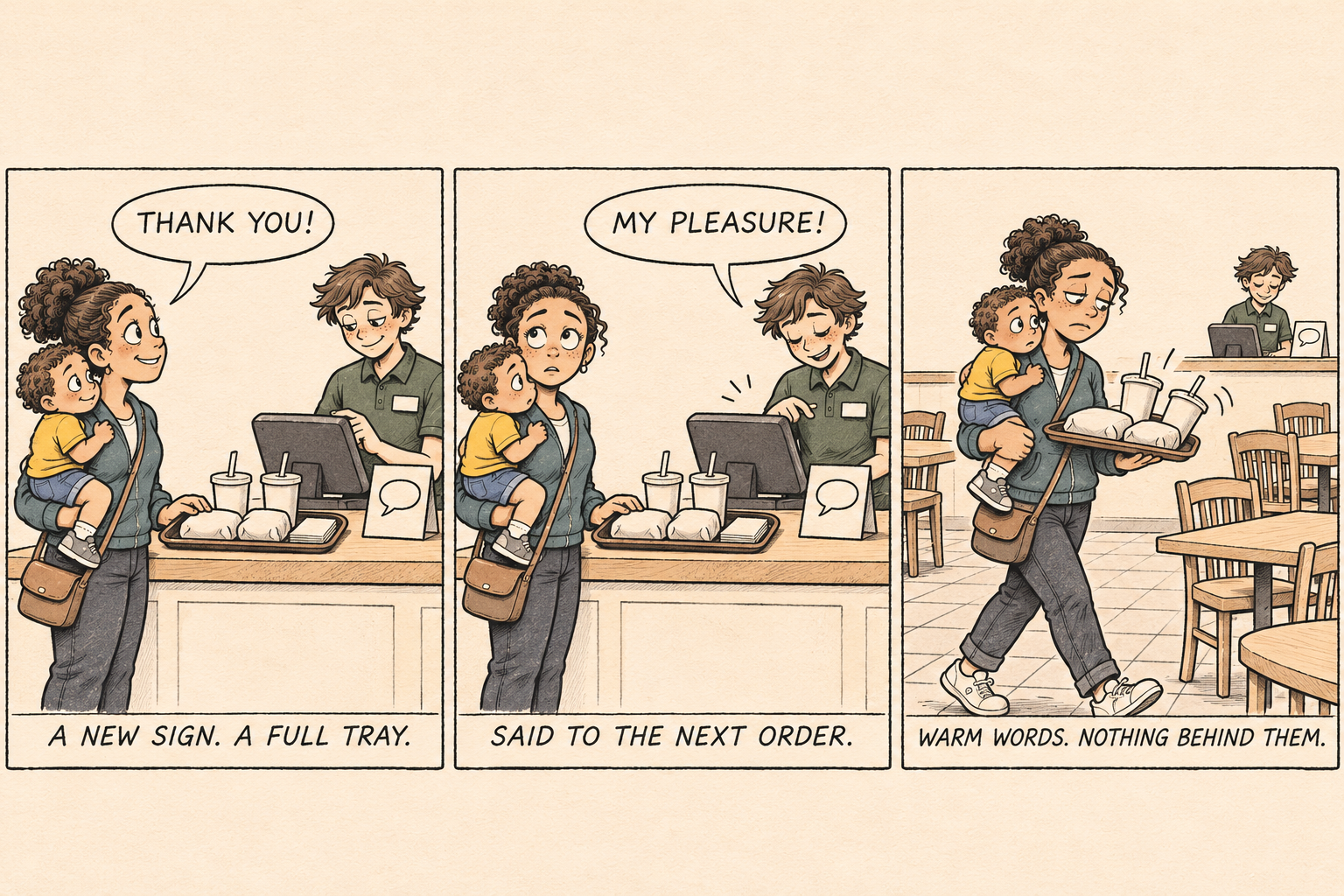
Nobody here is rude. The cashier said exactly what the sign told him to say. What’s missing is everything that makes the words true: someone looking up, someone seeing the tray, someone free to come around the counter. A warm phrase is a promise, and a promise with nothing behind it sounds like a script.
Chick-fil-A’s version began as a request. In the company’s telling, founder Truett Cathy thanked an employee at a high-end hotel, heard a sincere “my pleasure” in reply, and asked everyone at Chick-fil-A to answer thanks the same way.1, 2 Steve Robinson, the company’s former marketing chief, named the hotel as a Ritz-Carlton and recalled Cathy repeating the request at national meetings for three years.3 The restaurant operators had a worry, Robinson said: they were working hard to serve great food fast and accurately, and hospitality might slow them down.3
A request leaves each person to remember the words alone, at the busiest moment of the day. Telling people the words is the easy part.
The Exceptional Solution
Chick-fil-A’s Answer: Build the Welcome Like a Recipe
Chick-fil-A already knew how to make something reliable. Robinson recalled an earlier push, five or six years long, to make the food itself consistent. It drew on zero-defect principles that operators in Kentucky had learned, and it came with unannounced checks, thermometers and scales in hand.3
Hospitality got the same treatment: a standard to define, staff, teach and check. Here is what the company built, as Robinson and others have described it:3
Spell out the welcome. A small set of hospitality behaviors became defined standards, expected the way the recipe expects two pickles on every sandwich.3 Michael Lage, who worked under Dan Cathy, recalled learning four behaviors: make eye contact, share a smile, speak in a friendly tone and say “my pleasure.”5
Put a deed behind the words. Dan Cathy told Family Business Magazine that the meal you pay for is only the first mile: a transaction, a clean counter and waffle fries. The second mile, he said, is the relationship, and that is what brings customers back.6 He pointed to staff who carried customers’ trays to the table, pulled out a chair for them and greeted diners at their cars with an umbrella when it rained.6
Give it a leader and the right people. Robinson said every restaurant needed a hospitality leader. People were placed in hospitality roles because the roles fit them, not on the assumption that any kitchen worker could cover them.3 Operators paid for the extra talent and training.3
Have leaders say it first. CNN reports that from 2003, Dan Cathy, the founder’s son, said “my pleasure” himself and pushed others to follow.4 Cathy’s own belief is that new workers learn from what they see their leaders doing.5 He was plain about the effort, too: in his telling, a new menu item was the easy part, and teaching teenagers to say the words was the hard one.6
Check it, restaurant by restaurant. Feedback from customers and mystery shoppers came in every month. The company paid for the measurement, and every restaurant got its own results.3
The standards were worked out in real restaurants. Robinson recalled roughly two years of work in 100 test restaurants, with local leaders, named behaviors, training and feedback, and an internal business case to show for it.3
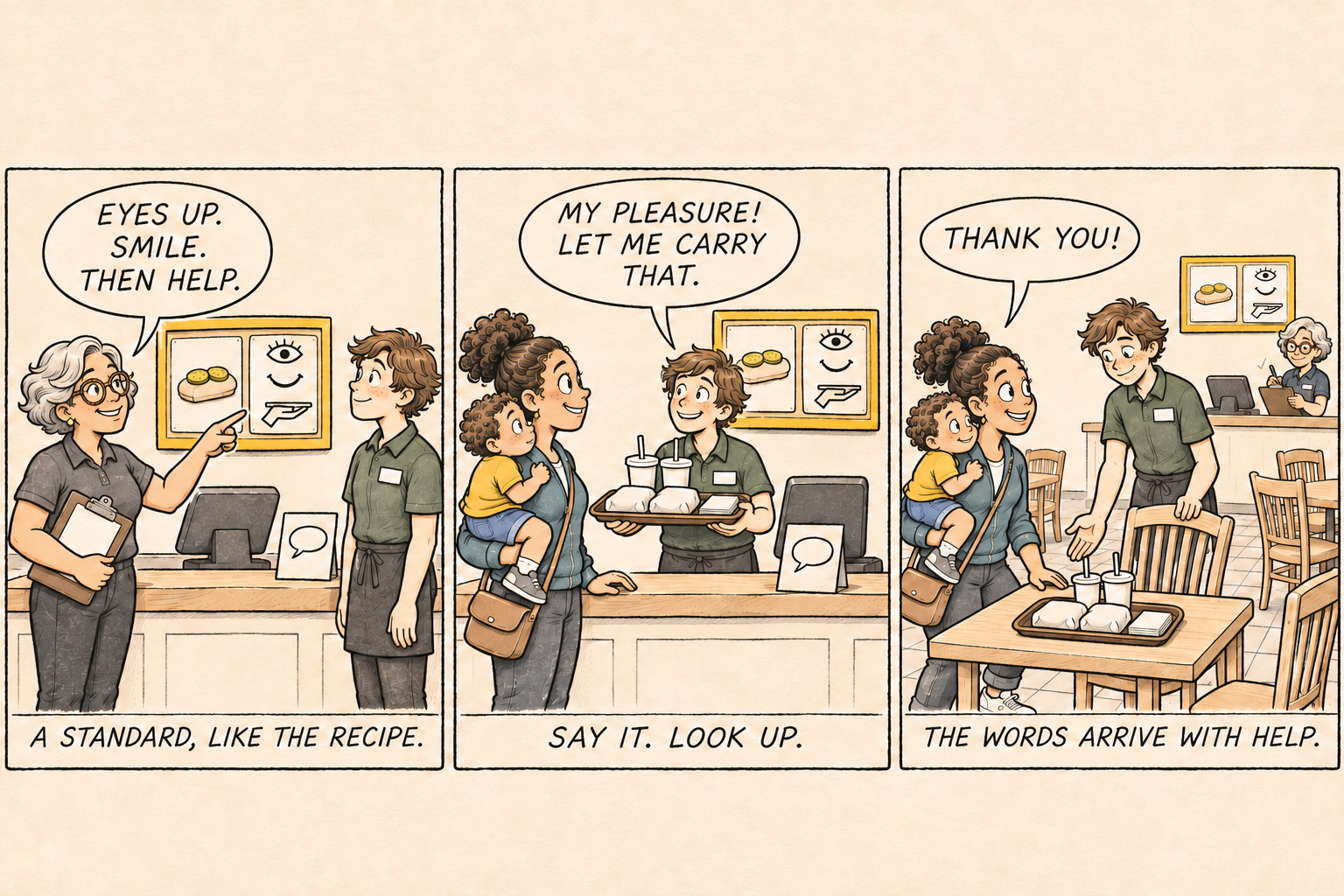
The ProblemA guest with a toddler on her hip and a loaded tray says thank you at the counter.
The Mediocre ApproachA phrase on a sign
Action
Say the words.
- “My pleasure,” said to the next order
- Nobody looks up, so nobody sees the tray
Poor outcome
Words with nothing behind them.
- She carries the tray across the room by herself
- The phrase sounds like a script
The Exceptional ApproachChick-fil-A’s answer: a standard and a deed
Action
Say it, look up, then help.
Exceptional outcome
A welcome she can feel.
- The words and the help arrive together
- The reply became habit: one manager told CNN she says it at home too4
What Made It Stick
The difference wasn’t the phrase. It was everything built around it:
A standard, not a slogan. Dan Cathy said he came to see the phrase as “a service signature for us, almost like two pickles on a sandwich.”4
Paid for, not just asked for. Operators paid for the extra talent and training, and the company paid for the monthly measurement.3
Practiced until it was natural. Emily Gilmore, a Chick-fil-A manager, told CNN in 2022 that the reply had become so natural she says it at home too.4
The counter in our first story had a sign. Chick-fil-A built a standard, a leader, a habit and a check, and the words arrived with help.
The mechanism
Why It Works
A phrase is easy to copy. What makes it mean something takes more, and each part does a different job: the standard makes the welcome specific, the deed makes it true, the right people make it sincere, leaders make it normal, and the check keeps it honest.
Tap or click a card to see why it works.
-
Why it works
- A standard, like the recipe. Robinson described a small set of hospitality behaviors, set as standards the way the recipe sets two pickles on every sandwich.3
- Small enough to remember. One staff member recalled learning four: eye contact, a smile, a friendly tone and “my pleasure.”5
- Something you can teach. “Be friendly” is a wish. “Look up and smile” is a behavior a new hire can copy on day one.
-
Put a deed behind the words.
The second mile is something you do.6
Why it works
- Past the transaction. Dan Cathy called the meal you pay for the first mile, and the relationship the second.6
- Help you can see. Staff carried trays to tables, pulled out chairs and met diners at their cars with umbrellas in the rain.6
- The job done well comes first. In a simulated hotel check-in, genuine warmth made the clerk seem friendlier, and it raised satisfaction when the check-in itself was done well.9
-
Staff the welcome.
A leader for it, and people who fit it.3
Why it works
- Someone owns it. Robinson said every restaurant needed a hospitality leader.3
- Fit comes first. People were placed in hospitality roles because the roles fit them, not on the assumption that any kitchen worker could cover them.3
- Why fit matters. In a study of service workers, putting on the expression without the feeling went with more stress and with lower coworker ratings of their warmth toward customers.10
-
Why it works
- The boss went first. CNN reports that from 2003, Dan Cathy said “my pleasure” himself and pushed others to follow.4
- New people watch. Cathy’s belief is that new workers learn from what they see their leaders doing.5
- It takes teaching. Cathy stressed how much work it took to teach teenagers to say the words.6
-
Check it like the food.
Feedback for every restaurant, every month.3
Why it works
- The food came first. The earlier push for reliable food came with unannounced checks, thermometers and scales in hand.3
- Then the welcome. Feedback from customers and mystery shoppers came monthly, paid for by the company, with results for each restaurant.3
- Tested in restaurants. Robinson recalled roughly two years of work in 100 test restaurants.3
The evidence
The Results, and Where Else It Works
A national survey asks customers how satisfied they are with each restaurant chain, and Chick-fil-A’s 2026 score was the highest of any chicken restaurant.7 Researchers elsewhere have studied two ingredients of a kept promise: using a person’s name,11 and saying exactly what you will do.12 Flip each card for the result and the lesson to take home.
Tap or click a card to flip it.
-
83 out of 100 for Chick-fil-A in the 2026 American Customer Satisfaction Index, the top score among chicken restaurants
- What was asked: Customers rated how satisfied they were with each restaurant chain.
- What it showed: Chick-fil-A scored highest among chicken restaurants.
Exceptional results7
83 vs 79 points out of 100: Chick-fil-A vs the fast-food average
- 83 was the highest score among chicken restaurants.
- 79 was the average across fast-food restaurants.
Valuable lesson: Ask patients how the whole visit felt, not whether the staff said the right words.
Source: ACSI Restaurant and Food Delivery Study 2026 · evidence row 7
-
80% of encounters earned a medical student an “excellent” for communication when the student used the patient’s name, against 65% when the student didn’t
- The small behavior: The student acknowledged the patient by name.
- What patients rated: The student’s overall communication: excellent, or not.
Exceptional results11
80% vs 65% rated excellent for communication: name used vs not used
- Patients rated a medical student’s communication “excellent” in 80% of encounters when the student used their name, against 65% without it.
- One small behavior went with a better rating of how the student communicated.
Valuable lesson: Make the small behaviors standard, starting with the patient’s name.
-
About 9% higher customer satisfaction when an employee’s words were a clear step more concrete
- The concrete words: The employee named specific things instead of speaking in general terms.
- What customers reported: How satisfied they were.
Exceptional results12
About 9% higher customer satisfaction, with more concrete employee words
- In real customer-service conversations, satisfaction rose with how concrete the employee’s language was.
- At a separate retailer, more concrete language went with 13% more customer spending over the next 90 days.
Valuable lesson: Say exactly what you will do, and when.
Source: Packard and Berger, J Consum Res 2021 · evidence row 12
Your dermatology clinic
Bringing It Home to Your Dermatology Clinic
Your clinic makes warm promises all day: “Of course.” “Happy to help.” “No problem.” Each one tells a patient that help is coming. Patients remember how they were answered. In a study of online reviews of dermatology practices, the bad experiences patients described included curt staff, trouble with scheduling, cleanliness and insurance problems.13
Get the work right first: a warm reply can’t make up for a lost result or a call that never came. Results, callbacks and refills handled reliably are what the words stand on.
Spell out the welcome: pick the moments where patients most often say “thank you” or “sorry to bother you,” such as check-in, the phone and the end of a procedure. For each one, agree on a few behaviors: look up, use the patient’s name, and answer in words you mean.
Put a deed, a name or a time behind it: “Let me carry that.” “Our nurse will call you by Thursday at five.” Specifics are easy to skip. In one study of medical students, patients heard an estimate of how long things would take in 15 of 246 encounters.11
Know who answers what: the front desk and schedulers answer for directions, forms, appointments and the wait. Billing answers for the bill. MAs and nurses carry clinical questions to the clinician, and the clinician decides. Nobody guesses outside their role: they say who will answer, and when.
Give it a leader, and go first: name one person who owns the welcome, such as the front-desk lead or the practice manager. Then have the physicians and the manager say the words and do the deeds where the team can see.
Check it every month: ask a handful of patients one question: “Did we do what we said we would?” Share the answers with each team, front desk, clinical and billing, and fix the most common miss.
Here’s how that plays out in two everyday moments. Each one starts with the problem, follows the mediocre approach to its outcome, then rewinds to the same moment for the exceptional approach: warm words, with something behind them.
Example One: “My Pleasure,” Said to the Screen
- The Problem
At check-in, a new patient with a walker is handed a clipboard with a history form. Her hands are already full. She says thank you, and the front desk’s phone is ringing.
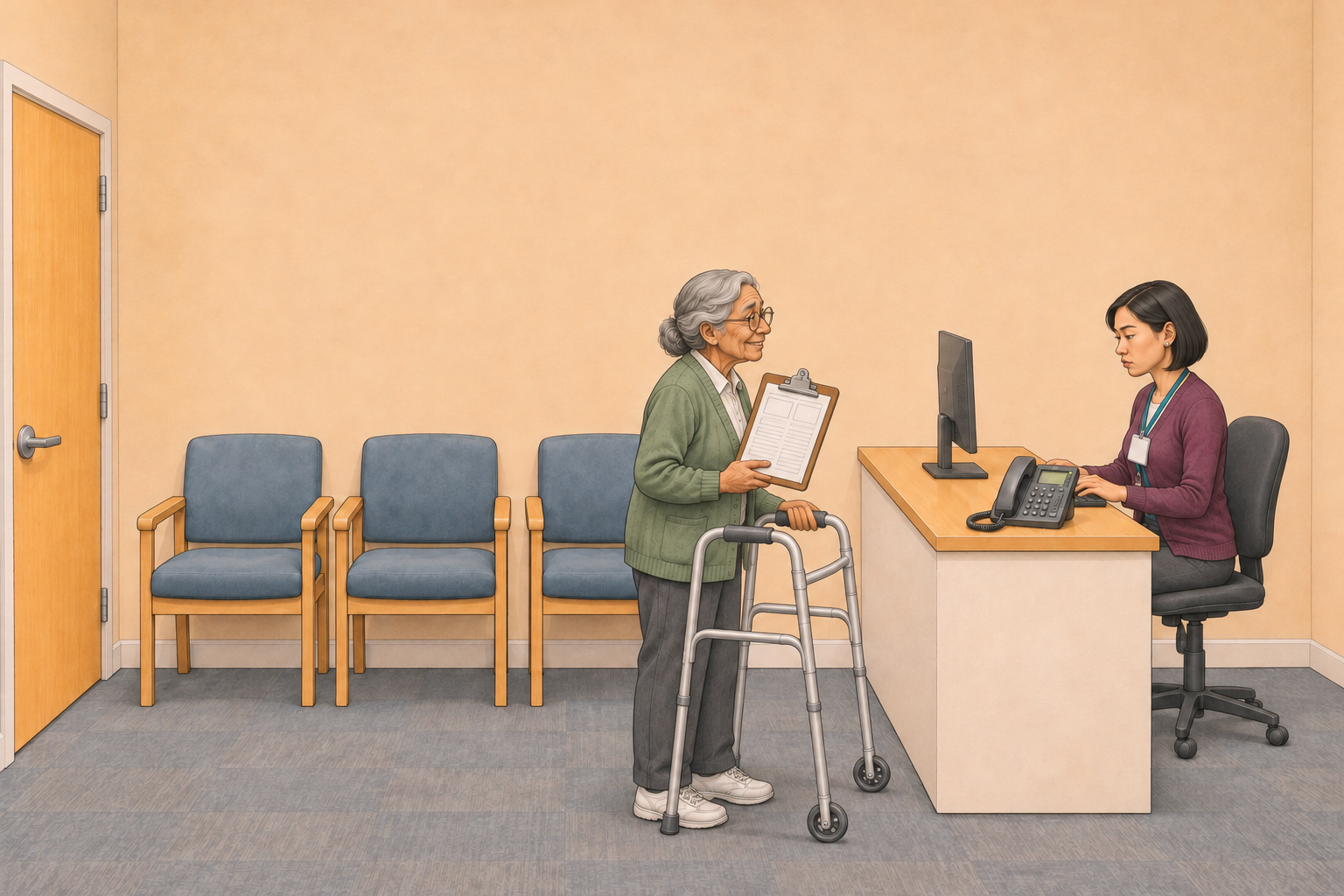 Patient:Thank you. I’ll get this filled out.Front desk (thinking):Phone’s ringing. Two more in line.
A thank-you, with her hands full. A reply is coming either way. One minute of help is cheapest right now. - The Mediocre ApproachThe action
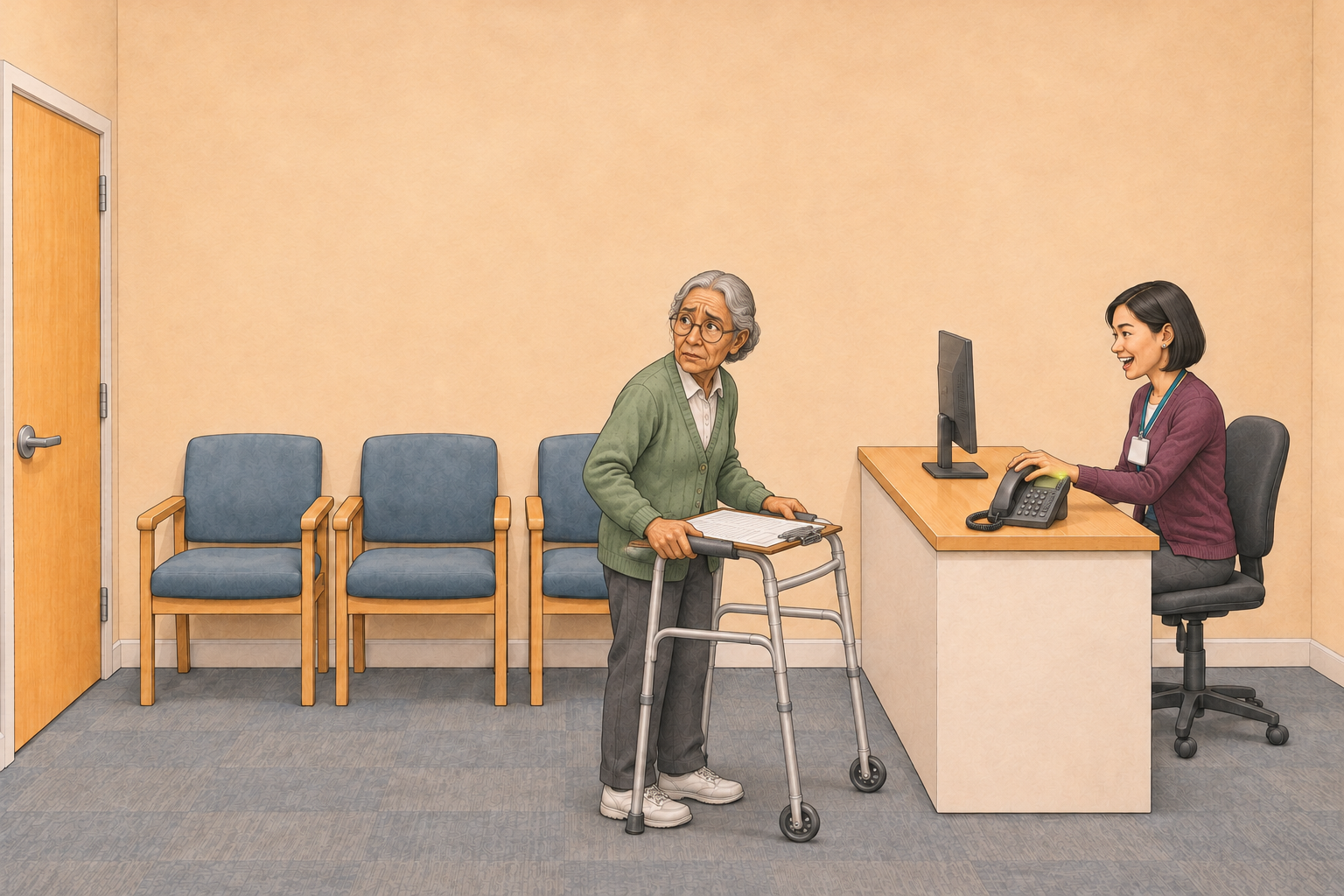 Patient (thinking):Anywhere? How do I carry this?Front desk:My pleasure! Have a seat anywhere.
The right words, said to the screen. She never looks up, so she never sees the walker. - The Mediocre ApproachThe poor outcome
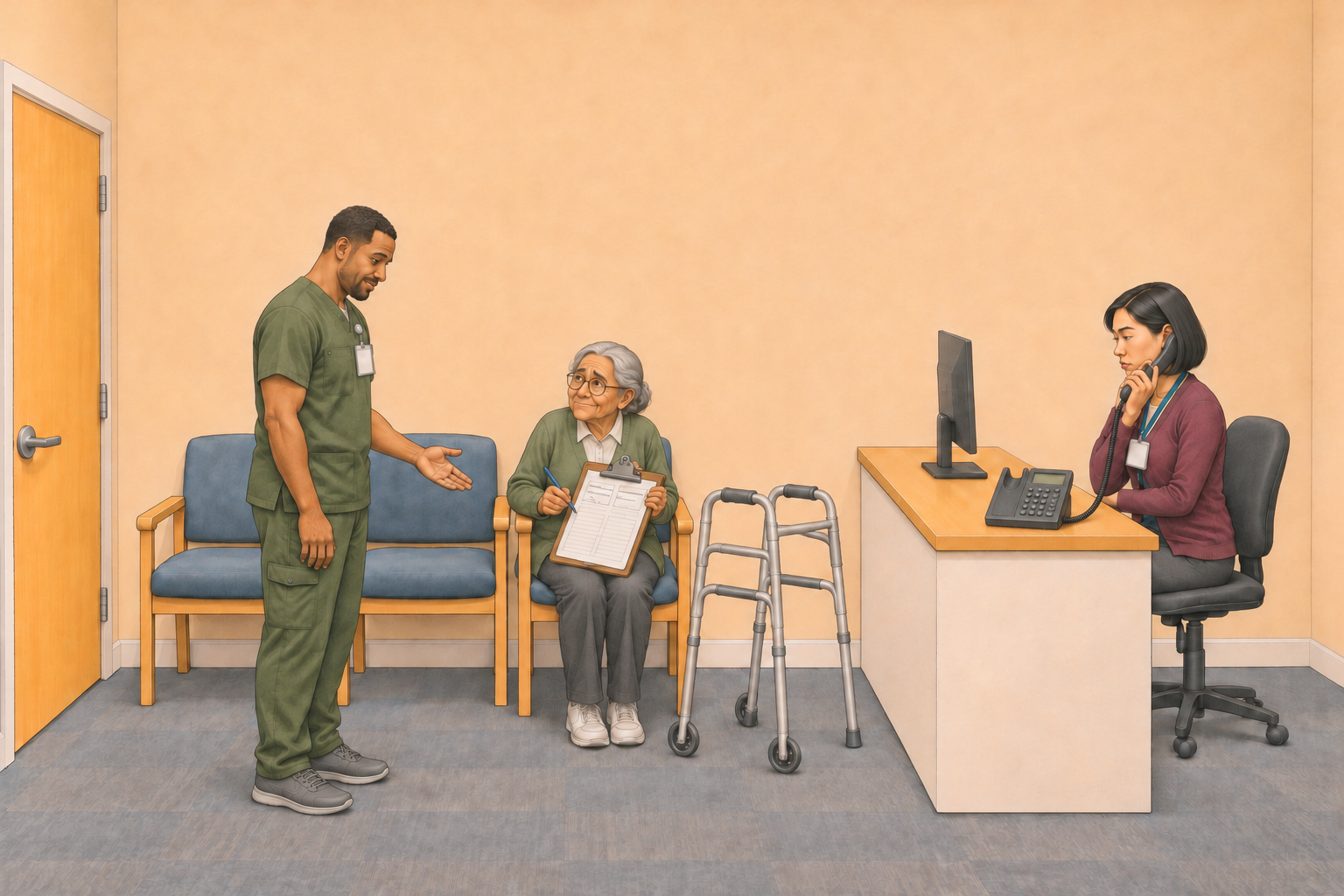 MA:We’re ready for you. All done with the form?MA (thinking):Ten more minutes in the room.Patient:Only page one. I’m so sorry.
Fifteen minutes later. The form is mostly blank, so the MA takes her history in the room and the visit starts late. Rewind. Same patient, same moment, same problem. This time, the warm words come with help.
- The Exceptional ApproachThe action: say it, then do it
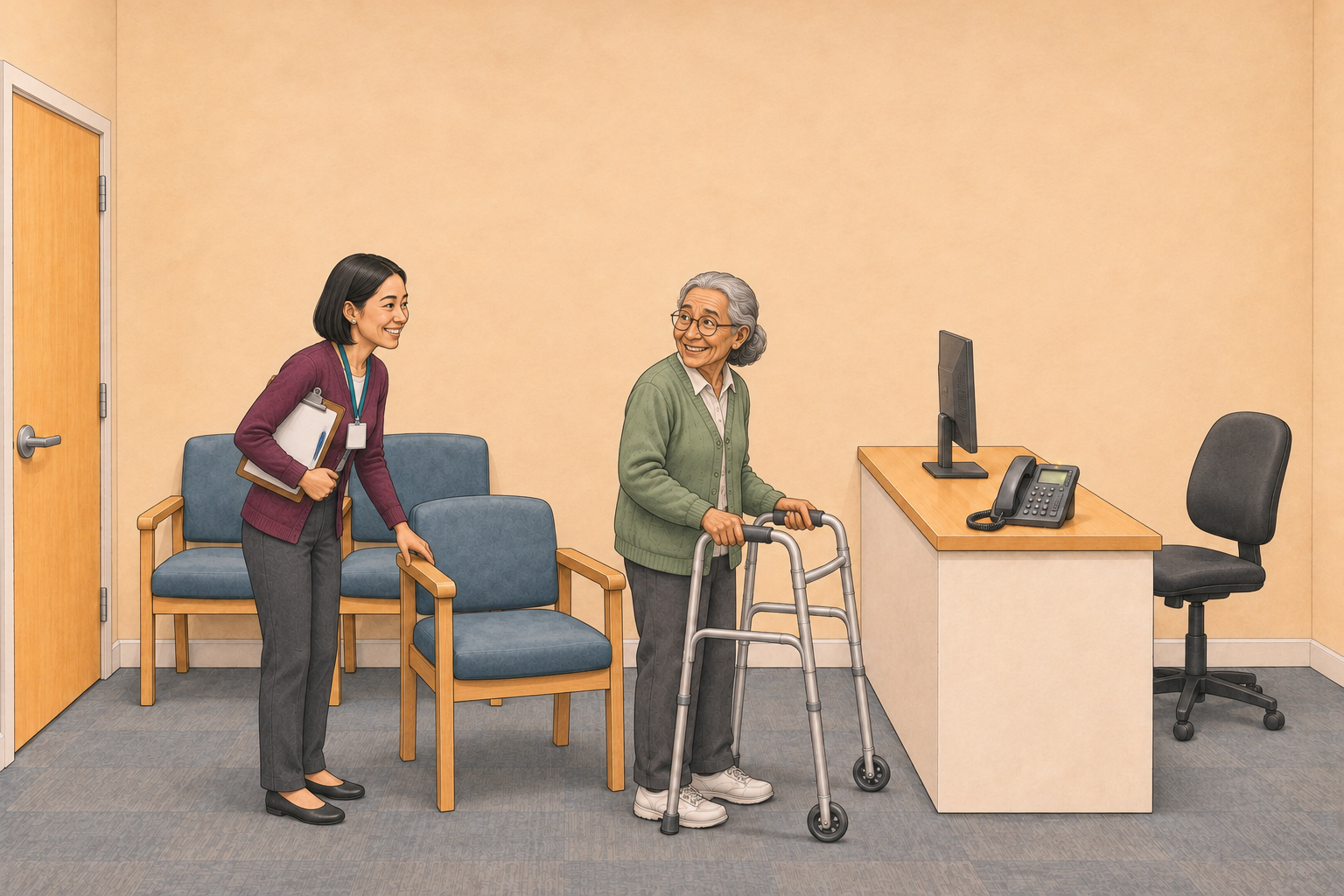 Front desk:My pleasure, Ms. Reyes. Let me carry that.Front desk:This chair’s closest. I’ll check on you in five.
The words, then the deed. She looks up, sees the walker and comes around the desk. - The Exceptional ApproachThe exceptional outcome
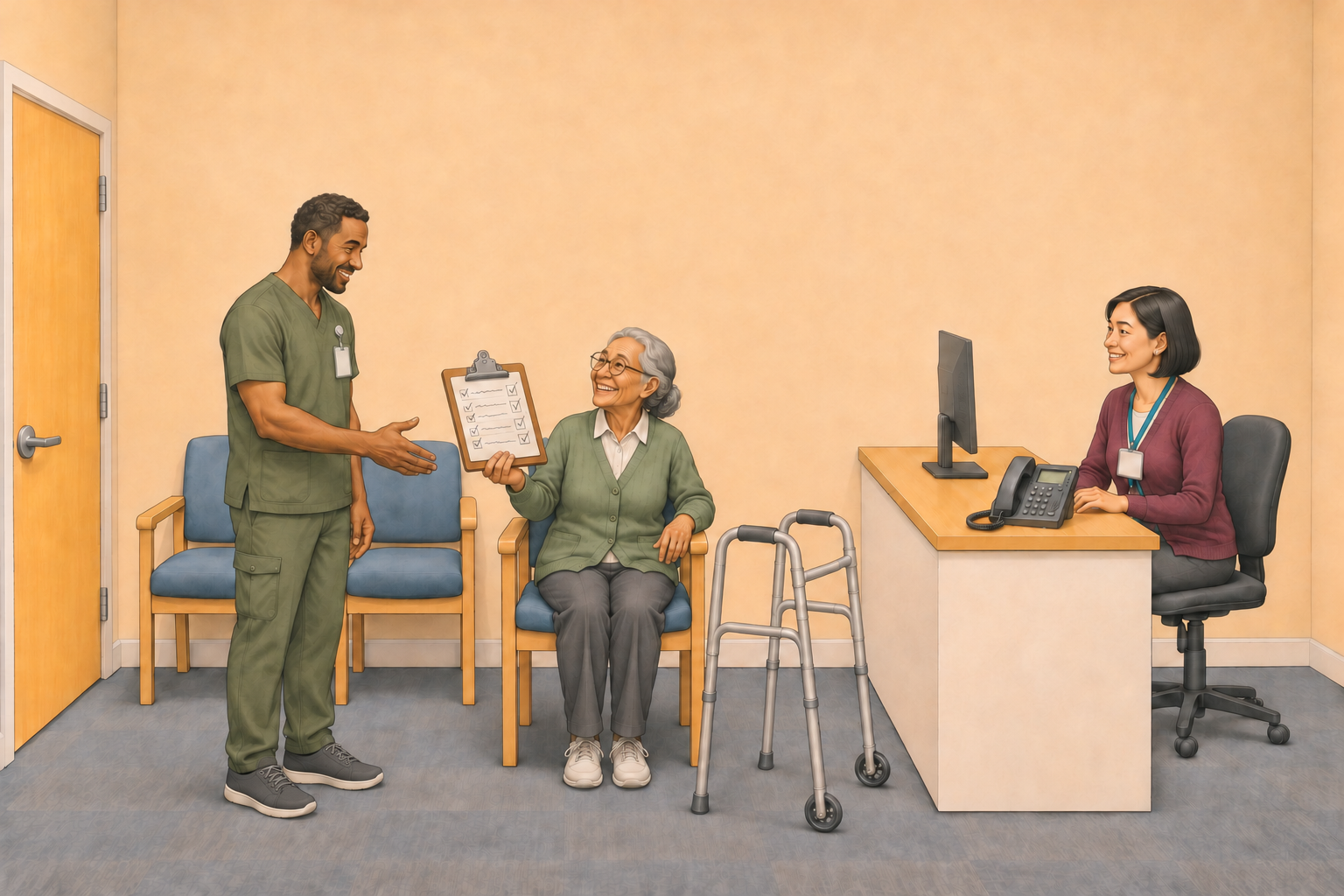 MA:Ms. Reyes? We’re ready for you.Patient:All done. She came back and helped me finish.
Fifteen minutes later. The front desk came back as promised, the form is complete, and she’s roomed on time.
Example OneAt a glance
The ProblemAt check-in, a new patient with a walker is handed a clipboard with a history form. Her hands are already full, the phone is ringing, and she says thank you.
The Mediocre ApproachThe words alone
Action
Say it to the screen.
- “My pleasure! Have a seat anywhere”
- She never looks up, so she never sees the walker
Poor outcome
A late, flustered start.
- Fifteen minutes later, the form is mostly blank
- The MA takes the history in the room, and the visit starts late
The Exceptional ApproachThe promise kept: look up, then help
Action
Say it, then do something.
- “My pleasure, Ms. Reyes. Let me carry that”
- She pulls out the nearest chair and says when she’ll check back
Exceptional outcome
Ready on time.
- She comes back in five minutes and helps finish the form
- The patient is roomed on time, with her history complete
Example Two: “Sorry to Be a Bother”
- The Problem
Partway through a skin-cancer removal on his forearm, the patient’s back starts to ache. He apologizes before he asks for a pillow under his knees.
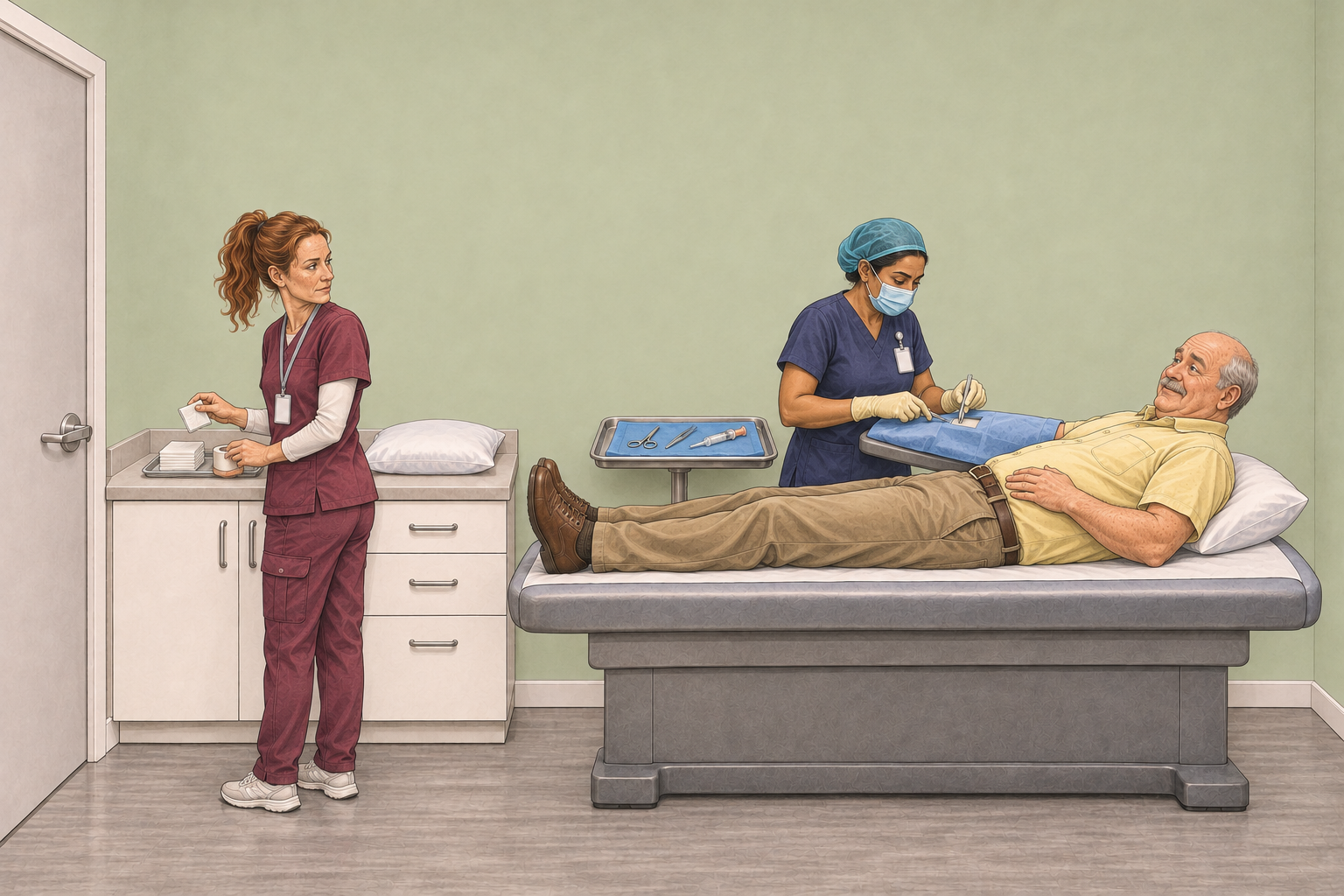 Patient:Sorry to be a bother. Could I get a pillow under my knees?MA (thinking):We’re so close to done.
A small ask, with an apology. The answer he gets now decides whether he asks again. - The Mediocre ApproachThe action
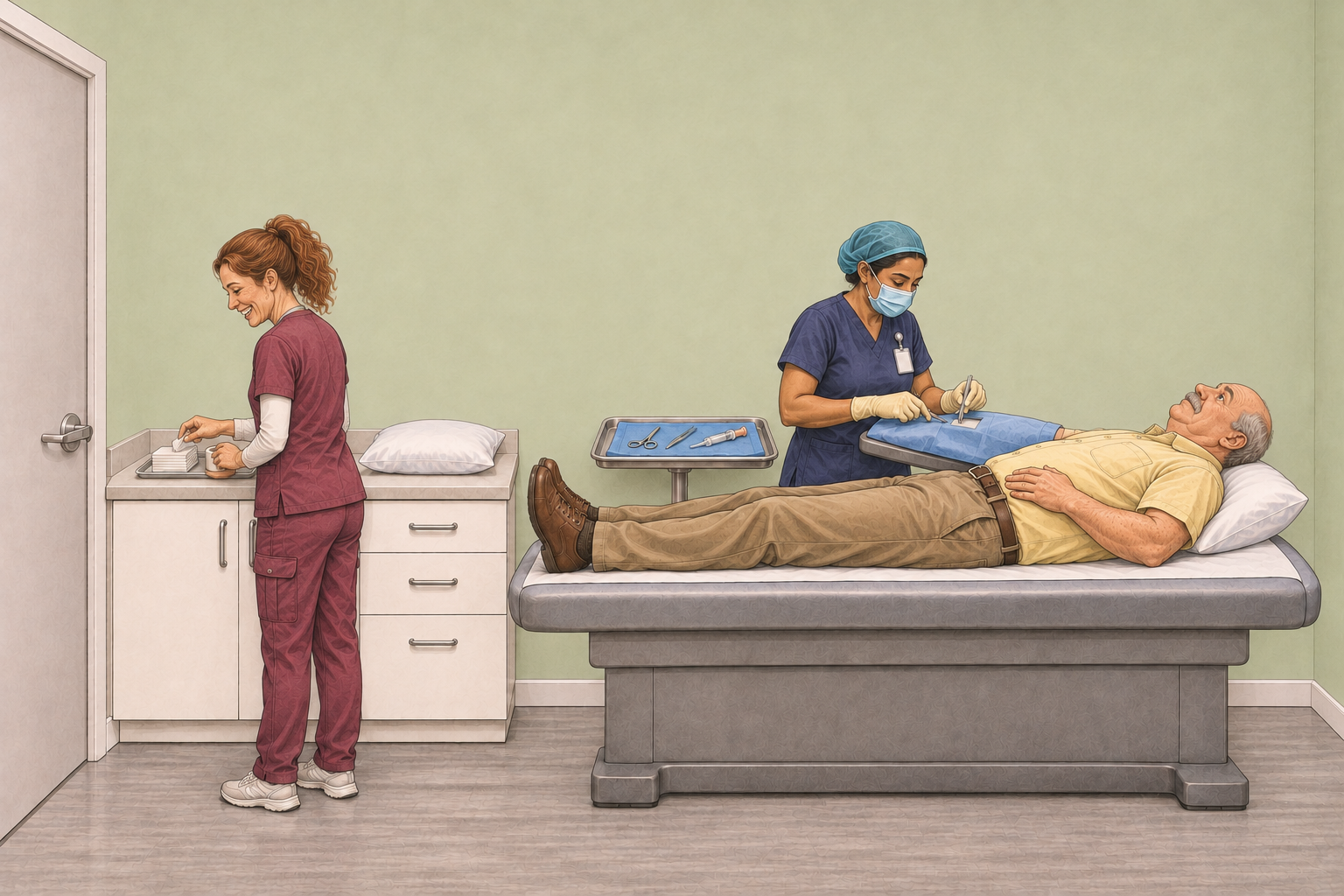 Patient (thinking):I shouldn’t have asked.MA:No problem at all! We’re almost done.
Warm words, no pillow. He hears a yes, and nothing happens. - The Mediocre ApproachThe poor outcome
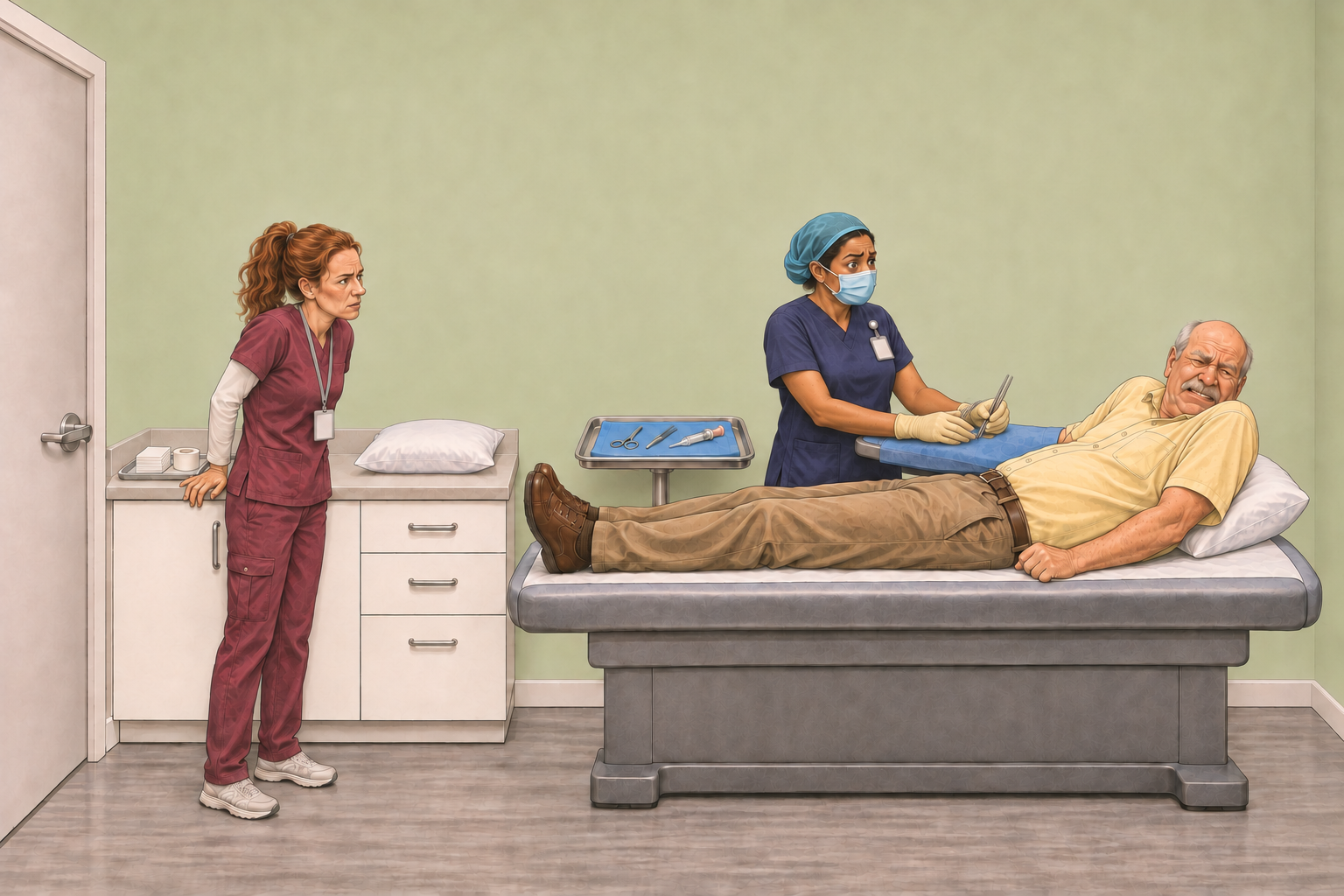 Patient:I didn’t want to bother you again.Doctor:You felt that? Why didn’t you tell us?
Ten minutes later. He starts to feel the stitches and keeps it to himself. Then he flinches, and the doctor has to stop. Rewind. Same patient, same moment, same problem. This time, the warm words come with help.
- The Exceptional ApproachThe action: say it, then do it
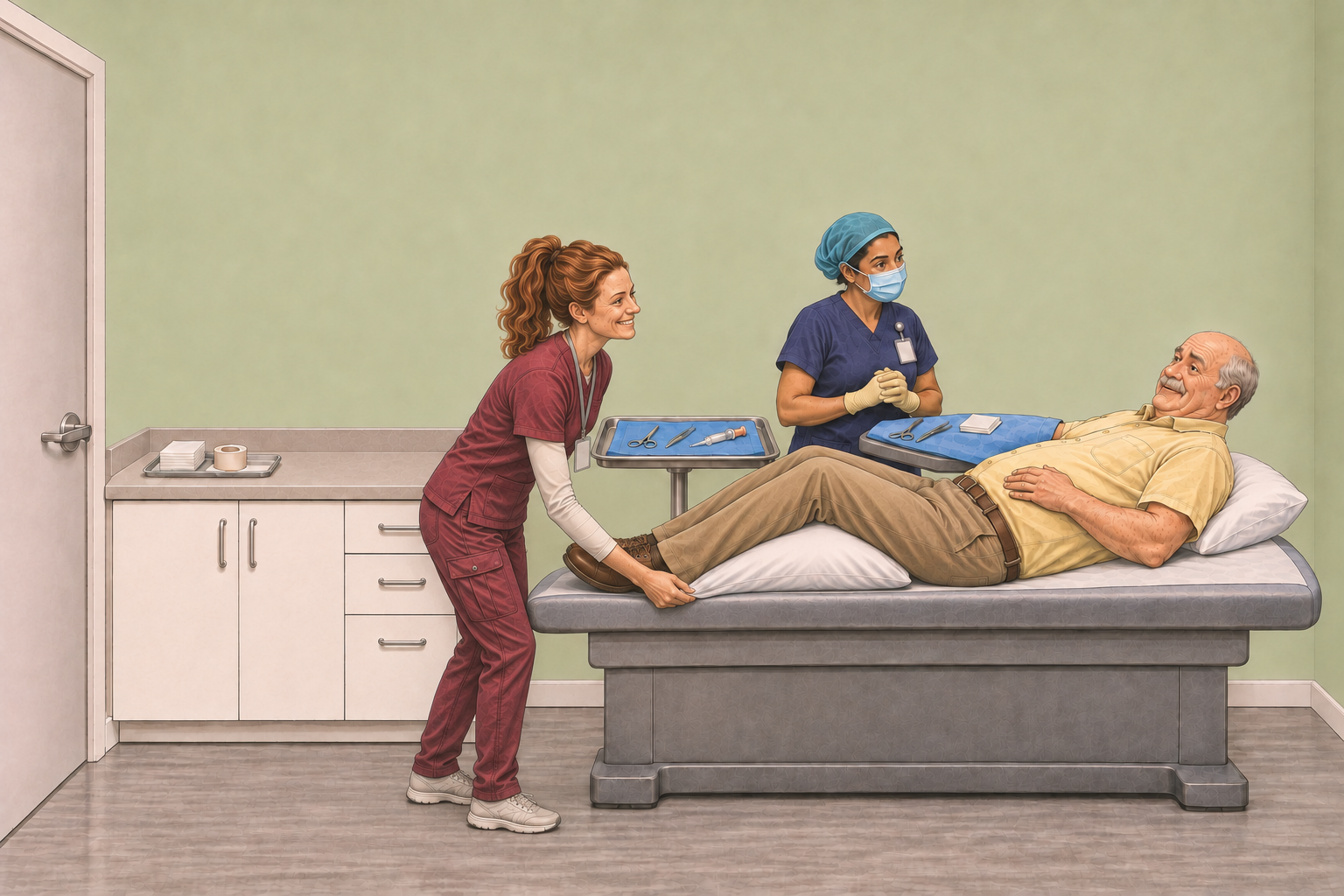 Doctor:Pausing for the pillow. Tell us anything, anytime.MA:Of course. I’m glad you asked.
Yes, and the pillow. The doctor pauses, the pillow goes under his knees, and he hears that asking is welcome. - The Exceptional ApproachThe exceptional outcome
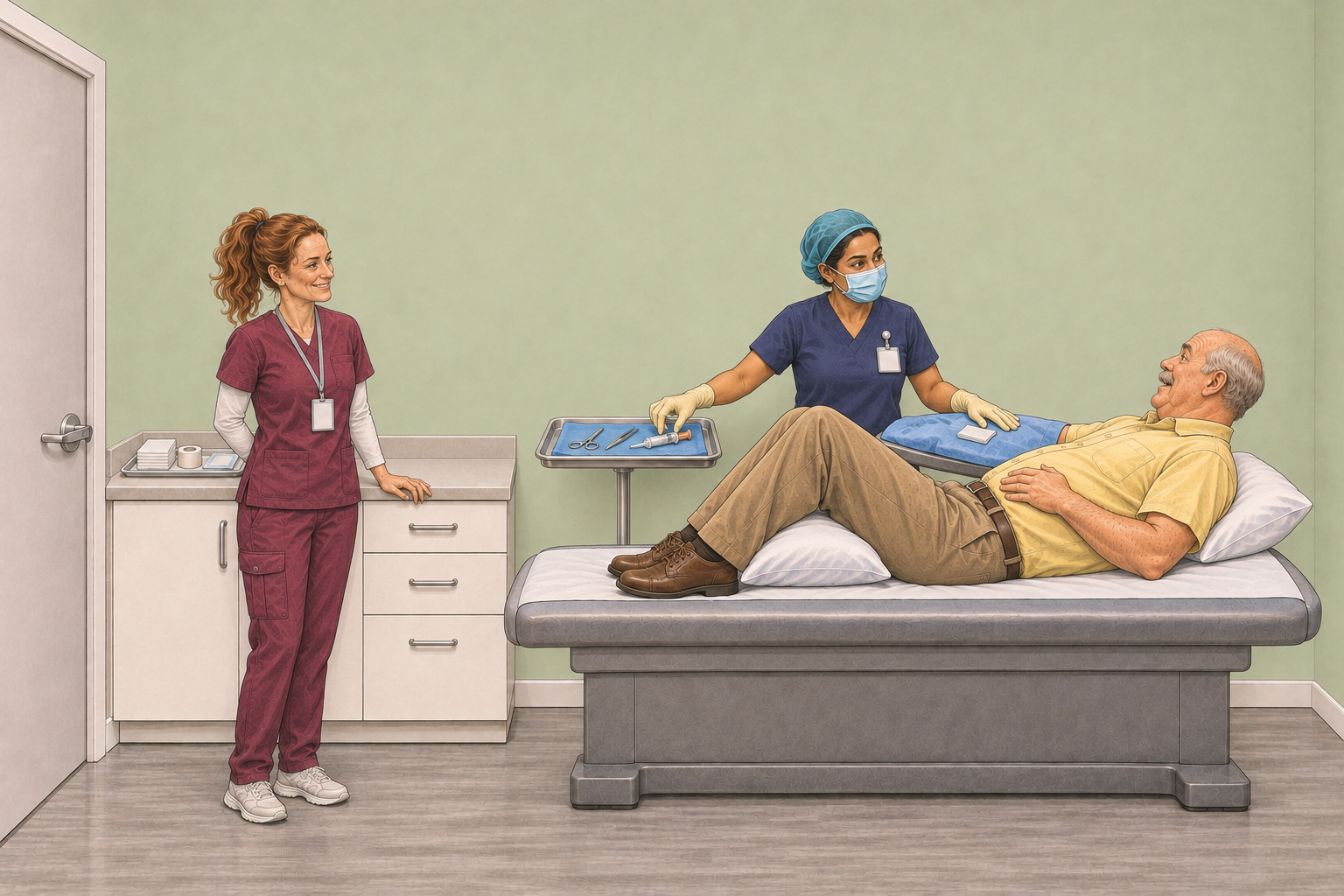 Patient:I’m starting to feel that one.Doctor:Thank you for telling me. I’ll add more numbing.
Ten minutes later. He speaks up the moment he feels a stitch. The doctor adds numbing medicine and finishes calmly.
Example TwoAt a glance
The ProblemPartway through a skin-cancer removal on his forearm, a patient’s back starts to ache. He apologizes, then asks for a pillow under his knees.
The Mediocre ApproachWarm words, no deed
Action
Say yes, do nothing.
- “No problem at all! We’re almost done”
- No pillow comes
Poor outcome
He stops asking.
- When he starts to feel the stitches, he keeps it to himself
- He flinches, and the doctor has to stop
The Exceptional ApproachThe promise kept: yes, then the pillow
Action
Say yes, and do it now.
- “Of course. I’m glad you asked”: the pillow goes under his knees
- The doctor adds, “Tell us anything, anytime”
Exceptional outcome
He speaks up in time.
- He says so the moment he feels a stitch
- The doctor adds numbing medicine and finishes calmly
Your clinic
More Promises to Keep in a Clinic
Same pattern every time: a warm reply, from the person whose job it is, with a deed, a name or a time behind it.
| What the patient says | Who answers, and how | Kept before they move on |
|---|---|---|
| On the phone: “Could you call me if something opens up sooner?” | The scheduler says, “Happy to,” and adds her to the cancellation list while she’s still on the line | She knows how she’ll be contacted and how long she’ll have to say yes |
| At checkout: “Sorry, I don’t understand this bill.” | The front desk says, “I’m glad you asked,” and brings billing to the desk or onto the phone | She leaves with an answer, or with the name of the person who will call and the day |
| In the exam room: “One more question: can I use this cream on my face?” | The MA says, “Good question,” and takes it to the clinician, who answers it | The clinician’s answer is on the visit summary before the patient leaves |
| During Mohs surgery: a family member asks, “Do you know how much longer he’ll be?” | The front desk says, “Let me find out,” and asks the Mohs nurse | She gets the nurse’s estimate, and a time for the next update |
| On a rainy day: a patient with a fresh bandage on his scalp says thanks and heads for the parking lot | The MA says, “My pleasure,” picks up the clinic umbrella and walks him to his car | He reaches the car with the bandage dry |
Adapt the words and the owner to your own team. Anything clinical still goes to a clinician.
Your move
Try It Today
Say it. Back it. Check it.
Try it for one week, at one moment in the visit. No new software, no budget, no script to memorize.
- Pick one moment. Check-in, the phone or the end of a procedure: wherever your patients most often say “thank you” or “sorry to bother you.”
- Spell out the welcome. Agree on three behaviors for that moment: look up, use the patient’s name, and answer in words you mean. Choose the words together, so they sound like your team.
- Add a deed, a name or a time. Every warm reply comes with something specific: “Let me carry that,” or “Our nurse will call you by Thursday at five.”
- Leaders go first. Physicians and the manager do it all week, where the team can see.
- Check it on Friday. Ask five patients, “Did we do what we said we would?” Keep a tally with no patient details, and fix the most common miss.
Anything urgent still goes straight to the clinician.
Anyone can say the words. Build the clinic that keeps them.
Explore the Evidence
13 sources · what each source is, what it found, what it supports here, and its limits
The Chick-fil-A story on this page is assembled from separate sources, each used for what it shows. The origin of the phrase is the company’s own account (references 1 and 2), which names no hotel; the Ritz-Carlton name comes from Steve Robinson, the company’s former marketing chief, in a 2021 podcast interview (reference 3). That interview is the source for the three years of repeated requests, the operators’ worry, the earlier five-to-six-year reliability effort, the small set of behaviors treated as standards, the hospitality leaders, placing people by fit, who paid for training and measurement, the monthly restaurant-level feedback and the roughly two years in 100 test restaurants. It is one former executive’s recollection. It is undated on these points, and its transcript contains typos, so it is paraphrased here and not quoted. He spoke of six or seven behaviors, not a published list. No data from the test restaurants have been published; his “business case” is his description of an internal argument, not a measured effect on sales or profit. The test was not a randomized experiment, and nothing here shows that no one used the phrase before it. The temperature standard he mentioned for food is not used on this page, and nothing here is a food-safety recommendation. The 2001 seminar and Dan Cathy’s example from 2003 are reported by CNN (reference 4), which draws on Robinson’s 2019 book; the book was not read for this chapter, and those dates are CNN’s, not the interview’s. The four behaviors (eye contact, a smile, a friendly tone and “my pleasure”) are host Michael Lage’s recollection in a 2025 conference conversation, read as an automatic transcript without a check against the audio (reference 5); they are not Dan Cathy’s words and not an official current list, and Cathy’s point about what new workers see leaders doing is his belief, not a measured effect. The second-mile examples (trays, chairs and umbrellas) and Cathy’s remark about teaching teenagers come from one magazine profile, web-dated 2008 with content from about 2007 (reference 6); they describe that time and do not show a current company-wide policy or a measured gain in loyalty. Emily Gilmore is one manager quoted by CNN in 2022. The counter scene that opens the chapter is hypothetical, and the contrast between a sign and a system is this chapter’s own. The two comic strips sketch that hypothetical counter in an invented, unbranded restaurant; they do not depict Chick-fil-A, its staff, its uniforms or its restaurants, and the picture cards, the hospitality leader’s lesson and her clipboard are illustration, not reported events. Nothing in these sources tests the phrase “my pleasure” against any other reply, and nothing shows that the phrase, or any single practice, caused Chick-fil-A’s sales or its satisfaction scores. The American Customer Satisfaction Index figure (reference 7) is an index score out of 100, not a percentage of customers. In the June 2026 release Chick-fil-A scored 83 and led the chicken category, Jersey Mike’s scored higher at 84, and the quick-service average was 79; the survey covers restaurants in general and isolates no cause. The studies come from other settings and are kept apart. The medical-student trial (reference 8) found no improvement after one brief refresher; it does not show that all communication training fails, and its often-quoted care-plan comparison (86.8% against 73.1% rated excellent) pools both groups, is unadjusted and is one of 18 comparisons. The name finding (reference 11) is an observed association in a pilot study of medical students in two emergency departments: the outcome is the student’s overall communication rated excellent, not overall patient satisfaction, and in the later trial by the same group the only comparison of this kind that stood out was explaining the care plan. The concrete-language figures (reference 12) are associations from field data at different companies, one for satisfaction and one for spending (13% in the conservative model and 30% in a less conservative one), measured per one standard deviation of concreteness; they come from commercial customer service and show no clinical benefit. The two studies by Grandey (references 9 and 10) were read as abstracts. In the 2005 paper, the simulated hotel check-in is where satisfaction depended on the task being done well; its second study, of 255 customers of 64 restaurant servers, found a direct link where task performance was generally high. Neither shows that warmth makes up for poor care. The 2003 paper reports associations among service workers: it does not show that a required phrase causes stress or burnout, and deep acting related differently from surface acting. The dermatology review study (reference 13) is a qualitative reading of self-selected online reviews; it gives themes, not how often each occurs. No source here tested Chick-fil-A’s practices in a dermatology clinic. The two clinic examples, the extra ideas and the one-week experiment are illustrations of the mechanism, written for this chapter with fictional people, not observed events or tested interventions. Status shows how each source was read: HTML (web page or published transcript), ABS (abstract) or FULL (full text).
| Source | Type and context | Key finding | What it supports here | Material limitation |
|---|---|---|---|---|
| [1] · HTMLChick-fil-A. Why do Chick-fil-A Team Members and employees say “My Pleasure?” | Company web page Chick-fil-A describing its own history, on its customer-support site | Truett Cathy heard a sincere “my pleasure” from an employee at a high-end hotel, then asked his company to answer thanks the same way | The origin of the phrase (summary and section 1) | The company’s own account; it names no hotel and reports no results |
| [2] · HTMLChick-fil-A Press Room. Humble beginnings: How Truett Cathy’s love for customers grew from a coke and a smile. 2016 | Company press-room story Chick-fil-A’s own account of its founder | The same origin account: a sincere “my pleasure” from a hotel employee, followed by Cathy’s request to his company | The origin of the phrase (summary and section 1) | Company narrative, not published outcome data; the hotel is not named |
| [3] · HTMLCole J, with Robinson S. Building Brands That Attract Customers. Business Done Differently, episode 25. 2021 | Podcast interview Steve Robinson, Chick-fil-A’s former marketing chief, interviewed by Jesse Cole; read as the published transcript | Robinson named the Ritz-Carlton; Cathy repeated his request at national meetings for three years; operators worried that hospitality could slow fast, accurate food service; an earlier reliability effort of five to six years drew on zero-defect principles that Kentucky operators had learned, with unannounced checks using thermometers and scales; roughly two years in 100 test restaurants, with local leaders, named behaviors, feedback, training and an internal business case; a small set of behaviors treated as defined standards; hospitality leadership needed in each restaurant; people placed in hospitality roles by fit; operators paid for extra training and talent; monthly customer and shopper feedback, centrally funded and reported for each restaurant | The request that was not enough (section 1), what the company built (section 2), the comparison and mechanism cards 1, 3 and 5 | One former executive’s recollection, undated on these points and paraphrased because the transcript contains typos; six or seven behaviors, not a published list; no test-restaurant data are published and the business case is not a measured effect; not a randomized test, and no proof that nobody used the phrase earlier; the food-temperature standard he mentioned is not used here |
| [4] · HTMLMeyersohn N. Why Chick-fil-A workers always say ‘my pleasure.’ CNN Business, 2022 | News feature CNN Business, read in full in WRAL’s republication | Truett Cathy told the hotel story at the company’s 2001 seminar for franchise owners; from 2003 Dan Cathy said the phrase himself and pushed others to follow; Dan Cathy came to see the phrase as the company’s service signature, compared with the two pickles on its sandwich; manager Emily Gilmore said she uses the reply at home too | The leader who went first (section 2, card 4), the pickles comparison and the habit | Secondary reporting that draws on Robinson’s 2019 book, which was not read for this chapter; the 2001 and 2003 dates are CNN’s, not the interview’s; one manager’s remark is not every employee’s experience |
| [5] · HTMLCathy DT, Schulze H, Lage M. Southbound ’25: A Conversation on Service Excellence. RevPartners, 2025 | Conference conversation Dan Cathy and Horst Schulze with host Michael Lage; read as a published automatic transcript | Lage recalled learning eye contact, a smile, a friendly tone and “my pleasure” under Dan Cathy; Cathy emphasized what new workers see their leaders doing | The four named behaviors (summary, section 2, card 1) and leaders going first (section 2, card 4) | Automatic transcript, selected passages, with speakers identified from the surrounding discussion and no check against the audio; Lage’s recollection, not Cathy’s words and not an official current list; Cathy’s point is a leadership belief, not a measured effect |
| [6] · HTMLFeldman KL. Chick-fil-A’s second generation aims to go ‘the second mile.’ Family Business Magazine, 2008 | Magazine profile A reporter’s profile of Dan Cathy and the family business; web-dated 30 November 2008, with content from about 2007 | Dan Cathy set the paid-for transaction (the first mile) apart from the relationship (the second mile); staff carried trays to tables, pulled out chairs and greeted diners at their cars with umbrellas in the rain; he stressed the work of teaching teenagers to say the words | The deed behind the words (summary, section 2, the comparison, card 2) and the work of teaching it (section 2, card 4) | Historical reporting in one profile; it does not show a current company-wide policy or a measured gain in loyalty; Cathy’s remark about teaching teenagers is his observation, not a tested comparison |
| [7] · HTMLAmerican Customer Satisfaction Index. Restaurant and Food Delivery Study 2026. Press release, 16 June 2026 | National customer survey An index of customer satisfaction, scored out of 100; the official press release | June 2026: Chick-fil-A 83, the leader in the chicken category; Jersey Mike’s 84; quick-service average 79 | Results card 1, the summary and section 4 | An index score, not a percentage of customers; Chick-fil-A was not the top quick-service restaurant in this release (Jersey Mike’s scored 84); the survey sample is not specific to Chick-fil-A and isolates no cause |
| [8] · FULLPettit KE et al. Effect of an educational intervention on medical student scripting and patient satisfaction: a randomized trial. West J Emerg Med 2018 | Randomized educational trial Medical students, block-randomized to a brief refresher on scripted communication or to no refresher | 474 observed encounters (231 control, 243 refresher); no improvement was detected in the targeted behaviors or in patient satisfaction | Kept for the record as counterevidence on reminders alone; not cited in the chapter text | One brief refresher, so it does not show that all communication training fails; its care-plan comparison (86.8% vs 73.1% rated excellent) pools both groups, is unadjusted and is one of 18 comparisons, so it is not a result of the refresher and is not used on the page |
| [9] · ABSGrandey AA, Fisk GM, Mattila AS, Jansen KJ, Sideman LA. Is “service with a smile” enough? Organ Behav Hum Decis Process 2005 | Two studies Study 1: an experiment with a simulated hotel check-in. Study 2: a field study of 255 customers of 64 restaurant servers | Authentic positive displays made employees seem friendlier; in Study 1, satisfaction depended on the task being done well; Study 2 found a direct link between authenticity and satisfaction where task performance was generally high | Mechanism card 2: warmth lands when the job is done well | Read as the abstract on the author’s institution page; the two studies differ and are kept apart, and Study 2 does not test the “job first” pattern; neither shows that warmth makes up for poor clinical care; hotels and restaurants, not clinics |
| [10] · ABSGrandey AA. When “the show must go on”: surface acting and deep acting as determinants of emotional exhaustion and peer-rated service delivery. Acad Manage J 2003 | Correlational study of service workers Workers’ own reports, with coworkers rating how warmly they served customers | Surface acting (changing only the outward expression) was associated with stress and with lower coworker-rated delivery; deep acting (changing the feeling) related differently | Mechanism card 3: why fit matters | Read as the abstract; associations, not proof that a required phrase causes stress or burnout; stress here is a measure of workers, not a patient outcome |
| [11] · FULLTurner JS, Pettit KE, Buente BB, Humbert AJ, Perkins AJ, Kline JA. Medical student use of communication elements and association with patient satisfaction. BMC Med Educ 2016 | Observational pilot study Emergency departments of two academic urban hospitals, each with more than 100,000 visits a year | 246 complete encounters with 40 students; when the student acknowledged the patient by name, the student’s overall communication was rated excellent in 80.0% of encounters, against 64.6% without (adjusted P = .009); an estimate of how long things would take was given in 15 of 246 encounters (6.1%) | Results card 2 and the clinic translation (the patient’s name; saying how long) | An observed association in a pilot, not a tested intervention; the measure is the student’s communication rated excellent, not overall patient satisfaction; medical students in emergency departments, not dermatology staff; in the later trial by the same group (reference 8), the only comparison of this kind that stood out was explaining the care plan |
| [12] · HTMLPackard G, Berger J. How concrete language shapes customer satisfaction. J Consum Res 2021 | Field analyses with companion experiments Real customer-service interactions at commercial firms, plus separate experiments | In one field study, a one-standard-deviation increase in the concreteness of the employee’s language was associated with almost 9% higher customer satisfaction; at a separate retailer, with 13% more spending over the next 90 days in the conservative model (30% in a less conservative one) | Results card 3 and the clinic translation (a deed, a name or a time) | Associations from different firms and different outcomes, kept apart from the experiments; commercial customer service, not clinics, and not a clinical benefit; publisher-indexed sections of the full text were read |
| [13] · ABSSmith RJ, Lipoff JB. Evaluation of dermatology practice online reviews: lessons from qualitative analysis. JAMA Dermatol 2016 | Qualitative analysis Online reviews of dermatology practices | Themes in patients’ negative experiences included curt interactions with staff, difficulty with scheduling, practice cleanliness and insurance problems | Why warm words need backing in a dermatology clinic (section 5) | Self-selected online reviews; themes, not how often each occurs; no intervention was tested; read as the PubMed abstract and publisher-indexed passages |
References
- Chick-fil-A. “Why do Chick-fil-A Team Members and employees say ‘My Pleasure?’” Chick-fil-A Customer Support. 2 June 2025. chick-fil-a.com/customer-support
- Chick-fil-A. “Humble beginnings: How Truett Cathy’s love for customers grew from a coke and a smile.” Chick-fil-A Press Room. 11 November 2016. chick-fil-a.com/press-room
- Cole J (host), Robinson S (guest). “Building Brands That Attract Customers With Steve Robinson.” Business Done Differently, episode 25. Find Your Yellow Tux. 7 July 2021. findyouryellowtux.com
- Meyersohn N. “Why Chick-fil-A workers always say ‘my pleasure.’” CNN Business. 9 April 2022; republished by WRAL. wral.com/archive/20228047
- Cathy DT, Schulze H, Lage M. “Southbound ’25: A Conversation on Service Excellence.” RevPartners. 2025. revpartners.io
- Feldman KL. “Chick-fil-A’s second generation aims to go ‘the second mile.’” Family Business Magazine. Web-dated 30 November 2008. familybusinessmagazine.com
- American Customer Satisfaction Index. “Restaurant and Food Delivery Study 2026.” Press release. 16 June 2026. theacsi.com
- Pettit KE, et al. Effect of an educational intervention on medical student scripting and patient satisfaction: a randomized trial. West J Emerg Med. 2018;19(3):585–592. doi.org/10.5811/westjem.2018.1.35992 · PMC5942029
- Grandey AA, Fisk GM, Mattila AS, Jansen KJ, Sideman LA. Is “service with a smile” enough? Authenticity of positive displays during service encounters. Organ Behav Hum Decis Process. 2005;96(1):38–55. doi.org/10.1016/j.obhdp.2004.08.002 · author’s institution page
- Grandey AA. When “the show must go on”: surface acting and deep acting as determinants of emotional exhaustion and peer-rated service delivery. Acad Manage J. 2003;46(1):86–96. doi.org/10.5465/30040678 · author’s institution page
- Turner JS, Pettit KE, Buente BB, Humbert AJ, Perkins AJ, Kline JA. Medical student use of communication elements and association with patient satisfaction. BMC Med Educ. 2016;16:150. doi.org/10.1186/s12909-016-0671-8 · PMC4875631
- Packard G, Berger J. How concrete language shapes customer satisfaction. J Consum Res. 2021;47(5):787–806. doi.org/10.1093/jcr/ucaa038 · academic.oup.com
- Smith RJ, Lipoff JB. Evaluation of dermatology practice online reviews: lessons from qualitative analysis. JAMA Dermatol. 2016;152(2):153–157. doi.org/10.1001/jamadermatol.2015.3950 · PubMed 26606326
Explore the evidence · Try it today · Read the Chick-fil-A Daily Brief · More lessons from The Exceptional Private Practice