Lessons from The Cheesecake Factory · for dermatology practices
Fix It on the Plate, Not at the Table.
In The Cheesecake Factory’s kitchens, station screens showed a photo of each finished plate, and at every restaurant a kitchen manager at the pass checked the food before servers picked it up: specific praise, then the fix, on the same plate. Your clinic can close the same loop at every handoff.
What you’ll take away
- The problem
- Work leaves one person’s hands looking finished, and the flaw is found later, by the next person or the patient, when it costs the most to fix.
- What to remember
- Fix it on the plate, not at the table: show what right looks like where the work happens, take one last look before it moves on, and fix it right there.
- What to do differently
- Post a picture of ready at each handoff, have someone who knows the work look before it leaves, and pair specific praise with specific corrections, made on the spot.
30-Second Summary
- When nobody looks before pickup, the guest is the first real check. A cook plates the food, a server carries it out, and any flaw is found at the table, if anyone mentions it at all.
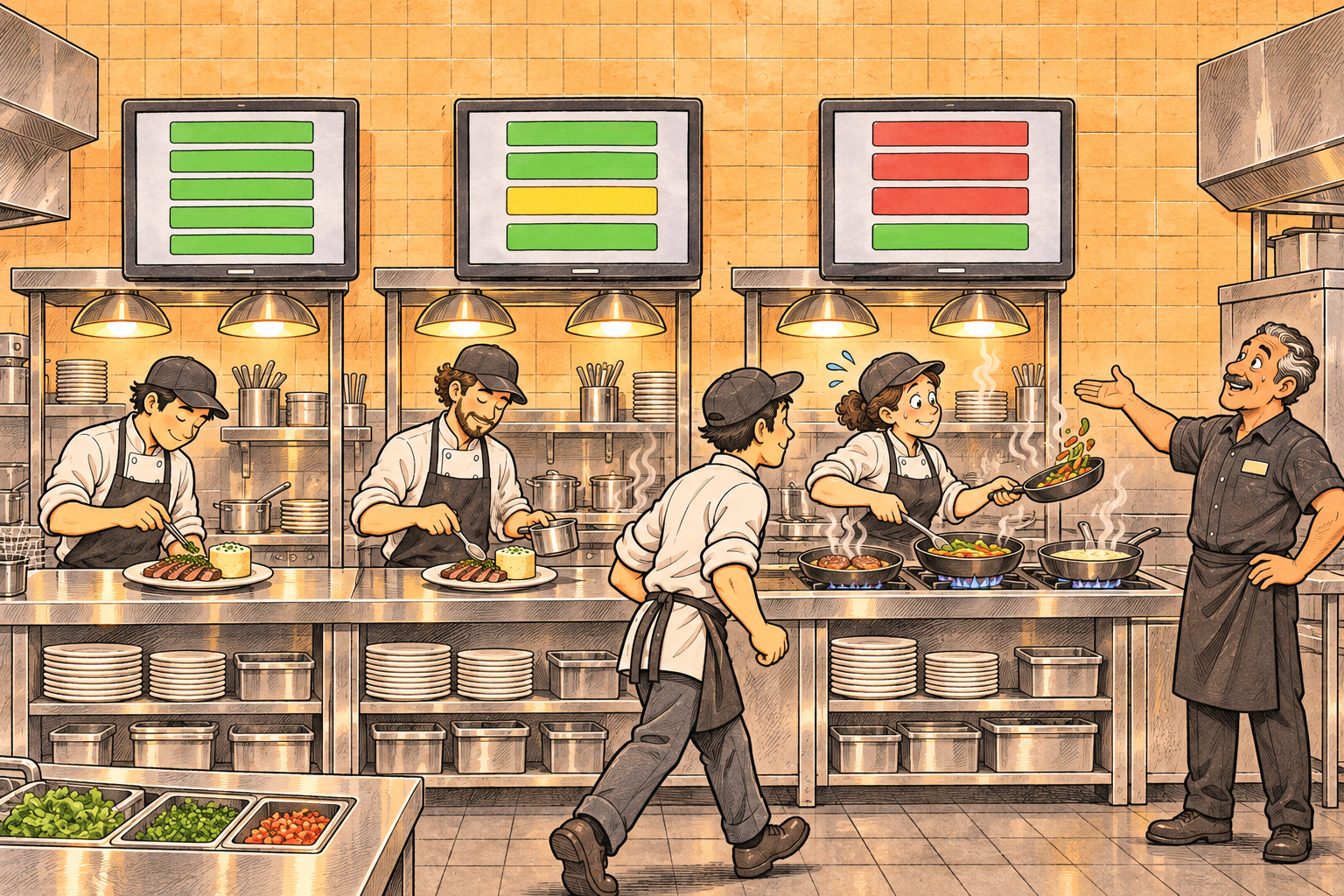
- The Cheesecake Factory worked the other way. Its station screens showed each order’s recipe and a photo of the finished plate, and a timer turned from green to yellow to red as an order neared and passed its target.2
- At every restaurant, a kitchen manager checked the food before servers picked it up. He rated plates from one to ten. On one steak, he praised the meat and the grill marks, said the mashed potatoes were packed too tight, and the cook fluffed them before the plate left.2
- Hospitals have studied related approaches. After a handoff program on units caring for children at nine hospitals, medical errors fell from 24.5 to 18.8 per 100 hospital stays.4
- In your clinic: keep a picture of ready where the work happens, have someone who knows the work take one last look before it moves on, and name and fix what’s missing right there, with specific praise for what’s right.
The Problem
What Goes Wrong When the Guest Is the First One to Check
Picture a busy kitchen on a Saturday night, with nothing set up at the pass, the counter where finished plates wait for a server. A cook works from a paper ticket and from memory. He builds a steak dinner fast, packs the mashed potatoes into a tight, tidy tower, slides the plate under the heat lamp and calls it.
A server grabs it and heads for the dining room. Nobody else looks. What reaches the table is whatever came off the line that minute.
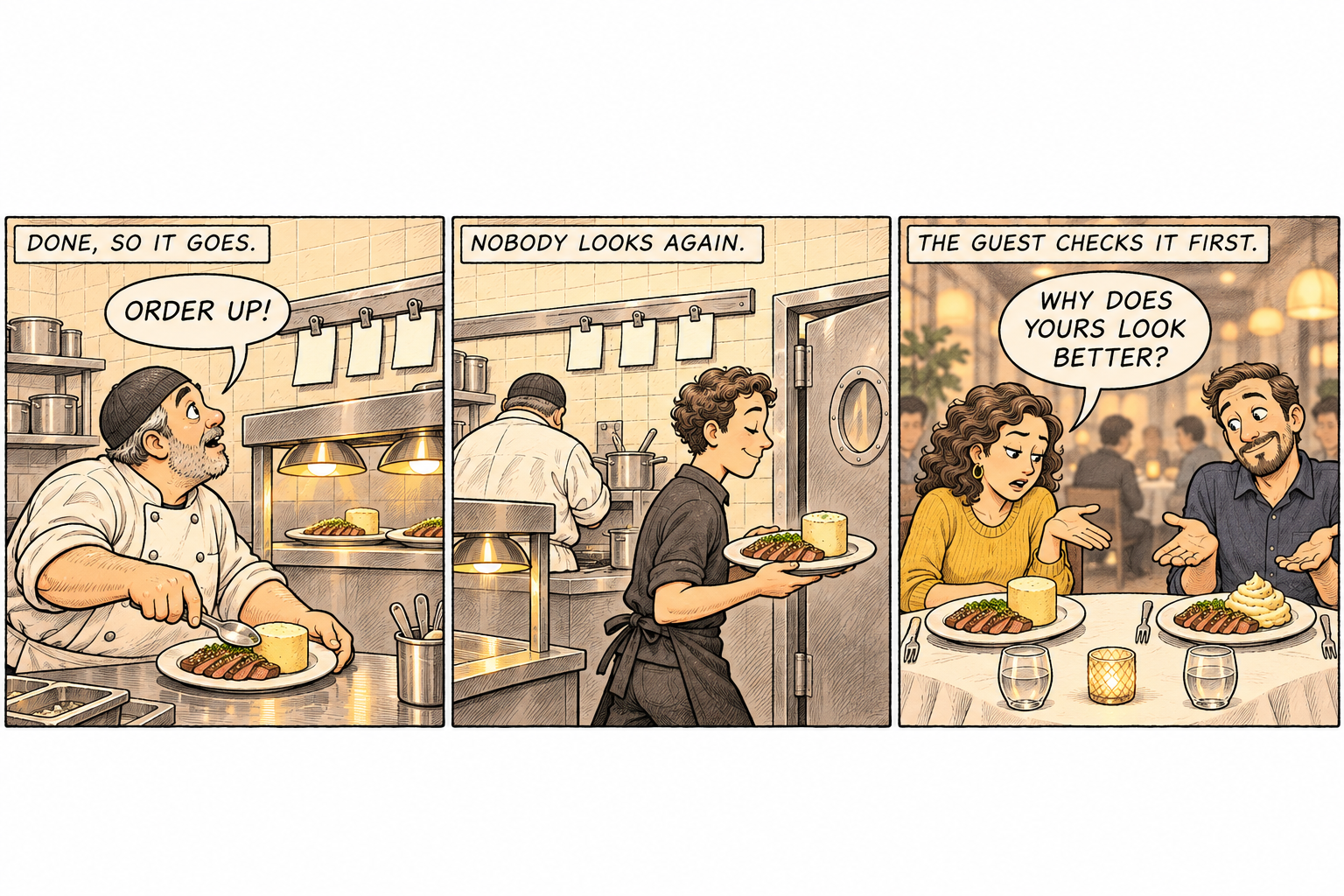
At the table, the guest is the first person who really looks. Her friend ordered the same dish, and the two plates don’t match. If something is badly wrong, the plate goes back, the cook remakes it in the middle of the rush and the table waits. If it’s only a little off, nobody says anything, and the cook never hears. The next plate goes out the same way.
Nobody here is careless. The cook did his part, and the server carried what he was handed. What’s missing is a loop: a clear picture of right, a look before the plate leaves and a word back to the person who made it.
A big menu makes that loop harder to close. The Cheesecake Factory describes a menu of more than 250 items, made from scratch in its restaurants.1
The Exceptional Solution
The Cheesecake Factory’s Answer: Fix It Before It Leaves the Kitchen
In a 2012 New Yorker article, the surgeon and writer Atul Gawande reported how The Cheesecake Factory ran its kitchens.2 The food didn’t go straight from the cook to the server. It went through a loop:
Show what right looks like. Head-high screens showed each station its orders, the recipe for each one and a photo of how the finished plate should look.2
Make the clock visible. A timer counted down to a target time for each order, and its background turned from green to yellow as the order neared the target and red once it passed. Managers scanned the screens for a station stacking up red orders and decided whether the cooks there needed a nudge or an extra pair of hands.2
Look before pickup. At every restaurant, a kitchen manager was stationed at the counter where the food came off the line. When a cook finished a dish and signaled the servers for pickup, the kitchen manager looked at it before it was taken away.2
Praise it, fix it, then send it. He named what was right and what wasn’t, and the cook fixed it on the same plate before it left.2
The last look had its own scale, and every score meant an action. A nine was near-perfect. An eight needed one or two corrections before it went out to a guest, a seven needed three, and a six was unacceptable and had to be redone.2
Here is what that sounded like. On one steak, the manager told the cooks the steak was perfect and the grill marks excellent, then said the tower of mashed potatoes was too tight. The cook fluffed up the potatoes with a fork before the plate left.2 He praised as often as he corrected, but he didn’t hesitate to correct. He tried, Gawande wrote, to be “a coach more than a policeman,” and the oversight was still tight.2
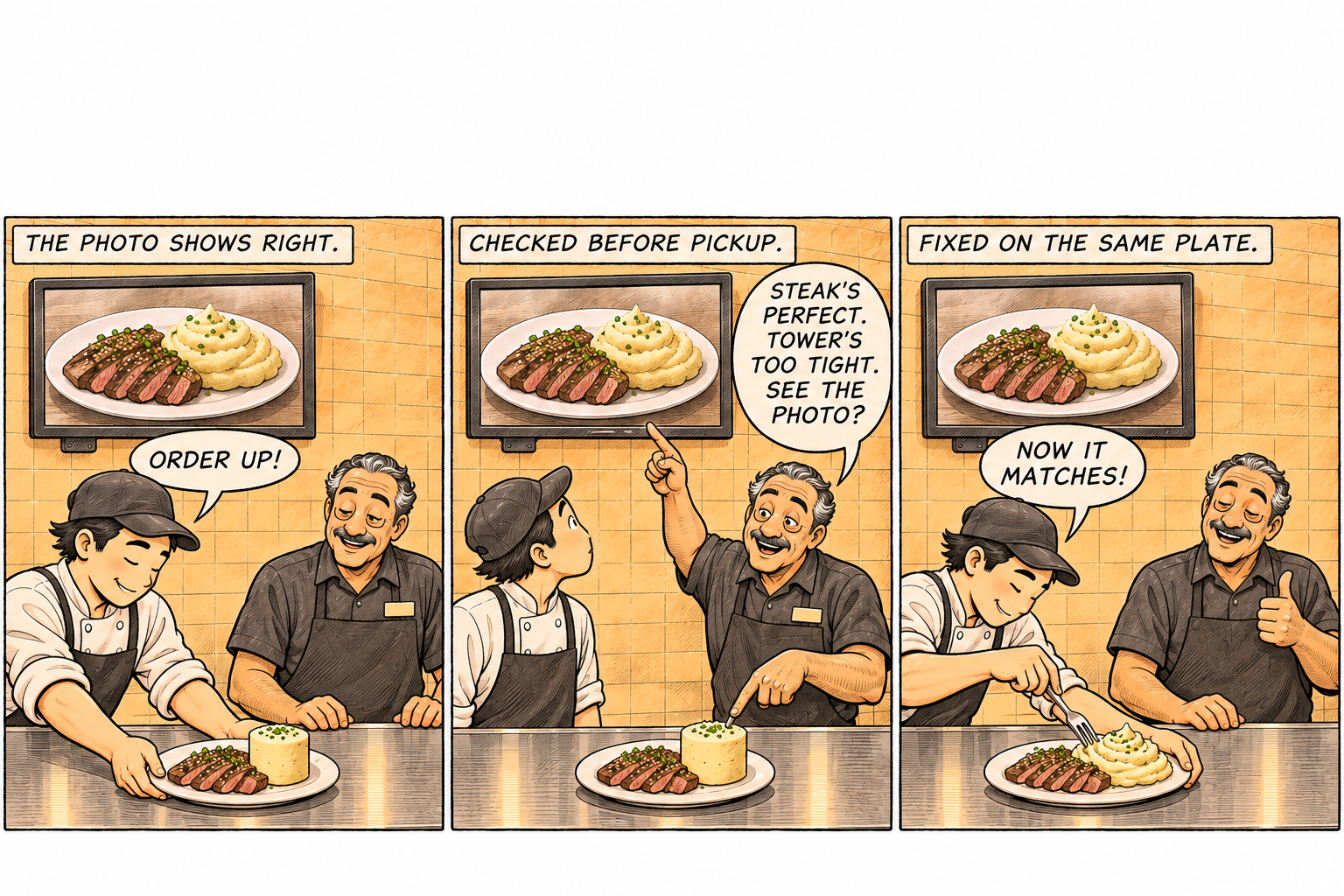
The ProblemA steak dinner is done and under the heat lamp. The steak is right, but the mashed potatoes are packed into a tight tower, and a server is reaching for the plate.
The Mediocre ApproachNo look before pickup
Action
Send it as made.
- The cook calls it done
- Nobody looks before the server takes it
Poor outcome
Judged at the table.
- The guest is the first to really look
- The cook never hears, so the next plate goes out the same way
The Exceptional ApproachThe Cheesecake answer: one last look
Action
Look before pickup.
Exceptional outcome
Fixed on the same plate.
- The cook fluffs the potatoes before the plate leaves2
- The guest gets the plate the kitchen meant to make
What Set The Cheesecake Factory Apart
The difference wasn’t one clever tool. It was how the pieces fit together, how exact they were and how far they reached:
A closed loop. The picture of right, the clock, the last look and the specific fix each fed the next, so a flaw was caught and fixed in the kitchen, and the cook knew right away what to change.
Exact where it counts. Each score on the one-to-ten scale meant a specific action, and the recipe set exact targets, like steak slices a quarter of an inch thick.2
At every restaurant. A kitchen manager was stationed at the pass in every Cheesecake Factory restaurant.2
In the kitchen we pictured at the start, the loop closes at the table, if it closes at all. At The Cheesecake Factory, it closed at the pass, before a guest ever saw the plate.2
The mechanism
Why It Works
A last look sounds simple. It works because of what surrounds it: a clear target before the work starts, a clock everyone can see, a check before pickup and words the cook can use right away.
Tap or click a card to see why it works.
-
Show what right looks like.
A picture at the station.2
Why it works
- One picture of done. The station screen showed the recipe and a photo of the finished plate, so right didn’t depend on anyone’s memory or mood.2
- One target for everyone. The cook and the checker aim at the same result, so a check isn’t a matter of taste.
-
Make the clock visible.
Trouble shows while there’s time.2
Why it works
- Green, yellow, red. Each order counted down to a target time and changed color as it neared and passed it.2
- Help goes where the red is. Managers watched for a station stacking up red orders and decided whether the cooks needed a nudge or an extra pair of hands.2
- Time to act. A visible backlog lets a manager send help while the work is still in the kitchen.
-
Look before pickup.
The cheapest moment to fix it.2
Why it works
- Before it leaves. The kitchen manager looked after the cook signaled for pickup and before a server took the plate.2
- Every score is an action. An eight meant one or two fixes before it went to a guest; a six meant start over.2
- After pickup, every fix costs more. At the table it means a walk back, a remake and a wait.
-
Praise it, fix it, same plate.
Specific words, right away.2
Why it works
- Name what’s right. On one steak, the manager praised the meat, the grill marks and the garnish.2
- Name what to fix, and fix it now. The potatoes were packed too tight, so the cook fluffed them before the plate left.2
- A coach, with tight oversight. He praised as often as he corrected and didn’t hesitate to correct.2
The evidence
Where Else It Works: Related Approaches in Hospitals
Hospitals have studied related approaches: one shared way to hand patients over, checks at each step of the surgical path, and feedback on how often real work matches agreed practice. Flip each card for the result and the lesson to take home.
Tap or click a card to flip it.
-
23% fewer medical errors after a handoff program at nine hospitals
- The picture of ready: One shared way to hand patients over, on paper and out loud.
- The look: Training, plus teachers who watched handoffs and coached.
Exceptional results4
24.5 → 18.8 medical errors per 100 hospital stays
- On units caring for children at nine hospitals, errors fell after doctors adopted one shared way to hand over.
Valuable lesson: Hand over the same way every time, so the next person starts ready.
Source: Starmer et al., NEJM 2014 · evidence row 4
-
10.6% of surgery patients had any complication, down from 15.4%
- The picture of ready: A checklist for each step of the whole surgical path.
- The look: Checked at each handoff, not just in the operating room.
Exceptional results5
15.4% → 10.6% of surgery patients had at least one complication
- Six hospitals added checks at each step of the surgical path, not just in the operating room.
Valuable lesson: Look at every handoff along the way, not just at the end.
Source: de Vries et al., NEJM 2010 · evidence row 5
-
+6.2 percentage points more care that matched agreed practice, after feedback
- The look: Measure how often the work matches the agreed practice.
- The fix: Show people their own results, so they can close the gaps.
Exceptional results6
6.2 more times in every 100 that care matched the agreed practice
- On average, when clinicians saw how often their own work matched an agreed practice, they matched it more often.
Valuable lesson: Look at real work often, and turn what you find into a specific fix.
Source: Ivers et al., Cochrane 2025 · evidence row 6
Your dermatology clinic
Bringing It Home to Your Dermatology Clinic
Your clinic has passes too: the moment a procedure room is called ready, a phone message goes to a nurse, a referral leaves for another office, a patient steps away from checkout. At each one, work can look finished and still not be ready, and the gap usually lands on the patient.
Make ready visible: a clinician-approved photo of the setup for each planned procedure, a sample of a complete phone message by the phone, the receiving office’s short list at the referral desk. It is the target for whoever does the work and for whoever takes the last look.
Name who takes the last look: the lead who checks a procedure room before the doctor is called, the front desk before a patient leaves, the coordinator before a referral goes out. The look happens before the handoff, while the work can still be completed.
Say what’s right, then name what to fix: “The punch and dressing match the plan. One thing: the suture packet.” Specific praise tells people what to keep doing, and specific corrections, made on the spot, keep problems small.
Make delays visible, and send help: let open messages change color as they age, and have the lead watch for anyone stacking up reds. A nudge or an extra pair of hands beats a patient waiting another day.
Here’s how that plays out in two everyday moments. Each one starts with the problem, follows the mediocre approach to its outcome, then rewinds to the same moment and takes the exceptional approach: one last look, and the fix made on the spot.
Example One: One Last Look Before the Doctor Walks In
- The Problem
The dermatologist’s plan is a punch biopsy closed with a suture. The MA has set up the tray and is about to call her. It matches the clinician-approved setup photo on the wall, except for one thing: the suture packet isn’t there.
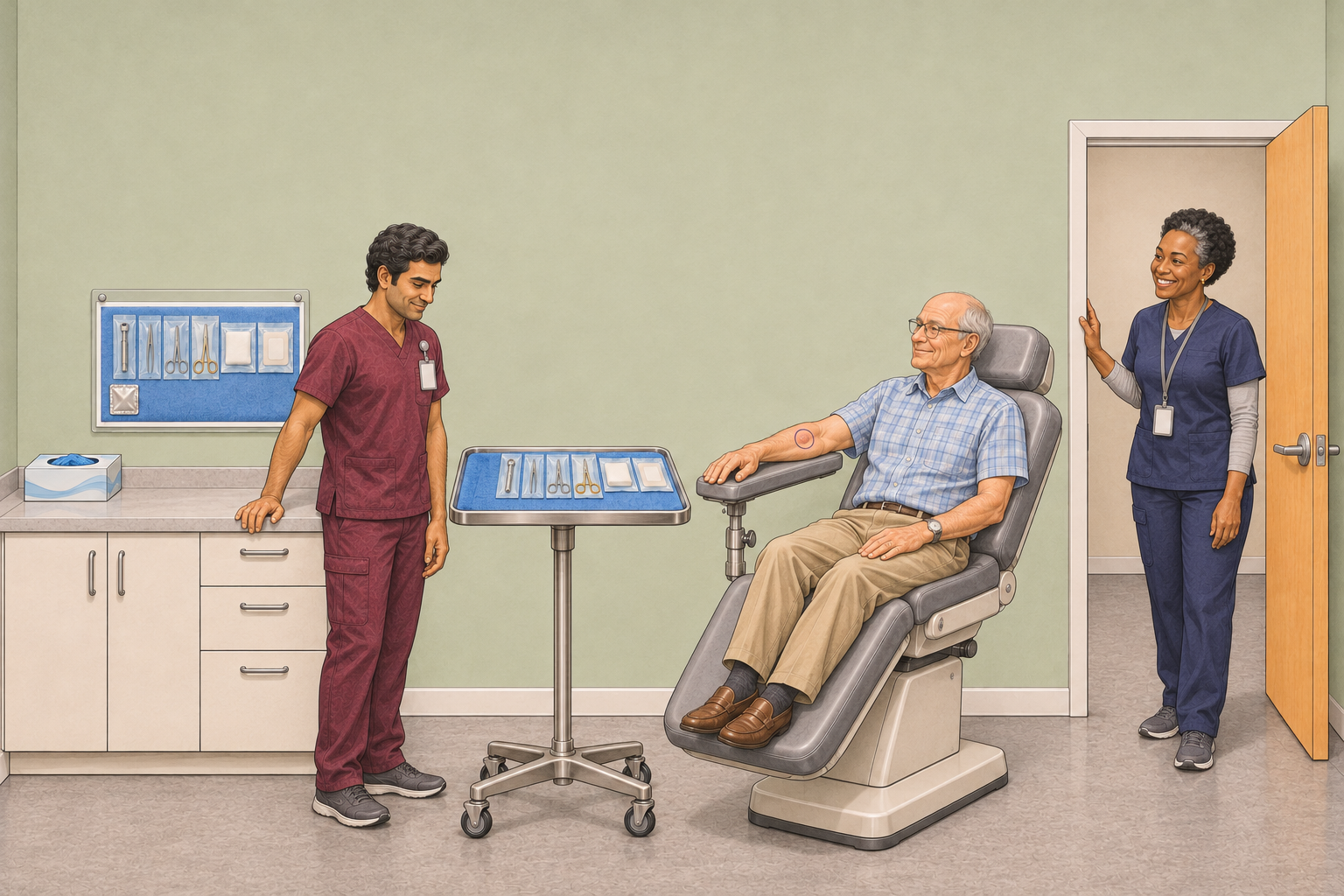 MA (thinking):Same setup as always.Lead:The doctor’s ready when you are.
Ready to call the doctor. The missing packet can still be added before she’s called, and nobody has spotted it yet. - The Mediocre ApproachThe action
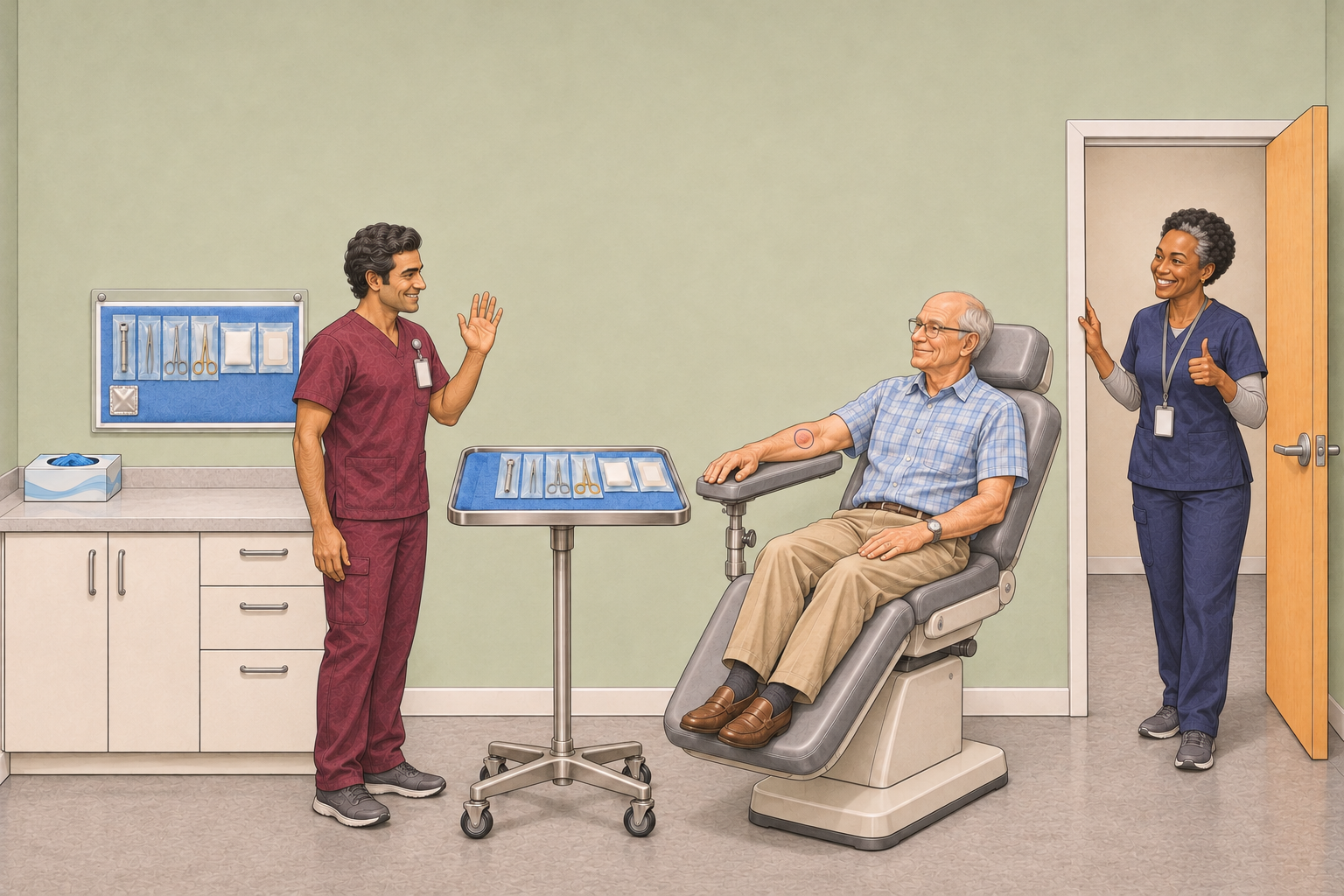 MA:All set in here!Lead:Looks good. I’ll send her in.
Waved through. From the door the tray looks complete, so the doctor is called in. - The Mediocre ApproachThe poor outcome
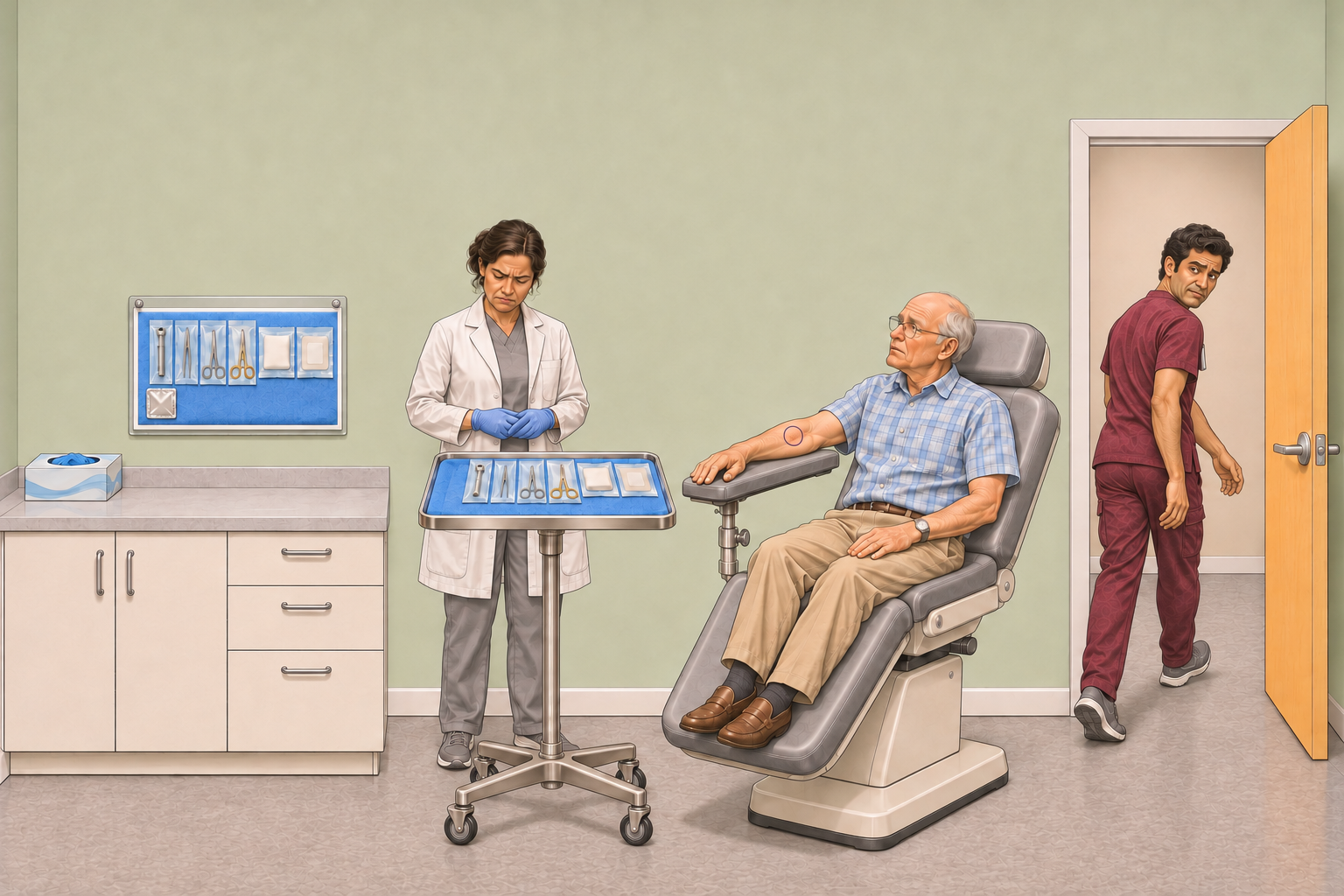 Doctor:Before we start: where’s the suture packet?Patient (thinking):Is something wrong?MA:Sorry! Getting one now.
The procedure waits. The doctor’s own check before starting finds no suture packet, so setup pauses while the MA goes for one and the patient wonders what’s wrong. Rewind. Same patient, same tray, same moment. This time, someone takes one last look before the doctor walks in.
- The Exceptional ApproachThe action: one last look
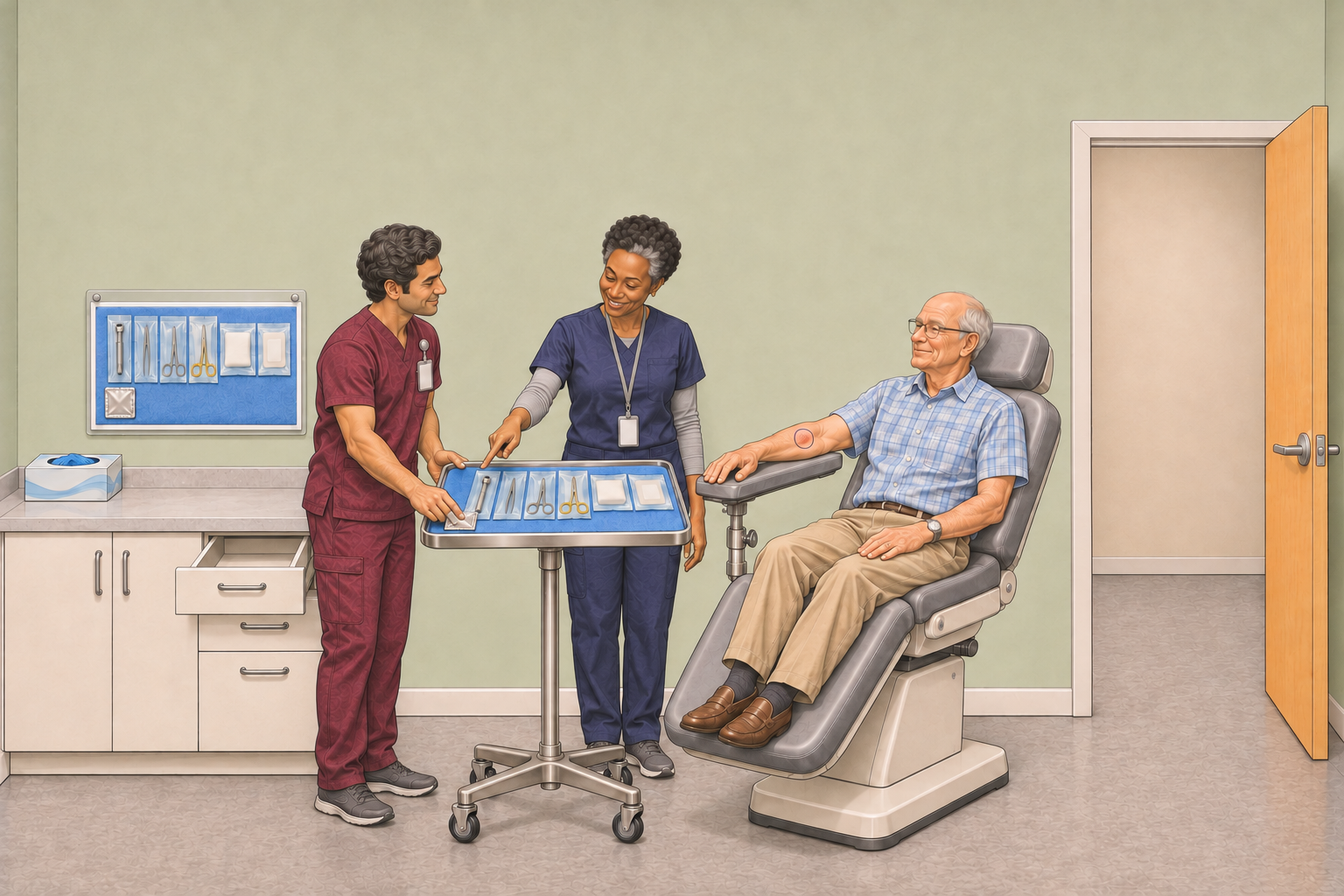 Lead:The punch and dressing match the plan.Lead:One thing: the suture packet.
One last look, against the setup photo. She names what matches the plan, then what’s missing, and the packet goes on the tray before the doctor is called. - The Exceptional ApproachThe exceptional outcome
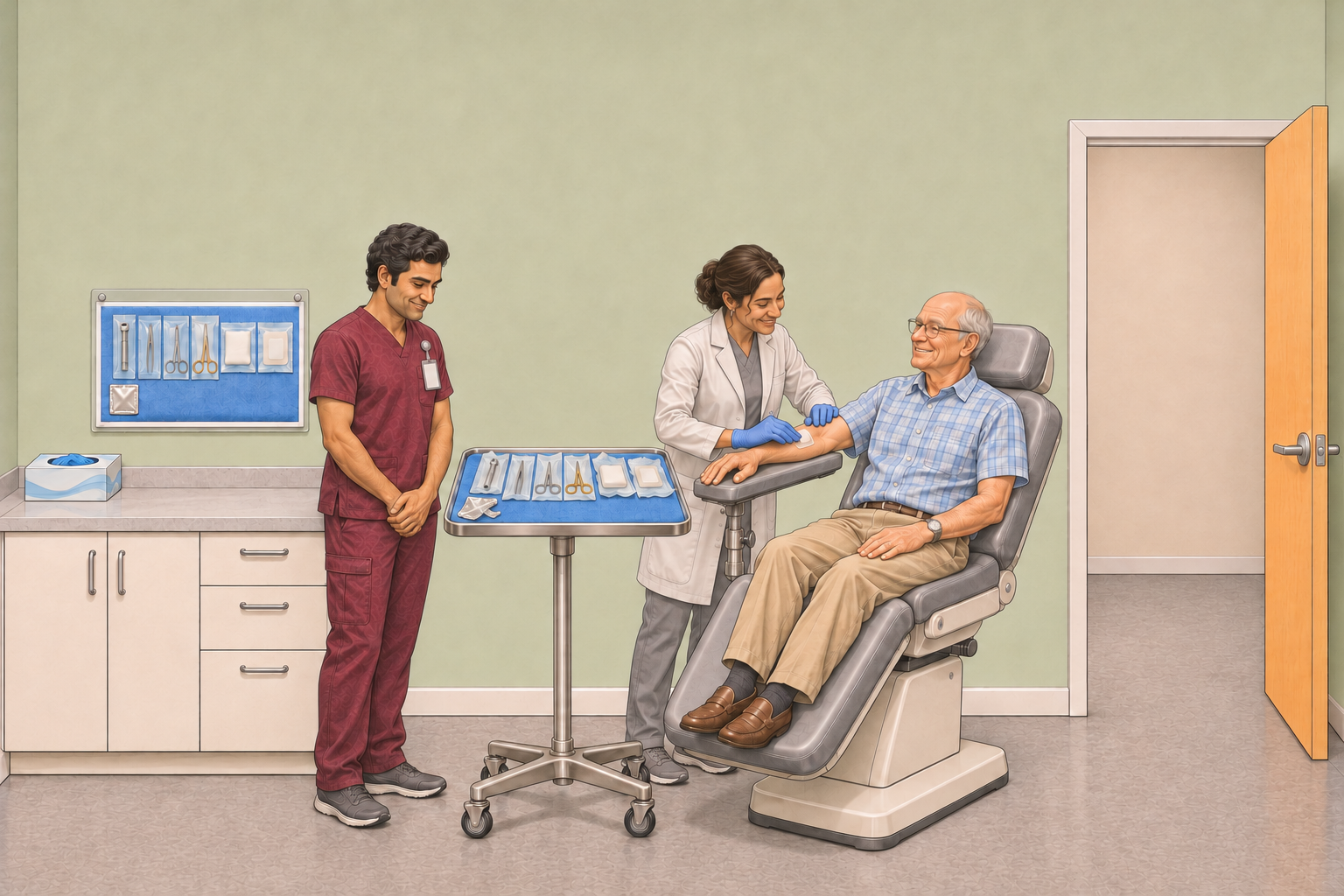 Doctor:All done. Everything was right here.Patient:Thank you. That was easy!
Ready before the doctor walked in. She found the setup her plan called for, and the patient is bandaged and on his way.
Example OneAt a glance
The ProblemThe dermatologist’s plan is a punch biopsy closed with a suture. The tray matches the clinician-approved setup photo, except the suture packet is missing, and the MA is about to call her.
The Mediocre ApproachWave it through
Action
Call the doctor in.
- A glance from the door: “Looks good”
- Nobody compares the tray with the setup photo
Poor outcome
The procedure waits.
- The doctor’s own check before starting finds no suture packet
- Setup pauses while the MA goes for one, and the patient worries
The Exceptional ApproachOne last look: check it against the setup photo
Action
Look before the doctor is called.
- The lead compares the real tray with the setup photo
- She names what matches the plan, then what’s missing
Exceptional outcome
Ready before she’s called.
- The suture packet goes on the tray before the call
- The doctor walks in to the setup her plan calls for
Example Two: The Patient Who Was “All Set”
- The Problem
At checkout, the doctor’s plan says skin-cancer surgery, but nothing is booked and the surgery request isn’t in yet.
 Front desk (thinking):Surgery… but no request and no date.Patient:So I’m all set?
Caught at the last pass. She’s still at the desk, so this is the easiest moment to settle the next step. - The Mediocre ApproachThe action
 Front desk:You’re all set! Scheduling will call you.Front desk (thinking):They always call.Patient:Wonderful, thank you!
“All set.” She leaves with a printout, no date, and nobody who owns the booking. - The Mediocre ApproachThe poor outcome
 Front desk:There’s no surgery request here. I’m so sorry.Patient:Three weeks. Nobody ever called me.
Three weeks later. No request, no date, no call. Now the clinic starts over while she waits and worries. Rewind. Same patient, same desk, same moment. This time, the desk takes one last look before she leaves.
- The Exceptional ApproachThe action: one last look
 Front desk:Before you go, let’s book your surgery.MA:Request’s in, from the doctor’s plan.Patient:The fourteenth works for me.
One last look before she leaves. The plan says surgery and the date is blank, so the MA enters the request from the doctor’s plan while she’s still here. - The Exceptional ApproachThe exceptional outcome
 Front desk:Welcome back! They’re ready for you.Patient:Right on the day you gave me.
Three weeks later, a different story. She walks in on the day she was promised, and nobody had to chase anything.
Example TwoAt a glance
The ProblemAt checkout, the doctor’s plan says surgery, but nothing is booked and the patient is about to leave.
The Mediocre Approach“You’re all set”
Action
Send her off with a printout.
- “Scheduling will call you”
- Nobody owns the booking
Poor outcome
Three lost weeks.
- No request, no date, no call
- She comes back worried, and the clinic starts over
The Exceptional ApproachOne last look: book it now
Action
Settle the next step at the desk.
- Is the next step booked, or owned by a named person?
- The MA enters the request from the doctor’s documented plan
Exceptional outcome
A date before she leaves.
- She leaves knowing when, and who to call
- She arrives on the day she was promised
Your clinic
More Passes to Check in a Clinic
Same pattern every time: a picture of ready, one last look before it moves on, and the fix made right there.
| At this pass | Who looks, against what | Fixed before it moves on |
|---|---|---|
| Phone messages: a message is about to go to the nurse | Whoever took the call, against a sample of a complete message kept by the phone | The patient’s exact question and a good callback time are in the note before the call ends |
| Open messages: portal and phone messages start turning yellow, then red, as they age | The lead, who watches for anyone stacking up reds | A nudge or an extra pair of hands goes to whoever is falling behind |
| Outside referrals: a referral packet is about to go out | The referral coordinator, against the receiving office’s short list | The question, the pathology report and contact details are attached before it’s sent |
| New staff: a new hire is about to handle a handoff alone | A trainer, watching one practice run | Specific praise and specific corrections, then the new hire goes solo |
Adapt the picture, the checker and the fix to your own team. Anything clinical still goes to a clinician.
Your move
Try It Today
Picture of ready. One last look. Fix it on the spot.
Try it for one week, at one pass. No new software, no budget, no committee.
- Pick one pass that keeps biting. For example, procedure rooms called ready with something missing, or patients who leave without a booked next step.
- Make a picture of ready. Photograph the clinician-approved setup for one planned procedure, or write down the three things the next person needs, and post it where the work happens.
- Name who takes the last look. One person looks before the handoff, every time, for the whole week.
- Praise first, then the fixes. Say exactly what’s right, name what’s missing, and fix it on the spot.
- Count the catches. Keep a tally with no patient details. At the week’s last huddle, fix the most common gap at its source.
Anything urgent still goes straight to the clinician.
The guest should never be the first one to check. Neither should your patient.
Explore the Evidence
8 sources · what each source is, what it found, what it supports here, and its limits
The Cheesecake Factory’s practices come from Gawande’s 2012 magazine account, in which the company’s Boston regional manager showed him a kitchen and Gawande reported that a kitchen manager was stationed at the pass in every restaurant, and from the company’s own descriptions (references 1 and 3; the annual report also says its restaurant general managers and executive kitchen managers average more than 15 years with the company). They are not an independent audit of every restaurant, and the 2012 details may not describe its kitchens today. Gawande’s account does not compare these practices with other restaurants’: the contrast in this chapter is a hypothetical kitchen with no look before pickup, and what stands out is the combination, precision and scale he described, not a claim that the company invented any of these tools. The solution comic shows the potato fix Gawande reported; the kitchen manager pointing to the photo on the screen illustrates the practice and is not a scene he described. Results from surgical checklists have varied: a program at eight hospitals was followed by fewer complications (reference 7), while adoption across 101 Ontario hospitals was not followed by a measured drop in deaths or complications (reference 8). The hospital studies tested whole programs, mostly with before-and-after designs, in settings very different from a dermatology clinic. The clinic examples and extra ideas are illustrations of the mechanism, not tested interventions. Status shows how each source was checked for this chapter’s accepted research package: HTML (complete public page captured), FILING (captured excerpt of the annual report), ABS (abstract and indexed record; no full text).
| Source | Type and context | Key finding | What it supports here | Material limitation |
|---|---|---|---|---|
| [1] · HTMLThe Cheesecake Factory: About Us (Made from Scratch)Codex (complete public HTML capture, 2026-11-09); accepted in independent review | Company webpage The company describing its own menu and kitchens | More than 250 menu items, made fresh and from scratch in each restaurant | The size of the kitchens’ job (the problem) | Self-description, not an audit; the desserts come from the company’s bakeries |
| [2] · HTMLGawande A. Big Med. The New Yorker, 2012Codex (complete public HTML capture, 2026-11-09); accepted in independent review; station, timer, rating and coaching details added in the independently accepted v1.2 package | Magazine reportage A surgeon and writer’s firsthand account of a Cheesecake Factory kitchen, published in 2012 | Station screens offered each order’s recipe and a photo of the finished plate; a timer turned from green to yellow to red, and managers sent a nudge or an extra pair of hands to stations stacking up red orders; at every restaurant, a kitchen manager at the counter where food came off the line checked food before pickup and rated it from one to ten (an eight needed one or two corrections; a six was redone); on one steak he praised the meat and grill marks, and the cook loosened a too-tight potato tower before the plate left; he praised as often as he corrected; an experienced cook worked from memory | The source case throughout: summary, sections 2 and 3, both strips and Figure 1 | A 2012 magazine account: the chain-wide practices were reported by Gawande and the company’s Boston regional manager, alongside one kitchen visit whose date is not stated; not a current audit of every restaurant; no comparison with other restaurants; no measured effect of any single practice |
| [3] · FILINGThe Cheesecake Factory Incorporated: 2025 Form 10-KCodex (captured excerpt; a full download was refused); accepted in independent review | Annual report to regulators The company’s own description of its operations, fiscal 2025 | Detailed procedures, standards and food-line management; recipe-management and kitchen-order systems; in-person and online training for hourly staff and managers; general managers and executive kitchen managers average more than 15 years with the company; two bakeries make the cheesecakes | Company context kept here: its procedures and standards, recipe and order systems, training, manager tenure and bakeries | Company self-report of its practices, not a measured effect |
| [4] · ABSStarmer AJ et al. Changes in medical errors after implementation of a handoff program. NEJM 2014Codex (abstract and indexed publisher excerpts); accepted in independent review | Before-and-after study A resident handoff program (a shared handoff format, training, observation and coaching) on pediatric inpatient units at nine hospitals; 10,740 admissions | Medical errors 24.5 to 18.8 per 100 admissions, a reported 23% relative reduction; preventable adverse events 4.7 to 3.3 per 100 admissions; oral handoffs 2.4 to 2.5 minutes per patient, not a significant change | Summary and evidence card 1: handoffs | No randomized comparison; a multifaceted program, so no single part can take the credit; units caring for children, not dermatology |
| [5] · ABSde Vries EN et al. Effect of a comprehensive surgical safety system on patient outcomes. NEJM 2010Codex (abstract and indexed record); accepted in independent review | Controlled before-and-after study A checklist covering the whole surgical path at six hospitals with high standards of care, with five comparison hospitals; 3,760 patients before and 3,820 after | Patients with at least one complication 15.4% to 10.6%; total complications 27.3 to 16.7 per 100 patients, a different count; no change in the five comparison hospitals | Evidence card 2: checks along the whole path | Not randomized; a comprehensive program, so no single check can take the credit; hospitals that already had high standards of care |
| [6] · ABSIvers N et al. Audit and feedback: effects on professional practice. Cochrane Database Syst Rev 2025Codex (full abstract via an indexed record; no full text); accepted in independent review | Systematic review of randomized trials 292 studies of audit and feedback; 177 in the main comparison of feedback with no feedback | Desired professional practice rose by a weighted mean of 6.2 percentage points (95% CI 4.1 to 8.2); the median across outcomes was 2.7 points (IQR 0.0 to 8.6); these are different summaries | Evidence card 3: feedback that leads to a fix | Professional-practice outcomes, not patient outcomes; co-interventions were common; searches ran through 2020 |
| [7] · ABSHaynes AB et al. A surgical safety checklist to reduce morbidity and mortality in a global population. NEJM 2009Codex (abstract and indexed record); accepted in independent review | Before-and-after study A surgical checklist program for noncardiac surgery at eight hospitals in eight cities; 3,733 patients before and 3,955 after | Inpatient complications 11.0% to 7.0%; deaths 1.5% to 0.8% | Context kept here: a checklist program followed by fewer complications | No randomized comparison; a program rather than the form alone; surgical inpatients, not dermatology clinics |
| [8] · ABSUrbach DR et al. Introduction of surgical safety checklists in Ontario, Canada. NEJM 2014Codex (abstract and indexed record); accepted in independent review | Natural experiment, before and after 101 hospitals that adopted surgical checklists; 109,341 procedures before and 106,370 after | Adjusted deaths 0.71% to 0.65% and complications 3.86% to 3.82%, not significant reductions | Counterevidence kept here: checklist adoption without a measured drop in deaths or complications | Adoption is not the same as using the checklist well; administrative data |
References
- The Cheesecake Factory. "About Us: Made from Scratch." Company webpage (undated). thecheesecakefactory.com/about-us.
- Gawande A. "Big Med." The New Yorker. 2012. newyorker.com/magazine/2012/08/13/big-med.
- The Cheesecake Factory Incorporated. Form 10-K for the fiscal year ended December 30, 2025. sec.gov/Archives/edgar/data/887596.
- Starmer AJ, et al. Changes in medical errors after implementation of a handoff program. N Engl J Med. 2014;371:1803–1812. doi.org/10.1056/NEJMsa1405556.
- de Vries EN, et al. Effect of a comprehensive surgical safety system on patient outcomes. N Engl J Med. 2010;363:1928–1937. doi.org/10.1056/NEJMsa0911535.
- Ivers N, et al. Audit and feedback: effects on professional practice. Cochrane Database Syst Rev. 2025;3:CD000259. doi.org/10.1002/14651858.CD000259.pub4.
- Haynes AB, et al. A surgical safety checklist to reduce morbidity and mortality in a global population. N Engl J Med. 2009;360:491–499. doi.org/10.1056/NEJMsa0810119.
- Urbach DR, et al. Introduction of surgical safety checklists in Ontario, Canada. N Engl J Med. 2014;370:1029–1038. doi.org/10.1056/NEJMsa1308261.
Explore the evidence · Try it today · Read the Cheesecake Factory Daily Brief · More lessons from The Exceptional Private Practice