Lessons from Adam Grant’s research · for dermatology practices
Don’t Just Say Their Work Matters. Let Them Meet Someone It Helped.
At a university call center, paid callers raised scholarship money from alumni, one rejection after another. Managers had tried speeches about the cause. Adam Grant’s team tried something else: one scholarship student, a few minutes, and the callers’ own questions. Your clinic has callers like these, and patients who could meet them.
What you’ll take away
- The problem
- Much of a clinic’s work happens out of the patient’s sight, so the people doing it rarely meet anyone it helped. A manager’s speech about why it matters is true, but no one it helped is saying it.
- What to remember
- Let the person the work helped deliver the message. Grant’s callers raised more after hearing from one real person the money helped, not after a leader’s speech or a letter alone.
- What to do differently
- When a patient volunteers thanks for unseen work, ask whether the manager may follow up. Later, with written consent, they meet only the staff who did it. They ask; the manager steps back.
30-Second Summary
- Work done out of sight hides its purpose. The callers Grant studied were low-paid, turned down by alumni call after call, and many soon quit.1 Managers had tried inspiring speeches about what the donations paid for. As Grant tells it, the trouble was not what the speeches said but who said them.2
- So his team brought in one person the money helped. In a 2007 study, two groups of callers read a scholarship student’s one-page letter, and a third group had no session. One of the two groups then spent about five minutes asking him about his classes, how he got the scholarship and his plans.3
- After meeting him, callers worked longer and raised more. A month later, their weekly phone time was 2.4 times what it had been, and their weekly donations 2.7 times. Callers who only read and discussed his letter barely changed.3
- The messenger matters. At another call center, a scholarship student’s talk about why the work mattered was followed by more money raised. Two leaders’ talks, rated about as inspiring, were not.4
- In your clinic: when a patient volunteers thanks for work done out of sight, ask quietly whether the manager may follow up. Later, with written consent, invite them to meet the staff who did it for a few minutes. Invite only those staff. Let them ask their own questions while the manager steps back.
The Problem
What Goes Wrong When People Never See Who Their Work Helps
Picture an evening shift at a university call center. A student caller works down a list of alumni, asking each one to give to a scholarship fund. Most say no. Some hang up mid-sentence. She marks the call and dials the next number.
Before the shift, a manager gave a short talk about the cause: scholarships open doors, and every dollar counts. Every word was true. By the tenth hang-up, it was hard to remember any of it.
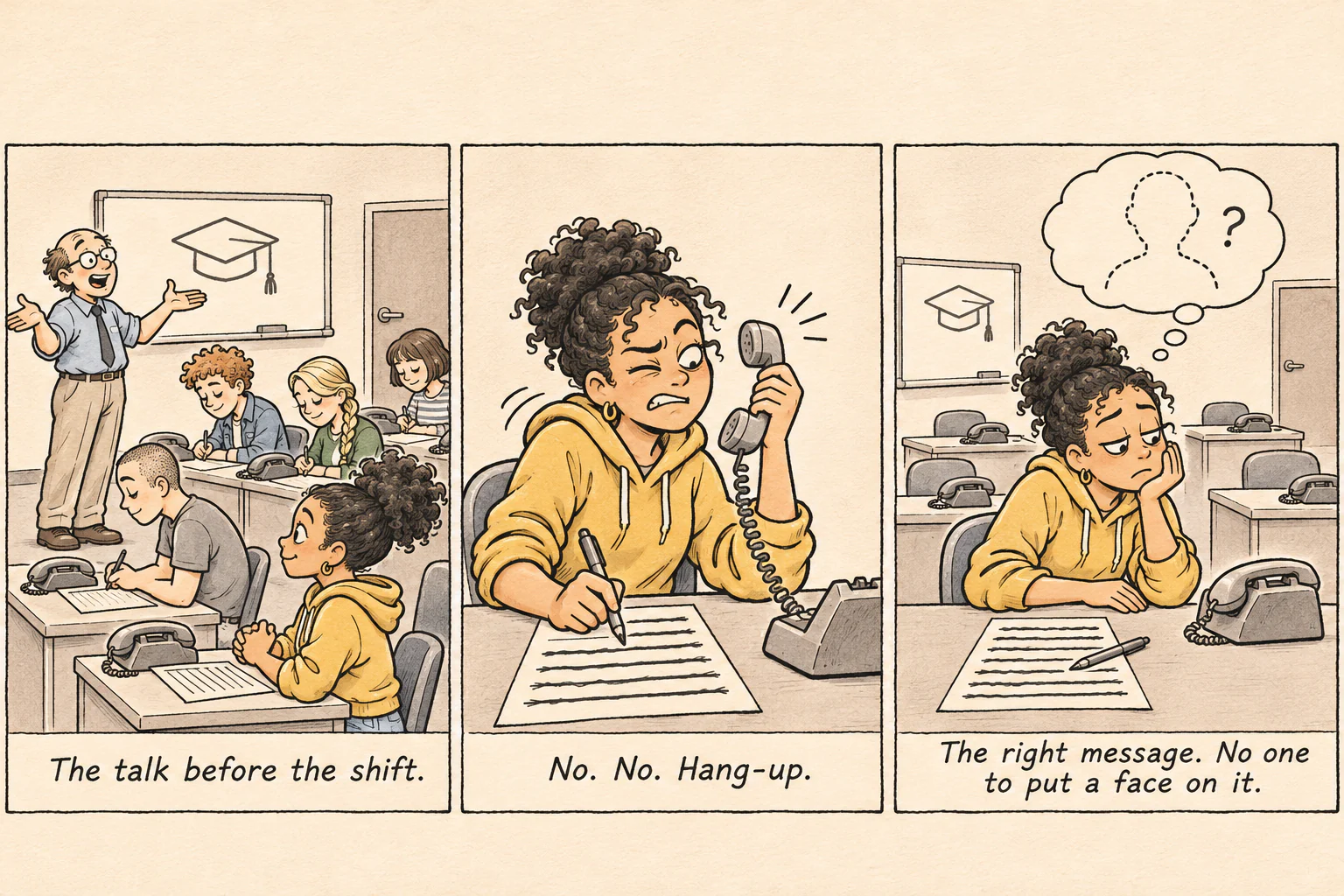
Nobody here is lazy. The caller does the work, and the manager believes the message. What’s missing is the person at the end of it: a student the calls will help, whom the caller never sees. She is asked to care about someone she has never met.
This was a real job. Knowledge at Wharton described the call-center work Grant studied as low-paid and heavy on rejection from alumni, with many people leaving and low morale common.1 In Adam Grant’s account, most callers at the center quit within two months, and managers had already tried inspiring speeches about what the donations paid for. His verdict: “the right message, but the wrong source.”2
A speech tells people their work matters. It can’t show them who it reached. The message was right. It came from the wrong person.
The Exceptional Solution
Grant’s Answer: Let Someone the Work Helped Deliver the Message
Grant’s team asked a simple question: what would happen if the callers heard from someone the work had actually helped?2 In a 2007 study at a university fundraising call center, they set it up like this:3
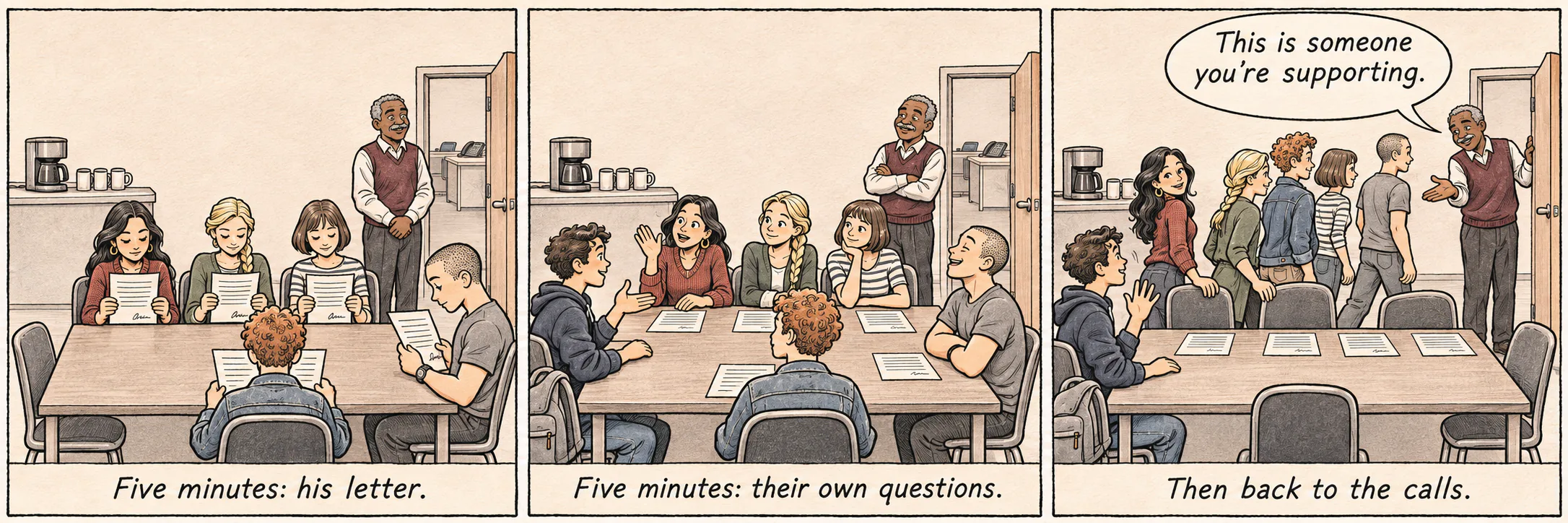
Bring in one real person. One scholarship student, a person the fundraising helped, came to the break room. A manager gathered callers in small groups of four to eight for ten minutes.3
Start with his own words. Callers in both session groups first spent five minutes reading a one-page letter from him.3
Then meet him, and ask. The callers in the meeting group spent about five more minutes with him, asking their own questions: about his classes, how he got the scholarship and his plans.3
Set it up, then step back. The manager closed each session with one line, telling the callers to keep him in mind during their calls: “this is someone you’re supporting.”3
Change only the meeting. The letter group got the same ten minutes, the same manager and the same letter, and talked it over among themselves without meeting him. A third group, the control, had no session at all.3
A month later, the difference showed up in the callers’ numbers. Those who met the student had gone from about 108 to 261 weekly phone minutes, and from $186 to $503 a week in donations: 2.4 times the minutes and 2.7 times the money.3 The callers who read the same letter, without meeting him, barely changed.3
The ProblemPaid callers ask alumni for scholarship money, hear no after no, and never meet a student the money helps.
The Mediocre ApproachA speech from the boss
Action
Tell them the work matters.
- A manager’s talk about what the donations pay for
- Nobody they helped ever comes into the room
Poor outcome
The message doesn’t stick.
- True words, hard to remember by the tenth hang-up
- In Grant’s account, most callers quit within two months2
The Exceptional ApproachGrant’s answer: meet one person it helped
Action
Bring in one person the work helped.
The Messenger Matters
Grant and David Hofmann then asked whether it mattered who delivered the message. At a university call center in the southeastern United States, two university leaders and one scholarship student each gave a talk of about ten minutes on why the work mattered, and the team followed 60 fundraisers for three months.4 Ten observers rated the three talks about equally inspiring.4 The student’s talk was followed by more money raised. The leaders’ talks were not.4
Laboratory follow-ups found the same message raised effort more when it seemed to come from someone it had helped than from a leader, because people were more suspicious of the leader’s motives.4 Leaders still have a part: in a later call-center study, meeting the people the work helped made leaders’ inspiring vision count for more in sales and revenue.5 The leader frames the purpose. The person helped brings it to life.
What Made It Work
One real person. Not a statistic or a slogan: a student with classes, a scholarship and plans of his own.3
The callers’ own questions. They asked what they wanted to know, face to face.3
A manager who stepped back. One closing line, and the student did the rest.3
The call center in our first story had a speech. Grant’s team brought in a person, and the callers met the reason for the calls.
The mechanism
Why It Works
A speech and a meeting can carry the same message. Each part of the meeting does a different job: a real person makes the impact visible, knowing what they needed makes it matter, the right messenger makes it believable, and talking it over together makes it the team’s own.
Tap or click a card to see why it works.
-
Show the impact, in person.
A short, respectful conversation.3
Why it works
- Small talk, real change. In a laboratory version, a person posing as the author of the cover letters students were editing chatted with each of them for about four minutes, and they kept working longer.3
- Impact you can feel. The extra effort ran through how much the students felt their work made a difference.3
- Respect both ways. At the call center, the manager rated the student 7 out of 7 for respectfulness, and the callers 6.3
-
Show the need, not just the face.
What the help made possible.3
Why it works
- Need plus a face. In another laboratory version, students who saw the person and also read that he needed the job to stay in school worked the longest: about 30 minutes, against 26 to 27 in the other groups.3
- The need does the work. When he simply sat in the room and students did not know his need, they worked no longer.3
- In a clinic, that means the patient says what the help made possible, in their own words.
-
Let the person helped say it.
The same words, a more believable messenger.4
Why it works
- Same message, different messenger. In laboratory studies, an inspiring message raised effort more when it seemed to come from someone it had helped than from a leader.4
- Less suspicion. People were more suspicious of the leader’s motives.4
- Leaders still frame it. In another call-center study, meeting the people helped made leaders’ inspiring vision count for more in sales and revenue.5
-
Talk it over together.
Real words, read and discussed.6
Why it works
- Stories, read together. In a 2008 study, callers who read two scholarship students’ own written stories and talked about each one were bringing in over twice their earlier weekly pledges and money a month later.6
- Time to talk. Those sessions gave five minutes to read and five minutes to discuss each story.6
- One letter alone barely moved them. In the 2007 study, callers who read and discussed the student’s single letter barely changed.3
The evidence
The Results, and Where Else It Works
Grant’s team tested the idea more than once: meeting the person,3 hearing the message from the person helped,4 and reading real people’s own stories together.6 Organizations have done their own versions. Grant wrote about Medtronic’s annual holiday party, where six patients described to employees what its products had meant for them, and John Deere inviting farmers buying their first tractor to the factory, where the employees who built it presented each farmer with a gold key.8 A mail-order pharmacy Grant worked with had its pharmacists spend time in regular pharmacies, meeting customers.1 Flip each card for the result and the lesson to take home.
Tap or click a card to flip it.
-
2.7 times the weekly donations of callers who met one scholarship student, a month later, compared with before
- The meeting: Callers read his letter, then spent about five minutes asking him their own questions.
- What was counted: The money each caller raised in a week, before and a month after.
Exceptional results3
$186 → $503 raised per caller each week, before vs a month after
- Callers at a university call center met one student their fundraising helped.
- A month later, each caller’s weekly donations were 2.7 times what they had been, and weekly phone time 2.4 times.
Valuable lesson: Let your team meet one real person their work helped.
Source: Grant et al., Organ Behav Hum Decis Process 2007 · evidence row 3
-
About 4 times as much money raised in two weeks by the 18 fundraisers who heard a scholarship student’s talk on why their work mattered
- The messenger: A scholarship student, not a university leader, explained why the work mattered.
- What was counted: The money each fundraiser raised in the two weeks before and after.
Exceptional results4
$2,459 → $9,705 average for the 18 who heard him, two weeks before vs after
- At a university call center, a scholarship student gave the fundraisers a short talk on why their work mattered.
- The 18 fundraisers who heard the student raised about four times as much in the next two weeks.
Valuable lesson: Let the person helped say why the work matters; the boss sets it up.
Source: Grant and Hofmann, Organ Behav Hum Decis Process 2011 · evidence row 4
-
More than twice the weekly pledges of callers who read and talked about two scholarship students’ own stories, a month later
- The stories: Callers read two short stories written by scholarship students, then talked about each one.
- What was counted: Pledges and money each caller brought in per week, before and a month after.
Exceptional results6
9 → 23 average weekly pledges per caller, before vs a month after
- Callers spent 20 minutes reading and discussing two real students’ stories.
- A month later, the money each raised in a week went from $1,288 to $3,131.
Valuable lesson: When you can’t meet the patient, read their own words together.
Source: Grant, J Appl Psychol 2008 · evidence row 6
Your dermatology clinic
Bringing It Home to Your Dermatology Clinic
Much of a dermatology clinic’s work happens where patients never see it. A prior-authorization specialist wins an appeal for a biologic. A referral coordinator chases the pathology report so a Mohs case can be booked. A scheduler finds an opening that week. A biller sets up a payment plan. Then the patient goes home, and the person who did the work moves on to the next call. They are the callers. Your patients are the students.
Catch the thanks no one asked for: when a patient, unprompted, thanks the clinic for something done out of sight, whoever hears it thanks them and asks quietly whether the practice manager may follow up in private. If the patient says yes, they note only that request, and who did the work, in the clinic’s approved private record. Nothing about the patient’s care is written at the desk. Never ask for thanks on the day of a procedure or while a result is pending.
Ask later, with care: the practice manager or another staff member who isn’t treating the patient follows up privately and asks whether they would be willing to meet the people who did the work for a few minutes. Ask for specific written consent, for the meeting or for sharing a note, that says what will be shared, with whom, and that they can say no or change their mind at any time. Saying no changes nothing about their care.
Invite only the people who did the work: the scheduler who found the slot, the specialist who won the appeal, the front-desk staffer who heard the thanks. The story never goes on a staff-wide board, a group chat or an all-staff email.
Let the patient talk and the team ask: five minutes is enough. The patient says what the help made possible. The staff ask their own questions. The manager adds one sentence about why this work matters, then steps back.
When a meeting can’t happen, read their words together: with written consent to share each note, the same staff read two patients’ own notes and talk about each one for a few minutes, the way Grant’s callers read and discussed two students’ stories. Any printed copy stays in the room and goes back to the manager afterward, under your clinic’s protocol.
Clinical decisions stay clinical: schedulers follow the clinicians’ written rules for urgent visits, and clinicians, not coordinators, give results. The meeting is about the work. It never changes who decides.
Here’s how that plays out in two everyday moments. Each one starts with the problem, follows the mediocre approach to its outcome, then rewinds to the same moment for the exceptional approach: the patient’s own words, brought to the people who did the work.
Example One: A Thank-You for Someone She Never Met
- The Problem
At checkout, a patient offers her thanks unprompted: she asks the front desk to thank “whoever fought my insurance.” The prior-authorization specialist who spent three weeks on that appeal sits thirty feet away and has never met her.
 Patient:Please thank whoever fought my insurance. I finally sleep through the night.Front desk (thinking):That was Dana’s appeal. Line two is blinking.
Thanks no one asked for. The person who did the work is down the hall, and right now her thanks is easy to catch. - The Mediocre ApproachThe action
 Front desk:Aw, that’s so nice! I’ll pass it along.Front desk (thinking):I’ll tell Dana at lunch.
“I’ll pass it along.” No one asks to follow up, so her thanks stays at the desk. - The Mediocre ApproachThe poor outcome
 Prior auth (on the phone):Yes, I’ll hold. Again.Prior auth (thinking):Another denial. Does anyone even see these?
Two weeks later. The thanks never arrived. Dana is on hold for the next appeal, and she has never heard what the last one did. Rewind. Same patient, same moment, same thank-you. This time, the words reach the person who did the work.
- The Exceptional ApproachThe action: bring the person to the work
 Front desk:Thank you. May our practice manager call you privately to follow up?Front desk:Only if you’d like. Saying no changes nothing about your care.
Ask before anything goes further. She asks quietly whether the manager may follow up, and notes only that request in the clinic’s secure record, so the thanks can reach Dana. - The Exceptional ApproachThe exceptional outcome
 Prior auth:Can I ask what changed for you?Patient:I can work a full day again. Thank you for not giving up.
A month later, five minutes. With written consent, the patient meets the specialist who won her appeal and the front-desk staffer who heard her thanks. Dana asks her own question, and the manager set it up and stepped back.
Example OneAt a glance
The ProblemAt checkout, a patient offers her thanks unprompted: she asks the front desk to thank “whoever fought my insurance.” The prior-authorization specialist who worked the appeal has never met her.
The Mediocre ApproachPass it along, someday
Action
Say thanks, ask nothing.
- “Aw, I’ll pass it along!”
- Nobody asks to follow up or notes who did the work
Poor outcome
The thanks never arrives.
- Two weeks later, Dana is on hold for the next appeal
- She has never heard what the last one did
The Exceptional ApproachClose the loop: ask first, follow up privately
Action
Ask, then follow up with care.
- A quiet question: may the manager call her privately?
- Only that request, and who did the work, in the secure record; later, a short meeting with written consent
Exceptional outcome
She hears it from the patient.
- A month later, five minutes with the specialist and the front-desk staffer
- Dana asks her own question; the manager steps back
Example Two: “Great Job, Team!” to Sixty Inboxes
- The Problem
A patient who drove two hours for Mohs surgery writes to thank “the people who got me in so fast.” The practice manager has typed “Great job, team!” and is about to forward it to all sixty staff.
 Manager (thinking):Lovely. Everyone should see this.
A thank-you with a name and a surgery in it. Two people did this work. Nothing has been sent yet. - The Mediocre ApproachThe action
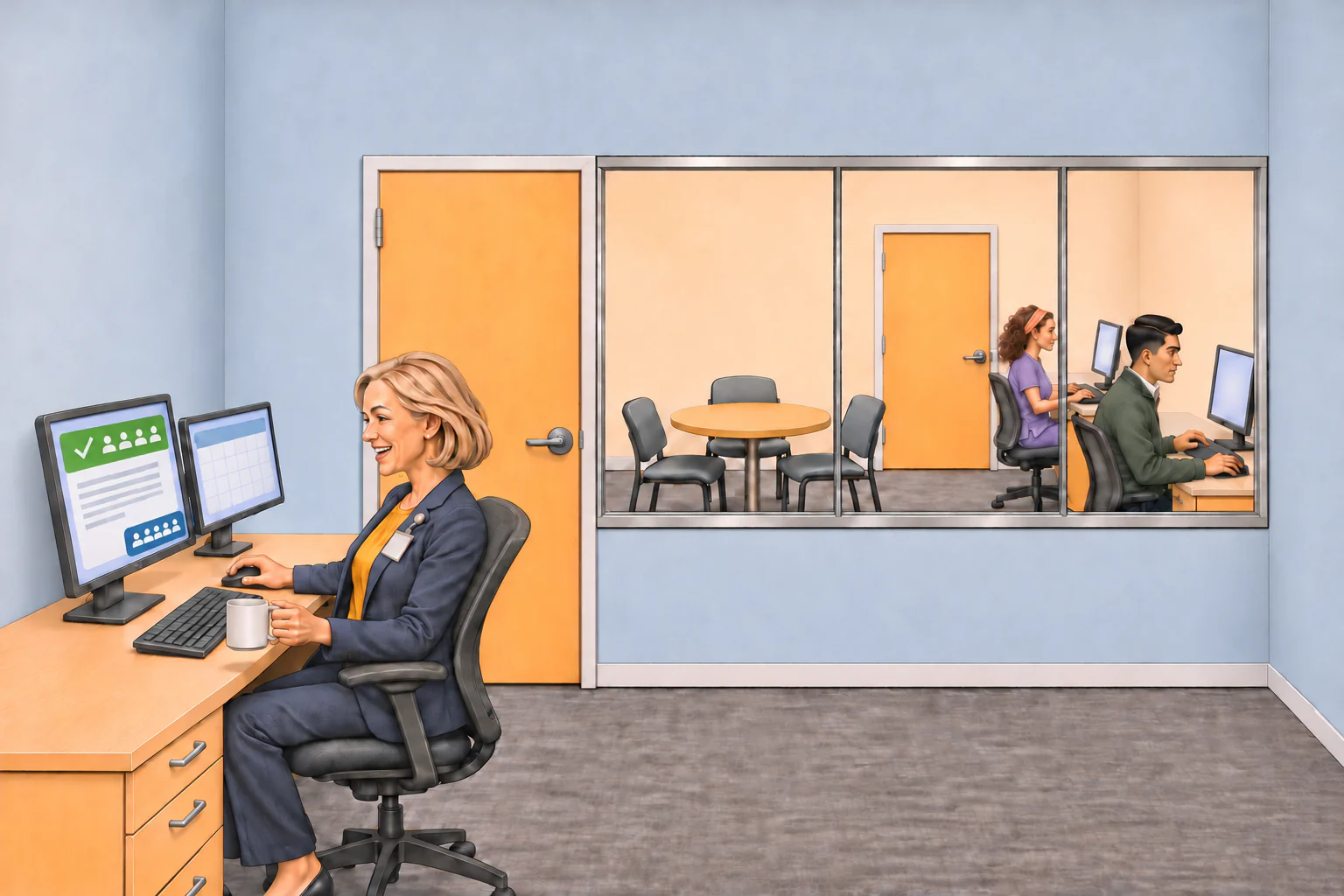 Manager:Sent! That should make everyone’s day.Manager (thinking):Done. Next, the holiday schedule.
Sent to everyone, from the boss. Her thank-you becomes one more all-staff email, with her name and her surgery in sixty inboxes. - The Mediocre ApproachThe poor outcome
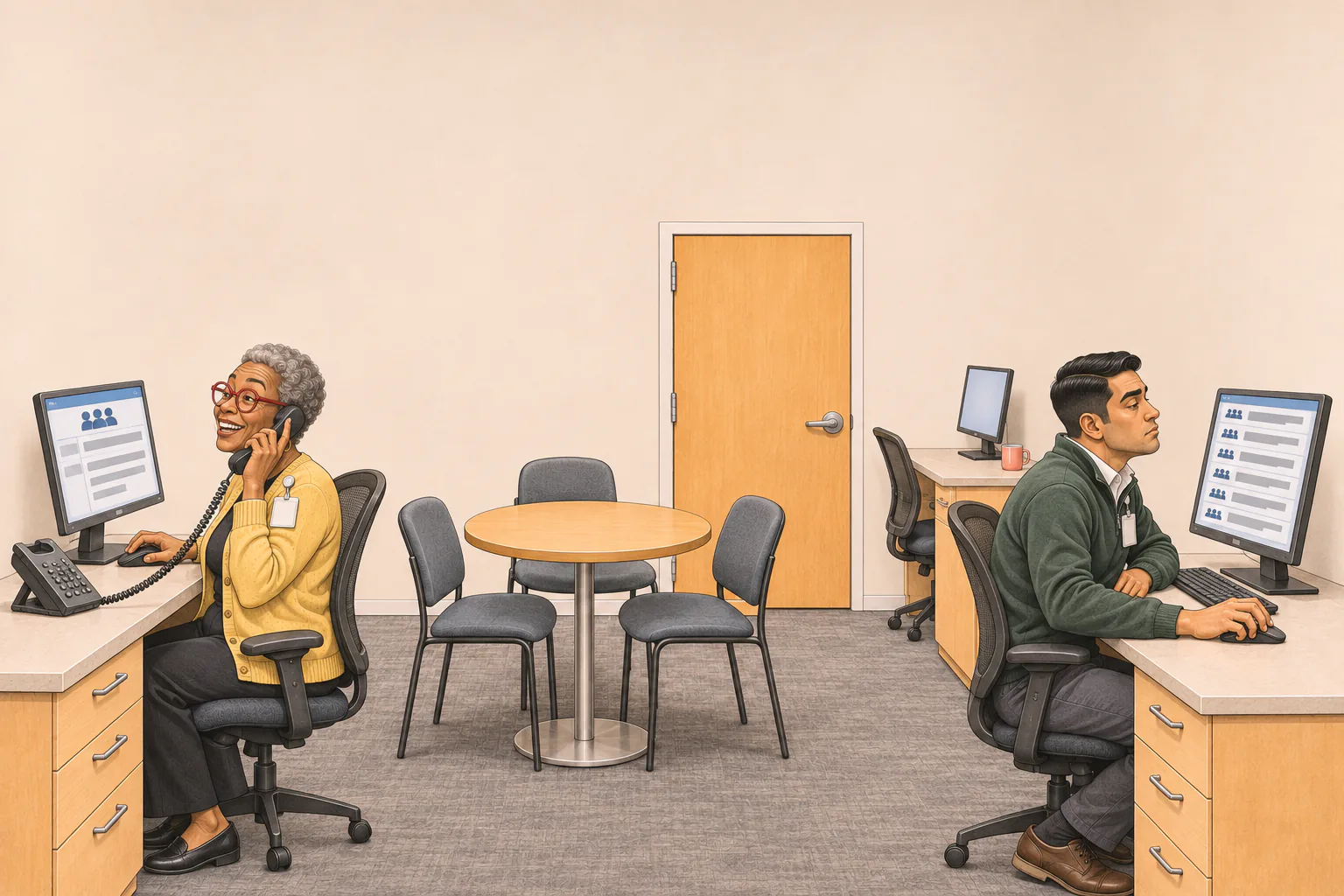 Biller (on the phone):Oh, you’re the one with the lovely surgery email!Coordinator (thinking):Another all-staff. Later.
Two days later. A biller covering the phones, who had no part in her care, brings up her surgery. The patient asks, “Everyone read that?” The coordinator who did the work scrolled past it as one more all-staff email. Rewind. Same patient, same moment, same thank-you. This time, her words go only to the people who did the work, and only with her yes.
- The Exceptional ApproachThe action: bring her words to the people who did the work
 Manager (thinking):Who did this? Luis chased the report. Kim found the slot.Manager (typing):May we share your note with the two people who arranged your surgery?
Find the two people who did it, and ask her first. The task log names the coordinator and the scheduler. She asks the patient before anyone else reads it. - The Exceptional ApproachThe exceptional outcome
 Manager:This is who that scramble was for.Coordinator:She drove two hours because we got her in that week?Scheduler:I booked her. I never knew how far she came.
The next Monday, ten minutes. With consent, the two people who did the work read her note, and one from another patient they helped, and talk about each. The manager says one sentence, then listens.
Example TwoAt a glance
The ProblemA patient who drove two hours for Mohs surgery writes to thank “the people who got me in so fast.” The manager is about to forward it to all staff with “Great job, team!”
The Mediocre ApproachEveryone hears it, from the boss
Action
Forward it to all staff.
- “Great job, team!” to sixty inboxes
- Her name and her surgery reach people who never cared for her
Poor outcome
The wrong people, the wrong messenger.
- A biller covering the phones, with no part in her care, brings up her surgery
- The coordinator who did the work scrolls past it
The Exceptional ApproachClose the loop: the right two people, her own words
Action
Find who did it, then ask her.
- The task log names the coordinator and the scheduler
- “May we share your note with the two people who arranged your surgery?”
Exceptional outcome
Her words reach the people who did it.
- With consent, the two read her note and one from another patient they helped
- The manager adds one sentence, then listens
Your clinic
More Ways to Close the Loop in a Clinic
Same pattern every time: the person the work helped, brought to the people who did it, with consent, in their own words.
| When the impact shows up | Who brings it, and to whom | Closed when |
|---|---|---|
| On the phone: a patient calls back: “Whoever found me that earlier appointment, thank you.” | The scheduler who hears it asks whether the manager may follow up and notes that request in the approved record; the manager later asks the patient about meeting the scheduler who found the slot | The scheduler hears it from the patient, not from a memo |
| In the Mohs lab: the lab technician who processes every Mohs layer never meets a patient | The manager, when a consenting Mohs patient comes back to thank the staff behind the scenes, invites the technician who processed that patient’s layers | She hears from a patient whose layers she processed |
| In billing: the billing team hears from patients only when something has gone wrong | The billing lead asks the manager to invite, once a quarter, a patient who offered thanks for a payment plan to meet the billers who set it up | Five minutes, with written consent, with only those billers |
| At the team meeting: the agenda says, “Why our work matters: manager, ten minutes.” | The manager moves those minutes to a five-minute meeting between a consenting patient and only the staff who did her work, and adds one sentence | The patient did the talking; her team asked the questions |
Adapt it to your team. Patients are asked later, by someone not treating them, and share only what they choose. Anything clinical still goes to a clinician.
Your move
Try It Today
Catch the thanks. Bring the person. Step back.
Try it for one month, with one moment of thanks. No new software, no budget, no speech to write.
- Listen for thanks no one asked for. This week, when a patient thanks the clinic for something done out of sight, whoever hears it asks quietly whether the practice manager may follow up, and notes only that request, and who did the work, in the clinic’s approved private record.
- Ask later, and gently. The practice manager, not the treating clinician, follows up privately and asks whether the patient would be willing to meet those staff for five minutes. Use a short written consent that names the meeting. No means no, and their care stays exactly the same.
- Invite only the people who did the work. The scheduler, the specialist, the front-desk staffer who heard it. No staff-wide board, no group chat.
- Let the patient talk and the team ask. The manager says one sentence about why the work matters, then steps back.
- If a meeting can’t happen, read their words together. With written consent to share each note, the same staff read two patients’ own notes and talk about each one.
Anything urgent still goes straight to the clinician. Patient stories are shared only with written consent, and only with the staff who cared for that patient.
Every booking, appeal and callback reaches a person. Let the people who did the work meet them.
Explore the Evidence
14 sources · what each source is, what it found, what it supports here, and its limits
This chapter is built from Adam Grant’s research on contact with the people one’s work helps, and each study is kept separate. The 2007 call-center experiment (reference 3), the 2008 written-story experiments (reference 6), the separate 2008 contact study (reference 9) and the 2011 messenger study (reference 4) involved different callers, designs and durations, and their numbers are never combined. The 2007 experiment had 39 callers at one university, with one scholarship student as the only beneficiary. The 17 callers who met him were not individually randomized: they were simply the callers whose shifts overlapped the four periods he was there, while callers in other slots were randomly split between the letter group and the no-exposure group. Grant’s later popular chapter (reference 2) describes the split as random; the paper governs here. The session lasted ten minutes in all, five reading his letter and about five with him, not a five-minute meeting. The figures used on the page (107.55 to 260.73 weekly phone minutes; $185.94 to $503.22 in weekly donations) are raw averages for the contact group, measured in one-week windows two weeks before and one month after, with large variation; the paired tests included 16 of the 17 callers. The letter and no-exposure groups showed no significant change, which in groups of 12 and 10 is not proof that they did not change at all. Compared directly with the no-exposure group, the gain in phone time was borderline (p = .07) and the gain in money firmer (p = .02). The laboratory experiments in the same paper used university students editing cover letters, with an actor as the beneficiary, and measured persistence, not clinical safety or patient outcomes; Knowledge at Wharton’s rounding to about 20% more time is larger than the table, which implies roughly 13% to 18%. In the 2011 messenger study (reference 4), fundraisers were not assigned to speakers at random, and the scholarship student always spoke a week after the second leader, so speaker and timing overlap; the authors adjusted for trends over time, and fundraisers who did not hear the student also rose somewhat ($2,775.33 to $3,790.67, not significant). The laboratory finding about suspicion is not a rule that leaders are untrustworthy or that patients should replace managers. The 2012 leadership study (reference 5) was read as an abstract only. The written-story study (reference 6) assigned 33 callers by drawing names from a hat; 12 were in the scholarship-story group, and the paper reports low power (.40 and .41) for its key tests. It tested two stories read and discussed in a 20-minute session and is not a direct comparison with a live meeting, a single letter, video or clinic patient stories. Across these small studies the evidence on format is mixed: one letter read and discussed left callers’ numbers flat in 2007, two stories read and discussed were followed by gains in 2008, and the 2008 contact study could not separate hearing from the beneficiary from hearing in person. Nothing here shows that one format beats another in a clinic, and video was not tested. The 406% gain Grant cites in his chapter (reference 2) comes from the separate 2008 contact study (reference 9): 23 callers working one Wednesday shift met a fellowship student in a 15-minute visit, and their average weekly donations went from $411.74 to $2,083.52. That study was not randomized and its variation was very large, so the figure is a within-group gain in one small study, not a randomized estimate of what a meeting does and not a forecast for a clinic. Grant also writes that his team saw the call-center result five times over; that count is his account. The hospital study (reference 7) changed the wording of hand-hygiene signs; it is framing, not contact with a patient, so it is kept here rather than in the teaching text. Signs that pointed hand hygiene at patients’ protection were followed by more soap and gel used and more observed hand cleaning, while signs about staff’s own protection were not (row 7). Its clinic counterpart, rewording a sink sign to name the patient it protects, is likewise a framing practice and is noted here, not taught as beneficiary contact. Its first measure is the share of soap and gel used from each dispenser, not the share of staff who cleaned their hands; its second is hand cleaning seen by covert observers on eight units. Each experiment lasted two weeks in one hospital, with no measure of infections or deaths, and the authors note that such effects often fade and suggest rotating messages. The rise was clear for physicians, marginal for nurses and absent for ancillary staff such as technicians and transporters, which does not prove a sign cannot work for them. The main independent field test (references 10 and 11) found that volunteer nurses assembling surgical kits worked longer, made more kits and made fewer errors after meeting health practitioners from the area the kits were for. The beneficiaries were practitioners, not patients; one of them worked alongside the nurses through a six-day shift; and productivity and error rate are separate outcomes. Counterevidence and cautions: a cluster-randomized study of U.S. federal employees (reference 13) found no effect of beneficiary contact on how much impact employees felt, with a small positive effect on feeling valued, and its abstract reports no performance outcome. A 2008 radiology conference abstract (reference 12) reported more empathy with patient photos attached, but the photos also carried clinical information, and its outcome was the reporting of incidental findings, not diagnostic accuracy. A review co-written by Grant (reference 14) notes that close contact with suffering can bring distress and that a sense of helping can be used to excuse unwise choices; this is one reason the clinic advice keeps meetings voluntary and chooses stories in which the team’s help made a difference. Most of the evidence comes from small studies by Grant’s own group, and the longest follow-up in these field studies is one month. The Medtronic and John Deere accounts (reference 8) are Grant’s descriptions from about 2013, with no outcome data and no confirmation that either continues. The mail-order pharmacy (reference 1) reported no outcomes, and its customer-photo practice is not recommended here. Grant’s origin story (references 1 and 2) is his own recollection. The call-center scenes at the start of the story and both comic strips are hypothetical sketches: the strips’ student, callers and managers are drawn figures, not the people in the studies. No source here tested beneficiary contact in a dermatology clinic or in back-office health care roles, and no performance, retention, patient-safety or clinic benefit is established. The two clinic examples, the extra ideas and the Try It Today plan are illustrations of the mechanism, written for this chapter with fictional people, not observed events or tested interventions. The consent and privacy steps are sensible defaults, not legal advice; a practice’s privacy officer should confirm them before use. Status shows how each source was read: HTML (web page), ABS (abstract) or FULL (full text).
| Source | Type and context | Key finding | What it supports here | Material limitation |
|---|---|---|---|---|
| [1] · HTMLKnowledge at Wharton. Putting a Face to a Name: The Art of Motivating Employees. 2010 | Business-school publication Knowledge at Wharton, the Wharton School’s own outlet, describing Grant’s research in February 2010 | Described the call-center job Grant studied as poorly paid and full of rejection by alumni, with frequent quitting and morale that often suffered; reported the 2007 contact group’s weekly averages of $185.94 before and $503.22 after; carried Grant’s account of the Let’s Go travel guides, where roughly two hundred office staff never dealt with the people who read the guides; reported a mail-order pharmacy that had staff pharmacists occasionally work in regular pharmacies to meet customers | The problem (summary, section 1) and the pharmacy example (section 4); Grant’s Let’s Go origin account is kept here for the record | Published by the outlet of Grant’s own employer; a popular account with no sample sizes; read from an Internet Archive capture because the live page refused automated access; the pharmacy example reports no outcomes, and its customer-photo practice is not recommended here without a separately reviewed privacy protocol; its rounding of a laboratory result to about 20% more time is larger than the table supports |
| [2] · FULLGrant AM. Work and the Art of Motivation Maintenance. Author manuscript of a book chapter, c. 2013 | Author’s first-person book chapter Grant’s own popular telling, posted as a manuscript on his faculty site | For his undergraduate thesis Grant collected survey answers from travel-guide editing teams alongside their managers’ ratings of each team; perceived positive impact on others was the most consistent predictor of success; at the call center, most callers quit within two months and managers had already tried inspiring speeches about what the donations funded, which he diagnosed as a problem of messenger rather than message | The problem and the call-center story (summary, sections 1 and 2, the comparison); his thesis survey is kept here for the record | The author’s retrospective account, not an experiment or an independently verified employment history; it describes the 2007 callers as randomly divided into three groups, which the 2007 paper qualifies (reference 3); its statement that the effect was replicated five times is the author’s count, not five independently documented studies |
| [3] · FULLGrant AM, Campbell EM, Chen G, Cottone K, Lapedis D, Lee K. Impact and the art of motivation maintenance. Organ Behav Hum Decis Process 2007 | Peer-reviewed field experiment, with two laboratory experiments 39 paid callers (17 contact, 12 letter, 10 no exposure) at a U.S. university fundraising call center; 30 and 122 students in the laboratory | A manager gathered groups of four to eight callers for a 10-minute session: 5 minutes reading one scholarship student’s letter, then, for the contact group, about 5 minutes of questions with him; contact-group weekly phone minutes went from 107.55 to 260.73 and weekly donations from $185.94 to $503.22, 2.42 and 2.71 times the earlier levels; the letter group (143.29 to 147.05 minutes; $251.67 to $254.18) and the no-exposure group showed no significant change; the manager rated the student 7 and the callers 6 out of 7 for respect. In the laboratory, about 4 minutes of small talk with the letters’ supposed author raised persistence through perceived impact; his silent presence raised persistence only when students also knew his need (30.49 against 25.76 to 27.04 minutes) | Summary, the solution steps and results (section 2), mechanism cards 1, 2 and 4, results card 1 | Small sample at one site with one beneficiary; the contact group was formed by which shifts the student attended, so selection differences are possible, and only the letter and no-exposure groups were randomly split; paired tests used 16 of 17 contact callers; large variation (contact-group donation SD $267.70 before, $294.70 after); measured in one-week windows a month apart; against the no-exposure group the phone-time gain was borderline (p = .07) and the money gain firmer (p = .02), and post-session minutes did not differ significantly in the corrected comparisons; laboratory tasks used students and an actor and measured persistence, not clinical safety, retention or patient outcomes |
| [4] · FULLGrant AM, Hofmann DA. Outsourcing inspiration: the performance effects of ideological messages from leaders and beneficiaries. Organ Behav Hum Decis Process 2011 | Peer-reviewed field quasi-experiment, with laboratory experiments 60 fundraisers at a university call center in the southeastern United States, tracked daily for three months | Two leaders and one scholarship student each gave a talk of about 10 minutes on why the work mattered; the student’s talk predicted performance (estimate 496.53) and the leaders’ talks did not; the 18 who heard the student went from $2,459.44 to $9,704.58 on average in the two weeks before and after; ten observers rated the leaders 5.20 and 5.22 and the student 5.00 for inspiration, out of 7; in the laboratory, a message portrayed as coming from a beneficiary beat the same message from a leader, explained by suspicion of the leader, for prosocial but not achievement messages | The messenger matters (section 2), mechanism card 3, results card 2 | Assignment of fundraisers was not random, and the student’s shift may have drawn more committed fundraisers; the student always spoke after both leaders, so speaker and timing overlap (the authors adjusted for time trends); fundraisers who did not hear him rose from $2,775.33 to $3,790.67, which the authors report as not significant; same research group; no conclusion that the messenger alone produced the gain |
| [5] · ABSGrant AM. Leading with meaning: beneficiary contact, prosocial impact, and the performance effects of transformational leadership. Acad Manage J 2012 | Peer-reviewed quasi-experiment and survey Call-center employees, and a separate survey of government employees | Beneficiary contact strengthened the effects of leaders’ inspiring vision on call-center employees’ sales and revenue; the survey supported a model running through perceived prosocial impact | Section 2 and mechanism card 3: the leader frames the purpose and the person helped brings it to life | Read as the abstract only, from its indexed record; methods, sample sizes and effect sizes were not seen; same author; not a tested recipe for the clinic sequence on this page |
| [6] · FULLGrant AM. The significance of task significance: job performance effects, relational mechanisms, and boundary conditions. J Appl Psychol 2008 | Peer-reviewed field experiments 33 paid callers assigned by names drawn from a hat; 32 lifeguards at one community recreation center; 34 new callers | Callers who read two scholarship recipients’ own stories in a 20-minute session (5 minutes reading and 5 discussing each) went from 9.08 to 23.00 weekly pledges and from $1,288.33 to $3,130.83 in weekly money a month later; the other groups showed no significant change. Lifeguards who read four rescue stories went from 7.06 to 10.11 voluntary weekly hours and from 3.81 to 4.62 in supervisor-rated helping. Among new callers, conscientiousness and prosocial values moderated the effect: workers who strongly value helping changed more, and workers high in overall conscientiousness changed less | Mechanism card 4 and results card 3 | Small groups (12 in the scholarship-story group) with low reported power (.40 and .41) for the key tests; within-group weekly figures a month later; stories, not contact, and not a direct comparison with a live meeting, one letter, video or clinic patient stories; lifeguard results are hours and supervisor ratings, not rescues; the moderator findings come from one sample and are not a hiring test or a prediction about any staff member; same author; read from a third-party copy of the published article |
| [7] · FULLGrant AM, Hofmann DA. It’s not all about me: motivating hand hygiene among health care professionals by focusing on patients. Psychol Sci 2011 | Peer-reviewed field experiments One U.S. hospital: 66 soap and gel dispensers for physicians and nurses, then four matched pairs of inpatient units | With the patient-focused sign, the share of each dispenser’s product used went from 37.25% to 54.18% (personal sign 35.49% to 33.98%; no new sign 38.24% to 40.13%); covert observers recorded hand cleaning rising from 80.69% to 89.20% of opportunities on patient-sign units and 80.00% to 79.71% on personal-sign units; by role, physicians 72.41% to 92.86%, nurses 79.53% to 88.39% (marginal) and ancillary staff 89.13% to 88.89%; the authors summarize this as more than 45% more product and more than 10% more hand hygiene | Kept for the record in Explore the Evidence as a related framing study, with its sink-sign counterpart; not used in the teaching text | Framing, not beneficiary contact; product used by weight per dispenser is not the share of staff who complied; two weeks per experiment, and the authors note such effects are often short-lived and suggest rotating messages; one hospital; no infection or mortality outcome; the 80.69% to 89.20% change is 8.5 percentage points, about 10.5% in relative terms; the ancillary-staff result does not prove zero effect for clinic technicians; read from a third-party copy of the published article |
| [8] · FULLGrant AM. Outsource Inspiration. Author manuscript of a book chapter, c. 2013 | Author’s practitioner chapter Grant’s own manuscript, posted on his faculty site | Grant tells of Medtronic’s annual holiday party, where six patients described to employees what its products had meant for them, with senior leaders describing the mission alongside, and John Deere inviting farmers buying their first tractor to the factory, where employees who built it presented each farmer with a gold key; he also summarizes the nurse study as 64% more minutes, more than twice the output and 15% fewer errors | Where else organizations have done it (section 4) | The author’s accounts from about 2013, with no outcome data and no confirmation that either practice continues; its 15% fewer errors for the nurses does not match the nurse study’s table (reference 10); the published book version was not opened |
| [9] · FULLGrant AM. Employees without a cause: the motivational effects of prosocial impact in public service. Int Public Manag J 2008 | Peer-reviewed field quasi-experiment 45 paid undergraduate callers at a large Midwestern public university | The 23 callers working one Wednesday shift met an anthropology graduate student whose fellowship their donations had funded, in a 15-minute visit; their average weekly donations went from $411.74 to $2,083.52 (5.06 times the level, about 406% more) and pledges from 149.09 to 364.32; the 22 others went from $454.55 to $619.77, a change that was not significant | Kept for the record as the study behind the 406% example in Grant’s chapter (reference 2); not used in the teaching text | Not randomized, in the author’s own words; Wednesday callers may have differed from the rest; who spoke and how were confounded; one occupation of college students; very large variation (post-session SD $1,725.76 on a mean of $2,083.52); a within-group gain in one small study, not a randomized 400% effect, a guaranteed productivity change or a clinic forecast; separate from the 2007 study (reference 3) and never combined with it |
| [10] · FULLBellé N. Experimental evidence on the relationship between public service motivation and job performance. Public Adm Rev 2013 | Peer-reviewed randomized field experiment, independent of Grant’s group 90 volunteer nurses at a large Italian public hospital, spring 2011 | Nurses randomly chosen from 249 volunteers and assigned 30 per group assembled surgical kits, outside normal hours, for a project in a former war zone; in the contact group, three health practitioners from that area spoke at the kickoff for roughly a quarter of an hour, and at least one worked alongside the nurses through the six-day shift; compared with control: 238.73 against 145.96 minutes (about 64% more), 254.83 against 123.40 kits (2.07 times), 0.92 against 0.80 kits per minute (15% more) and 5.80% against 8.70% of kits assembled wrongly (2.9 percentage points, about a third fewer); effects were larger for nurses with higher public service motivation | Kept for the record as the main independent field test; not used in the teaching text | Volunteers on a humanitarian project; the beneficiaries were visiting health practitioners, not patients; a kickoff plus sustained practitioner presence, not one brief meeting; calendar weeks differed by group; comparisons between groups, not before and after; productivity and error rate are different outcomes; the magnitudes do not transfer to routine dermatology work |
| [11] · HTMLUniversità Bocconi. Motivation matters for performance in public organizations. University news item, c. 2013 | University news item The author’s university describing reference 10 | A field experiment with 90 nurses assembling surgical kits, in which beneficiary contact and self-persuasion improved persistence, output, productivity and vigilance, more so for more motivated nurses | Kept for the record alongside reference 10 | A university press account, undated, with no numbers beyond the sample size |
| [12] · HTMLTurner Y, Hadas-Halpern I. The effects of including a patient’s photograph to the radiographic examination. RSNA 2008 Scientific Assembly abstract | Conference abstract 15 radiologists at one tertiary-care hospital; photographs added for 267 CT patients (1,137 examinations) | Radiologists reported feeling more empathy and reading more meticulously with a photograph attached; when 30 of the photo-group scans containing incidental findings were reread three months later, blinded and with the photograph removed, 80% of those findings were left out of the reports | Kept for the record; not used in the teaching text | Conference abstract only, not a peer-reviewed paper, with no statistics; the photographs also showed medical information, so empathy cannot be separated from clinical clues; the outcome was reporting of incidental findings, not diagnostic accuracy; patient-photo practices are not recommended here |
| [13] · ABSSiciliano MD, Thompson JR. A field experiment on the impact of beneficiary contact on federal employee perceptions of prosocial impact and social worth. Int Public Manag J 2021 | Peer-reviewed cluster-randomized field experiment, independent of Grant’s group U.S. federal employees | Beneficiary contact had a small positive effect on employees’ sense of social worth and no effect on perceived prosocial impact | Counterevidence, kept for the record | Read as the abstract only (publisher page paywalled); sample size and any performance outcome not seen; a null result on a perception measure, not a failed replication of the call-center money results and not proof that contact never helps federal employees |
| [14] · FULLBolino MC, Grant AM. The bright side of being prosocial at work, and the dark side, too. Acad Manag Ann 2016 | Narrative review Co-written by Grant | Caregivers with close contact with the people they help, as nurses have with patients, may feel more sadness and distress, and the review cites an argument that compassion fatigue stems from seeing others suffer while being unable to do anything about it; a sense of helping others can be used to justify poor or damaging decisions, and people tend to overestimate their own impact; perceived impact was strongest in studies where leaders set out how the work helps others and beneficiaries supplied personal examples | Counterevidence, and the choice of voluntary meetings and stories in which the team’s help made a difference (Explore the Evidence only) | A narrative, not quantitative, review; the compassion-fatigue explanation is a cited argument, not an established mechanism; the sections on dark sides are largely a research agenda; the leader-plus-beneficiary account is not a tested recipe for this clinic sequence |
References
- Knowledge at Wharton. Putting a Face to a Name: The Art of Motivating Employees. Knowledge at Wharton. 17 February 2010. knowledge.wharton.upenn.edu
- Grant AM. Work and the Art of Motivation Maintenance. In: Gernsbacher M, ed. Psychology and the Real World, 2nd ed. Author manuscript, c. 2013. faculty.wharton.upenn.edu
- Grant AM, Campbell EM, Chen G, Cottone K, Lapedis D, Lee K. Impact and the art of motivation maintenance: the effects of contact with beneficiaries on persistence behavior. Organ Behav Hum Decis Process. 2007;103(1):53–67. author’s copy, faculty.wharton.upenn.edu
- Grant AM, Hofmann DA. Outsourcing inspiration: the performance effects of ideological messages from leaders and beneficiaries. Organ Behav Hum Decis Process. 2011;116:173–187. author’s copy, faculty.wharton.upenn.edu
- Grant AM. Leading with meaning: beneficiary contact, prosocial impact, and the performance effects of transformational leadership. Acad Manage J. 2012;55(2):458–476. doi.org/10.5465/amj.2010.0588
- Grant AM. The significance of task significance: job performance effects, relational mechanisms, and boundary conditions. J Appl Psychol. 2008;93(1):108–124. doi.org/10.1037/0021-9010.93.1.108 · copy read
- Grant AM, Hofmann DA. It’s not all about me: motivating hand hygiene among health care professionals by focusing on patients. Psychol Sci. 2011;22(12):1494–1499. doi.org/10.1177/0956797611419172 · copy read
- Grant AM. Outsource Inspiration. In: Dutton JE, Spreitzer GM, eds. Putting Positive Leadership in Action. Author manuscript, c. 2013. faculty.wharton.upenn.edu
- Grant AM. Employees without a cause: the motivational effects of prosocial impact in public service. Int Public Manag J. 2008;11(1):48–66. doi.org/10.1080/10967490801887905 · author’s copy
- Bellé N. Experimental evidence on the relationship between public service motivation and job performance. Public Adm Rev. 2013;73(1):143–153. doi.org/10.1111/j.1540-6210.2012.02621.x · author’s copy
- Università Bocconi. Motivation matters for performance in public organizations. University news item, c. 2013. unibocconi.it
- Turner Y, Hadas-Halpern I. The effects of including a patient’s photograph to the radiographic examination. Radiological Society of North America Scientific Assembly, abstract SSM12-03, 3 December 2008. archive.rsna.org
- Siciliano MD, Thompson JR. A field experiment on the impact of beneficiary contact on federal employee perceptions of prosocial impact and social worth. Int Public Manag J. Published online 2021. doi.org/10.1080/10967494.2021.1887985
- Bolino MC, Grant AM. The bright side of being prosocial at work, and the dark side, too: a review and agenda for research on other-oriented motives, behavior, and impact in organizations. Acad Manag Ann. 2016;10(1). doi.org/10.1080/19416520.2016.1153260 · author’s copy
Explore the evidence · Try it today · Read the Adam Grant Daily Brief · More lessons from The Exceptional Private Practice