Lessons from Toyota’s andon cord · for dermatology practices
Pull the Cord Before the Defect Moves.
On a Toyota assembly line, anyone can pull the cord. It puts one of Toyota’s founding rules to work: catch a problem where it starts, and make sure someone is ready to answer the call.
30-Second Summary
- On a Toyota assembly line, anyone who spots a problem pulls a cord. A team leader comes straight to that station, and the problem gets fixed where it started instead of riding down the line.1, 2
- Too often, clinics quietly reward the opposite: keep the schedule moving and let the problem tag along, like a missing site photo nobody flags until the dermatologist walks in, or a specimen jar that doesn’t match its requisition, shipped off to the lab anyway.
- Hospitals using related ways to catch problems early have reported striking results. Safety reports rose nearly 100-fold at a Seattle hospital applying Toyota’s methods. In a Johns Hopkins ICU, where nurses could stop a central-line insertion as part of a safety bundle, line infections fell to zero.3, 4
- The dermatology version is simple: agree on what counts as a problem, give everyone one way to flag it, and name the person who answers, all before the patient moves to the next step.
The Problem
What Goes Wrong When the Line Never Stops
Picture a modern car factory running flat out. A car is made up of more than 30,000 parts,1 and they go on station by station as each car rolls down the line.
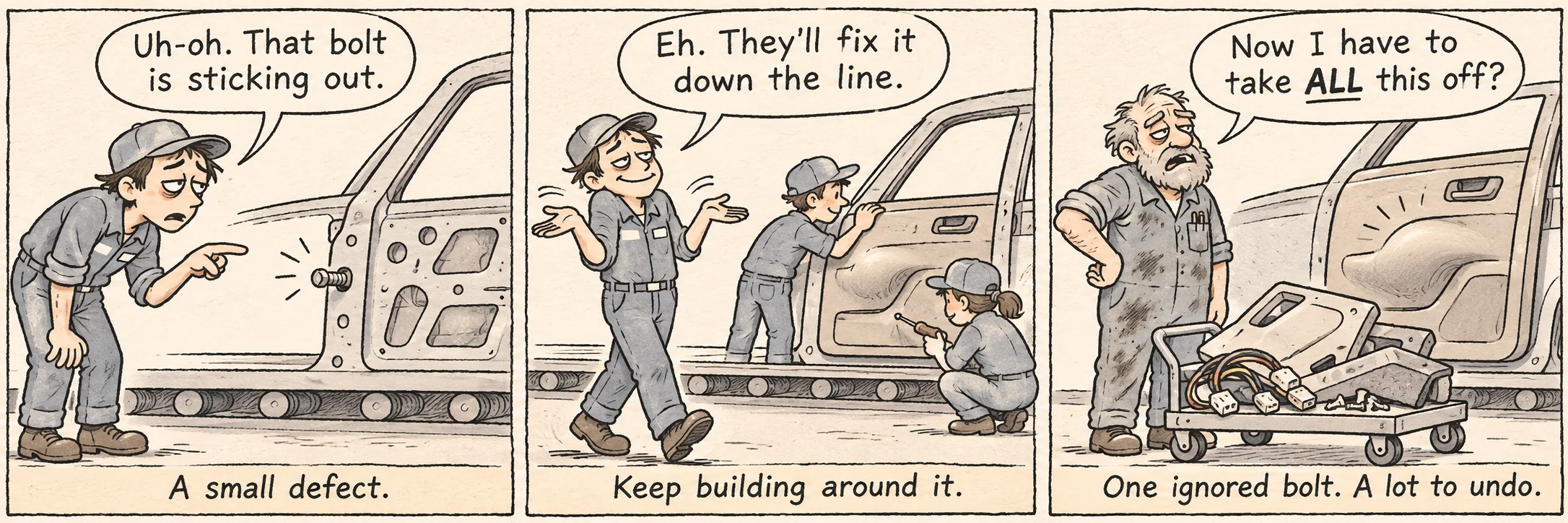
Now imagine a worker at Station 4 notices a door bolt that won’t torque down cleanly. In a traditional factory, stopping the line feels like a career-limiting sin. The unwritten rule is simple: keep the line moving. Even Toyota’s own UK magazine admits that stopping a line “seems like a costly measure – both in terms of time and productivity.”2 So the worker does the best they can, lets the car roll on to Station 5, and hopes someone down the line catches it.
Within minutes, more trim panels and wiring get bolted right over that bad joint. Now what was a quick fix at Station 4 is buried under other people’s work. Catch it at final inspection, and somebody has to tear all that work back out just to reach one bolt. Catch it in a customer’s driveway, and that little fix has mutated into a warranty claim, or even a recall. Moving fast didn’t save time. It just buried the mistake inside the finished product.2
The Exceptional Solution
Toyota’s Solution: Pull the Cord, Swarm the Problem
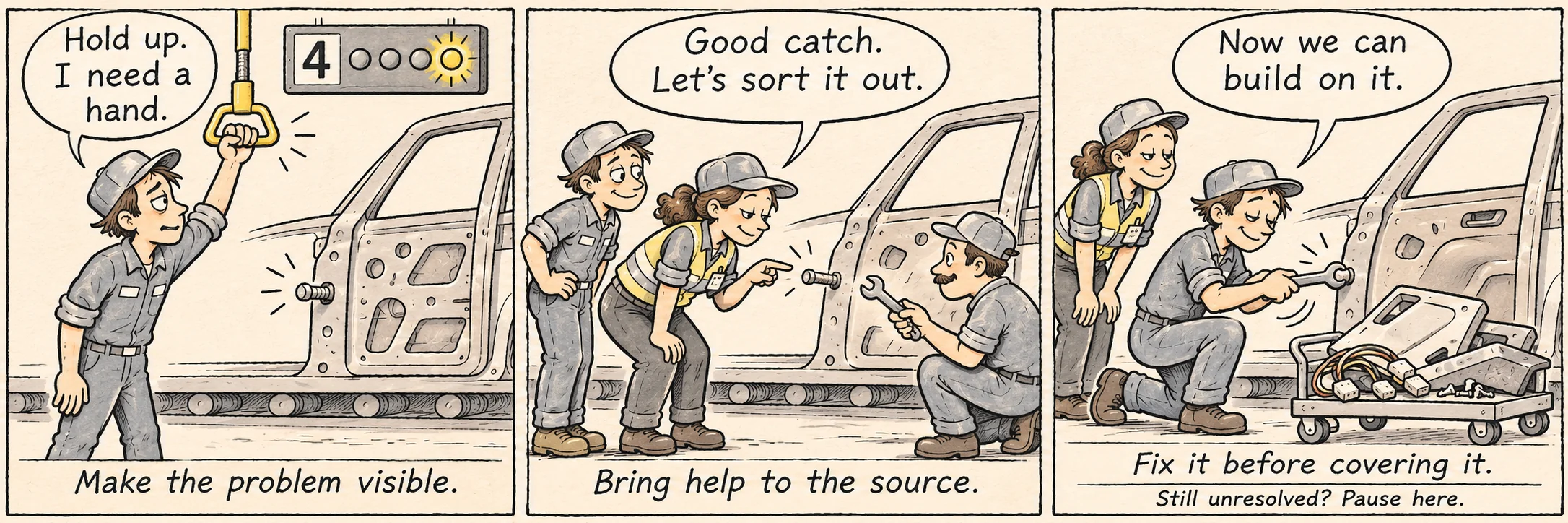
Toyota flipped that incentive on its head. At its Burnaston plant in the UK, a cord runs the full length of the assembly line, wired to an audio alert, a signboard and a flashing light. That signboard is the andon, named for a traditional Japanese paper lantern.2
Here’s the twist many people miss: pulling the cord doesn’t slam the brakes on the whole factory.2 It sets off a fast, two-step rescue:
Signal and swarm. The moment a worker spots a problem, such as a quality defect or work falling behind, they pull the cord.1, 2 The board lights up with that station’s number, so the team leader heads straight there to help.2
Fix it in time, or pause right here. Each station has a set window, its process time, before the car moves on. Fixed inside that window, production carries on: the line never stops. If not, the whole line pauses until the problem is solved, and a second pull restarts it.2
So the cord is a call for backup, not a kill switch. Toyota calls the idea behind it jidoka, loosely “automation with a human touch”: stop the moment something is wrong, make it visible, and fix it before it moves on.1
The ProblemAt Station 4, a door bolt won’t torque down cleanly, and the car keeps moving toward Station 5.
The Mediocre ApproachLet it ride
Action
Let it ride.
- The worker lets the car roll on to Station 5
- Hopes someone down the line catches it
Poor outcome
The mess compounds.
- Trim and wiring get bolted right over the bad joint
- At final inspection, someone tears that work back out to reach one bolt
- In a customer’s driveway: a warranty claim, or even a recall2
The Exceptional ApproachToyota’s answer: pull the cord
Action
Pull the cord.
- The board lights up with Station 4’s number
- The team leader heads straight there to help2
What Toyota Gets for It
Defects stay out of finished cars. Toyota says the cord keeps a defective part from “finding its way into a finished vehicle.”2
The line keeps moving. A problem fixed within the station’s time doesn’t stop production at all.2
Fixes that stick. Toyota says flagging each problem clearly lets it build quality in and keep problems from coming back, and that in the long run this saves time.1, 2
Studied worldwide. Toyota credits the production system behind the cord with letting it compete head-on with carmakers in Europe and the U.S., and that system is now studied around the world.1
The mechanism
Why It Works
Toyota didn’t just hang a cord and wish everyone luck. Pulling it is only half the move. The other half is the team leader who shows up.2 A flag with nobody on the other end is just decoration. The cord builds in both halves of the conversation:
Tap or click a card to see why it works.
-
Fix it where it’s cheap.
At the station, not in a finished car.2
Why it works
- Sorted at the source. Toyota’s aim is to sort problems out exactly when and where they occur.2
- One bolt, not a teardown. At Station 4 it’s one fix; once trim and wiring cover it, all of that comes off again.
- Cheaper than it looks. Stopping seems costly, but Toyota says it keeps a defective part out of a finished vehicle and, in the long run, saves time.2
-
No “is it big enough?”
What counts is agreed in advance.1
Why it works
- Triggers set ahead of time. Toyota names what counts: a quality problem, an equipment problem or a work delay.1
- No lonely judgment call. Nobody has to decide in the moment whether it’s serious enough to speak up.
- A call for backup, not a kill switch. If the fix fits in the station’s time, the line keeps moving; it pauses only when it doesn’t.2
-
Someone comes.
A pull brings the team leader to that station.2
-
Learn from each pull.
Find the cause; stop the repeat.1
Why it works
- Stop and make it visible. Jidoka means stopping when something is wrong, so the problem can’t hide.1
- Fix the cause, not just the car. Toyota says flagging each problem keeps defects from flowing on and stops them from coming back.1
- Every pull points somewhere. Each one shows where the work slips, so the next fix can aim right there.
The evidence
Where Else This Works
Health care loves a slogan: speak up! Harvard’s Amy Edmondson defined the climate that makes speaking up possible, psychological safety, as “a shared belief held by members of a team that the team is safe for interpersonal risk taking.”5 But here’s the catch: research on speaking up in health care has focused on the speaker and neglected the listener.6 The cord, remember, builds in both halves.
Hospitals have borrowed the idea, and some of the numbers are wild. Flip each card for the results and the lesson to take home.
Tap or click a card to flip it.
-
100× more safety reports at a Seattle hospital
- The cord: Any employee who sees a risk to a patient is expected to stop and call an alert.
- The response: The alert gets handled fast: most within 24 hours.
Exceptional results3
3 → 285 safety alerts a month
- Staff at Virginia Mason Medical Center in Seattle flagged risks to patients nearly 100 times as often from 2002 to 2006.
- Most alerts were handled within 24 hours.
Valuable lesson: Make speaking up easy and answer fast, and people keep speaking up.
Source: Furman & Caplan, 2007 · evidence row 3
-
2.5× as often, insulin orders met the protocol for patients without diabetes
- The cord: A public board shows which patients have blood sugar running too high or too low.
- The response: The board prompts the care team to act on it.
Exceptional results7
15% → 37% insulin orders that followed the plan
- Patients without diabetes: orders for an extra dose to bring a high blood sugar down followed the hospital’s plan 2.5 times as often.
- Patients with diabetes: orders for the steady daily dose followed the plan more often too, 56% → 77%.
Valuable lesson: Put the problem where everyone can see it, so someone acts on it.
Source: Franco et al., 2019 · evidence row 7
-
Half as many deaths after surgery, across eight hospitals
- The cord: A 19-item checklist with three built-in team pauses.
- The response: At each pause the team stops and checks together before going on.
Exceptional results8
1.5% → 0.8% of patients died in the hospital after surgery
- Complications fell too: 11% → 7%.
- Across eight hospitals around the world, after surgical teams started the checklist.
Valuable lesson: Build the pause into the routine, so stopping to check is normal, not an accusation.
Source: Haynes et al., 2009 · evidence row 8
-
0 central-line infections in a Johns Hopkins ICU
- The cord: Nurses could stop a central-line insertion that broke the rules.
- The response: The insertion stops until the steps are followed.
11.3 → 0 central-line infections per 1,000 days of use
- A central line is a thin tube placed in a large vein to give medicine.
- One Johns Hopkins ICU reached zero by late 2002, after it adopted a five-step safety plan that included the nurses’ power to stop.
Valuable lesson: Give the person who sees the problem the authority to stop the work.
Source: Berenholtz et al., 2004 · evidence row 4 · evidence row 9
Your dermatology clinic
Bringing It Home to Your Dermatology Clinic
Your dermatology clinic is a line, too. A patient moves from check-in to rooming to the exam, and sometimes to a biopsy, a specimen jar, a pathology report and checkout. At every handoff, something can be slightly wrong and keep moving. And a small problem that slips past rooming doesn’t fix itself in the hallway. It ambushes the dermatologist in the exam room, or turns up days later on a pathology report.
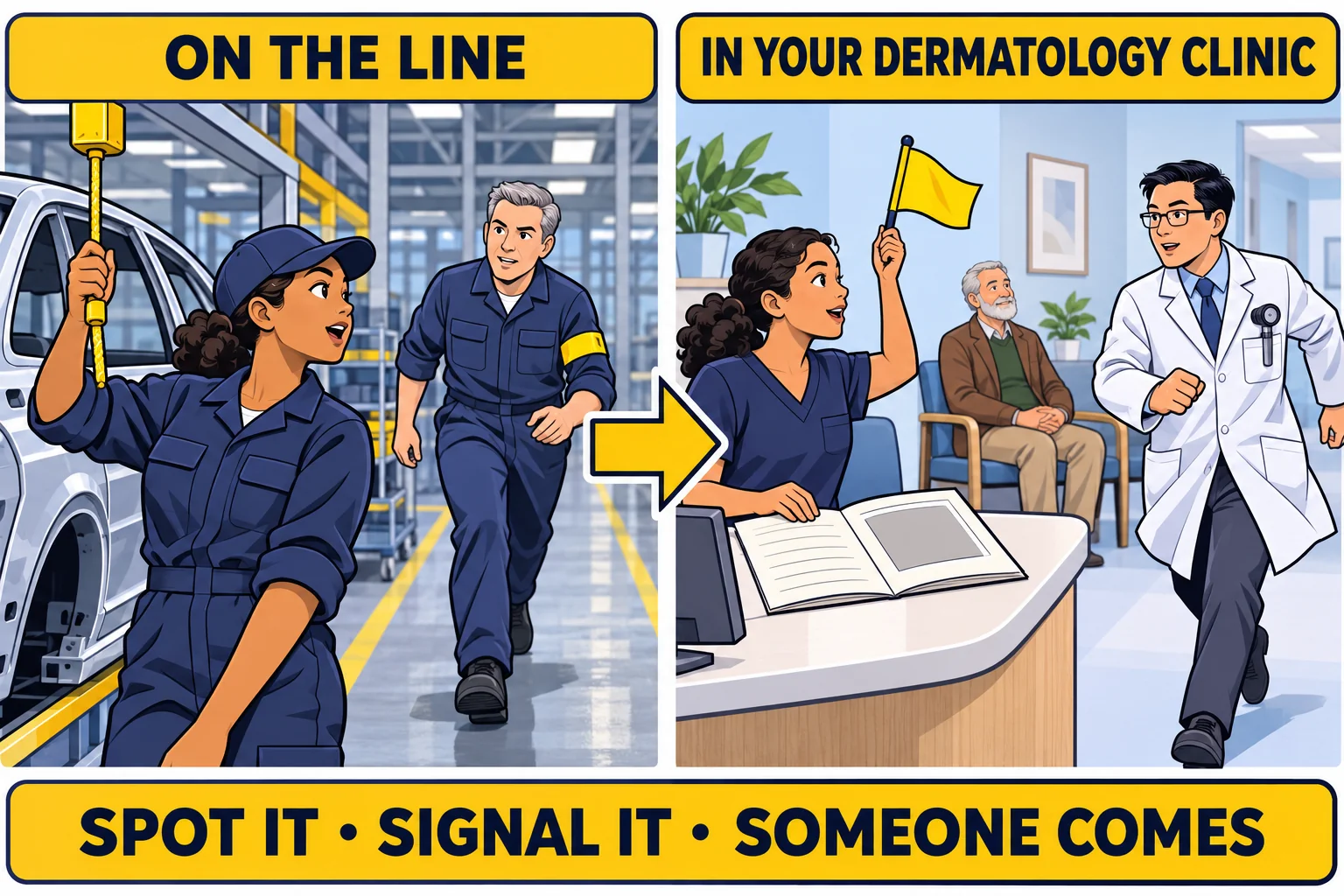
Decide in advance what counts: a missing biopsy-site photo, a specimen jar that doesn’t match its requisition, a medication list that doesn’t match the chart, a new or changing spot a patient mentions at checkout.
Name who answers: each session, one dermatologist or PA for clinical questions and the lead MA for flow. The medical director and practice manager pick the triggers.
Here’s how that plays out in two everyday messes. Each one starts with the problem, follows the mediocre approach to its bad outcome, then rewinds to the same moment and takes the exceptional approach: someone pulls the cord.
Example One: Three Look-Alike Biopsy Sites, No Photo
- The Problem
Your patient is here for surgery, and the MA rooming him notices there is no photo of the intended surgical site, only three look-alike healed spots on his upper back.
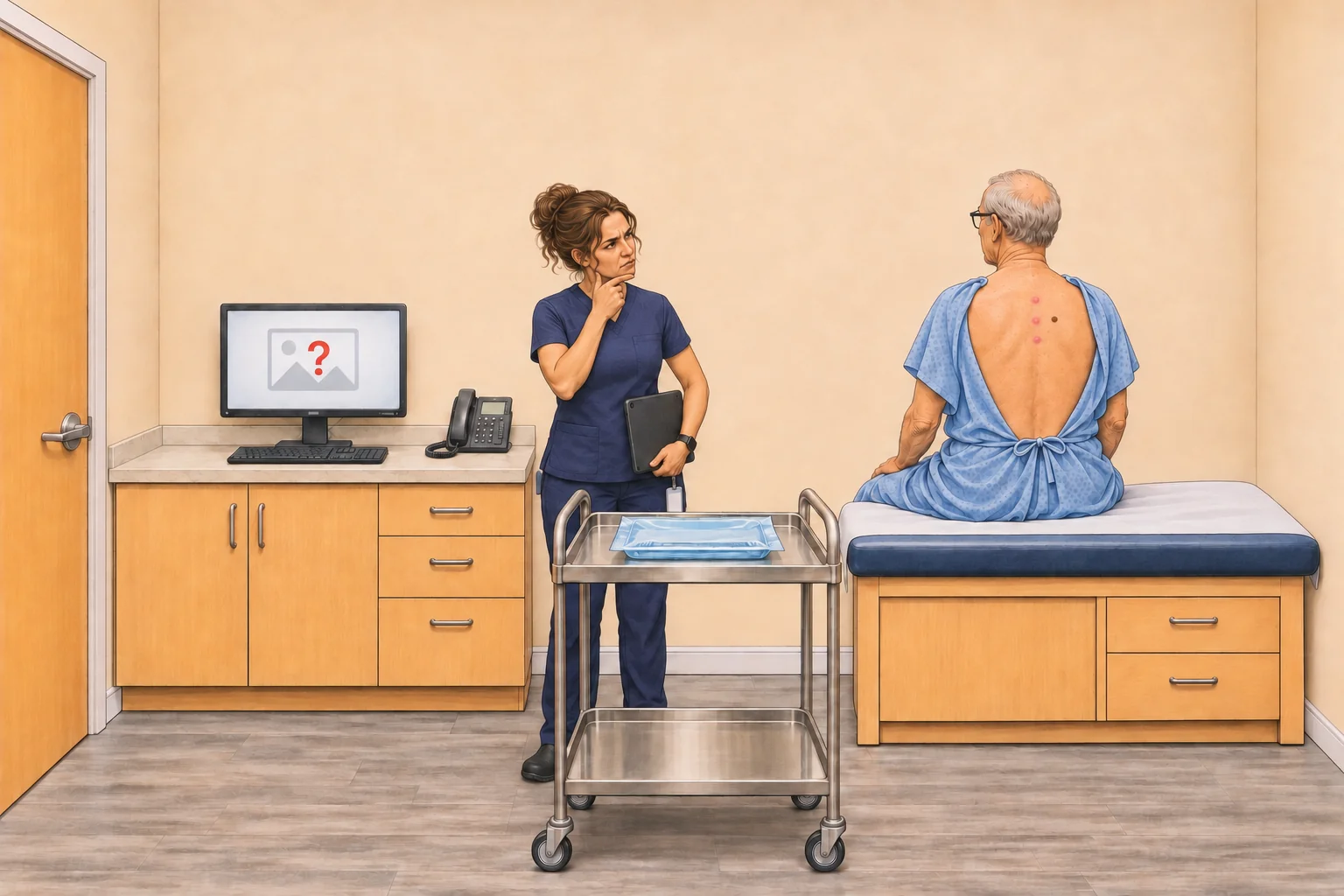 MA:Okay, three little healed spots up here.MA (thinking):Which one? No referral photo…
Caught while rooming. The doctor isn’t in yet. No surgical tray is opened, so this is the cheapest moment to settle the site. - The Mediocre ApproachThe response
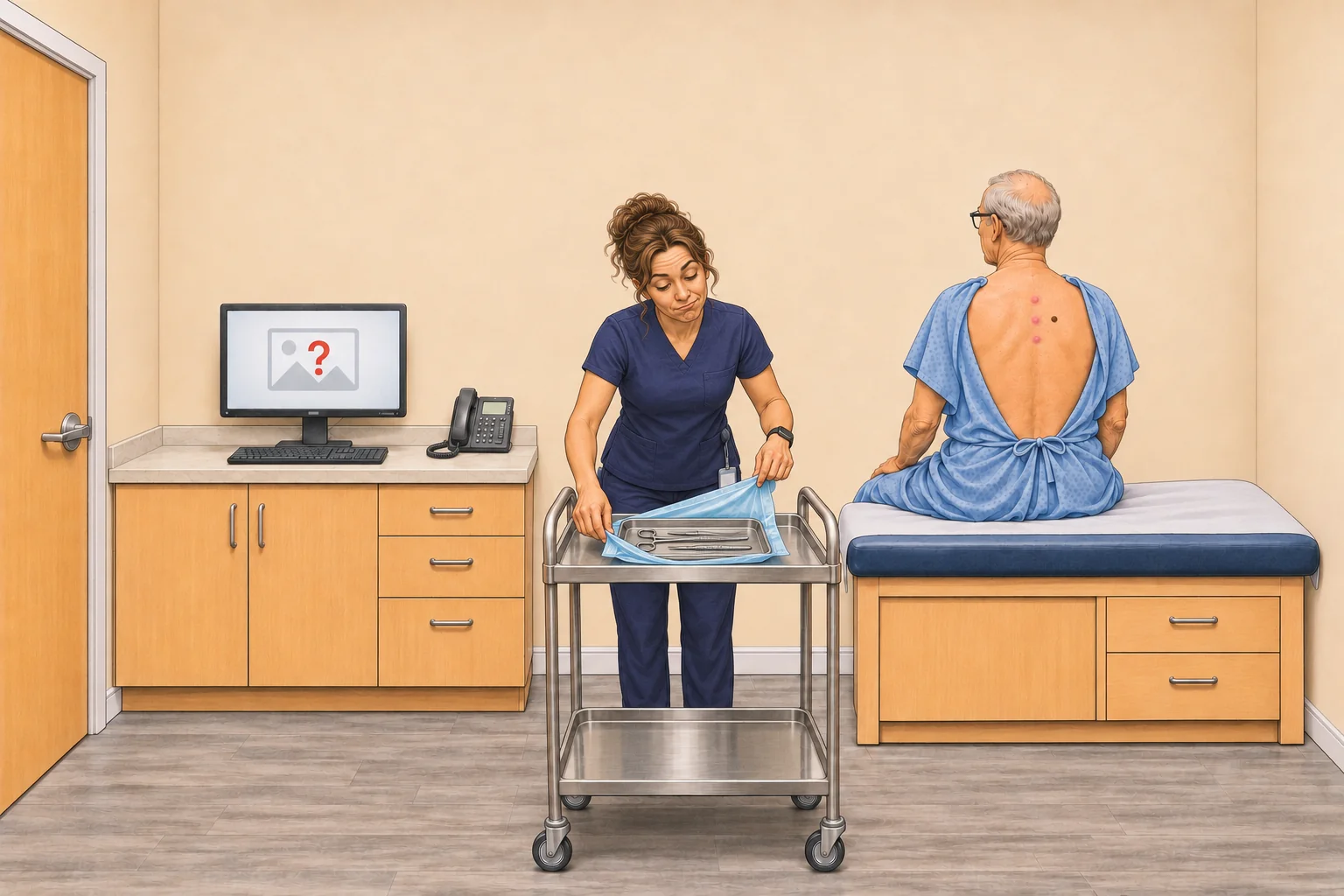 MA:We’re running behind. Let’s get you set up.MA (thinking):Eh. The doctor can sort it out.
Put it off. The tray gets opened, and the missing photo rides along to the doctor. - The Mediocre ApproachThe bad outcome
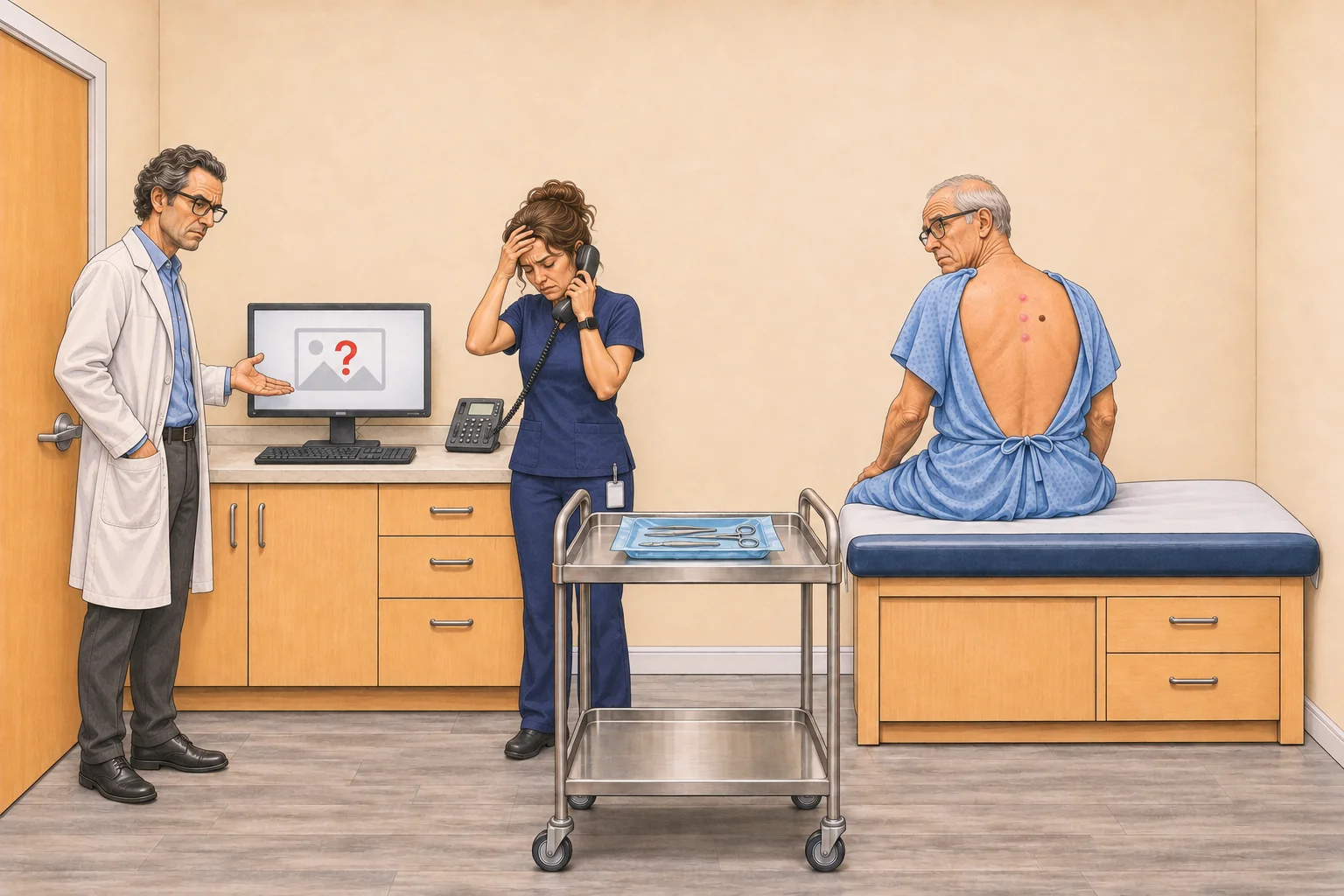 Dermatologist:Which one? I won’t cut on a guess.MA (on the phone):Can you send that site photo? We’re all… waiting.Patient (thinking):So… how long do I sit like this?
Now everyone waits. The patient, the room and the doctor wait on a call that could have come earlier, and the opened setup may go to waste. Rewind. Same patient, same moment, same problem. This time, someone pulls the cord.
- The Exceptional ApproachThe response: pull the cord
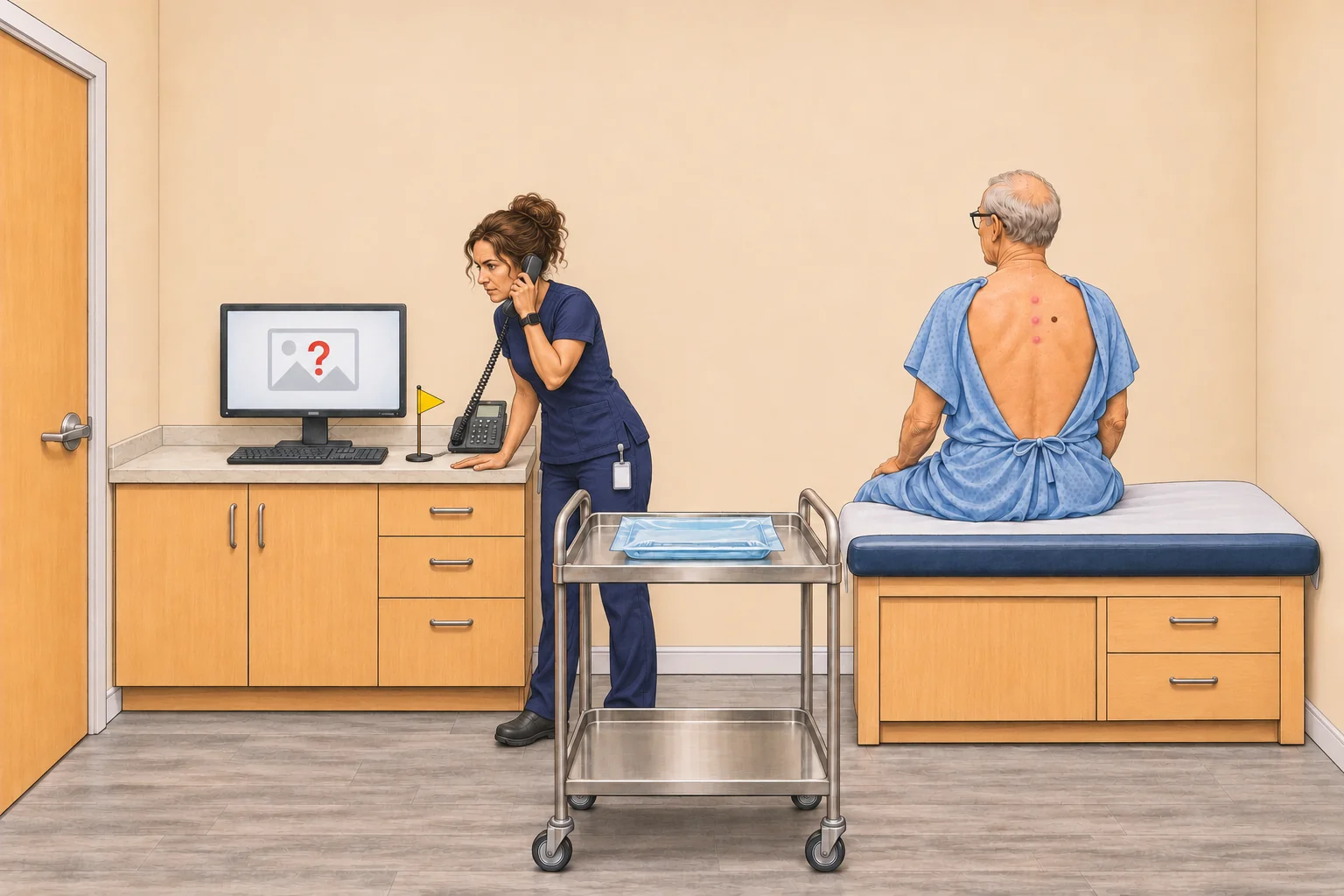 MA (thinking):No photo, three look-alikes. That’s our flag.MA (on the phone):Please send the photo with the biopsy site marked.
Flag it while rooming. A missing site photo is an agreed trigger: the MA calls before anything is opened, and the tray stays sealed. - The Exceptional ApproachThe much better outcome
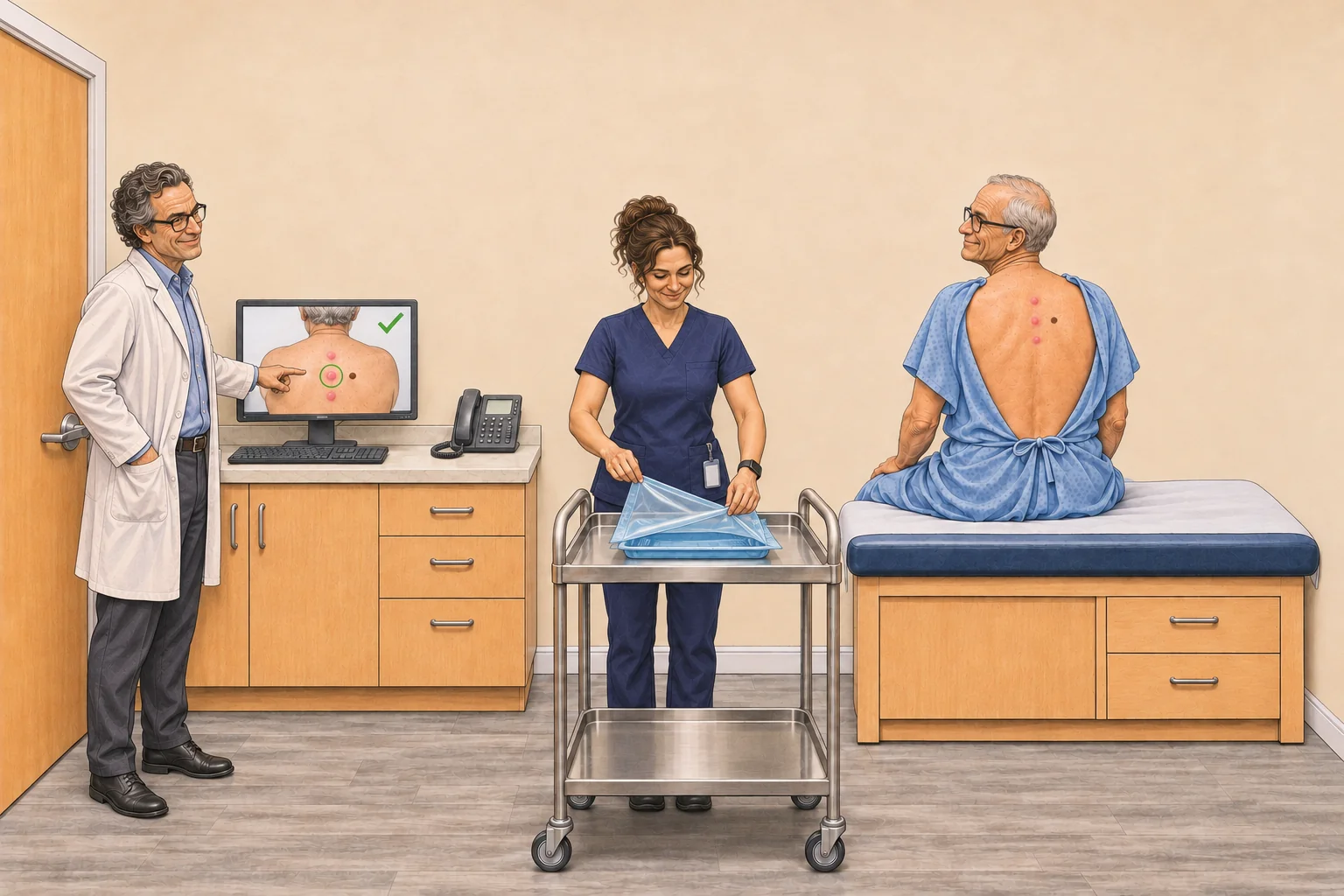 Dermatologist:Photo and referral both mark this middle one. Is that it?Patient:Yes, that’s the one they biopsied.
Verified, then opened. Only after the site is confirmed does the tray come open, so the planned visit can go ahead.
Example OneAt a glance
The ProblemYour patient is here for surgery on the upper back. While rooming, the MA sees three look-alike healed biopsy sites and no photo of the intended surgical site. The doctor isn’t in yet; the tray is still sealed.
The Mediocre ApproachPut it off
Action
Put it off.
- The MA sees the photo is missing but opens the tray anyway
- The question is left for the doctor
- The gap rides along to the next person
Poor outcome
Everyone waits.
- The doctor won’t cut on a guess
- Patient, room and doctor wait on a call that could have come earlier
- Rooms can back up, or the visit may be cancelled
- An opened setup may need replacing if the visit is cancelled or it can’t be kept sterile
The Exceptional ApproachPull the cord: flag it
Action
Flag it while rooming.
- A missing site photo is an agreed trigger
- The MA calls the referring office for the photo with the site marked
- The tray stays sealed
Exceptional outcome
Verified, then opened.
- The photo marks one of the three sites
- The doctor checks it against the referral and with the patient
- Only then is the tray opened, so the visit goes ahead without a wasted setup
- No confirmation? Pause; don’t guess.
Example Two: The Biopsy Jar That Doesn’t Match the Requisition
- The Problem
Right after a biopsy, the MA notices the specimen jar says forearm, but the requisition says shoulder.
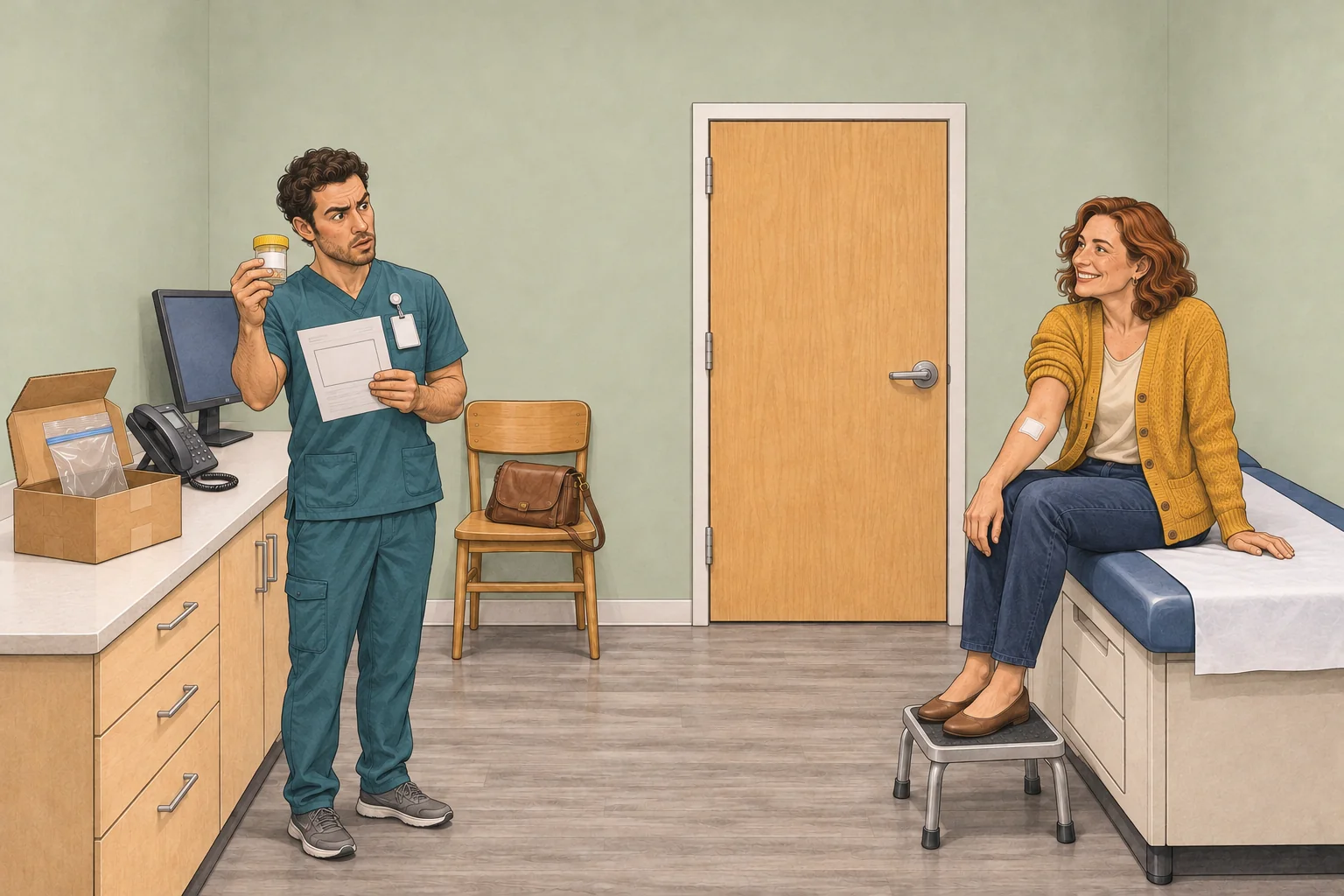 MA (thinking):Jar says forearm… requisition says shoulder?Patient:So, am I all set?
Caught before it leaves. The patient is still in the room, so the site can be checked with her now, the cheapest moment to fix it. - The Mediocre ApproachThe response
 MA (on the phone):Dermatology, can you hold, please?MA (thinking):Fix it later… probably.
Out the door. The jar ships with the mismatch, and the one person who could settle it walks out, none the wiser. - The Mediocre ApproachThe bad outcome
 Dermatologist:What the f#@k?! Shoulder?! We biopsied her forearm!Dermatologist (thinking):Call her back. Call the lab. File the correction. Breathe.
Days later, the cleanup. The report can come back tied to the wrong site, and the treatment plan waits on the fix. Rewind. Same patient, same moment, same problem. This time, someone pulls the cord.
- The Exceptional ApproachThe response: pull the cord
 MA:Mismatch! Flag’s up before this leaves.Dermatologist:Good catch. Let’s check with you.Patient:It was right here.
Stopped in the room. The site is confirmed with her and her photo, and both labels are corrected before it ships, following the lab’s procedure. - The Exceptional ApproachThe much better outcome
 Dermatologist:Forearm, just like we documented.MA:Boring. I love boring.
Nothing to fix. The report is tied to the right site, so the next decision starts from good information.
Example TwoAt a glance
The ProblemRight after a biopsy, the jar says forearm and the requisition says shoulder, and the patient is still in the room.
The Mediocre ApproachBag it, fix it later
Action
Bag it, fix it later.
- The clinic is running late
- The jar goes into the outgoing bag, mismatch and all
- The patient walks out, none the wiser
Poor outcome
The problem piles up.
- The report can come back tied to the wrong site, after she’s gone home
- Callbacks and a correction through the lab
- The treatment plan is stuck waiting
The Exceptional ApproachPull the cord: flag it
Action
Stop it before it leaves the room.
- A mismatch is an agreed trigger: the MA flags it
- The dermatologist confirms the site with the patient and her site photo
- Jar and requisition are corrected following the lab’s procedure
Exceptional outcome
Contained at the source.
- The specimen leaves with the correct site on both
- The report comes back tied to the correct site
- The next decision starts from good information
Your clinic
More Cords to Pull in a Clinic
Same pattern every time: a trigger anyone can see, one named person who answers, and the loop closed before the work moves to the next person.
| The trigger | Who answers | Closed before it moves on |
|---|---|---|
| Pre-visit chart check: the booking doesn’t match the referral (wrong visit type or length) | The scheduler flags the clinician’s nurse | Booking and referral agree, and the chart notes who confirmed, before the reminder call goes out |
| Room setup: a planned instrument or supply isn’t in the room | Whoever sets up flags the charge nurse | The item is in the room, or the schedule is adjusted, before the patient is brought back |
| Pre-visit insurance check: prior authorization still isn’t approved | The authorization coordinator owns it | Approved, or the patient is called with options, before the patient travels |
| End of shift: a patient message is still open with no owner | The outgoing staffer hands it to a named person on the next shift; clinical questions follow the clinic’s agreed escalation route | The new owner confirms they have it, before the outgoing staffer leaves |
| Pre-visit check: the chart says an interpreter is needed and none is booked | The front-desk lead books one | Interpreter confirmed, before the visit |
These are illustrations of what a clinic can agree on in advance, not rules. Adapt the trigger and the person who answers to your own team.
Your move
Try It Today
One problem. One flag. One person who answers.
Try it for one week. No new software. No six-week committee.
- Pick one recurring headache. For example, patients showing up for surgery without a site photo.
- Pick the flag. Choose one thing anyone can do in the moment: a colored card on the chart, a sticky note, or one agreed message in the EHR.
- Pick who answers. For each session, name the dermatologist or PA who will come right away.
- Count your catches. Keep a paper tally with no patient identifiers: how many flags, and how many were fixed before the patient moved on. A flag that turns out to be nothing still counts as a good catch.
- Talk about it at your next huddle. Zero flags? Don’t celebrate yet. Ask why: no cases, missed cases, an unclear trigger, or people hesitating to speak up.
Anything urgent still goes straight to the clinician.
The cord is the visible part. The promise behind it is what matters: if you pull, someone comes.
Explore the Evidence
9 sources · what each study did, what it found, what it supports here, and where it falls short
Toyota’s own accounts describe its practice; they are not independent evidence of effect. The hospital studies are single-site or before-and-after designs. The clinic examples are illustrations, not tested interventions. Status shows how each source was checked: FULL (full text), ABS (abstract), SEC (secondary account), ROOT (checked by the coordinator).
| Source | Type and context | Key finding | What it supports here | Material limitation |
|---|---|---|---|---|
| [1] · FULLToyota: Toyota Production SystemClaude (full page, 2026-10-30); Argon (full page) | Corporate primary account Toyota's own description of jidoka, andon and its production system | Jidoka, "automation with a human touch": a machine stops itself, or the operator pulls a stop cord, when something is abnormal (quality, equipment, or a work delay); the andon lights so workers can call the person in charge; this "eliminates the outflow of defective products" and prevents recurrence; traced to Sakichi Toyoda's loom | More than 30,000 parts per car; anyone can pull the cord for a quality problem or a work delay; jidoka; problems agreed in advance; fixes that prevent repeats; Toyota credits its production system with letting it compete head-on with carmakers in Europe and the U.S., and calls it studied worldwide | Toyota describing itself, not independent evidence of effect; undated; simpler than the Burnaston help-first rule |
| [2] · FULLToyota UK Magazine: Andon CordClaude (full page); Argon (full page, including the lantern etymology) | Corporate magazine feature, one plant Toyota Manufacturing UK, Burnaston assembly plant | The cord runs the length of the line; a pull lights the station number and brings the team leader; fixed within the station's process time, production continues; otherwise the line pauses until resolved and a second pull restarts it; stopping "seems like a costly measure"; problems "sorted out exactly when and where they occur" | The whole factory story: stopping "seems like a costly measure"; the cord, chime, signboard and light; the team leader; the process-time rule (fixed in time, the line never stops; otherwise it pauses and a second pull restarts it); defects kept out of finished cars; long-run time savings; "andon" as a paper lantern | One plant's account; no data on pull frequency, stop time or quality; its "dates back to 1950" claim is not used because first dates vary by account |
| [3] · ABSFurman & Caplan 2007Claude (abstract quotes); Argon (PubMed abstract) | Single-center descriptive report Virginia Mason Medical Center, Seattle, hospital-wide Patient Safety Alerts, 2002–2006 | 6,112 alerts; average 3 a month (2002) rising to 285 a month (2006), about 95-fold; most processed within 24 hours and resolved within 2–3 weeks | Summary and flip card 1: "roughly 100x more safety reports" (3 to 285 a month, 95-fold) at a Seattle hospital | Uncontrolled; written by the hospital about itself; counts reports, not harm and not the number of people reporting; abstract only |
| [4] · SEC + ROOTBerenholtz et al. 2004 (Johns Hopkins)Root (abstract via Johns Hopkins Pure); Claude (press release) | Two-ICU comparison over time (non-randomized) Johns Hopkins ICUs caring for surgical patients, 1998–2002 | With a bundle that included nurses empowered to stop insertions that broke the guidelines, bloodstream infections fell from 11.3 to 0 per 1,000 catheter-days; the comparison ICU went from 5.7 to 1.6, not statistically significant (p = .56) | Summary and flip card 4: line infections fell to zero in a Johns Hopkins ICU, within a bundle; the comparison ICU's fall was not significant | Multi-component bundle, so the stop rule can't be isolated; one institution; non-randomized; control-ICU figures from root's check of the abstract |
| [5] · FULLEdmondson 1999Claude (full text); Argon (full text) | Multimethod field study 51 work teams in one manufacturing company; author at Harvard | Defines team psychological safety as "a shared belief held by members of a team that the team is safe for interpersonal risk taking"; associated with team learning behavior | Where Else This Works, opening lines: the definition of psychological safety | Cross-sectional association; one company; not health care; says nothing about andon |
| [6] · ABS (Claude) / FULL (Argon)Kane et al. 2023Claude (abstract); Argon (full text, including the listener finding) | Systematic review of definitions 294 eligible articles (1999–2020); 58 focused on speaking up; 43 defined it | Defines speaking up as raising a patient-safety concern "to someone with the power to address it"; the research concentrates on the speaker and neglects the listener | Where Else This Works, opening lines: research on speaking up has focused on the speaker and neglected the listener | Definitional review; no effect data |
| [7] · ABSFranco et al. 2019Claude (abstract quotes); Argon (PubMed abstract) | Retrospective pre/post study Adult medical inpatients at Virginia Mason, Seattle | A public "clinical andon board" was followed by basal-insulin prescribing rising from 56% to 77% (a 37.5% relative rise) and correctional-insulin prescribing in patients without diabetes from 15% to 37% (about 2.5 times); mean glucose improved only slightly (statistically, not clinically, significant) | Flip card 2: correctional-insulin prescribing more than doubled (15% to 37%); basal insulin up more than a third (56% to 77%); blood sugar barely moved | Single site; no concurrent control; process measures; N not stated in the abstract |
| [8] · ABS (Argon) + ROOTHaynes et al. 2009 (WHO surgical checklist)Argon (PubMed abstract); root (figures 2026-10-30; author list 2026-11-02) | Prospective before-and-after study 8 hospitals in 8 cities worldwide; 3,733 patients before, 3,955 after | A 19-item checklist with three team pause points was followed by complications falling from 11.0% to 7.0% (about 36% relative) and in-hospital deaths from 1.5% to 0.8% (about 47%) | Flip card 3: complications 11.0% to 7.0% and deaths 1.5% to 0.8% after the checklist, in "the surgical checklist study by Atul Gawande and colleagues" | No concurrent control hospitals; a bundled checklist program, so the pauses can't be isolated |
| [9] · SECJohns Hopkins press release 2004Claude (full page) | Institutional press release The Johns Hopkins ICU program in [4] | Describes the bundle, including nurses empowered to stop catheter insertions that broke the guidelines | Flip card 4: what the Johns Hopkins stop rule was (nurses could stop insertions that broke the guidelines) | Secondary account; its statement that the control ICU "remained the same" is contradicted by the abstract (see [4]) |
References
- Toyota Motor Corporation. "Toyota Production System." Toyota global website (undated page). global.toyota/en/company/vision-and-phil…uction-system/.
- Biddle A. "TMUK's 25 Objects – 19: Andon Cord." Toyota UK Magazine, 11 Dec 2017 (updated 9 Sep 2024). mag.toyota.co.uk/toyota-manufacturing-25…ts-andon-cord/.
- Furman C, Caplan R. Applying the Toyota Production System: using a patient safety alert system to reduce error. Jt Comm J Qual Patient Saf. 2007;33(7):376–386. pubmed.ncbi.nlm.nih.gov/17711139/.
- Berenholtz S, Pronovost P, Lipsett P, et al. Eliminating catheter-related bloodstream infections in the intensive care unit. Crit Care Med. 2004 (PMID 15483409). Abstract also at Johns Hopkins Pure. pubmed.ncbi.nlm.nih.gov/15483409/. Also: pure.johnshopkins.edu/en/publications/el…-the-intens-3/.
- Edmondson A. Psychological safety and learning behavior in work teams. Administrative Science Quarterly. 1999;44:350–383. web.mit.edu/curhan/www/docs/Articles/153…cal_safety.pdf.
- Kane J, Munn L, Kane SF, Srulovici E. Defining speaking up in the healthcare system: a systematic review. J Gen Intern Med. 2023;38(15):3406–3413. pubmed.ncbi.nlm.nih.gov/37670070/. Also: pmc.ncbi.nlm.nih.gov/articles/PMC10682351/.
- Franco T, Aaronson B, Williams B, Blackmore C. Use of a real-time, algorithm-driven, publicly displayed, automated signal to improve insulin prescribing practices. Diabetes Res Clin Pract. 2019;157:107833. pubmed.ncbi.nlm.nih.gov/31476347/.
- Haynes AB, Weiser TG, Berry WR, et al., for the Safe Surgery Saves Lives Study Group. A surgical safety checklist to reduce morbidity and mortality in a global population. N Engl J Med. 2009;360(5):491–499. pubmed.ncbi.nlm.nih.gov/19144931/.
- Johns Hopkins Medical Institutions. "Simple Intervention Nearly Eliminates Catheter-related Bloodstream Infections." ScienceDaily, 9 Dec 2004. sciencedaily.com/releases/2004/11/041130200807.htm.
Read the Toyota Daily Brief · More lessons from The Exceptional Private Practice