The Spurs Tell the Truth, Then Help. Your Clinic Can, Too.
Four everyday ways to give feedback that says plainly what the work needs, then helps the person get it right.
What you’ll take away
- The problem
- Criticism that sounds like a verdict leaves people feeling judged without knowing what to change, so the work doesn’t get better.
- What to remember
- Tell the truth about the work, show you believe the person can meet the standard, then help with one specific fix.
- What to do differently
- When work falls short, name one thing about the work, show the fix, have them try it right away and look at the result together.
Criticism that sounds like a verdict leaves people judged and stuck. A new medical assistant’s dermoscopy photos keep coming out soft at one edge. On a busy afternoon, the quick fix is to retake them yourself and say, “You just don’t have the hands for this.” She hears a judgment about herself and nothing about the photo, so the next one comes out the same, and she stops offering to take them. Softening it until nobody can tell anything is wrong doesn’t help either. People get better when they hear the plain truth about the work and get real help to fix it. The San Antonio Spurs show what that looks like.
The player says: “Why do I keep missing?”
The coach says: “Good form. Your hand sits too high.”
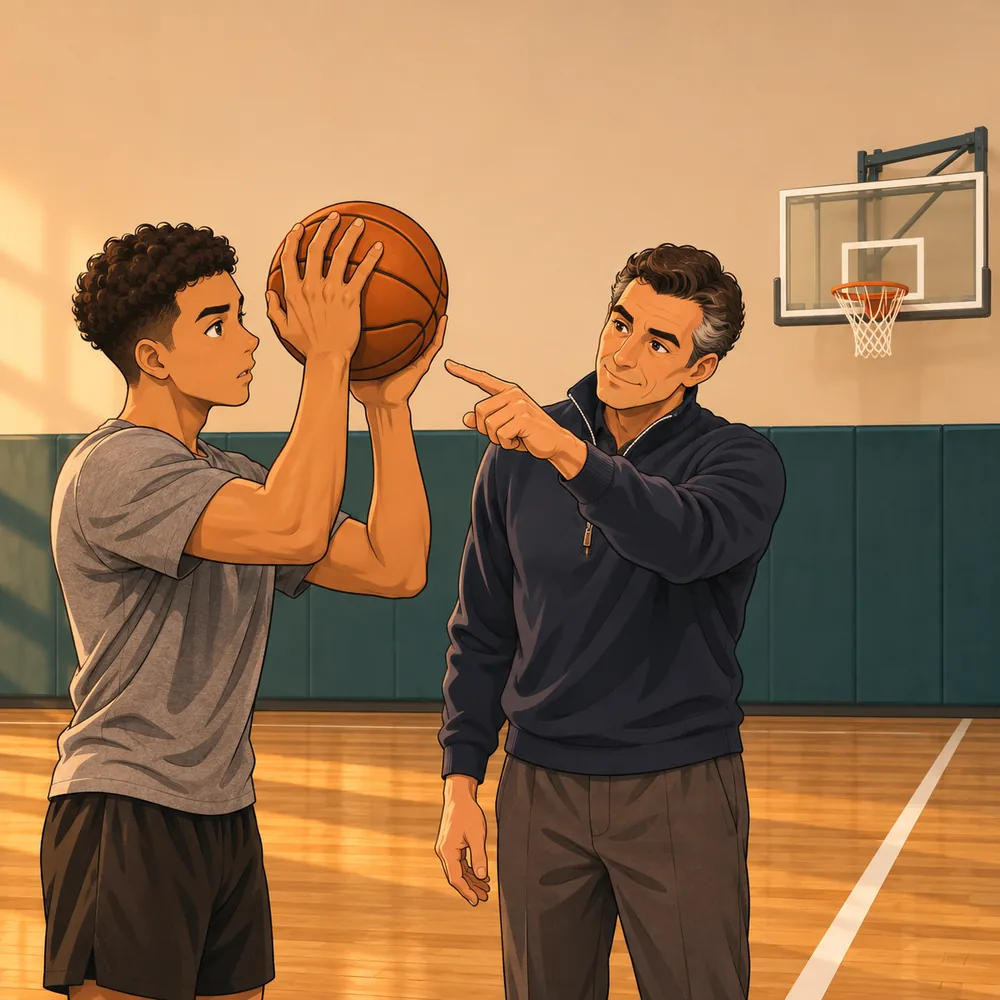
Tell the truth about the work. One exact thing, where the hand sits on the ball, and no verdict on the player.
The player says: “Hand under, thumb out?”
The coach says: “That’s it. You’ve got this.”

Help with one fix. Hand under the ball, thumb out: a change he can feel, with plain belief that he’ll get it.
The player says: “That felt different.”
The coach says: “Same hand. Again.”
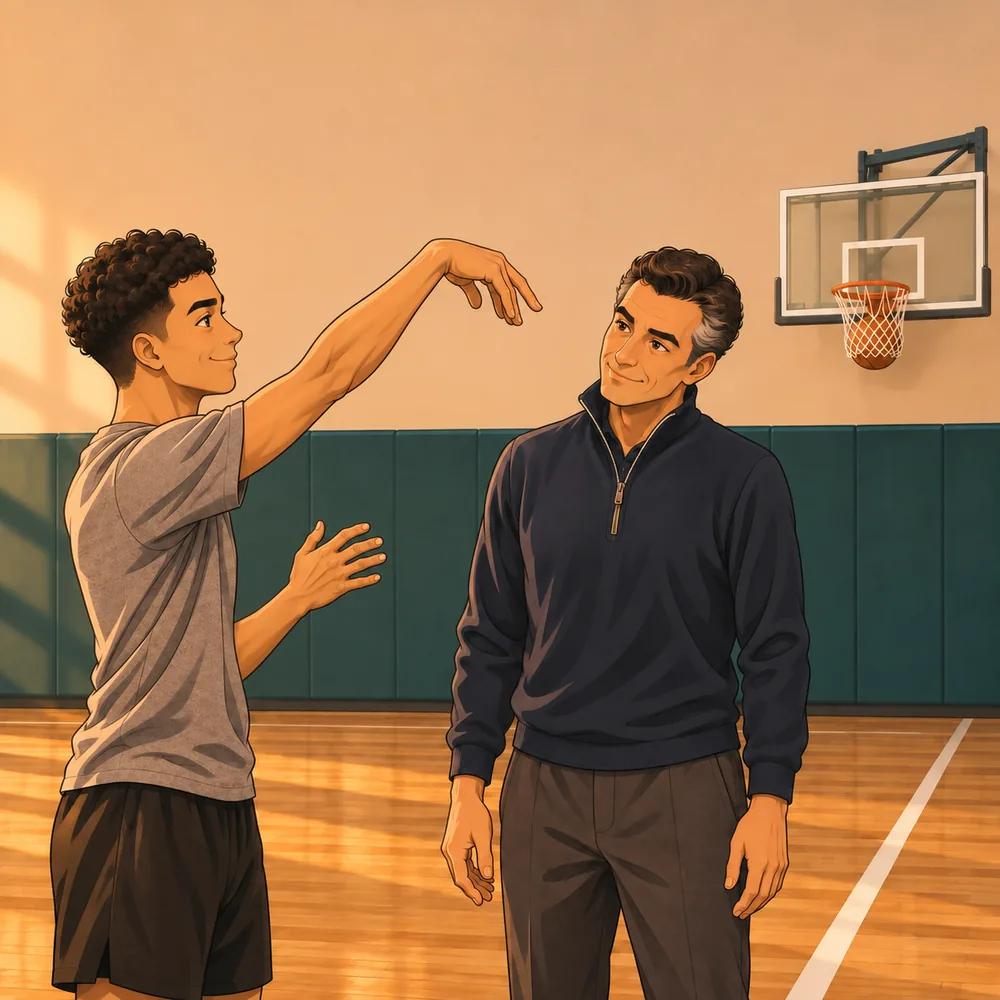
Let the result decide. He tries it right away. The ball dropping through convinces him more than praise could.
Tony Parker was a 19-year-old starter for the Spurs with one big hole in his game: his outside shot. Defenses left him open in key situations.1 The message came through decisions. In the 2003 playoffs, when he struggled, head coach Gregg Popovich sent in backup guards late in games, and that summer the Spurs went hard after Jason Kidd, a star veteran point guard.1, 2 Looking back, Parker wrote that there was “no B.S.” in Popovich’s criticism, and none in his encouragement either.2
The truth alone didn’t fix the shot. When shooting coach Chip Engelland joined the Spurs in 2005, it was still the obvious hole in Parker’s game, and Parker became Engelland’s first project.1 In writer Chris Ballard’s account, as quoted by Grantland’s Bill Barnwell, the first thing Engelland noted set a strength beside the flaw: Parker’s form was exemplary on his one-handed runners and teardrops, but on his jump shot his right hand sat slightly higher instead of under the ball.1 From training camp that fall, Engelland rebuilt the shot: right hand down, thumb out to widen the grip, a slower motion and a new release point. He also had Parker take the three-pointer out of his game, from nearly 200 attempts a season to just over 56 in the nine seasons that followed.1, 5
Each player got his own fix. The night after the 2011 draft, Kawhi Leonard went to Texas for his first session with Engelland, who had just 72 hours before the lockout cut off contact. They moved Leonard’s release point from over his head to in front of his face and drilled it for a couple of days. Leonard kept practicing on his own through the lockout, and the new mechanics stuck.1 With Marco Belinelli, Engelland resisted the urge to rebuild an unorthodox shot and let him keep much of his old motion.1 “I think everybody is different,” Engelland said in an interview about his approach; different habits and “scarring” have to be weighed “before you touch anybody’s shot.”4
Then the result does the convincing. “The ball tells the truth,” Engelland said. Players start believing in a change when they see the ball go in more often, and his own encouragement can’t stand in for that: “I’m pretty enthusiastic and positive but you can’t cheat the ball.”4 Parker’s free throws, the same shot from the same spot every time, went from 69.7% in his four seasons before the rebuild to 77.2% in the nine after.1, 5
Belief holds it together. “A lot of coaches can yell or be nice, but what Pop does is different,” Engelland told author Daniel Coyle. “He delivers two things over and over: he’ll tell you the truth, with no BS, and then he’ll love you to death.”3 Each part covers a gap in the others. Two seasons after the hard truth of 2003, Parker’s shot was still the obvious hole; the change came with specific help. Help needs a plain truth to aim at. Belief makes a hard truth easier to hear. And the result, not praise, shows whether the fix worked. The aim isn’t catching the next miss. It’s a player who can make the shot on his own.
Principles of Excellence
- The truth is about the work. The problem was one part of Parker’s game, his outside shot, and Engelland’s first observation pinned it to where his right hand sat on the ball.1
- Truth comes with belief. Engelland describes Popovich telling players the truth and then loving them “to death.” Parker remembered the encouragement as honest as the criticism.2, 3
- Help is specific and visible. Engelland started from Parker’s strong runner form and changed what a player can feel and a coach can see: hand, thumb, tempo and release. He also took the three-pointer out of Parker’s game.1, 5
- The fix fits the person. Leonard got a different change, his release point, in a 72-hour window. Belinelli’s unorthodox shot was largely left alone. “I think everybody is different,” Engelland said.1, 4
- The result is the judge. Players believe a change when they see the ball go in more often, and no amount of encouragement can replace that. In Engelland’s words, “The ball tells the truth.”4
4 Exceptional Practices for your Clinic
- Start with what’s right, then name one thing about the work. Engelland’s first observation set Parker’s strong runner form beside the one difference on his jump shot, so the correction pointed at the shot, not at the player. When a new MA’s dermoscopy photos keep coming out soft at one edge, which makes them hard to compare at the next visit, say it at the scope: “The center is sharp. The left edge is soft because the scope is tilted. Lay it flat.” Then have her retake the photo while the patient is still in the room.
- Say the standard and your belief in the same breath. Engelland describes Popovich pairing the plain truth with real care, and Parker heard encouragement as honest as the criticism. Hearing both makes a correction sound like an investment, not a dismissal. When you mark up a new scribe’s visit notes, write one line beside the comments: “These plans need to say what the patient agreed to. I know you can get them there.” Then read the next five notes together on Friday.
- Fit the fix to the person, and leave what works alone. Engelland changed Leonard’s release point, rebuilt Parker’s grip and release, and left most of Belinelli’s unusual motion untouched. One change that fits the person is easier to practice than a list of everything you would do differently. When a new PA’s closure edges sit uneven, watch the next one and name the one thing that matters, such as unequal bite depth. Show one even bite, then let her place the next. If her technique differs from yours but the edges sit even, leave it alone. If a patient could be harmed, step in first and coach afterward.
- Have them try again right away, and let the result decide. Leonard drilled his new release with Engelland and then kept practicing it on his own, and Engelland trusted the ball, not his own encouragement, to tell players whether a change was working. People start believing in a change when they see it work. When a new PA teaches wound care after a biopsy and the patient nods but looks lost, a quiet word is enough: “She’s nodding, but she’s lost. Ask her to show you.” The patient walks through the steps before she leaves, and her demonstration shows whether the teaching landed.
Explore the Evidence Further
Explore the Evidence Further. All 10 sources, with methods, findings and clinic applications
Ten sources, grouped by kind of evidence: accounts of how the Spurs coached, the shooting record, and research on feedback from classrooms, surgical training and a review of many studies. Each row gives the design and its main caution, the key finding, why it matters and a way to apply it. Study names link to the original sources, and the full references close this section. None of these sources measured feedback in a dermatology clinic, so every application is our proposal, not a tested intervention.
The Spurs practice: first-person and reported accounts
| Study or source | Setting, design and sample | Key finding | Why it matters | How to Apply It to Your Derm Clinic |
|---|---|---|---|---|
| Barnwell, “The Shot Doctor”1 | Reported feature: Grantland, April 2014, on Engelland’s work. The Parker mechanics and his outside-the-paint and midrange figures are quoted from Chris Ballard’s 2009 book, which was not read for the research. Full article read. Before-and-after figures, not controlled comparisons. | Engelland noted Parker’s exemplary runner form and a jump-shot hand sitting high, then rebuilt the shot from training camp in fall 2005: right hand down, thumb out, a slower motion and a new release; he also had Parker take the three-pointer out of his game. Parker’s shooting outside the paint went from 34.5% to 39.7% in his first year with Engelland, and his midrange percentage rose from 39.3% to 41.6% that year and reached 45.5% by 2008-09. Leonard’s release point was moved in a 72-hour window before the 2011 lockout. Belinelli’s shot was largely left alone, though Barnwell credits the Spurs’ offense for some of Belinelli’s gains. | It documents the specific, visible help that followed the hard truth, fitted differently to each player. | Proposed: start from what already works and change one visible thing, such as how the dermatoscope sits on the skin. |
| Parker, “Thank You, San Antonio”2 | First-person essay: Parker’s essay on leaving San Antonio (The Players’ Tribune, August 2018), written 15 years after the 2003 events and edited for publication. Full essay read. It gives no mechanics or statistics. | In the 2003 playoffs Popovich sent in backup guards late in games, and that summer the Spurs went hard after Jason Kidd. Parker writes that there was “no B.S.” in Popovich’s criticism or in his encouragement, and that the good and the hard experiences “all made me a better player.” | It shows the truth arriving through decisions, and how it read to the player years later. | Proposed: say the hard part plainly, and make your encouragement just as honest. |
| Coyle, The Culture Code (TIME excerpt)3 | Book excerpt: Daniel Coyle’s 2018 book, excerpted by TIME, combining firsthand observation of a Spurs practice with staff interviews. Read in full online; no stored copy. The description of Popovich is a staff member’s characterization. | “A lot of coaches can yell or be nice, but what Pop does is different,” assistant coach Chip Engelland told Coyle. “He delivers two things over and over: he’ll tell you the truth, with no BS, and then he’ll love you to death.” | It names belief as the partner of the hard truth. | Proposed: say your standard and your belief in the same breath, in writing or in person. |
| Gordian, “The Ball Tells the Truth: An Interview with Chip Engelland”4 | Interview: 48 Minutes of Hell (ESPN TrueHoop Network), undated; the 2009-10 season by internal evidence. Engelland describes his general method; the interviewer notes he would not discuss specific players, so none of this is about Parker or Leonard by name. Full interview read. | “The ball tells the truth.” Players believe in a change when they see the ball go in more, and “you can’t cheat the ball.” “I think everybody is different,” he said; different habits and “scarring” have to be weighed “before you touch anybody’s shot,” and shooters who make shots at a high rate are left alone. | It is the coach’s own account of fitting the fix to the person and letting results build confidence. | Proposed: have the person try again right away and look at the result together. |
Before and after: the shooting record
| Study or source | Setting, design and sample | Key finding | Why it matters | How to Apply It to Your Derm Clinic |
|---|---|---|---|---|
| Basketball-Reference, Tony Parker5 | Statistical record: Regular-season totals, recomputed for the research; the selected rows were independently matched. One player compared with himself: his age, role and teammates also changed, so the figures cannot say how much of the change the rebuild caused. | Parker made 69.7% of his free throws (728 of 1,045) in his four seasons before the rebuild and 77.2% (2,181 of 2,824) in the nine after, through 2013-14. His three-point attempts fell from about 197 a season to about 56. | The free throw is the same shot from the same spot every time, with no defender, so it is a clean measure of the shot itself. | Proposed: pick one result that shows the skill itself, such as a sharp photo edge, and compare it before and after the change. |
| Basketball-Reference, Kawhi Leonard6 | Statistical record: Regular-season totals, recomputed for the research; the selected rows were independently matched. College and NBA seasons differ in the length of the three-point line, the offense and his age, so this is not a controlled comparison. | Leonard made 25% of his three-point attempts in two college seasons (41 of 164)7 and 37.6% of 465 in his first three NBA seasons, from the longer NBA line. | The new release held up over three seasons, from a longer distance. | Proposed: check the change again weeks later, not only on the first try. |
Critique paired with belief: a classroom experiment
| Study or source | Setting, design and sample | Key finding | Why it matters | How to Apply It to Your Derm Clinic |
|---|---|---|---|---|
| Yeager and colleagues, “Breaking the cycle of mistrust”8 | Randomized field experiments: Studies 1 and 2, both double-blind, in three seventh-grade social studies classrooms at one suburban public middle school; 44 students earning B’s and C’s in each study (22 African American, 22 White). Teachers wrote their usual critique of an essay, and each essay came back with a randomly assigned handwritten note. Studies 1 and 2 read in full. Education outcomes, not workplace, clinic or Spurs results. | The wise-feedback note read: “I’m giving you these comments because I have very high expectations and I know that you can reach them.” In Study 2, revision was required and the analyses covered the 35 students who revised, of 44 recruited; students with that note incorporated nearly twice as many of their teachers’ suggestions (raw means 4.93 vs 2.58; covariate-adjusted 5.54 vs 2.19), for African American and White students alike. In Study 1, where revision was optional, the note made revision more likely in the full sample; the difference was significant among the 22 African American students (71% vs 17% adjusted; 64% vs 27% raw) but not among the White students. The authors note that their samples were relatively small. | In a controlled comparison, critique paired with a stated high standard and belief was acted on more. | Proposed: add one line of standard and belief beside your written comments, for example on a scribe’s notes. |
Coaching on one’s own work: a surgical training trial
| Study or source | Setting, design and sample | Key finding | Why it matters | How to Apply It to Your Derm Clinic |
|---|---|---|---|---|
| Bonrath and colleagues, “Comprehensive surgical coaching enhances surgical skill in the operating room”9 | Randomized trial: One surgical training program; 20 residents randomized and 18 completed (9 per group) on a minimally invasive surgery rotation. Individualized coaching (performance analysis, debriefing, feedback and behavior modeling) versus conventional training, with skill rated on blinded video of each trainee’s first and last recorded cases. Abstract only. Trainee skill and technical errors, not patient outcomes. | Coached trainees made fewer technical errors (median 10 vs 18) and scored higher on a procedure-specific skill scale (median 3.90 vs 3.60), and only the coached group improved on every skill metric. | Specific coaching on a person’s own recorded work improved skill in a medical training setting. | Proposed: watch the work, name one thing and look at the next case together, as with a new PA’s closures. |
When feedback backfires: a review of many studies
| Study or source | Setting, design and sample | Key finding | Why it matters | How to Apply It to Your Derm Clinic |
|---|---|---|---|---|
| Kluger and DeNisi, “The effects of feedback interventions on performance”10 | Meta-analysis: 607 effect sizes (23,663 observations) from feedback interventions across many tasks and settings, none of them dermatology clinics. Abstract only. | Feedback improved performance on average (d = .41), but more than a third of feedback interventions lowered performance, and feedback worked less well as attention moved away from the task and toward the self. | Feedback is not automatically helpful, and verdicts about the person are the riskiest kind. | Proposed: aim every correction at the work: the photo, the note, the stitch, never the person. |
Across all ten sources:
- None measured feedback in a dermatology clinic.
- The shooting figures compare each player with himself at another age, role and team; they show improvement after a specific fix, not how much of it the fix caused.
- The Spurs accounts are secondhand, retrospective or general: a book quoted in a magazine feature, an essay written 15 years later, a staff member’s description in a book excerpt and an interview about general method.
- The classroom and surgical studies are small, each at one school or one training program, and two sources were read at abstract level.
Principles of Excellence: related evidence from other settings
The main text explains the Spurs’ practice in plain English. These sources describe it or study related ideas elsewhere; none measured the Spurs’ results.
| Point in the brief | Related evidence |
|---|---|
| The truth is about the work. | Engelland’s first observation of Parker’s shot (reported feature quoting a book).1 Feedback worked less well as attention moved from the task to the self (meta-analysis, abstract only).10 |
| Truth comes with belief. | Engelland’s description of Popovich (book excerpt).3 Parker’s essay (first-person, retrospective).2 A critique with a stated high standard and belief was acted on more (randomized field experiments, seventh graders; education outcomes).8 |
| Help is specific and visible. | The rebuild of Parker’s shot (reported feature quoting a book).1 Individualized coaching on recorded cases improved trainee skill (randomized trial, abstract only).9 |
| The fix fits the person. | Leonard’s release and Belinelli’s shot (reported feature).1 Engelland on his general method (interview).4 |
| The result is the judge. | Engelland on his general method (interview).4 Parker’s free throws and Leonard’s three-pointers before and after (statistical records; one player compared with himself).5, 6, 7 |
Our clinic suggestions: proposed, not tested
The four practices and today’s action are our suggestions for a dermatology practice, not a tested program.
| Suggestion | What it draws on |
|---|---|
| Start with what’s right, then name one thing: at the scope, the sharp center, the soft edge and the tilt, then a retake. | Engelland’s first observation of Parker’s shot (reported feature quoting a book).1 Feedback aimed at the self often lowers performance (meta-analysis, abstract only).10 The clinic scene is an illustration, not a documented case. |
| Standard and belief in the same breath: one line beside the comments on a scribe’s notes, then five notes read together on Friday. | Engelland on Popovich (book excerpt).3 The high-expectations note (randomized field experiments, seventh graders; education outcomes).8 |
| Fit the fix and leave what works: one point on a new PA’s closures and one even bite shown; step in first if a patient could be harmed. | Leonard, Parker and Belinelli (reported feature).1 Engelland’s general method (interview).4 Individualized surgical coaching (randomized trial, abstract only; trainee skill, not patient outcomes).9 |
| Try again now and let the result decide: a quiet word and a show-back during wound-care teaching. | “The ball tells the truth” (interview).4 Leonard drilled the new release and then practiced it alone (reported feature).1 |
| One action today: one thing right, one thing to change, your belief and an immediate retry. | No study tested this one-day trial; it applies the same pattern. |
Sources
- Barnwell B. The Shot Doctor. Grantland. 24 April 2014. grantland.com
- Parker T. Thank You, San Antonio. The Players’ Tribune. 6 August 2018. theplayerstribune.com
- Coyle D. How Gregg Popovich Uses ‘Magical Feedback’ to Inspire the San Antonio Spurs (excerpt from The Culture Code). TIME. 30 January 2018; updated 12 December 2023. time.com
- Gordian G. The Ball Tells the Truth: An Interview with Chip Engelland. 48 Minutes of Hell (ESPN TrueHoop Network). Undated page; 2009-10 season by internal evidence. 48minutesofhell.com
- Sports Reference LLC. Tony Parker Stats. Basketball-Reference.com. Accessed 9 November 2026. basketball-reference.com
- Sports Reference LLC. Kawhi Leonard Stats. Basketball-Reference.com. Accessed 9 November 2026. basketball-reference.com
- Sports Reference LLC. Kawhi Leonard College Stats. Sports-Reference.com College Basketball. Accessed 9 November 2026. sports-reference.com
- Yeager DS, Purdie-Vaughns V, Garcia J, Apfel N, Brzustoski P, Master A, Hessert WT, Williams ME, Cohen GL. Breaking the cycle of mistrust: wise interventions to provide critical feedback across the racial divide. J Exp Psychol Gen. 2014;143(2):804-824. doi:10.1037/a0033906. Author-hosted PDF (sparq.stanford.edu)
- Bonrath EM, Dedy NJ, Gordon LE, Grantcharov TP. Comprehensive surgical coaching enhances surgical skill in the operating room: a randomized controlled trial. Ann Surg. 2015;262(2):205-212. doi:10.1097/SLA.0000000000001214. doi.org
- Kluger AN, DeNisi A. The effects of feedback interventions on performance: a historical review, a meta-analysis, and a preliminary feedback intervention theory. Psychol Bull. 1996;119(2):254-284. doi:10.1037/0033-2909.119.2.254. Authors’ abstract (huji.ac.il)