Lessons from the San Antonio Spurs · for dermatology practices
Tell the Truth. Then Help Them Get Better.
In 2003, defenses dared Tony Parker to shoot, and late in big playoff games the Spurs sent in a backup. They didn’t stop at the hard truth. From 2005, a shooting coach rebuilt Parker’s jump shot, starting with where his hand sat on the ball. Your clinic can coach the same way: honest about the work, then real help to fix it.
What you’ll take away
- The problem
- When someone’s work falls short, they often get a verdict instead of help, so they get quieter, not better.
- What to remember
- Tell the truth, then help them get better: be honest about the work, show one specific fix, and check the result together.
- What to do differently
- Name what’s wrong with the work, not the person; say you know they can meet the standard; show one fix and have them try it now; and go first by asking for the truth about your own work.
30-Second Summary
- A verdict makes people quieter, not better. Tell a young guard “You can’t shoot,” and he stops shooting. In a review of 607 feedback results, more than a third made performance worse, and feedback worked worse the more it pointed at the person instead of the task.10
- The Spurs told Tony Parker the truth. In the 2003 playoffs, Gregg Popovich sent in backup guards for him late in games, and that summer the team went after star point guard Jason Kidd. Parker later wrote that Popovich was straight with him in praise and in criticism alike.1, 2
- Then they helped him fix it. From 2005, shooting coach Chip Engelland rebuilt Parker’s jump shot: right hand down under the ball, thumb out, a slower motion and a new release. His free-throw percentage rose from 70% to 77%.1, 5
- Belief makes the truth usable. Engelland said Popovich tells players the truth “with no BS, and then he’ll love you to death.” In a classroom experiment, seventh graders whose essay critique came with a note of high expectations and belief made nearly twice as many of the suggested fixes.3, 8
- In your clinic: say what’s wrong with the work, not the person, and that you know they can get it right; show one fix; have them try it now; and check the result together. Leaders go first: Parker described Tim Duncan, the team’s star, taking coaching as eagerly as a player fighting for a roster spot.2
The Problem
What Goes Wrong When Feedback Is Only a Verdict
Picture a quick young point guard who can get to the rim whenever he wants but can’t make an open jump shot. Defenders know it. They back off and dare him to shoot.
After one more miss, his coach says it plainly: “You can’t shoot. Stop taking that shot.”
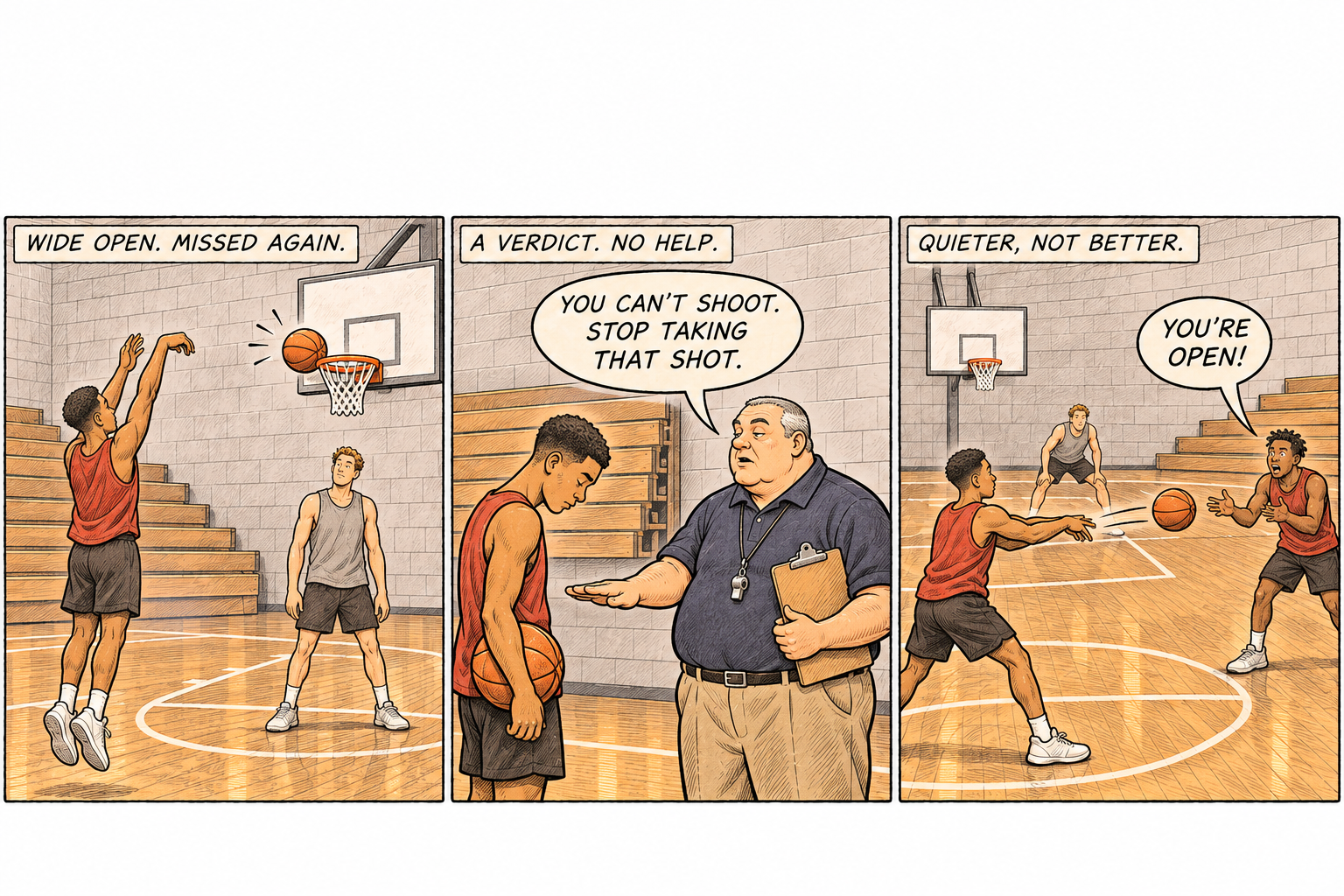
Every word is true, and the guard does exactly what he’s told. He stops shooting. His defender backs off even farther and helps crowd the lane for everyone else. He’s quieter now. He isn’t better.
Feedback like that often backfires. In a 1996 review of 607 feedback results, feedback helped performance on average, but more than a third of the time it made performance worse, and it worked worse the more it pointed at the person instead of the task.10
Nobody here is cruel. The coach told the truth. What’s missing is the second half: what to change, how to change it, and a way to see the change working.
The Exceptional Solution
The Spurs’ Answer: The Truth, Then the Work
The Spurs had a point guard like that. Tony Parker started for them as a 19-year-old rookie whose speed got him to the rim, but his outside shot was the big hole in his game. Defenses left him open when it mattered.1
The truth came without cushioning. In the 2003 playoffs, when Parker struggled, Gregg Popovich sent in backup guards for him late in games. That summer, the team went hard after star point guard Jason Kidd.1, 2 Parker later wrote that Popovich gave him “no B.S.,” whether the words were praise or criticism.2
The truth alone didn’t fix the shot. When shooting coach Chip Engelland arrived in 2005, Parker’s outside shot was still the weak spot, and it became Engelland’s first project in San Antonio.1 Here is what the help looked like, as the writer Chris Ballard described it:1
Start from what works. Engelland began with what already worked: the form on Parker’s one-handed runners and teardrops was excellent.1
Name the one difference. On his jump shot, Parker held the ball differently: his right hand sat slightly high instead of under the ball.1
Change it, and slow it down. From training camp that fall, Engelland lowered Parker’s right hand, moved his thumb out for a wider grip, slowed the motion and changed the release point.1
Narrow the job. Engelland had Parker take the three-pointer out of his game: from nearly 200 attempts a season to about 56.1, 5
The jump shot got better. In his first season with Engelland, Parker made 39.7% of his shots from outside the paint, up from 34.5% the season before, and by 2008-09 he made 45.5% from midrange.1 His free throws, the same shot from the same spot every time, went from 69.7% made in his four seasons before the rebuild to 77.2% in the nine after.1, 5
Here’s what helpful coaching looks like, in three moves:
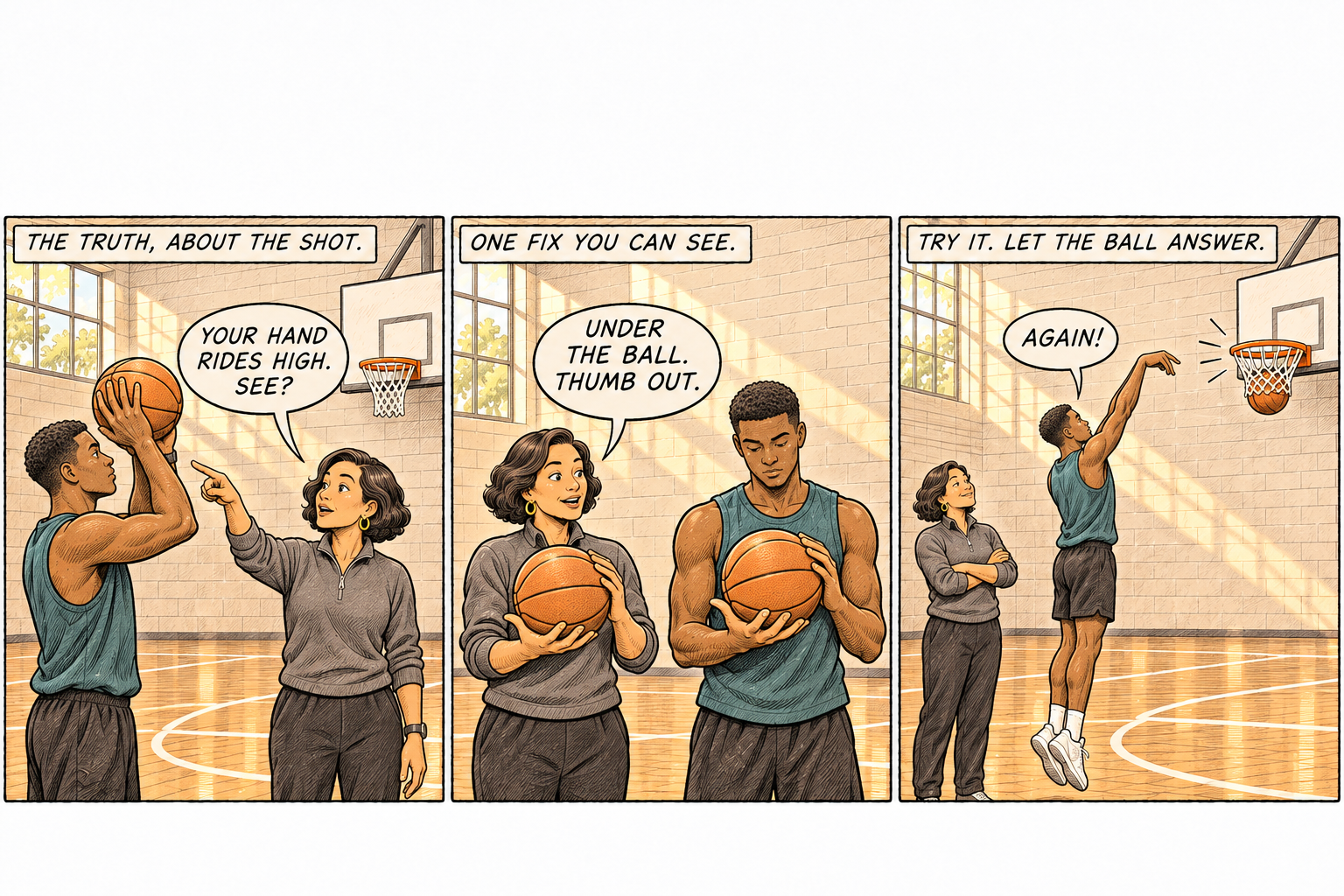
The ProblemA quick young point guard keeps missing open jump shots. Defenders back off and dare him to shoot.
The Mediocre ApproachA verdict
Action
Tell him he can’t shoot.
- “You can’t shoot. Stop taking that shot.”
- Nobody shows him what to change
Poor outcome
Quieter, not better.
- He stops shooting, and defenders back off even more
- The flaw never gets fixed
The Exceptional ApproachThe Spurs’ answer: the truth, then help
Action
Tell the truth, then rebuild the shot.
The Same Coach, a Different Fix
Engelland didn’t hand every player the same fix. The night after the 2011 draft, Kawhi Leonard hurried to Texas to start working with him. A lockout was coming, so they had 72 hours. They lowered Leonard’s release from above his head to in front of his face and drilled it for a couple of days. Then, through the lockout, he practiced alone in San Diego and Las Vegas.1
The new release held up. Leonard had made 25% of his three-point shots in two college seasons. In his first three NBA seasons, shooting from the longer NBA three-point line, he made 37.6%.1, 6, 7
And sometimes the best fix is no fix. Engelland chose not to rebuild Marco Belinelli’s unusual shot and left most of his old motion alone.1 “Everybody is different,” Engelland said in an interview, so he weighed each shooter’s habits before changing anything.4
What Set the Spurs Apart
The difference wasn’t softness. It was what came after the truth:
The truth, without B.S. Parker heard hard news straight: late in big games he sat, and the team went after a star at his position.1, 2
Help that fit the player. A new grip for Parker, a new release point for Leonard, and no rebuild at all for Belinelli.1
Practice until it stuck. Leonard drilled his new release, then kept at it alone. “The ball tells the truth,” Engelland said.1, 4
The coach in our first story told the truth and stopped there. The Spurs told the truth and then went to work, starting with one hand on one ball.
The mechanism
Why It Works
Hard truth plus real help sounds simple. It works because each part does a different job: the truth points at the work, belief keeps the person listening, one visible fix makes change possible, and the result proves it.
Tap or click a card to see why it works.
-
The truth about the shot, not the shooter.
Name the work, not the person.10
Why it works
- One exact difference. Engelland’s note on Parker’s jump shot was specific: his right hand sat high on the ball.1
- Aim at the task. In a review of 607 feedback results, feedback worked worse the more it pointed at the person instead of the task.10
- Straight both ways. Parker wrote that Popovich was just as straight in criticism as in praise.2
-
Why it works
- Truth, then love. Engelland described Popovich’s pattern: the plain truth first, then real affection.3
- Say why you’re saying it. Seventh graders whose critique came with a note of high expectations and belief made nearly twice as many of the suggested fixes.8
- Belief isn’t softness. The standard stays high; the person hears that you think they can reach it.
-
Why it works
- Start from what works. Engelland’s first note was praise: Parker’s runners and teardrops already looked right.1
- Name it, move it. Hand down, thumb out, a slower motion, a new release: changes a player can feel and a coach can see.1
- Fit the person. Engelland treated every shooter as different, and for Belinelli the best fix was leaving his shot alone.1, 4
-
Let the result tell the truth.
The result, not praise, is the proof.4
Why it works
- Praise can’t make it go in. Engelland said his cheering can’t put a shot in the basket; players trust a change once they see more shots fall.4
- Try it now, then again. Leonard drilled his new release with Engelland for a couple of days, then kept practicing it alone.1
- One step at a time. Engelland moved shooters farther out “one foot at a time,” so confidence grew with every shot that fell.4
-
The best player goes first.
Coachable at the top.2
Why it works
- The star took coaching. Parker called Tim Duncan “the most coachable great player of all time.”2
- Like he had to earn it. In practice, Duncan took coaching like someone still trying to make the team.2
- Everyone else hears it. Parker heard a challenge to the whole gym: if the league’s best player could set his ego aside for the team, so could everyone else.2
The evidence
The Results, and Where Else It Works
Two Spurs players got two different fixes, and both shot better afterward. Classrooms and surgical training have tested the same ingredients: a hard critique paired with stated belief, and coaching on a person’s own work.
Tap or click a card to flip it.
-
77% of Tony Parker’s free throws made after the rebuild, up from 70% before
- The truth: Late in big playoff games, he sat.
- The help: Hand under the ball, thumb out, a slower motion, a new release.
69.7% → 77.2% of Parker’s free throws made, before vs after the rebuild
- Before: 728 of 1,045, in four seasons.
- After: 2,181 of 2,824, in nine seasons.
Valuable lesson: Don’t stop at the truth: rebuild the skill with them.
Source: Barnwell, Grantland 2014 · Basketball-Reference: Tony Parker · evidence row 1 · evidence row 5
-
38% of Kawhi Leonard’s threes made in his first three NBA seasons, up from 25% in college
- The fix: His release moved from over his head to in front of his face.
- The reps: Drilled for days, then practiced alone.
25% → 37.6% of Leonard’s threes made, college vs first three NBA seasons
- College: 41 of 164.
- NBA: 175 of 465, from the longer NBA three-point line.
Valuable lesson: Fix one thing, then give them reps until it holds.
Source: Barnwell, Grantland 2014 · Basketball-Reference: Kawhi Leonard · Sports-Reference: Kawhi Leonard (college) · evidence row 1 · evidence row 6 · evidence row 7
-
Nearly twice as many teacher suggestions used by seventh graders revising essays, when the critique came with high expectations and belief
- The truth: Teachers’ written critique of a seventh grader’s essay.
- The belief: A one-line note: the teacher expected a lot and believed the student could get there.
Exceptional results8
4.9 vs 2.6 suggestions used on average, with vs without the note
- Seventh graders revised essays after their teachers’ written critique, which came with one of two notes.
- The belief note: “I’m giving you these comments because I have very high expectations and I know that you can reach them.”
Valuable lesson: Pair the hard truth with real belief that they can reach the standard.
Source: Yeager et al., J Exp Psychol Gen 2014 · evidence row 8
-
10 vs 18 technical errors after coaching vs usual training, among surgical trainees
- The truth: Their own operating performance, analyzed and debriefed.
- The help: Specific feedback and a coach modeling the moves.
Exceptional results9
10 vs 18 technical errors after training, coached vs usual training
- Surgical trainees got individual coaching on their own performance: analysis, debriefing, feedback and modeling.
- Coached trainees also scored higher on skill.
Valuable lesson: Show them their own work, then show them how to do it better.
Source: Bonrath et al., Ann Surg 2015 · evidence row 9
Your dermatology clinic
Bringing It Home to Your Dermatology Clinic
Your clinic coaches skills every day: the photos an MA takes, the way a new PA teaches wound care, a closure, a phone call. When the work falls short, the easy moves are a verdict or taking the task back. Either way, the person gets quieter, not better.
Say it about the work: “The left edge of this photo is soft” gives someone something to change. “You’re just not good with that scope” gives them nothing to do but feel bad.
Say why you’re saying it: “We compare these photos at the next visit, and I know you can get them sharp.” A high standard and your belief, in one breath.
Show one fix, not ten: one change they can see and feel, shown on the real task. Leave what already works alone.
Try it now, and let the result answer: a sharp photo, a patient who can show the steps back. Then look again next week.
Go first: ask your team for one truth about your own work, and change it where they can see.
Here’s how that plays out in two everyday moments. Each one starts with the problem, follows the mediocre approach to its outcome, then rewinds to the same moment for the exceptional approach.
Example One: A Mole Photo Too Soft to Compare
- The Problem
The dermatologist wants a sharp dermoscopy photo of this mole, to compare at a three-month check. The new MA’s photos keep coming out soft at one edge, because she holds the scope at a slight tilt.
 Doctor:Is that the one we’ll compare?MA (thinking):Soft again… it’ll do.
A soft edge, again. Nobody has told her why, so she’s about to save it. - The Mediocre ApproachThe action
 Doctor:You’re just not good with that scope.MA (thinking):What did I do wrong?
A verdict. It’s about her, not the photo, and it says nothing about what to change. - The Mediocre ApproachThe poor outcome
 MA (thinking):I’d just mess it up.Doctor:Too blurry to compare.Patient:So we can’t tell?
Three months later. Last time’s photo is too soft to compare, so the doctor redoes the work herself. The MA no longer trusts herself with the scope. Rewind. Same patient, same photo, same moment. This time, the truth comes with help.
- The Exceptional ApproachThe action: truth, then help
 Doctor:Left edge is soft. It’s tilted. Lay it flat. You can get these sharp.MA:Flat. Got it.
The truth, then one fix. She names the soft edge and the tilt, shows how to fix it, and the MA retakes it: sharp. - The Exceptional ApproachThe exceptional outcome
 Doctor:Sharp both times. Easy to compare.MA (thinking):I’ve got this now.
Three months later. Both photos are sharp, so the comparison is easy, and the MA takes every photo on her own now.
Example OneAt a glance
The ProblemThe dermatologist wants a sharp dermoscopy photo of a mole, to compare at a three-month check. The new MA’s photos keep coming out soft at one edge: she holds the scope at a slight tilt.
The Mediocre ApproachA verdict
Action
Judge the person.
- “You’re just not good with that scope”
- Nobody names the tilt or shows the fix
Poor outcome
Quieter, not better.
- Three months later, the old photo is too soft to compare
- The doctor redoes the work herself, and the MA has lost her confidence
The Exceptional ApproachTruth, then help: name it, show it, try it
Action
Name the problem, show one fix.
- “Left edge is soft. It’s tilted”
- Lay it flat, hold still, let it focus: retake it now
Exceptional outcome
Photos worth comparing.
- Three months later, the two photos are easy to compare
- She takes every photo on her own now
Example Two: Nodding Isn’t Knowing
- The Problem
After a biopsy on the patient’s shin, the new PA explains wound care in one fast stream and asks if she has questions. She nods. She’s lost.
 PA:…once a day, keep it covered. Questions?Patient (thinking):Wash it? Can it get wet?
A polite nod. No one can tell from a nod what she’ll do at home tomorrow. - The Mediocre ApproachThe action
 Doctor:That was a mess. Just hand them the sheet.Doctor (thinking):Faster that way.PA (thinking):So why even try?
A verdict, and a lower bar. He hears he did badly, and he’s told to stop teaching. - The Mediocre ApproachThe poor outcome
 Doctor:What happened to the bandage?Patient:I wasn’t sure it could get wet.
Five days later. The bandage is soaked and the skin around it is irritated, so she’s back for an extra visit. The PA hands out sheets now. Rewind. Same patient, same nod, same moment. This time, the truth comes with help.
- The Exceptional ApproachThe action: truth, then help
 Doctor:She’s nodding, but she’s lost.Doctor:Ask her to show you. You’ve got this.
The truth, then one fix. A quiet word about the nod, and one thing to try before she leaves: ask her to show it. - The Exceptional ApproachThe exceptional outcome
 PA:Show me what you’ll do tomorrow.Patient:Wash, jelly, new bandage. Every day.
She shows it back. She leaves knowing exactly what to do, and the PA asks every patient to show him now.
Example TwoAt a glance
The ProblemAfter a biopsy on the patient’s shin, the new PA explains wound care in one fast stream and asks if she has questions. She nods, but she’s lost.
The Mediocre ApproachA verdict, and a lower bar
Action
Judge it, then lower the bar.
- “That was a mess. Just hand them the sheet”
- Nobody tells him what to change
Poor outcome
An extra visit.
- Five days later, a soaked bandage and irritated skin
- He hands out sheets and explains less
The Exceptional ApproachTruth, then help: one thing to try now
Action
Name it quietly, give one fix.
- “She’s nodding, but she’s lost”
- “Ask her to show you”: try it before she leaves
Exceptional outcome
She shows it back.
- She walks through every step before she leaves
- He asks every patient to show it back now
Your clinic
More Moments to Coach in a Clinic
Same pattern every time: the truth about the work, one fix shown on the real task, and a try right away, checked together.
| The moment | The truth, and the one fix | Check it together |
|---|---|---|
| Closures: a new PA’s closure edges sit uneven | “Your bites are different depths.” Show one even bite on the next stitch | Watch the next closure together and agree on the next target |
| Hard news: a new clinician explains a skin cancer, and the patient hears only “malignant” | Lead with “a common skin cancer that we treat,” then the details | Ask the next patient what they understood |
| Phone calls: callers hang up unsure when to arrive | End every call by reading the arrival time back | Listen to the next three calls together |
| Visit notes: plans don’t say what the patient agreed to | Add one closing line: what we agreed and when we’ll check | Read five notes together on Friday |
| Your own work: the team rarely tells you what slows them down | Ask, “What did I make harder this week?” Then change one thing | Say what you changed, and ask again next month |
Adapt the words to your team. If a patient could be harmed, fix it first, then coach.
Your move
Try It Today
Tell the truth. Show one fix. Check it together.
Try it for one week, with one skill and one person. It costs nothing but attention.
- Pick one skill that matters. Dermoscopy photos, wound-care teaching, closures or check-in calls: one skill, one person.
- Say the truth about the work. Name exactly what falls short, why it matters, and that you know they can get there.
- Show one fix, then have them try it now. One change they can see, done on the real task, right away.
- Check it together. Look at the next result with them today, and again next week.
- Go first. Ask your team for one truth about your own work, and fix it where they can see.
If a patient could be harmed, fix it on the spot first. Coach right after.
A verdict makes people quieter. The truth, plus help, makes them better.
Explore the Evidence
10 sources · what each source is, what it found, what it supports here, and its limits
The Spurs story on this page is assembled from separate sources, each used for what it shows. The 2003 playoff benching and the Kidd pursuit come from Parker’s own 2018 essay and Bill Barnwell’s 2014 Grantland feature. The details of Engelland’s rebuild of Parker’s shot (hand position, grip, tempo and release) come from Chris Ballard’s 2009 book as quoted by Barnwell; the book itself was not read for this chapter. The shooting figures are before-and-after comparisons for individual players, not controlled tests: players mature, roles and teammates change, and Barnwell credits the Spurs’ offense for some of another shooter’s gains. The free-throw and three-point figures were recomputed from Sports Reference season totals and match Barnwell’s exactly; the outside-the-paint and midrange figures are Ballard’s, via Barnwell. Engelland’s own words come from an undated interview, placed in the 2009-10 season by its contents, in which he would not discuss specific players, so his quotations describe his general approach. The description of Popovich as truthful first and loving after is Engelland’s, told to Daniel Coyle in a book excerpt. The truth-then-help loop on this page is the chapter’s own synthesis of these sources, not a named or documented Spurs program, and no quotation here is a composite. The classroom result comes from small experiments with seventh graders who earned B’s and C’s at one suburban school; the larger revision-rate difference reported for 22 African American students in the first study is not used on the page. The surgical result comes from 18 trainees at one program, measured as technical errors and skill on video rather than patient outcomes, and was read at abstract level, as was the 1996 feedback review. No source here measured this approach in a dermatology clinic; the clinic examples are illustrations.
| Source | Type and context | Key finding | What it supports here | Material limitation |
|---|---|---|---|---|
| [1] · HTMLBarnwell B. The Shot Doctor. Grantland, 2014 | Reported feature A sportswriter’s account of shooting coach Chip Engelland’s work, quoting Chris Ballard’s 2009 book on Parker | Parker’s outside shot was the hole in his game; from fall 2005 Engelland moved his right hand down and thumb out, slowed his motion and changed his release; outside the paint 34.5% to 39.7% in a year; free throws 69.7% to 77.2%; Leonard’s release moved in front of his face; Belinelli’s shot left alone | The source case: summary, sections 2 to 4, the comparison and results cards 1 and 2 | Secondary reporting; the Parker mechanics and some percentages are Ballard’s, via Barnwell; before-and-after figures, not controlled comparisons |
| [2] · HTMLParker T. Thank You, San Antonio. The Players’ Tribune, 2018 | First-person essay Parker looking back on his Spurs career | Popovich sent in Speedy Claxton and Steve Kerr for him late in 2003 playoff games; the team went after Jason Kidd; Popovich was straight in praise and in criticism; Parker ranked Duncan first among great players for coachability | The hard truth (summary and section 2) and the leader who took coaching (card 5) | A retrospective, edited essay written 15 years after 2003; how events felt to him |
| [3] · WEBCoyle D. How Gregg Popovich Uses ‘Magical Feedback’ to Inspire the San Antonio Spurs. TIME, 2018 | Book excerpt Daniel Coyle’s firsthand reporting from a Spurs practice, with staff interviews, from The Culture Code | Engelland: where many coaches either yell or stay nice, Popovich does two things again and again: the plain truth, then love | Belief that makes the truth usable (summary and card 2) | A staff member’s description in an author-framed excerpt; “magical feedback” is Coyle’s own label |
| [4] · HTMLGordian G. The Ball Tells the Truth: An Interview with Chip Engelland. 48 Minutes of Hell, about 2009-10 | Interview Engelland in his own words, on a Spurs fan site in the ESPN TrueHoop Network | Every shooter is different, so habits are weighed before any change; shooters who already make shots are left alone; the result is the judge, and praise can’t stand in for it; shooters move out a foot at a time | One fix that fits the person, and the result as the judge (section 2, cards 3 and 4) | Undated page (internal evidence: 2009-10); he would not discuss specific players, so these describe his general approach |
| [5] · DATASports Reference. Tony Parker Stats. Basketball-Reference.com | Statistics database Tony Parker’s regular-season totals | Free throws: 728 of 1,045 (69.7%) in 2001-05 and 2,181 of 2,824 (77.2%) in 2005-14; three-point attempts: 787 in four seasons, then 505 in nine | Card 1, and the free-throw and three-point figures in the summary and section 2 | Regular season only; a before-and-after comparison for one player |
| [6] · DATASports Reference. Kawhi Leonard Stats. Basketball-Reference.com | Statistics database Kawhi Leonard’s regular-season totals | 175 of 465 three-point attempts made (37.6%) in 2011-14 | Card 2 and section 2 | Regular season only; a before-and-after comparison for one player |
| [7] · DATASports Reference. Kawhi Leonard College Stats. Sports-Reference.com | Statistics database Kawhi Leonard’s college totals, San Diego State | 41 of 164 three-point attempts made (25.0%) in 2009-11 | Card 2 and section 2 | Two seasons; the college three-point line was shorter than the NBA’s |
| [8] · PDFYeager DS et al. Breaking the cycle of mistrust: wise interventions to provide critical feedback across the racial divide. J Exp Psychol Gen 2014 | Randomized field experiments Seventh graders’ essays in three social-studies classes at one suburban middle school; the teachers’ usual written critique plus one of two notes | Study 2 (44 recruited; the 35 who revised were analyzed): with the belief note, students used more of their teachers’ suggestions, 4.93 vs 2.58 on average (adjusted 5.54 vs 2.19), for both African American and White students. Study 1: 59% revised overall; among 22 African American students, 71% vs 17% revised (adjusted; raw 64% vs 27%) | Card 3, and the belief points in the summary and card 2 | Small samples; only students earning B’s and C’s; one school; education, not clinics; the Study 1 subgroup result is not used on the page |
| [9] · ABSBonrath EM et al. Comprehensive surgical coaching enhances surgical skill in the operating room: a randomized controlled trial. Ann Surg 2015 | Randomized trial Surgical trainees on a minimally invasive surgery rotation at one program: individual coaching vs usual training | 18 trainees completed; after training, technical errors 10 vs 18 (medians) and higher procedure-specific skill scores, 3.90 vs 3.60; only the coached group improved on every skill measure | Card 4: coaching on a person’s own work | One program, 18 trainees; skill and errors rated on video, not patient outcomes; abstract only |
| [10] · ABSKluger AN, DeNisi A. The effects of feedback interventions on performance. Psychol Bull 1996 | Meta-analysis 607 effect sizes from studies of feedback across many tasks | On average feedback helped (d = .41), but more than a third of feedback efforts made performance worse; feedback did worse as it moved from the task toward the self | The problem (summary and section 1) and card 1 | Abstract only; many kinds of feedback and tasks, none in clinics |
References
- Barnwell B. “The Shot Doctor.” Grantland. 24 April 2014. grantland.com/features/the-shot-doctor
- Parker T. “Thank You, San Antonio.” The Players’ Tribune. 6 August 2018. theplayerstribune.com/articles/tony-parker-san-antonio-spurs
- Coyle D. “How Gregg Popovich Uses ‘Magical Feedback’ to Inspire the San Antonio Spurs.” TIME. 30 January 2018 (updated 12 December 2023). time.com/5125421
- Gordian G. “The Ball Tells the Truth: An Interview with Chip Engelland.” 48 Minutes of Hell. Undated (about 2009-10). 48minutesofhell.com
- Sports Reference. “Tony Parker Stats.” Basketball-Reference.com. Accessed 9 November 2026. basketball-reference.com/players/p/parketo01.html
- Sports Reference. “Kawhi Leonard Stats.” Basketball-Reference.com. Accessed 9 November 2026. basketball-reference.com/players/l/leonaka01.html
- Sports Reference. “Kawhi Leonard College Stats.” Sports-Reference.com College Basketball. Accessed 9 November 2026. sports-reference.com/cbb/players/kawhi-leonard-1.html
- Yeager DS, Purdie-Vaughns V, Garcia J, et al. Breaking the cycle of mistrust: wise interventions to provide critical feedback across the racial divide. J Exp Psychol Gen. 2014;143(2):804–824. doi.org/10.1037/a0033906
- Bonrath EM, Dedy NJ, Gordon LE, Grantcharov TP. Comprehensive surgical coaching enhances surgical skill in the operating room: a randomized controlled trial. Ann Surg. 2015;262(2):205–212. doi.org/10.1097/SLA.0000000000001214
- Kluger AN, DeNisi A. The effects of feedback interventions on performance: a historical review, a meta-analysis, and a preliminary feedback intervention theory. Psychol Bull. 1996;119(2):254–284. doi.org/10.1037/0033-2909.119.2.254
Explore the evidence · Try it today · Read the Spurs Daily Brief · More lessons from The Exceptional Private Practice