A busboy’s school essay became a hotel company’s motto. Behind it is a practical claim worth testing in any clinic, that dignity for the people doing the work is a condition of good service, not a reward for it.
There is an old arrangement in service work that nobody writes down. The people being served are the point. The people serving them are the means, interchangeable, ideally invisible, expected to absorb whatever comes their way. Anyone who has bussed tables, staffed a front desk or roomed patients in a busy clinic has felt it.
That arrangement is usually discussed as a matter of fairness. It is also a matter of performance. People treated as servants respond predictably. Some shrink. They stop volunteering what they notice, stop asking for help and do only what they are told. Others harden. They become guarded, curt and quietly resentful. Neither group gives its best to the person being served, and neither shares much with its colleagues.
Healthcare has its own version of the arrangement. Think of the medical assistant who is snapped at in front of a patient, the scheduler who has to find a manager before fixing an obvious mistake, or the receptionist left alone while a patient shouts. The work suffers in each case. The patient waits longer and the team shares less. Sometimes the person who saw the problem coming says nothing.
A teenager working in a European hotel saw a way out of the arrangement, and later built a company motto around it.
Part A: The problem and the principle
“We are servants”
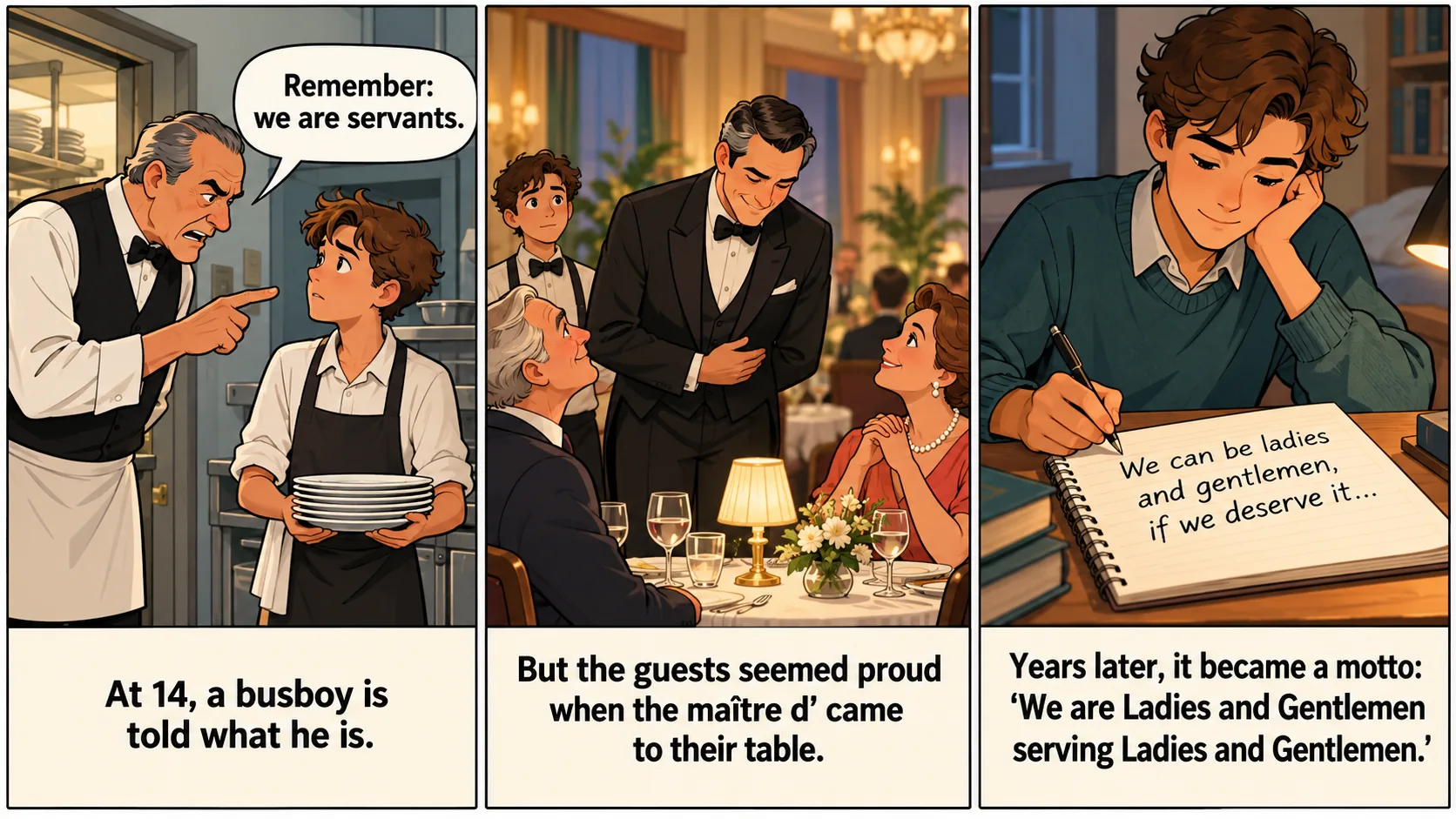
Horst Schulze started work in a hotel at 14, as a busboy, about 100 kilometres from home. The lesson he was taught was clear: “We were told we are servants, we are servants.”1
But Schulze noticed something that did not fit. When the maître d’ approached a table, the guests seemed proud that he had come to them. “I could tell when he approached the table that the guests were proud that he came to their table,” he recalled decades later.1 The maître d’ was serving them, but nobody would have called him a servant. He was respected because he was excellent, and he carried himself like someone who expected respect. His advice to the young busboy was to “come to work to create excellence.”1
At 16, Schulze was asked at hotel school to write an essay about what he thought of the business. He wrote down what he had seen: “We can be ladies and gentlemen, if we deserve it, if we define ourselves like that at work.”1
That sentence contains a condition that is easy to miss: if we deserve it. Schulze was not proposing that service staff be flattered. He was proposing that they be treated, and treat themselves, as professionals, with the standards that implies.
From essay to motto
Schulze went on to co-found the Ritz-Carlton hotel company and served as its president.1 The teenager’s sentence became the company’s motto, which it still publishes: “We are Ladies and Gentlemen serving Ladies and Gentlemen.”2
A motto is cheap. What made this one more than decoration, at least in Schulze’s telling, was that it came with operating commitments.
Authority. Every employee was taught how to resolve problems and told: “You can spend up to $2,000” to fix a guest’s problem, on their own authority.1 The number was a statement of trust more than a budget. “Nobody ever spent $2,000,” Schulze said in a 2019 interview. Typical fixes were a breakfast or a food basket.1
Ownership. The company’s published Service Values include “I own and immediately resolve guest problems” and “I create a work environment of teamwork and lateral service, so that the needs of our guests and each other are met.”2
Voice. Another value reads “I am involved in the planning of the work that affects me.”2
A promise to staff. The Employee Promise calls the company’s Ladies and Gentlemen “the most important resource in our service commitment,” and commits to “trust, honesty, respect, integrity, and commitment.”2
So the motto pointed in both directions. Staff were to treat guests as ladies and gentlemen, and the company was to treat staff the same way. The respect came with real authority to act.
What we can and cannot say about the story
Everything above comes from Schulze’s own recollections and the company’s published standards. These are valuable as a description of intent and design. They are not independent evidence of how consistently the standards were lived, or of what they achieved. We are not claiming that the motto made the company successful.
The story also has a limit that belongs in plain view. In July 2025, California’s Labor Commissioner cited the Ritz-Carlton Hotel Company and janitorial contractors at its Half Moon Bay hotel. The contractors allegedly classified 155 janitors as independent contractors, denying them minimum wage, overtime and other protections. The citations exceeded $2 million, and the hotel company could be jointly liable for about $746,000 if two of the contractors failed to pay. The release described appeal rights; we have not been able to verify the current disposition.3 Whatever the outcome, it shows the obvious risk in any dignity motto. It applies only to the people an organization actually treats by it, and those are not always the people doing the least visible work.
The principle
Treat the people who do the work as professionals, with respect and real authority, and they can extend that dignity to the people they serve. Respect is an operating condition, not a courtesy.
There are three working parts:
- Respect in how people are spoken to and about, especially in front of others.
- Authority to act, with clear limits, so the first person who sees a problem can own it.
- A voice in the work, so the people closest to the problem help design the fix.
The claim that these improve service and safety is our interpretation of the story. The research below tests pieces of it in other settings.
Why it matters
Disrespect degrades the work, not just the mood
The most striking evidence comes from a series of randomized simulations with neonatal intensive care teams in Israel.
In the first, 24 teams took part in a training simulation of a premature infant who deteriorated suddenly. They were told a foreign expert would be observing. Half the teams heard neutral comments from the expert; half heard mildly rude ones that had nothing to do with anything the team had done. Blinded judges scored the videotaped simulations. Teams exposed to rudeness scored lower on diagnostic performance (2.6 vs 3.2) and procedural performance (2.8 vs 3.3). The researchers traced the effect to two behaviours: teams shared less information and sought less help.4
A second study of 39 teams moved the rudeness to a more familiar source, the simulated infant’s mother. It found the same damage to therapeutic performance and to teamwork processes such as information sharing and helping. A brief preventive exercise in avoiding cognitive distraction reduced most of the harm. A narrative exercise afterwards did not.5
A third study tested the opposite. When a mother expressed gratitude to the teams, performance rose modestly (3.9 vs 3.6), again mostly through better information sharing.6
Laboratory experiments outside medicine point the same way. In three studies, rudeness reduced performance on both routine and creative tasks and decreased helpfulness. The effect held whether the rudeness came from an authority figure or a third party, or was merely imagined. Disrupted thinking explained the effect.7
These are simulations and laboratory tasks, not patient outcomes. But they identify a plausible mechanism. Disrespect consumes attention and makes people less willing to speak and less willing to ask, which are exactly the behaviours teams rely on to catch problems.
Respect shows up in outcomes
Two observational studies connect workplace respect to what happens to patients.
- At two academic medical centres, researchers linked coworker reports of surgeons’ unprofessional behaviour to their patients’ outcomes. Among 13,653 patients, those whose surgeons had four or more such reports had complications 14.1% of the time, compared with 10.7% for surgeons with none. After adjustment, rates remained higher.8
- Across 31 South Carolina hospitals, operating-room staff rated the safety of surgical practice. Each one-point increase in a hospital’s mean score for respect was associated with a lower 30-day death rate after inpatient surgery (adjusted relative risk 0.78). The pattern appeared among nurses but was often absent among surgeons.9
Neither study proves that disrespect causes harm. Hospitals and surgeons differ in many ways. They are consistent with the simulation evidence, though.
Civility can be built
A respectful culture is not simply a matter of hiring nice people. In one study, eight healthcare units took part in a six-month programme called CREW (Civility, Respect and Engagement at Work), while 33 units served as a comparison. The intervention units improved more on coworker civility, supervisor incivility, respect, cynicism, job satisfaction, trust in management and absences. Better civility appeared to drive the gains in attitudes.10 The abstract does not describe randomization, but the study shows that a team can deliberately change how it treats itself.
Authority and voice matter, not just courtesy
The $2,000 rule was about authority. A large meta-analysis of empowerment research found that people who feel empowered at work are more satisfied and committed, perform better, and report less strain and less intention to leave. Empowered teams perform better.11 Empowerment tracks personal traits as strongly as workplace conditions. But those conditions are ones leaders control: management practices, support, leadership and how the work is designed. A clinic cannot change its staff’s temperaments, but it can change who may fix what.
How staff are treated reaches customers
In a classic study of 134 bank branches, Benjamin Schneider and colleagues measured how well employees were supported in their work and how strongly each branch emphasized service. Branches where employees felt supported developed a stronger “climate for service,” and that climate predicted customers’ ratings of service quality. The relationship ran both ways: customer perceptions also fed back into the climate.12
That reciprocity resembles the motto. How staff are treated shapes how customers are treated, and how customers treat staff shapes the climate in turn.
Where else this works
- Neonatal intensive care (simulation). Rudeness reduced, and gratitude modestly raised, team performance through information sharing.4,5,6
- Surgery (observational). Coworker reports about surgeons’ behaviour, and staff ratings of respect, were associated with patient outcomes.8,9
- Hospital units (controlled intervention). A structured civility programme improved respect and satisfaction.10
- Banking (longitudinal). Employee support built a service climate that customers could feel.12
- Many industries (meta-analysis). Empowerment was associated with performance and commitment.11
None of this tests a hotel motto, and none promises that a clinic adopting a motto will see results. The evidence supports the working parts: treat people respectfully, especially in front of others; give them real authority; involve them in their work.
Part B: Bringing This Principle to Your Clinic
The busboy’s problem appears in clinics in at least three recognizable forms:
- The public correction. A clinician, under pressure, criticizes a team member in front of a patient.
- The fix nobody may make. A staff member can see the solution but needs permission, so the patient waits.
- The guest who is not a gentleman. A patient or family member berates staff, and nobody steps in.
Each is the old arrangement at work. The person doing the job is treated as a means rather than a professional, and the job gets worse for it. What the principle changes is what leaders, clinicians and managers do in these specific moments.
The examples below are illustrative, with invented names and dialogue.
Example 1: The Hallway Correction
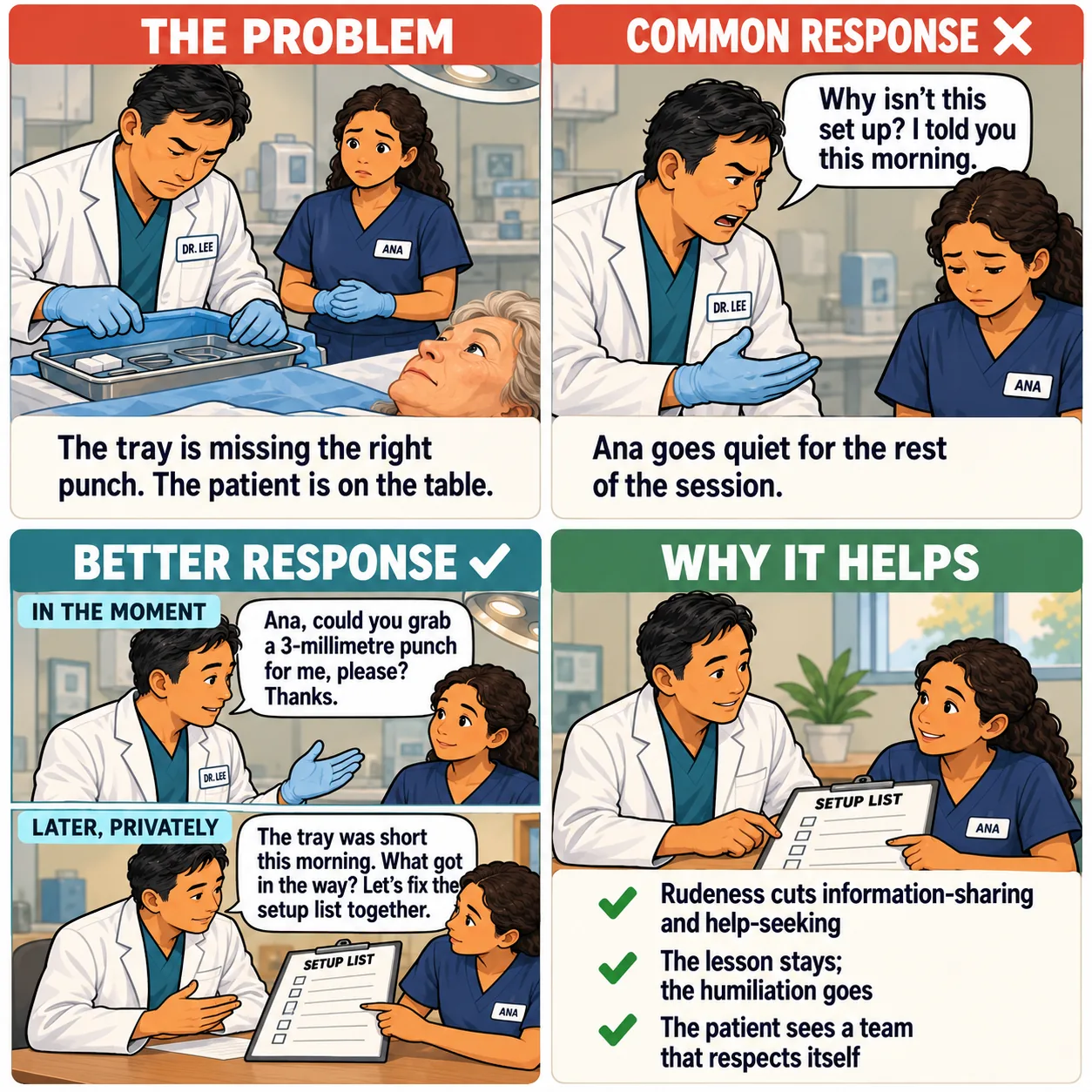
The problem. A procedure is about to begin and the patient is on the table. The physician opens the tray and finds the wrong punch size.
A common response. “Why isn’t this set up? I told you this morning.” The tone is sharp and the patient hears it. The medical assistant fetches the instrument and says very little for the rest of the session.
A better response.
- In the moment: “Ana, could you grab a 3-millimetre punch for me, please? Thanks.”
- Later, privately: “The tray was short this morning. What got in the way? Let’s look at the setup list together. Maybe it needs a line for punch size.”
Why it helps.
- The simulation studies suggest that rudeness reduces the information sharing and help-seeking a team needs.4,5 An assistant who was humiliated at 9 a.m. may not mention the allergy she noticed at 11.
- The private conversation keeps the lesson, which is to fix the setup, and lets the assistant help design the fix.2
- The patient sees a team that respects itself, which is part of what makes care feel trustworthy.
Example 2: Who’s Allowed to Fix It?
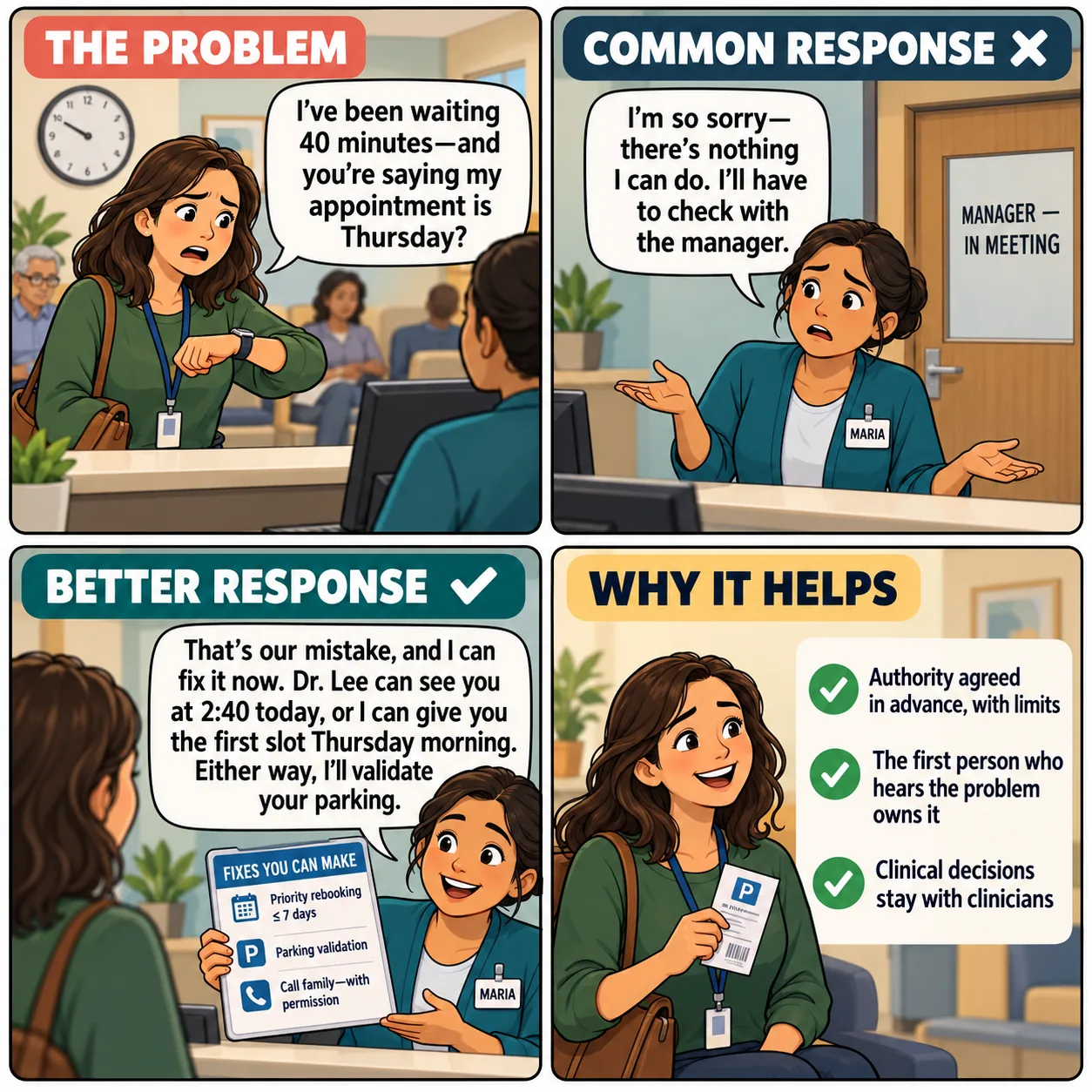
The problem. A patient arrives for an appointment that was booked on the wrong day, a clinic error. She has already waited 40 minutes.
A common response. “I’m so sorry, there’s nothing I can do. I’ll have to check with the manager.” The manager is in a meeting. The person who understands the problem is waiting for permission to solve it, and the patient waits with her.
A better response. “That’s our mistake, and I can fix it now. Dr. Lee can see you at 2:40 today, or I can give you the first slot Thursday morning. Either way, I’ll validate your parking.”
Why it helps.
- It applies the $2,000 idea in clinic terms. Agree in advance on a short list of fixes any team member may make without asking, with clear limits. Examples might be a priority rebooking, parking validation or a call to a waiting family member with the patient’s permission.
- The first person who hears about the problem owns it, much as the published value “I own and immediately resolve guest problems” describes.2
- Authority to act is one of the conditions leaders control that are associated with empowerment.11
- Clinical decisions stay where they belong. The list covers logistics, not medical judgment.
Example 3: When the Guest Isn’t a Gentleman
The problem. A patient, angry about a long delay, raises his voice at the receptionist, who is alone at the desk.
A common response. Two things are common. The receptionist absorbs it, alone, then carries it into the next ten interactions. Or she snaps back. Nearby clinicians keep their heads down.
A better response. A clinician or manager steps in: “I can hear you’re frustrated about the wait, and you’re right that it’s been too long. We’re going to sort it out. I need you to speak to Maria respectfully while we do.” Afterwards, someone checks on Maria.
Why it helps.
- In the second simulation study, rudeness from a patient’s mother degraded teamwork.5 Rudeness from patients is part of the working environment, and leaders can buffer it.
- The patient’s frustration is acknowledged and addressed. The motto’s dignity applies to him too, and it does not license abuse of staff.
- Staff learn that respect is protected, not just requested.
What the principle is not
- Not flattery. Schulze’s condition was “if we deserve it.” Professional dignity comes with professional standards.
- Not abdication. Authority to act has limits, and clinical judgment stays with qualified clinicians.
- Not a slogan. If the clinic posts a motto but still corrects people in public, the slogan teaches cynicism.
How to make dignity operational
1. Introduce people as professionals
Introduce team members to patients by name and role: “This is Ana. She’ll coordinate your scheduling and can connect you with me for any clinical question.” It costs a few seconds and tells the patient that this person matters here.
2. Give authority with limits
Ask the team which small problems they see every week that need permission to fix. Choose a few and write them down, with limits (“priority rebooking within seven days,” “parking validation”). Then back people up when they use them. Authority that gets second-guessed afterwards stops being used.
3. Correct in private, thank in public
Make this a norm for everyone, clinicians included. In the moment of a mistake, ask for what you need, politely. Afterwards, privately, ask what got in the way. When something goes well, say so where others can hear.
4. Protect staff from abuse
Agree in advance what happens when a patient becomes abusive: who steps in, what they say, and who checks on the staff member afterwards. Respect for staff is part of patient safety, not an alternative to patient-centred care.
5. Include everyone
Cleaning staff, scribes, interpreters, couriers and contracted workers do clinic work too. If the respect, the introductions or the authority stop at the payroll boundary, the principle is incomplete. The 2025 California citation is a reminder that this boundary is where dignity is easiest to overlook.3
6. Involve people in planning the work that affects them
The people who set up trays, answer phones and room patients know where the work breaks. Give them a regular way to say so, and visibly use what they say.2
7. Make civility a team project
CREW was an employee-based civility programme run within work units, focused on how colleagues treat each other.10 A clinic doesn’t need a formal programme to start. A short, regular huddle about what helped and what hurt this week is a beginning.
Try It Today
Owner: the practice manager.
The experiment. Ask the front desk and medical assistants one question: “What small problem do you see every week that you need permission to fix?” Choose two or three of those fixes, agree on their limits and post them where the team works. For one week, team members jot down each time they use one.
The observation. At the end of the week, hold a ten-minute huddle with three questions:
- Did patients wait less, or leave with a clearer plan?
- Did any fix need a clearer rule, or turn out to need clinical input?
- Did anyone feel exposed using their new authority, and what would make it feel safe?
What to do with it. Keep the fixes that helped, refine the limits, and add one new item each month from the team’s own suggestions.
This is a local experiment to learn from, not a validated intervention.
Explore the Evidence
12 studies and sources, grouped by role: the original story, core evidence, implementation conditions, and boundaries. Tap to expand.
The original story (organizational accounts and reporting)
| Study or source | Setting and design | What it found | What it adds to the principle | Useful nuance or application | Original source |
|---|---|---|---|---|---|
| Schulze interview (Wharton) 2019 | Edited first-person interview · Ritz-Carlton co-founder and former president | Schulze: busboy at 14, told “we are servants”; saw guests proud of the maître d’; at 16 wrote “We can be ladies and gentlemen, if we deserve it…”; every employee could spend up to $2,000 to fix a guest problem. | The origin of the motto and its working parts: dignity plus authority. | Self-account; not outcome evidence. | link |
| Ritz-Carlton Gold Standards | Published company standards · Ritz-Carlton hotels | Published motto, Employee Promise and Service Values (own and resolve problems; teamwork; involvement in planning one’s work). | Shows the motto was tied to authority and voice. | Stated standards, not observed practice. | link |
Core supporting evidence
| Study or source | Setting and design | What it found | What it adds to the principle | Useful nuance or application | Original source |
|---|---|---|---|---|---|
| Riskin et al. 2015 | Randomized simulation; blinded judges · NICU teams, Israel · N: 24 teams | Mild rudeness lowered NICU team diagnostic (2.6 vs 3.2) and procedural (2.8 vs 3.3) scores via less information-sharing and help-seeking. | Disrespect degrades teamwork, not just mood. | Randomized simulation; 24 teams. | link |
| Riskin et al. 2017 | Randomized simulation with mitigation arms · NICU teams · N: 39 teams | Rudeness from a ‘mother’ lowered therapeutic and teamwork scores; preventive cognitive bias modification mitigated. | Rudeness from patients/families also harms teams; leaders can buffer it. | Same group; 39 teams. | link |
| Riskin et al. 2019 | Randomized simulation, 4 arms · NICU teams (2 physicians, 2 nurses) · N: 43 teams | Maternal gratitude modestly improved team performance (3.9 vs 3.6) via information sharing. | Positive regard has the opposite, smaller effect. | Same group; small effect. | link |
| Porath & Erez 2007 | Three experiments · Laboratory | Rudeness (authority, third-party, or imagined) reduced routine and creative performance and helpfulness. | Mechanism: rudeness disrupts thinking. | Laboratory experiments. | link |
| Cooper et al. 2019 | Retrospective cohort (NSQIP) · 2 US academic centers, 2012–2016 · N: 13,653 patients; 202 surgeons | Patients of surgeons with ≥4 coworker reports of unprofessional behaviour had more complications (14.1% vs 10.7%). | How clinicians treat colleagues is associated with patient outcomes. | Association; two academic centres. | link |
| Molina et al. 2017 | Hospital-level survey linked to outcomes · 31 South Carolina hospitals (Safe Surgery 2015) · N: 1,793 respondents (38.1% response) | Hospital staff ratings of respect associated with lower 30-day surgical mortality (aRR 0.78 per point). | Respect as an operating condition. | Cross-sectional; 38% response; seen among nurses more than surgeons. | link |
Conditions and implementation
| Study or source | Setting and design | What it found | What it adds to the principle | Useful nuance or application | Original source |
|---|---|---|---|---|---|
| Leiter et al. 2011 | Pre/post with contrast units; 6-month CREW intervention · 41 healthcare units (8 intervention, 33 contrast) · N: 1,173 (T1); 907 (T2) | Six-month CREW civility programme improved civility, respect, satisfaction and absences vs 33 contrast units. | Respectful culture can be deliberately built. | Allocation method not stated in abstract; self-report. | link |
| Seibert et al. 2011 | Meta-analysis · Employees and teams across industries | Empowerment linked to satisfaction, commitment, performance, lower strain; antecedents include traits and leader-controlled context. | Supports giving real authority, within limits. | Correlational. | link |
| Schneider et al. 1998 | Longitudinal employee and customer surveys; SEM and cross-lagged analyses · 134 bank branches | In 134 bank branches, employee support built a service climate that predicted customer-rated quality; effects were reciprocal. | How staff are treated reaches customers—and back. | Banking; observational. | link |
Boundaries and contrary findings
| Study or source | Setting and design | What it found | What it adds to the principle | Useful nuance or application | Original source |
|---|---|---|---|---|---|
| California DIR 2025 | Government press release · Half Moon Bay hotel; subcontracted janitorial workers | 2025 California citation of the Ritz-Carlton Hotel Company and janitorial contractors: 155 janitors allegedly misclassified by the contractors; >$2 million; hotel company jointly liable for $746,001 if two contractors fail to pay. | A motto covers only the people actually treated by it. | Allegation; release noted appeal rights; outcome not verified. | link |
Expanded details for each row (sample size, comparison, effect estimate, limitations, funding, and how deeply each source was read) are in the downloadable evidence table.
References
- Knowledge at Wharton. Becoming the best: excellent customer service always wins (interview with Horst Schulze). 2 May 2019. https://knowledge.wharton.upenn.edu/podcast/knowledge-at-wharton-podcast/horst-schulze-ritz-carlton-book/
- The Ritz-Carlton Leadership Center. Foundations of our brand: Gold Standards. https://ritzcarltonleadershipcenter.com/about-us/about-us-foundations-of-our-brand/
- California Department of Industrial Relations. Labor Commissioner cites the Ritz-Carlton and subcontractors more than $2 million for misclassifying workers (Release 2025-70). 16 Jul 2025. https://www.dir.ca.gov/DIRNews/2025/2025-70.html
- Riskin A, Erez A, Foulk TA, et al. The impact of rudeness on medical team performance: a randomized trial. Pediatrics. 2015;136(3):487-95. https://pubmed.ncbi.nlm.nih.gov/26260718/ doi:10.1542/peds.2015-1385
- Riskin A, Erez A, Foulk TA, et al. Rudeness and medical team performance. Pediatrics. 2017;139(2):e20162305. https://pubmed.ncbi.nlm.nih.gov/28073958/ doi:10.1542/peds.2016-2305
- Riskin A, Bamberger P, Erez A, et al. Expressions of gratitude and medical team performance. Pediatrics. 2019;143(4):e20182043. https://pubmed.ncbi.nlm.nih.gov/30846617/ doi:10.1542/peds.2018-2043
- Porath CL, Erez A. Does rudeness really matter? The effects of rudeness on task performance and helpfulness. Acad Manage J. 2007;50(5):1181-97. https://doi.org/10.5465/amj.2007.20159919
- Cooper WO, Spain DA, Guillamondegui O, et al. Association of coworker reports about unprofessional behavior by surgeons with surgical complications in their patients. JAMA Surg. 2019;154(9):828-34. https://pubmed.ncbi.nlm.nih.gov/31215973/ doi:10.1001/jamasurg.2019.1738
- Molina G, Berry WR, Lipsitz SR, et al. Perception of safety of surgical practice among operating room personnel from survey data is associated with all-cause 30-day postoperative death rate in South Carolina. Ann Surg. 2017;266(4):658-66. https://pubmed.ncbi.nlm.nih.gov/28657942/ doi:10.1097/SLA.0000000000002378
- Leiter MP, Laschinger HKS, Day A, Oore DG. The impact of civility interventions on employee social behavior, distress, and attitudes. J Appl Psychol. 2011;96(6):1258-74. https://pubmed.ncbi.nlm.nih.gov/21744942/ doi:10.1037/a0024442
- Seibert SE, Wang G, Courtright SH. Antecedents and consequences of psychological and team empowerment in organizations: a meta-analytic review. J Appl Psychol. 2011;96(5):981-1003. https://pubmed.ncbi.nlm.nih.gov/21443317/ doi:10.1037/a0022676
- Schneider B, White SS, Paul MC. Linking service climate and customer perceptions of service quality: tests of a causal model. J Appl Psychol. 1998;83(2):150-63. https://doi.org/10.1037/0021-9010.83.2.150