The Ritz-Carlton Makes People Feel Respected. Your Clinic Can, Too.
Five everyday ways to make patients and staff feel respected, so patients feel looked after and staff can speak up and fix problems.
People need to feel that they matter—and that someone will take responsibility for helping them. Too often, service leaves them feeling like an interruption. You reach the counter, but nobody looks up. You explain your problem, get sent elsewhere, and explain it again. Now you have two problems: the one you came in with, and the work of finding someone who will help. You leave feeling unimportant, even if everyone was technically polite.
The guest says: “Thank you so much!”
The bellman says: “My pleasure, Ms. Grant.”

Greet guests like they’re expected. Use their name, and help before they have to ask.
The guest says: “My room isn’t ready?”
The front-desk agent says: “Breakfast is on us while we finish it.”

Trust staff to fix it on the spot. The person who hears the problem solves it.
The general manager says: “After you, Rosa.”
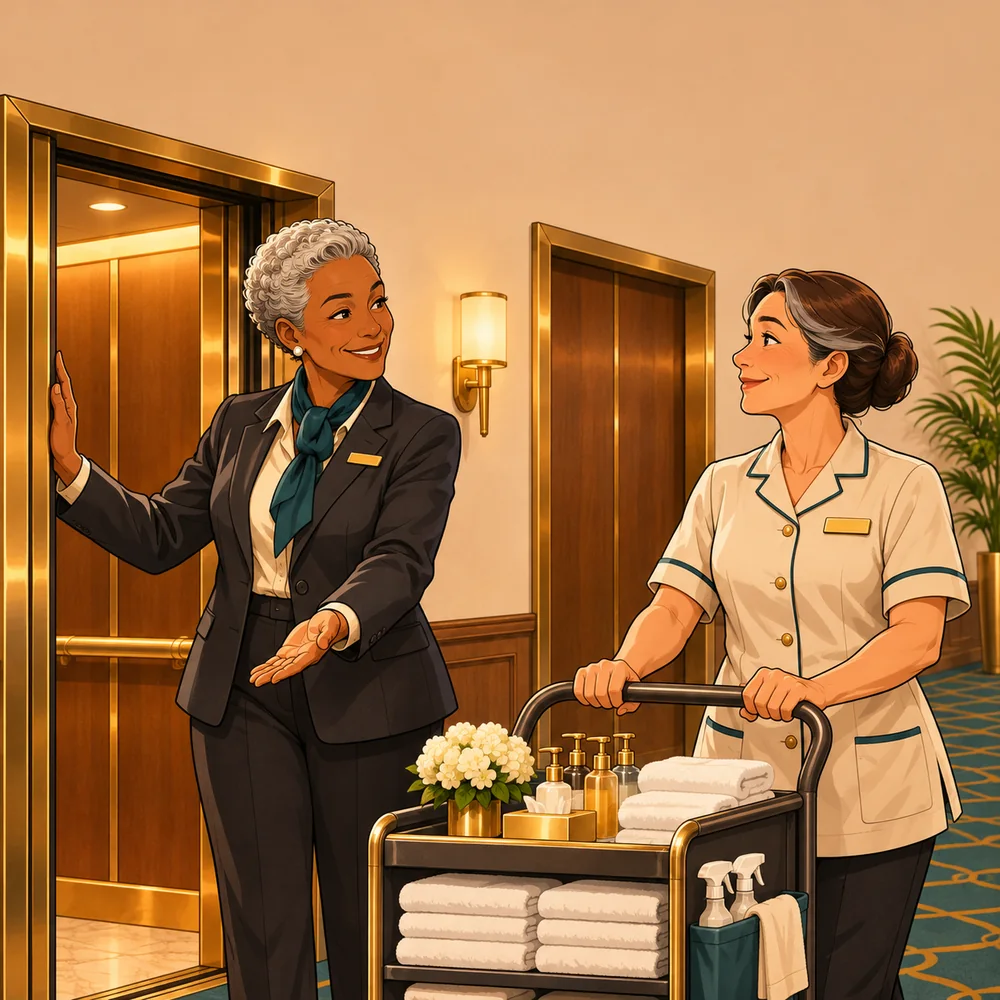
Respect runs both ways. “We are Ladies and Gentlemen serving Ladies and Gentlemen.”
A name turns an arrival into a welcome. The Ritz-Carlton’s Gold Standards call for a warm greeting using the guest’s name.2 Think of the difference between “Next!” and “Welcome, Ms. Grant. We’re glad you’re here.” The second greeting recognizes a person before processing a reservation. It answers the first problem at the counter: Will anyone notice me?
Anticipation means helping before the guest has to manage you. In a GLOBIS interview, Ritz-Carlton Okinawa front-office assistant manager Chiaki Harada described offering early check-in or late checkout without waiting for a request. Hearing a guest cough might prompt an offer of a warm drink. Staff shared observations across teams so others could act on them, too.13 The point is simple: notice a small need and offer help before it becomes another thing the guest has to ask for.
Respect belongs on both sides of the counter. “We are Ladies and Gentlemen serving Ladies and Gentlemen” means the person carrying a suitcase or cleaning a room deserves dignity, too. The company’s Employee Promise emphasizes trust, respect and valuing staff; its Service Values give them a voice in their work.2 The practical lesson: treat employees as capable professionals whose judgment matters. That supports the attentive, personal service guests came for.
Ownership ends the runaround. The Service Values make responsibility personal: “I own and immediately resolve guest problems.”2 In a 2019 interview, former president Horst Schulze recalled that employees could spend up to $2,000 to fix a guest’s problem without asking a manager. His examples were small: a breakfast, a food basket.1 The lesson is the authority, not the amount: the person who hears the problem can help solve it, instead of making the guest start over with someone else.
Principles of Excellence
- Being noticed shows people they matter. A greeting by name tells a guest they were expected, not processed.
- Respect keeps a team talking. Staff treated as ladies and gentlemen, not servants, speak up about what they notice and help each other. That is how a need gets met before the guest asks.
- Authority ends the runaround. When the employee who hears a problem can fix it on the spot, the guest tells the story once, and nobody waits for a manager.
- Respect travels. People tend to pass on the way they’re treated. Treat staff as ladies and gentlemen, and guests are treated the same way.
5 Exceptional Practices for your Clinic
- At check-in. Look up, smile and use the patient’s name, even mid-call: a nod and “I’ll be right with you” counts. If you’re running behind, say so now and offer real options.
- Before a full skin exam. Introduce yourself by name and role. Explain what will happen, offer a gown and privacy, and knock before you come back in.
- After a biopsy. Answer the next question before it’s asked: how the results will reach them, and whom to call if they haven’t heard by the date your clinic sets. Put it in writing.
- When something goes wrong. A booking mix-up, a missing referral, a confusing bill: the first person who hears it owns it. Say “I’ll take care of it,” then use the fixes your clinic has agreed anyone may make, such as priority rebooking or validated parking. If it needs a clinician, hand it to a named person and tell the patient what happens next.
- When a colleague slips. Correct in private; thank in public, where patients can hear it. If a patient turns abusive, a clinician or manager steps in. Respect runs both ways.
Explore the Evidence Further
Explore the Evidence Further. All 13 sources, with methods, findings and clinic applications
Thirteen sources, grouped by kind of evidence. Each row gives the design and its main caution, the key finding, why it matters and a way to apply it. Study names link to the original sources, and the full references close this section. None of these sources tested the practices in a dermatology clinic, so every application is our proposal, not a tested intervention.
The Ritz-Carlton practice: company standards and first-person accounts
| Study or source | Setting, design and sample | Key finding | Why it matters | How to Apply It to Your Derm Clinic |
|---|---|---|---|---|
| Ritz-Carlton Gold Standards2 | Company standards: stated commitments, not audited outcomes. The published Three Steps of Service, Service Values, motto and Employee Promise for Ritz-Carlton hotels. |
| Ties the motto to working commitments: owning problems, teamwork, a voice in the work and respect for staff. | Proposed: write three or four clinic promises in the first person, such as “I own a patient’s problem until I hand it to a named person,” and review one at each huddle. |
| Horst Schulze interview, Knowledge at Wharton, 20191 | First-person account: his recollection, not outcome evidence. Edited interview with the former Ritz-Carlton president, published 2 May 2019. | Every employee was taught to resolve problems and could spend up to $2,000 to fix a guest’s problem without asking a manager. “Nobody ever spent $2,000.” His examples were small: a breakfast, a food basket. The $2,000 was authority to solve problems, not money for guests. | Authority given in advance. The amount signaled trust; it was not a budget. | Proposed: agree on a short list of fixes anyone may make on the spot, with limits: priority rebooking, validated parking, a callback from a named person. Clinical decisions stay with clinicians. |
| Ritz-Carlton Okinawa manager interview, GLOBIS, 201813 | Manager account at one hotel: interview with Takeshi Hara and Chiaki Harada, not a controlled study or chain-wide outcome audit. |
| Makes anticipation concrete: notice, offer, and communicate rather than wait for a complaint. | Proposed: offer the next useful piece of information before patients ask—for example, explain how biopsy results will arrive before they leave. |
Experiments: simulated clinical teams and laboratory tasks
| Study or source | Setting, design and sample | Key finding | Why it matters | How to Apply It to Your Derm Clinic |
|---|---|---|---|---|
| Riskin et al. 2015, Pediatrics4 | Randomized NICU simulation: not real patients. 24 neonatal intensive care teams in Israel; blinded judges scored videos of a simulated premature infant who deteriorated suddenly. | Teams were told a foreign expert was observing. The expert’s mildly rude comments, unrelated to anything the team had done, lowered scores:
| Disrespect affects the work itself, through the behaviors teams use to catch problems. | Proposed: during biopsies and excisions, ask for what you need politely and debrief privately later, so assistants keep speaking up about what they notice. |
| Riskin et al. 2017, Pediatrics5 | Randomized NICU simulation: not real patients; same research group. 39 neonatal intensive care teams, with arms testing ways to limit the effect. | Rudeness from the simulated infant’s mother lowered therapeutic performance and teamwork, such as information sharing and helping. A brief preventive exercise in avoiding cognitive distraction reduced most of the harm; a narrative exercise afterwards did not. | Rudeness from patients and families harms teams too, and preparation may blunt it. | Proposed: agree in advance who steps in when a patient or family member is rude, what they say, and who checks on the staff member afterwards. The study tested a brief cognitive exercise, not this plan. |
| Riskin et al. 2019, Pediatrics6 | Randomized NICU simulation: not real patients; a small effect. Four arms; 43 neonatal intensive care teams of two physicians and two nurses. | Gratitude expressed by the simulated mother modestly improved team performance (3.9 vs 3.6), mostly through better information sharing. | Positive regard moves the same behaviors the other way, with a smaller effect. | Proposed: pass on patients’ thanks at the huddle, and thank team members for specific things, where patients can hear it. |
| Porath and Erez 2007, Academy of Management Journal7 | Laboratory experiments: not health care. Three studies. | Rudeness reduced performance on routine and creative tasks and reduced helpfulness, whether it came from an authority figure or a third party, or was merely imagined. Disrupted thinking explained the effect. | A likely mechanism: rudeness takes attention the work needs. | Proposed: treat curt remarks in a busy session as a performance problem, not just a mood problem, and settle friction away from patients before the next visit. |
Observational studies: associations, not proof of cause
| Study or source | Setting, design and sample | Key finding | Why it matters | How to Apply It to Your Derm Clinic |
|---|---|---|---|---|
| Cooper et al. 2019, JAMA Surgery8 | Observational cohort: an association, not proof of cause; surgery, not dermatology. NSQIP data from two US academic medical centers, 2012 to 2016; 13,653 patients of 202 surgeons. | Patients of surgeons with four or more coworker reports of unprofessional behavior had complications 14.1% of the time, vs 10.7% for surgeons with none. Rates remained higher after adjustment. | Conduct that coworkers notice is associated with patient outcomes. | Proposed: give staff a safe, simple way to raise concerns about anyone’s conduct, clinicians included, and act on repeated concerns. This study does not show that dermatology complications would fall. |
| Molina et al. 2017, Annals of Surgery9 | Cross-sectional survey: an association, not proof of cause; inpatient surgery. Operating-room staff in 31 South Carolina hospitals (Safe Surgery 2015); 1,793 respondents (38.1% response). | Each one-point rise in a hospital’s mean staff rating of respect was associated with a lower 30-day death rate after inpatient surgery (adjusted relative risk 0.78). The pattern appeared among nurses but was often absent among surgeons. | Respect, rated by staff as part of surgical safety, tracked with outcomes. | Proposed: ask your team anonymously, a few times a year, whether they feel respected, and act on the answers. This is a hospital surgery association, not evidence of a survival benefit in dermatology. |
| Schneider et al. 1998, Journal of Applied Psychology12 | Observational, over time: associations; banking, not health care. Employee and customer surveys in 134 bank branches, with structural-equation and cross-lagged analyses. | Where employees felt supported, branches built a stronger climate for service, which predicted customers’ ratings of service quality. Customer perceptions also fed back into the climate. | How staff are treated reaches customers, and back again: the motto’s two directions. | Proposed: before asking the front desk for warmer service, fix what gets in its way, such as staffing gaps, slow tools or no backup, then watch patient comments. |
| Seibert et al. 2011, Journal of Applied Psychology11 | Meta-analysis: correlational studies; many industries, not health care specifically. | People who feel empowered at work were more satisfied and committed, performed better, and reported less strain and less intention to leave; empowered teams performed better. Empowerment tracked personal traits as strongly as workplace conditions such as management practices, support, leadership and work design. | Supports giving real authority within limits; the workplace conditions are the part leaders control. | Proposed: give each role one decision it owns, such as the front desk’s rebooking list; say so publicly, and back people when they use it. |
A program that built civility: a controlled comparison
| Study or source | Setting, design and sample | Key finding | Why it matters | How to Apply It to Your Derm Clinic |
|---|---|---|---|---|
| Leiter et al. 2011, Journal of Applied Psychology10 | Controlled comparison: allocation not stated in the abstract; self-reported measures. Six-month CREW program (Civility, Respect and Engagement at Work) in 8 health care units vs 33 contrast units; 1,173 and 907 survey respondents. | Program units improved more on coworker civility, supervisor incivility, respect, cynicism, job satisfaction, trust in management and absences. Better civility appeared to drive the gains in attitudes. The gains belong to the whole six-month program, not to courtesy alone. | A team can deliberately change how it treats itself. | Proposed: start smaller than CREW: a ten-minute monthly huddle on what helped and what hurt, with one change agreed each time. This is not the tested program. |
Limits, including a dated allegation
| Study or source | Setting, design and sample | Key finding | Why it matters | How to Apply It to Your Derm Clinic |
|---|---|---|---|---|
| California Department of Industrial Relations, Release 2025-703 | Government press release: allegations, outcome not verified; not a finding about current practice. 16 July 2025, about janitorial work at the Ritz-Carlton, Half Moon Bay. | California’s Labor Commissioner cited the Ritz-Carlton Hotel Company and janitorial contractors. The contractors allegedly misclassified 155 janitors as independent contractors, denying them minimum wage, overtime and other protections. Citations totaled more than $2 million; the hotel company could be jointly liable for about $746,000 if two of the contractors failed to pay. The release noted appeal rights. | A dignity motto covers only the people an organization actually treats by it, including contracted workers. | Proposed: extend introductions, thanks and huddle invitations to contracted workers: cleaners, scribes, interpreters and couriers. |
Across all twelve sources:
- None tested the Ritz-Carlton’s practices, its motto or a dermatology clinic.
- Simulations and laboratory tasks show mechanisms, not patient outcomes.
- Associations can reflect other differences between hospitals, surgeons or branches.
- A program’s results belong to the whole program, not to courtesy alone.
Principles of Excellence: related evidence from other settings
The main text explains the hotel’s practices in plain English. These studies test related ideas elsewhere; none measured the Ritz-Carlton.
| Point in the brief | Related evidence |
|---|---|
| Being noticed shows people they matter. | The greeting by name in the Gold Standards (company standards). No study here measures it directly.2 |
| Respect keeps a team talking. | In randomized simulations, rudeness cut information sharing and help-seeking in neonatal intensive care teams, and gratitude helped modestly; laboratory experiments point the same way (experiments).4, 5, 6, 7 |
| Authority ends the runaround. | Schulze’s account of authority given in advance and the Service Value on owning problems; across industries, empowerment is associated with better performance (a meta-analysis of correlational studies).1, 2, 11 |
| Respect travels. | In bank branches, support for employees fed a climate for service that customers noticed; coworker-reported conduct and staff-rated respect were associated with surgical outcomes (observational associations).8, 9, 12 |
Our clinic suggestions: proposed, not tested
The five practices and today’s action are our suggestions for a dermatology practice, not a tested program.
| Suggestion | What it draws on |
|---|---|
| At check-in: use the patient’s name; if you’re running behind, say so early. | The Ritz-Carlton’s warm greeting and anticipating needs (company standards).2 |
| Before a full skin exam: introduce yourself by name and role; offer a gown and privacy. | Ordinary professional courtesy and the dignity principle. No source here tests it. |
| After a biopsy: say how results will arrive and whom to call, in writing. | Anticipating needs (company standard).2 |
| When something goes wrong: the first person who hears it owns it, using fixes agreed in advance. | Owning guest problems (company standard); Schulze’s account of authority given in advance; empowerment research (an association).1, 2, 11 |
| When a colleague slips: correct in private, thank in public, and step in if a patient turns abusive. | Simulations on rudeness, including from a parent, and on gratitude (experiments).4, 5, 6 |
| Today: ask which small problem staff could fix on the spot; agree on limits; let them use it. | Schulze’s account of authority; the Service Value on being involved in planning one’s work.1, 2 |
Sources
- Knowledge at Wharton. Becoming the best: excellent customer service always wins (interview with Horst Schulze). 2 May 2019. knowledge.wharton.upenn.edu
- The Ritz-Carlton Leadership Center. Foundations of our brand: Gold Standards. ritzcarltonleadershipcenter.com
- California Department of Industrial Relations. Labor Commissioner cites the Ritz-Carlton and subcontractors more than $2 million for misclassifying workers (Release 2025-70). 16 July 2025. dir.ca.gov
- Riskin A, Erez A, Foulk TA, et al. The impact of rudeness on medical team performance: a randomized trial. Pediatrics. 2015;136(3):487-95. PubMed 26260718 · doi:10.1542/peds.2015-1385
- Riskin A, Erez A, Foulk TA, et al. Rudeness and medical team performance. Pediatrics. 2017;139(2):e20162305. PubMed 28073958 · doi:10.1542/peds.2016-2305
- Riskin A, Bamberger P, Erez A, et al. Expressions of gratitude and medical team performance. Pediatrics. 2019;143(4):e20182043. PubMed 30846617 · doi:10.1542/peds.2018-2043
- Porath CL, Erez A. Does rudeness really matter? The effects of rudeness on task performance and helpfulness. Acad Manage J. 2007;50(5):1181-97. doi:10.5465/amj.2007.20159919
- Cooper WO, Spain DA, Guillamondegui O, et al. Association of coworker reports about unprofessional behavior by surgeons with surgical complications in their patients. JAMA Surg. 2019;154(9):828-34. PubMed 31215973 · doi:10.1001/jamasurg.2019.1738
- Molina G, Berry WR, Lipsitz SR, et al. Perception of safety of surgical practice among operating room personnel from survey data is associated with all-cause 30-day postoperative death rate in South Carolina. Ann Surg. 2017;266(4):658-66. PubMed 28657942 · doi:10.1097/SLA.0000000000002378
- Leiter MP, Laschinger HKS, Day A, Oore DG. The impact of civility interventions on employee social behavior, distress, and attitudes. J Appl Psychol. 2011;96(6):1258-74. PubMed 21744942 · doi:10.1037/a0024442
- Seibert SE, Wang G, Courtright SH. Antecedents and consequences of psychological and team empowerment in organizations: a meta-analytic review. J Appl Psychol. 2011;96(5):981-1003. PubMed 21443317 · doi:10.1037/a0022676
- Schneider B, White SS, Paul MC. Linking service climate and customer perceptions of service quality: tests of a causal model. J Appl Psychol. 1998;83(2):150-63. doi:10.1037/0021-9010.83.2.150
- Vlad C. Anticipating Guest Expectations at The Ritz-Carlton, Okinawa. GLOBIS University. Interview with Takeshi Hara and Chiaki Harada, 23 February 2018. GLOBIS interview