The Last Minutes Shape the Memory. Design How Your Visits End.
Four ways to design the end of a dermatology visit: a clear, clinician-approved recap, the next step in writing, the estimate discussed privately and early, and a goodbye that isn’t rushed.
What you’ll take away
- The problem
- A careful visit can still end on a rushed goodbye, a balance due and no clear next step, and that ending is part of what the patient takes home.
- What to remember
- How a procedure ends can change how the whole of it is remembered. Design the last minutes on purpose, and never by making anything longer or more uncomfortable.
- What to do differently
- End every procedure visit the same way: a clinician-approved recap once the patient is ready, the next step in writing, the estimate discussed privately and early, and a goodbye that isn’t rushed.
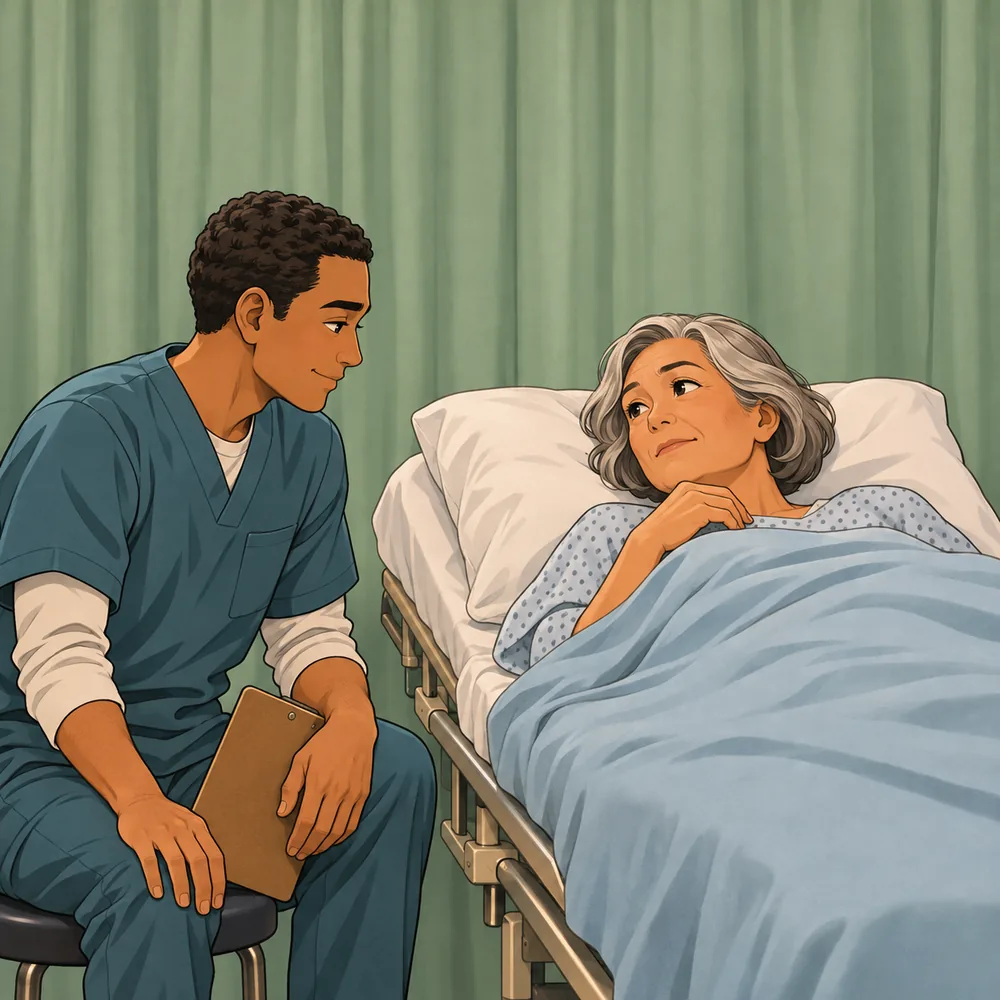
Patients take the end of a visit home with them. A patient has a shave biopsy on her back. The care is careful and kind. Then the last two minutes go like this: she dresses alone, someone leans in to say “You’re all set,” and at the desk the first thing she hears is a balance due. She walks out unsure when the result will come or who will call. Nobody planned that ending. It just happened. Yet how a procedure ends can change how the whole of it is remembered, and an ending can be designed. Three researchers showed this in a Toronto hospital in the mid-1990s, with 682 colonoscopy patients and one change made only to the final minutes.
The study staff member says: “Your pain right now, zero to ten?”
The patient says: “Maybe a three.”
Measure the moment. In Toronto in 1994 and 1995, patients rated their pain every minute during the procedure, from zero to ten.
The study staff member says: “Now the whole thing. How unpleasant was it?”
The patient says: “About here.”

Then measure the memory. Once sedation had worn off, each patient marked how unpleasant the whole procedure had been on a 10 cm line.
It began with a puzzle about memory. In 1993 experiments with pleasant and unpleasant film clips, Barbara Fredrickson and Daniel Kahneman found that length had only small effects on how people judged a clip afterwards; their judgments looked like “a weighted average of ‘snapshots’.”2 In 1996, Donald Redelmeier and Kahneman found a similar pattern in 154 colonoscopy and 133 lithotripsy patients: remembered pain tracked the worst moment and the last three minutes, and long procedures were not remembered as especially bad.3 The pattern is known as the peak-end rule.
A trial in Toronto asked the harder question: if only the ending changes, does the memory change? Between November 1994 and December 1995, Redelmeier, Joel Katz and Kahneman enrolled 682 outpatients having colonoscopy at a Toronto hospital.1 Each patient was assigned a sealed envelope at the start, and it was opened only at the final stage of the procedure. For patients assigned the modified ending, the tip of the scope was then left resting for up to three minutes before removal, with no suction, no inflation and no added anaesthetic. Patients were never told which group they were in, and staff were asked to keep their behavior unchanged.1
Only the ending changed, and the memory changed with it. Patients rated their pain from zero to ten every minute. Pain in the final minutes was lower with the modified ending (1.7 versus 2.5), with no significant difference at the start, in the middle or at the worst moment; the procedure ran about 0.8 minutes longer on average.1 Once sedation had worn off, patients also rated how unpleasant the whole procedure had been, a separate measure from the minute-by-minute pain scores. Those with the gentler ending remembered it as less unpleasant: 4.4 versus 4.9 on a 10 cm line, about 10 percent lower.1
Length barely registered. Across all 682 patients, how long the procedure lasted hardly tracked how it was remembered, while average pain over the whole procedure tracked it most closely.1 The ending is the part a team can plan, and when this team changed it, the memory moved with it.
Their advice was gentleness, with the ethics in view. The authors called the trial a proof of concept.1 They suggested physicians take “special gentleness and care at the end” of an unpleasant procedure on an awake patient, especially one with no previous procedure and no abnormal findings, and they named the ethical tension with patient autonomy themselves.1 A 2025 ethical analysis argues that prolonging painful procedures to exploit the rule, without telling patients, fails to respect their autonomy and may violate the duty to do no harm.5
Service businesses got similar advice. In Harvard Business Review in 2001, Richard Chase and Sriram Dasu set out five principles for service drawn from behavioral science. The first was to end strongly, because the ending is the part customers remember. The second was to deal with the unpleasant experiences early.4 For a clinic, the lesson is the shape of the visit, not its length: make the last minutes calmer and clearer, never longer or harder.
Principles of Excellence
- The ending is part of the experience. Changing only the final minutes of a colonoscopy, with no significant change at the start, in the middle or at the worst moment, made the whole procedure remembered as less unpleasant.1
- Length is not the lever. How long the procedure lasted barely tracked how it was remembered; average pain, the worst moment and the end tracked it more. Pooled studies, as corrected by their authors, put length close to zero too.1, 6
- Measure the memory, not just the moment. Pain every minute, how unpleasant the whole procedure was remembered to be once sedation wore off, and years of return visits: the team measured all three and kept them separate.1
- Gentler, never longer. The trial’s authors advised being especially gentle and careful as an unpleasant procedure draws to a close. A 2025 analysis argues that stretching a painful procedure without telling patients fails to respect their autonomy.1, 5
- End strongly, and get the hard parts done early. These were Chase and Dasu’s first two service principles: end well, because the ending is what stays with the customer, and deal with the unpleasant experiences early.4
4 Exceptional Practices for your Clinic
- Close the room before the patient stands. In Toronto, only the final minutes changed, and patients remembered the whole procedure as less unpleasant. A better last few minutes can improve what the patient remembers. After a shave biopsy, once the patient is comfortable and ready, and before she stands, the nurse gives a concise recap from the clinician’s approved template: what was done, how to care for the site, when to expect an update and who will call. Questions about the diagnosis or treatment go to the clinician.
- Put the next step in writing. The Toronto team measured more than pain: they followed patients for years to see who came back for another colonoscopy. The end of today’s visit is also the start of the next one. When the nurse finishes the recap, she hands over the written next step: when to expect an update and who will call, the warning signs to call about and the clinic’s number. If the clinician has planned a follow-up visit, the scheduler gives its date in writing before the patient leaves.
- Keep the bill out of the last minute. Chase and Dasu advised ending strongly and dealing with the unpleasant experiences early. When the hard moments come first, the last minute is free for the recap and the goodbye. Before an excision, the billing specialist goes over the estimate with the patient privately and early, by phone before the visit or in a private spot at check-in. At checkout, the front desk only confirms what was already agreed and books any follow-up the clinician ordered.
- Give the goodbye time. The trial’s authors suggested being especially gentle and careful as a procedure finishes, especially for people having one for the first time. The ending is the part a patient carries out the door. When a patient checks out after a first biopsy, the front desk stops typing, turns to face her, confirms when to expect an update and who will call, and asks whether anything is unclear. If the question is clinical, the front desk walks it back to the nurse or the clinician rather than answering it.
Explore the Evidence Further
Explore the Evidence Further. All 18 sources, with methods, findings and clinic applications
Eighteen sources, grouped by kind of evidence: the Toronto trial and the ethics of changing an ending, the earlier studies and a service framework, later studies in health care, the pooled evidence as its authors corrected it, and studies where endings did not stand out. Each row gives the design and its main caution, the key finding, why it matters and a way to apply it. Study names link to the original sources, and the full references close this section. None of these sources measured the end of a dermatology visit. The clinic scenes on this page are illustrations, not documented cases, and every clinic application is our proposal, not a tested intervention. A spoken recap, a written next step and a checkout goodbye borrow the structure of the Toronto trial, not its evidence: the trial changed the physical end of a procedure.
The Toronto trial, and the ethics of changing an ending
| Study or source | Setting, design and sample | Key finding | Why it matters | How to Apply It to Your Derm Clinic |
|---|---|---|---|---|
| Redelmeier, Katz and Kahneman, “Memories of colonoscopy: a randomized trial”: design and the ending1 | Randomized trial: 682 consecutive colonoscopy outpatients at one Toronto hospital (733 approached), medically stable, mentally competent and English-speaking, recruited 7 November 1994 to 12 December 1995 and published in 2003; conventional sedation of the era. Sealed envelopes were assigned at the start and opened only at the final stage; patients were never told their group, and staff were asked to keep their behavior unchanged. Pain was rated every 60 seconds on a 0 to 10 scale. Full text read. A historical cohort, not current colonoscopy practice or dermatology evidence, and Kahneman is a co-author, so it is not independent of the idea’s originator. | In the modified group the scope tip was held still inside the rectum, for as long as 3 minutes, before it was withdrawn, and nothing else was done in that time: no suction, no inflation and no extra anaesthetic. Final-phase pain was 1.7 versus 2.5 (P < 0.001; mean of the final 3 minutes), with no statistically significant difference in initial, middle or worst pain. The procedure lasted 27.6 versus 26.8 minutes on average (P > 0.20), about 0.8 minutes longer. | Only the ending changed, so any change in memory can be traced to it. | Proposed: design the last minutes of a procedure visit on purpose, starting with a recap before the patient stands. Never lengthen a procedure, delay removing an instrument or add discomfort to shape a memory; any change to a procedure is the clinician’s decision. |
| Redelmeier, Katz and Kahneman: remembered discomfort1 | Randomized trial, memory outcomes and correlations: Retrospective ratings taken after the effects of sedation had abated (the paper does not say the same day). The correlations are within the trial cohort, not causal weights. | Patients with the gentler ending rated total discomfort 4.4 versus 4.9 on a 10 cm visual analogue scale (P = 0.006), about 10 percent lower in relative terms, not 10 points, and ranked colonoscopy 4.1 versus 4.6 among eight items, itself plus seven other unpleasant experiences (8 = worst; P = 0.002); results were similar after adjustment. Across all 682 patients, remembered discomfort correlated with average pain r = 0.56, peak pain 0.44, mid-procedure pain 0.40, final pain 0.33, initial pain 0.32 and duration 0.10, a weak association. On correlations alone the ending carried no extra weight; its importance here rests on the randomized comparison. | A gentler ending changed how the whole procedure was remembered, while the whole experience still tracked memory most closely. | Proposed: keep the ending calm and clear, and keep working on the whole visit; a good goodbye does not repair a long wait or a missed step. |
| Redelmeier, Katz and Kahneman: who came back1 | Randomized trial, behavioral outcome: Return for repeat colonoscopy from Ontario billing data to August 2000, median follow-up 5.3 years. The adjustment used three predictors chosen by step-wise regression. The memory-return link is an association within the cohort, not a randomized effect of changing memory. Remembered discomfort and observed return are different outcomes. | Return was 53 versus 48 percent, not statistically significant unadjusted (P > 0.20; 18 percent relative increase in odds, 95% CI −13% to 59%). Adjusted for prior colonoscopy, indication and abnormal findings, the odds of return were 41 percent higher (odds ratio 1.41, 95% CI 2% to 96%, P = 0.038); this is not 41 percent more patients returning. In a subgroup analysis, the difference was concentrated among patients otherwise unlikely to return (43 versus 32 percent, n = 426, P = 0.023), with no significant difference among those likely to return (72 versus 71 percent, n = 256), which is not proof of no effect; the authors’ estimate of about one extra return per nine patients treated applies only to the low-propensity subgroup. Separately, patients who ranked colonoscopy the worst of the listed experiences returned less often than those who ranked it the best (45 versus 64 percent, P = 0.016). | Memory and return went together, but the gentler ending’s own effect on return was modest and appeared only after adjustment. | Proposed: leave the next step in writing, and don’t promise or expect more return visits from a nicer ending. |
| Redelmeier, Katz and Kahneman: the authors’ limits and advice1 | Authors’ discussion: The trial authors speaking in 2003. Their recommendation is about how an unpleasant procedure physically finishes, not conversation or checkout, and it is not an approved clinic protocol. | They called the study a proof of concept and noted that significant return differences appeared only after controlling for clinical features. They also note that memories are not the only factor in behavior, that repeat colonoscopy is not always needed, and that they did not know what each patient was told afterwards. They suggested physicians use “special gentleness and care at the end of an aversive procedure” on an awake patient, especially with no previous procedure and no abnormal findings, and named an ethical tension between the limits of human judgment and patients’ right to decide for themselves. | The researchers themselves framed the result as modest and the use of it as an ethical question. | Proposed: slow the goodbye, not the procedure: the front desk gives the last minute its full attention. |
| Armitage, “Prolonging Medical Procedures to Exploit the Peak-End Rule: An Ethical Analysis”5 | Ethical analysis: A peer-reviewed normative analysis by one UK author (University of Nottingham), published 28 August 2025. Full text read from a preserved copy. Not an empirical result, consensus or legal guidance. | Armitage argues that prolonging painful procedures to exploit the peak-end rule without telling patients fails to respect autonomy and may violate non-maleficence. He notes it is unclear whether the effect persists if patients are fully informed, and that reducing peak pain with analgesia is a separate route needing its own analysis. The same paper says prolonging appears to satisfy the principles of beneficence and justice, before concluding that failing to inform patients is the main problem. | It draws the line a clinic must not cross: no added time or discomfort to shape a memory. | Proposed: explain honestly, if a patient asks, why every visit ends the same way; never stretch a procedure or add discomfort for effect. |
Where the idea came from: film clips, two procedures and a service framework
| Study or source | Setting, design and sample | Key finding | Why it matters | How to Apply It to Your Derm Clinic |
|---|---|---|---|---|
| Fredrickson and Kahneman, “Duration neglect in retrospective evaluations of affective episodes”2 | Laboratory experiments: Two experiments with 32 and 96 university volunteers who watched pleasant and aversive film clips, published in 1993. Abstract only. Film clips, not clinic visits; effect sizes do not transfer. | The length of a clip had small effects on later judgments, further reduced when judged from memory. Retrospective evaluations looked like “a weighted average of ‘snapshots’”, “as if duration did not matter.” | It is the laboratory starting point for the idea that length matters little to memory. | Proposed: don’t judge a visit by its length alone; look at its hardest moment and its last minute too. |
| Redelmeier and Kahneman, “Patients’ memories of painful medical treatments”3 | Observational study: Real-time and retrospective pain recordings in Toronto patients having colonoscopy (154) or lithotripsy (133), published in 1996. Abstract only. Correlations, not a test of changing anything; co-authored by the idea’s originator. | Judgments of total pain correlated strongly with peak intensity (P < 0.005) and with intensity in the last 3 minutes (P < 0.005); longer procedures were not remembered as especially unpleasant. | It found the pattern in real medical procedures, not only in the laboratory. | Proposed: at the end-of-day huddle, ask about procedure visits: what was the hardest moment, and what was the last thing the patient heard? Note one change for tomorrow, with no patient identifiers. |
| Chase and Dasu, “Want to perfect your company’s service? Use behavioral science”4 | Management article: Harvard Business Review, June 2001, read through its PubMed abstract; the article body is paywalled and was not read. A practitioner framework translating behavioral research, not a test, and not a proven ranking of every moment of a visit. | Five principles, led by “finish strong”, because the ending is the part customers remember, and “get the bad experiences out of the way early”. The other three: spread out the pleasant parts and bundle the unpleasant ones, let people choose so they feel committed, and keep to familiar rituals. | It turns memory research into advice for the order of a service encounter. | Proposed: discuss estimates privately before the procedure, so checkout only confirms what was agreed. Required cost information is never delayed or hidden. |
Later studies in health care
| Study or source | Setting, design and sample | Key finding | Why it matters | How to Apply It to Your Derm Clinic |
|---|---|---|---|---|
| Yen and colleagues, “Adding a nonpainful end to reduce pain recollection of Pap smear screening”9 | Randomized trial: Women aged 30 to 70 at a Taiwanese cervical screening center; 266 analyzed (intention to treat); published 2023. Abstract only. The abstract does not say what the nonpainful final step was. Willingness at one year is stated intention, not observed repeat screening. | A nonpainful final step lowered recalled pain (1.50 versus 2.02 on a five-point scale; 2.12 versus 3.12 on a 0 to 10 scale) and raised stated willingness, a year later, to repeat Pap testing (adjusted beta 2.11, P < 0.001). | A second randomized trial, in a different procedure, found the same direction for remembered pain. | Proposed: treat remembered discomfort and willingness to come back as separate things when you ask patients about a visit. |
| Chajut and colleagues, “In pain thou shalt bring forth children: the peak-and-end rule in recall of labor pain”10 | Observational study: Mothers at an Israeli medical center, asked about labor pain at 2 days and 2 months; published 2014. Abstract only; sample size not given in the abstract. No dermatology intervention. | Memory of labor pain was pulled toward the average of the worst pain and the pain at the end, and duration had little effect. An epidural at the end changed the remembered pain, and at two months the effect was weaker in mothers who had given birth before. | Peak and end showed up in memory of a long, real, painful experience. | Proposed: pay attention to the hardest moment as well as the last one; how to ease pain is always the clinician’s decision. |
| Schneider and colleagues, “Peak and end effects in patients’ daily recall of pain and fatigue”11 | Ecological momentary assessment: 97 US rheumatology patients rated symptoms several times a day for 28 days; published 2011. Abstract only. Chronic symptoms, not single visits. | Peak and end pain created a small bias in daily recall of pain, and no significant peak or end effect was found for fatigue, with large differences between individuals. The authors judged the effects too small to distort end-of-day reports much. | The effect can be small and varies from person to person. | Proposed: keep the designed ending modest and consistent; it is one part of a visit, not the whole. |
| Wu and colleagues, “Three-step irradiance schedule versus two-step irradiance schedule for pain control during topical 5-aminolevulinic acid-photodynamic therapy of facial acne”12 | Randomized comparative study: 90 patients with moderate to severe facial acne randomized at one hospital in Shenyang (87 completed); published 2022. Abstract only. A clinical treatment change with clinical efficacy measured, not a front-desk or conversation change; the abstract does not separate a gentler ending from lower overall intensity. | A three-step light schedule “derived from the psychological ‘peak-end rule’” gave lower pain recorded 30 minutes after each session (1.61 versus 3.14) with similar effectiveness (88.64 versus 88.37 percent). | It is the one dermatology trial found, and it changed the treatment itself. | Proposed: leave any change to how a treatment ends to the clinician; it is never a front-desk or scripting decision. |
| Scheveneels and colleagues, “Applying the peak-end rule to improve exposure outcomes in fear and anxiety”13 | Small experiment: 36 spider-fearful volunteers in the Netherlands and Belgium, virtual-reality exposure; published online 17 March 2026. Abstract only; the authors call the support preliminary. Retrospective ratings and willingness, not clinical adherence. | Ending the exposure at low fear made it remembered as less unpleasant and frightening, raised willingness to repeat it and reduced avoidance. | Researchers are still testing endings in 2026, in a very different setting. | Proposed: don’t read willingness to return as actual return; they are different outcomes. |
The pooled evidence, as its authors corrected it
| Study or source | Setting, design and sample | Key finding | Why it matters | How to Apply It to Your Derm Clinic |
|---|---|---|---|---|
| Alaybek and colleagues, peak-end meta-analysis: the authors’ posted corrigendum materials6 | Meta-analysis, authors’ posted corrected tables: A 2022 meta-analysis of studies relating moments of an experience to later summary judgments. A corrigendum was published in January 2024 (volume 180, article 104278, per its Crossref record8). The figures here are read from the authors’ own posted files: recoded data, sign-reversal rules, the corrigendum supplement tables and analysis outputs. The printed corrigendum and the paper’s full text were not read, and no analysis was rerun, so this is repository evidence, not proof that every posted value matches print. Correlations across heterogeneous pooled samples, most with very high heterogeneity; not effects of changing a clinic moment. A journal editor’s note, seen only as publisher-indexed text and not in the printed corrigendum, reports that the researchers who raised the coding issue do not agree with the new coding. | In the posted corrigendum supplement Table S5 (unipolar scales), correlations with later judgments were: overall average .60, peak-end average .54, peak .51, end .44, lowest moment .39, beginning .36, trend .08 and duration .04; the original 2022 supplement gave .61, .58, .53, .46, .43, .40, .11 and .00.7 In the 58 samples that reported peak, end and average together (Table S4), the corrected estimates were average .60, peak .50 and end .47, with no formal peak-versus-end test seen. The posted main-table output (Table 2) is a separate file: it gives a combined peak-end row of .568, a peak-end average of .5349 (Table S5 prints .54) and a trend of .0988 (Table S5 prints .08). The originally published combined estimate, r = .581, is historical, and which corrected value replaces it in print is unconfirmed. In a December 2023 sensitivity file, leaving out every sign-reversed effect changed 37 moderator estimates by −0.003 to +0.103, with five outside the original confidence interval. | Across many studies, the whole experience tracked later judgments most closely, with the peak and the end behind it and length near zero. | Proposed: fix the whole visit first, then design the end; a warm goodbye does not repair a long wait. |
| Strijbosch and colleagues, “From Experience to Memory”: two earlier studies, as described14 | Secondary description: A 2019 peer-reviewed paper whose introduction describes two earlier studies. Neither primary study was opened, so both findings are secondhand and attributed to Strijbosch and colleagues’ description. Only these two descriptions are used in this brief. | They report that Geng and colleagues (2013) found peaks, ends and peak-ends predicted how a vacation was remembered the day after and three weeks after, but not seven weeks after, and they call the lack of data on the rule’s robustness over time a substantial gap. They also report that a 2008 meta-analysis by Cojuharenco and Ryvkin found peak, end, peak-end and average scores are often highly correlated, more so for varied experiences, which makes it hard to credit the end on its own. | An ending’s effect on memory may fade, and its share is hard to separate from the rest. | Proposed: design the ending for clarity today, not as a way to change how a visit is remembered months later. |
Where endings did not stand out
| Study or source | Setting, design and sample | Key finding | Why it matters | How to Apply It to Your Derm Clinic |
|---|---|---|---|---|
| Miron-Shatz, “Evaluating multiepisode events: boundary conditions for the peak-end rule”15 | Large survey: About 2,435 people in the United States (810), France (820) and Denmark (805) reconstructed the previous day; published 2009. Abstract only. Whole days are multi-episode events, not single visits. | Judgments of the whole day relied on the average feeling and, in this study’s comparison, ignored ends; lows, and occasionally peaks, also counted. | For a long, many-part day, the end did not stand out. | Proposed: on a long, multi-step visit, fix the middle as well as the end. |
| Kemp, Burt and Furneaux, “A test of the peak-end rule with extended autobiographical events”16 | Diary study: 49 New Zealand students sent daily text messages over about seven days of vacation; published 2008. Abstract only. | The peak-end rule “was not an outstandingly good predictor” of remembered happiness, duration had no effect, and much of the remembered feeling was reconstructed. | In a long, pleasant experience, peak and end predicted memory only modestly. | Proposed: don’t rely on the ending alone; it is one part of the visit. |
| Rode, Rozin and Durlach, “Experienced and remembered pleasure for meals”17 | Studies of real and imagined meals: US university participants; two real meals and one imagined meal; published 2007. Abstract only. Meals, not procedures, and no transfer to all positive service experiences. | Remembered pleasure showed duration neglect but no peak, first-dish or last-dish effects, with only weak evidence that rising patterns are preferred. | Endings designed like a restaurant’s dessert course may not carry over. | Proposed: put the effort into a clear, calm ending rather than a treat at the door. |
| Mah and Bernstein, “No Peak-End Rule for Simple Positive Experiences Observed in Children and Adults”18 | Pre-registered replication experiments: Three experiments with 988 people aged 2 to 97; the first was pre-registered midway through data collection and the later ones in advance; candy and toys; published 2019. Full text read. They tested whether adding a lesser gift after a better one lowers satisfaction, not whether a pleasant extra at the end improves memory, and they do not establish that a clinic giveaway never helps. | No peak-end effect for small positive gifts in preschoolers, school-age children, younger adults or older adults; the authors argue the original study was underpowered. | For small, simple pleasures, the rule did not replicate. | Proposed: don’t count on a small end-of-visit token; this evidence neither supports nor rules one out. |
Across all eighteen sources:
- None measured the end of a dermatology visit. The recap, the written next step, earlier billing and the unhurried goodbye borrow the structure of a designed ending; the Toronto trial changed the physical end of a procedure, and no source shows that these clinic changes improve satisfaction, adherence, safety or return.
- Remembered discomfort, stated willingness to repeat and observed return are three different outcomes. The Toronto trial changed remembered discomfort; its return difference was not significant before adjustment.
- In the trial, average pain tracked memory more closely than the worst moment or the end, and in the corrected pooled figures the overall average came first. The case for the ending rests on the randomized comparison.
- Several studies found little or no end effect: whole days, vacations, meals and small gifts. Durability is uncertain, from a secondhand description.
- Abstracts only: eleven of the eighteen sources. The Toronto trial and the 1993 and 1996 studies were co-authored by Kahneman, so they are not independent of the idea’s originator.
- The pooled figures come from a 2022 meta-analysis as corrected by its authors in 2024, read from their posted tables rather than the printed corrigendum.
Principles of Excellence: related evidence from other settings
The main text explains the Toronto trial in plain English. These sources describe it or study related ideas elsewhere; none measured the end of a dermatology visit.
| Point in the brief | Related evidence |
|---|---|
| The ending is part of the experience. | Changing only the final minutes changed the remembered rating of the whole procedure (randomized trial, Toronto, 1994 to 1995).1 Memory of total pain tracked the worst and the last three minutes (observational, abstract only).3 A nonpainful final step lowered recalled pain in Pap testing (randomized trial, abstract only).9 |
| Length is not the lever. | Duration correlated weakly with memory in the trial (r = 0.10; correlations).1 Film length had small effects on later judgments (laboratory experiments, abstract only).2 Corrected pooled correlation for duration .04, against .60 for the overall average (authors’ posted Table S5).6 |
| Measure the memory, not just the moment. | Real-time pain, remembered discomfort and return were measured separately and gave different results (randomized trial).1 Recalled pain and stated willingness were separate outcomes in the Pap trial (randomized trial, abstract only).9 |
| Gentler, never longer. | The trial authors’ recommendation and the ethical tension they named (trial report).1 Prolonging procedures without telling patients fails to respect autonomy (ethical analysis, one author; normative).5 |
| End strongly, and get the hard parts done early. | Chase and Dasu’s first two service principles (management article, abstract only; advice, not a test).4 |
Our clinic suggestions: proposed, not tested
The four practices and today’s action are our suggestions for a dermatology practice, not a tested program.
| Suggestion | What it draws on |
|---|---|
| Close the room before the patient stands: a nurse’s concise recap from a clinician-approved template after a shave biopsy, once the patient is comfortable and ready. | The trial changed the physical end of a procedure, not a conversation (randomized trial).1 The recap borrows the idea of a designed ending, not the trial’s evidence. The clinic scene is an illustration, not a documented case. |
| Put the next step in writing: when to expect an update and who will call, warning signs and the clinic’s number. | Patients who remembered colonoscopy as worst returned less often (association within the trial); the trial’s own return difference was significant only after adjustment.1 |
| Keep the bill out of the last minute: the estimate discussed privately before the excision; checkout only confirms. | End strongly and deal with the unpleasant experiences early (management article, abstract only; advice, not a test).4 |
| Give the goodbye time: the front desk’s full attention at checkout after a first biopsy; clinical questions go back to the nurse or the clinician. | The trial authors’ advice to be especially gentle as an unpleasant procedure finishes (trial report), applied here by analogy to checkout.1 |
| One action today: watch the last two minutes of five procedure visits. | No study tested this one-day observation; it applies the same pattern. |
Sources
- Redelmeier DA, Katz J, Kahneman D. Memories of colonoscopy: a randomized trial. Pain. 2003;104(1-2):187-194. doi:10.1016/S0304-3959(03)00003-4. Author-hosted PDF (sparq.stanford.edu)
- Fredrickson BL, Kahneman D. Duration neglect in retrospective evaluations of affective episodes. J Pers Soc Psychol. 1993;65(1):45-55. doi:10.1037/0022-3514.65.1.45. pubmed.ncbi.nlm.nih.gov
- Redelmeier DA, Kahneman D. Patients’ memories of painful medical treatments: real-time and retrospective evaluations of two minimally invasive procedures. Pain. 1996;66(1):3-8. doi:10.1016/0304-3959(96)02994-6. pubmed.ncbi.nlm.nih.gov
- Chase RB, Dasu S. Want to perfect your company’s service? Use behavioral science. Harv Bus Rev. 2001;79(6):78-84, 147. PubMed abstract. pubmed.ncbi.nlm.nih.gov
- Armitage RC. Prolonging Medical Procedures to Exploit the Peak-End Rule: An Ethical Analysis. J Eval Clin Pract. 2025;31(6):e70264. doi:10.1111/jep.70264. pmc.ncbi.nlm.nih.gov
- Alaybek B, et al. Peak-End Rule Meta-Analysis, Open Science Framework project 74tph, folder “June 2023 Update”: description of files, online supplement tables for the corrigendum, analysis outputs, sign-reversal rules (July to August 2023) and a no-reversed-sign comparison (29 December 2023). osf.io
- Alaybek B, et al. Peak-End Meta-Analysis Online Supplement (original 2022 coding). Open Science Framework project 74tph, uploaded 27 March 2022. osf.io
- Crossref metadata record for the corrigendum to “All’s well that ends (and peaks) well?”, Organizational Behavior and Human Decision Processes 2024;180:104278. doi:10.1016/j.obhdp.2023.104278. Retrieved 10 November 2026. api.crossref.org
- Yen HK, Cheng SY, Chiu KN, Huang CC, Yu JY, Chiang CH; NTUH Pap Study Group. Adding a nonpainful end to reduce pain recollection of Pap smear screening: a randomized controlled trial. Pain. 2023;164(8):1709-1717. doi:10.1097/j.pain.0000000000002897. pubmed.ncbi.nlm.nih.gov
- Chajut E, Caspi A, Chen R, Hod M, Ariely D. In pain thou shalt bring forth children: the peak-and-end rule in recall of labor pain. Psychol Sci. 2014;25(12):2266-2271. doi:10.1177/0956797614551004. pubmed.ncbi.nlm.nih.gov
- Schneider S, Stone AA, Schwartz JE, Broderick JE. Peak and end effects in patients’ daily recall of pain and fatigue: a within-subjects analysis. J Pain. 2011;12(2):228-235. doi:10.1016/j.jpain.2010.07.001. pubmed.ncbi.nlm.nih.gov
- Wu HE, Liu YB, Cui L, Xu GJ, Sun XD. Three-step irradiance schedule versus two-step irradiance schedule for pain control during topical 5-aminolevulinic acid-photodynamic therapy of facial acne in Chinese patients: a prospective randomized comparative study. Lasers Surg Med. 2022;54(2):224-229. doi:10.1002/lsm.23464. pubmed.ncbi.nlm.nih.gov
- Scheveneels S, Dibbets P, Hommerich Z, Van Den Bergh O. Applying the peak-end rule to improve exposure outcomes in fear and anxiety. Cogn Emot. Published online 17 March 2026. doi:10.1080/02699931.2026.2644243. pubmed.ncbi.nlm.nih.gov
- Strijbosch W, Mitas O, van Gisbergen M, Doicaru M, Gelissen J, Bastiaansen M. From Experience to Memory: On the Robustness of the Peak-and-End-Rule for Complex, Heterogeneous Experiences. Front Psychol. 2019;10:1705. doi:10.3389/fpsyg.2019.01705. frontiersin.org
- Miron-Shatz T. Evaluating multiepisode events: boundary conditions for the peak-end rule. Emotion. 2009;9(2):206-213. doi:10.1037/a0015295. pubmed.ncbi.nlm.nih.gov
- Kemp S, Burt CD, Furneaux L. A test of the peak-end rule with extended autobiographical events. Mem Cognit. 2008;36(1):132-138. doi:10.3758/MC.36.1.132. pubmed.ncbi.nlm.nih.gov
- Rode E, Rozin P, Durlach P. Experienced and remembered pleasure for meals: duration neglect but minimal peak, end (recency) or primacy effects. Appetite. 2007;49(1):18-29. doi:10.1016/j.appet.2006.09.006. pubmed.ncbi.nlm.nih.gov
- Mah EY, Bernstein DM. No Peak-End Rule for Simple Positive Experiences Observed in Children and Adults. J Appl Res Mem Cogn. 2019;8:337-346. Author-hosted PDF (lifespancognition.com)