Lessons from Hermès · for dermatology practices
One Maker, the Whole Piece. Earned First, Then Signed.
At Hermès, one craftsperson assembles and finishes each bag and leaves a hidden mark that identifies it, and makers earn harder work in stages. Your clinic can do the same: give one signed-off person a whole piece of the patient’s day, and let them put their name on it.
What you’ll take away
- The problem
- When a piece of work is passed down a line, everyone owns a part and nobody owns the whole, so what falls between the stations has no owner.
- What to remember
- One trained person, the whole piece, their name on it. At Hermès one maker assembles and finishes each bag and marks it, and makers earn harder work in stages. Ownership comes after sign-off.
- What to do differently
- Give one MA a procedure patient’s whole visit; keep the surgeon’s work with the surgeon. A senior MA coaches each step, the supervising clinician approves it, then the MA signs the aftercare sheet.
30-Second Summary
- A piece passed down a line has many hands and no maker. Hermès has said no to building bags that way. Guillaume de Seynes, an executive vice president, said the alternative would leave people on handles or edges all day, and the house has decided against it.1
- One craftsperson makes the whole bag. One person makes each piece, de Seynes said in 2025, “because this is where the artisanal aspect resides.”1 CBS reported that the bags have been made that way, one craftsman from start to finish, for a century.2
- The maker’s mark goes on the finished bag. Artisans “sign” bags when they’re completed, CBS reported, and the hidden mark is how Hermès authenticates them.2 “Every bag is identifiable,” de Seynes said.1
- The whole bag is earned in stages. The house school’s 18-month course moves from basic gestures to one model, generally the Kelly, then to the workshop.1 On a 2019 workshop visit, IGNANT reported that complex bags and difficult skins are assigned only after the Kelly is perfected.4
- In your clinic: give one signed-off medical assistant a procedure patient’s whole visit, keep every clinical decision with the clinician, approve each step before the MA does it alone, and let the MA put their name on the aftercare sheet.
The Problem
What Goes Wrong When Work Is Passed Down a Line
Picture a leather bag built on a line. One worker cuts the pieces. The next sews handles, all day. Another paints edges, all day. A fourth checks the finished bag and sends it on.
Every step is done with skill. But ask who made the bag, and the honest answer is everyone, which means no one. Nobody on the line ever held the whole bag. Nobody’s name is on it.
Nobody here is careless. Each person did exactly the part they were given. What’s missing is an owner: one person who sees the whole piece, answers for all of it and can say, “I made this.”
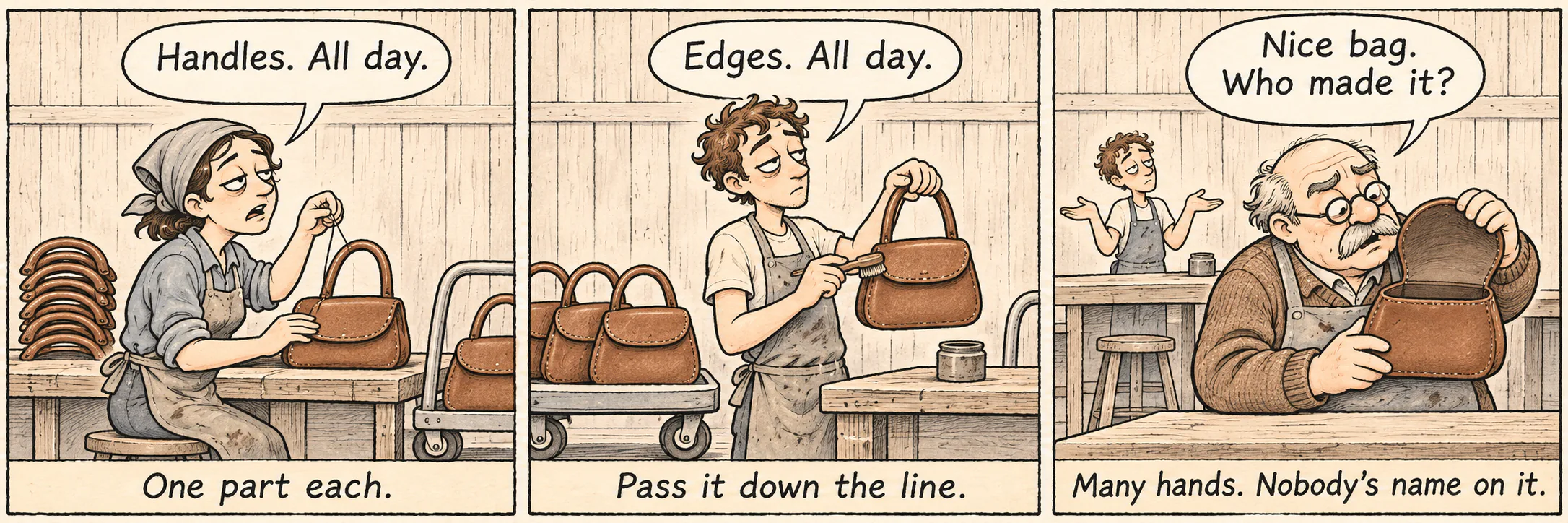
Hermès has looked at that line and said no. In 2025, Guillaume de Seynes, a family member and executive vice president, described the alternative: one person on handles all day, another on edges. The house, he said, has decided against going that way.1
Handing over the whole piece has a trap of its own. Give someone a whole bag before they’re ready, and ownership is only a gamble. The whole piece has to be earned.
The Exceptional Solution
Hermès’s Answer: One Maker, the Whole Bag, Earned and Signed
Hermès dates to 1837, when Thierry Hermès began selling made-to-measure harnesses in Paris.2 For its bags, Harper’s Bazaar summed up the house’s credo in four words: “One craftsman, one bag.”3
Here is how the house’s leaders, and reporters who visited its workshops, describe the work:
Draw the edges of the piece. On a 2023 visit to the Louviers site in Normandy, Monocle reported that each workshop has its own cutting room next door. The cut leather then goes to one craftsperson, who assembles the item from start to finish.5
Give the whole piece to one maker. Harper’s Bazaar reported that a Hermès craftsperson spends 15 to 20 hours on each bag. Catherine Fulconis, then head of the house’s leather goods and saddlery division, added that cutting and preparing the leather take extra hours on top.3
Earn it in stages. De Seynes described the house school, L’École Hermès des savoir-faire, as an 18-month course that ends in a French vocational diploma: six months of basic gestures, six months on one model, generally the Kelly, and six months in the workshop learning the exact quality requirements.1 IGNANT, visiting the Pantin workshop in 2019, reported that new makers master the Kelly first, because its assembly covers 99% of the techniques used in making the bags. Complex bags and difficult skins come only once the Kelly is perfected.4
Sign the finished piece. The artisan “signs” each bag once it is finished, CBS reported, with a hidden mark that Hermès uses to authenticate it.2 Each bag carries a personal mark, de Seynes said, so any bag can be identified.1
Meet the work again. De Seynes said the house has stories of artisans, now working in repair, who have mended bags they made themselves.1
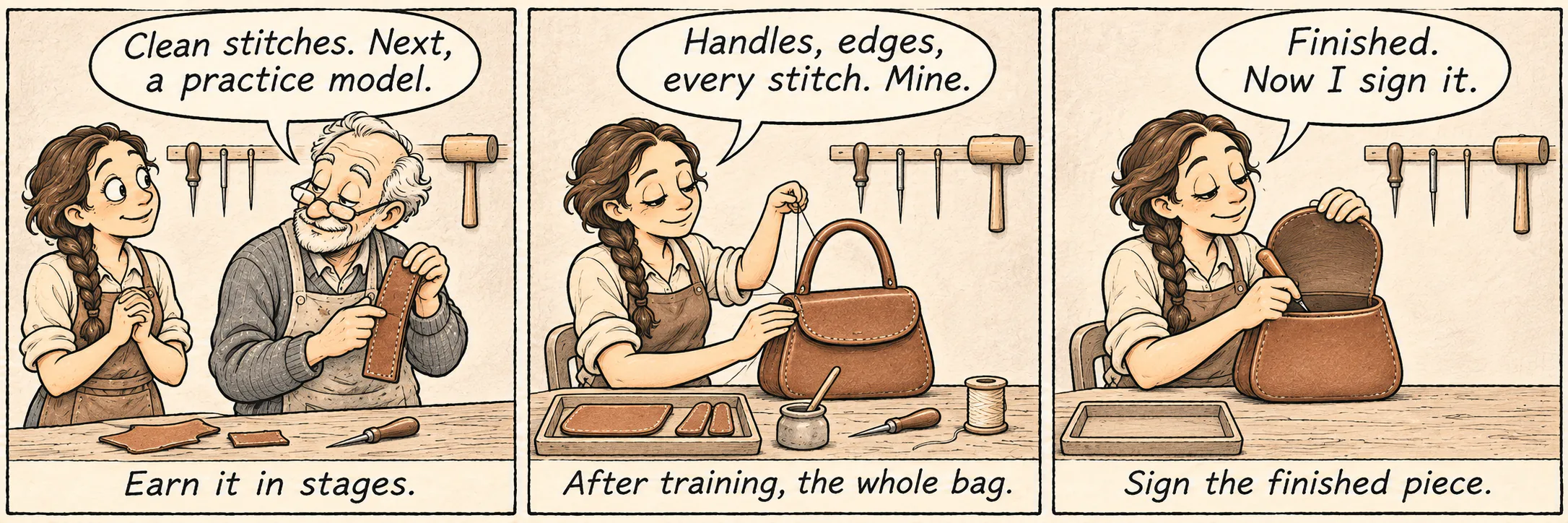
The ProblemA bag needs cut pieces, handles, edges, stitching and a last look before it leaves.
The Mediocre ApproachA line of specialists
Action
Split it into stations.
- Handles all day at one bench, edges all day at the next
- The bag passes from hand to hand
Poor outcome
Many hands, no maker.
- Nobody ever holds the whole bag
- Nobody’s name is on it
The Exceptional ApproachHermès’s answer: one maker, earned and signed
Action
One trained maker assembles and finishes the whole bag.
One maker and a name give the work three things:
Credit for a whole piece. The mark goes on when the bag is finished, so it stands for all of the work, not one part of it.2
A name that stays with the bag. With a personal mark on each one, any bag can be identified, de Seynes said.1
Quality sets the pace. “We don’t go quicker than music,” Fulconis said. “Quality is what guides us in everything.”3
A Maker Meets Her Work
De Seynes told one more story, of a different kind. During a speech by Axel Dumas, a woman held out a rare violet crocodile bag to one of the artisans, who said, “I think I made your bag.”1
The line in our first story made a bag that nobody could claim. Hermès gives one trained maker the whole bag, so every bag has a maker who can claim it.
The mechanism
Why It Works
One maker per bag sounds like a craft tradition, and it is. It also works as a system, because each part does its own job: the whole piece gives one person the full picture, clear edges tell them what is theirs, staged sign-off makes the trust real, and the name ties the person to the finished work.
Tap or click a card to see why it works.
-
Give one maker the whole piece.
A bag to finish, not a part to repeat.1
Why it works
- The house’s own reason. De Seynes said one person makes each piece because that is where the craft itself lies.1
- No gaps between stations. One pair of hands means no hand-to-hand pass for anything to fall through.
- The full picture. The person who assembles and finishes the whole bag sees how every part fits the rest.
-
Draw clear edges.
At Louviers, the leather arrives cut.5
Why it works
- A clean handoff in. At Louviers, Monocle described leather cut in a room beside the workshop, then delivered to one craftsperson.5
- Counted on top. Fulconis said the time to cut and prepare the leather comes on top of the hours to make the bag.3
- Know what’s yours. When the piece has clear edges, the owner knows exactly what they carry, and what someone else does first.
-
Why it works
- Three steps up. The house school moves from basic gestures to one model, generally the Kelly, to six months in the workshop.1
- One model first. On a 2019 workshop visit, IGNANT reported that building the Kelly covers 99% of the techniques the bags call for.4
- Harder work, once ready. Complex bags and difficult skins are assigned only after the Kelly is perfected.4
-
Why it works
- Signed when done. The mark goes on once the bag is finished, and Hermès uses it to authenticate the bag.2
- Credit that stays with the bag. A personal mark on each one means any bag can be identified, de Seynes said.1
- A standard behind the name. Fulconis said quality guides the house in everything it does.3
The evidence
The Results, and Where Else It Works
Health care has studied the idea behind the bench in two forms: keeping the same people with a patient,7, 8 and handing work over the same careful way when it has to change hands.6 Flip each card for the result and the lesson to take home.
Tap or click a card to flip it.
-
18 of 22 studies linked seeing the same doctor over time with lower death rates
- The continuity: Patients kept seeing the same doctor across visits.
- What was counted: Whether each study found fewer deaths with more continuity.
Exceptional results7
18 of 22 studies found lower death rates with more continuity
- The pattern held for specialists as well as family doctors.
Valuable lesson: Keep the same trusted person with the patient whenever you can.
-
70% of births came without a caesarean or instruments when women kept the same midwives, against 66% with other models of care
- The continuity: Women had midwife continuity of care, compared with other models of care.
- What was counted: Births without a caesarean, forceps or vacuum.
Exceptional results8
70% vs 66% births without caesarean or instruments, by model of care
- Caesarean births: 15 in 100, against 16 in 100.
- Women generally described their care more positively.
Valuable lesson: Let patients keep the same people through the whole of something that matters.
Source: Sandall et al., Cochrane 2024 · evidence row 8
-
23% fewer medical errors per 100 hospital admissions after resident doctors in nine hospitals began a structured handoff program
- The handoff: Resident doctors learned one structured way to hand their patients over.
- What was counted: Medical errors per 100 admissions, before and after.
Exceptional results6
24.5 → 18.8 medical errors per 100 admissions, before vs after
- Preventable harm to patients fell from 4.7 to 3.3 per 100 admissions.
Valuable lesson: When work must change hands, hand it over the same careful way every time.
Your dermatology clinic
Bringing It Home to Your Dermatology Clinic
On a busy procedure day, it’s natural to run the clinic by station. One person rooms every patient, another sets every tray, a third does every bandage and checkout. Each step gets done. But by afternoon, a Mohs patient may have met four people and belonged to none of them.
Choose the whole piece: a Mohs or excision patient’s visit day. One named MA greets and rooms the patient, brings the site photo and biopsy record for the surgeon to confirm with the patient, sets up the room and tray, checks in between stages, and walks the patient through the surgeon’s written wound-care sheet.
Draw the edges: the surgeon confirms the site, does the procedure, judges the wound and writes the instructions. The MA’s piece is the visit around that work, and only the tasks your clinic has delegated to MAs in writing, within their scope.
Earn it in stages: a senior MA coaches and watches each step on a sign-off card. Then the supervising physician or nurse approves each delegated clinical task. Until that approval is recorded, the new MA does the task only under direct supervision.
Sign it: once every step is approved, the MA writes their name in a box on the aftercare sheet: “Your assistant today.” The surgeon stays named as the author of the instructions, and the number to call is the clinic’s monitored line, which reaches the on-call clinician after hours.
Design the break: when the owner has to step away, they hand over in a set order: patient, site and stage, what’s pending, what was promised. The new MA introduces themselves by name, and the surgeon is told. Promise what the schedule can keep: “I’ll be with you today, and if that changes, I’ll introduce you to the person taking over.”
Here’s how that plays out in two everyday moments. Each one starts with the problem, follows the mediocre approach to its outcome, then rewinds to the same moment for the exceptional approach: one trained, signed-off person with the whole piece.
Example One: Heard at Rooming, Missed at Checkout
- The Problem
It’s 7:15 on a Mohs surgery morning: six patients, three MAs and an empty board. First on the list is Mr. Alvarez, for surgery on his left earlobe. He is hard of hearing, and he reads best in large print.
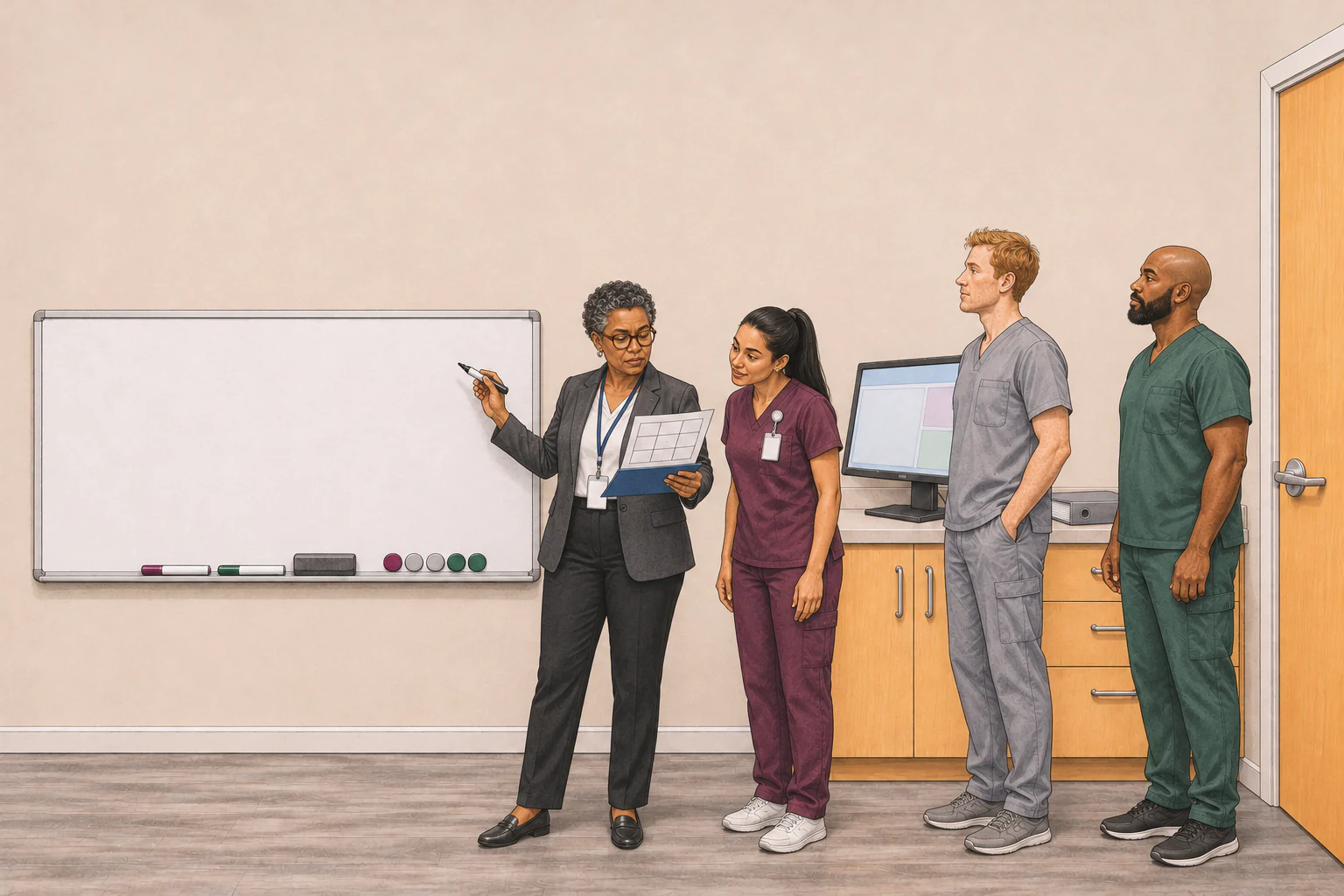 Practice manager (thinking):Stations are quickest to fill in.Ana:Who’s got Mr. Alvarez today?
Before the first patient. The board decides who carries each patient today, and nothing has started yet. - The Mediocre ApproachThe action
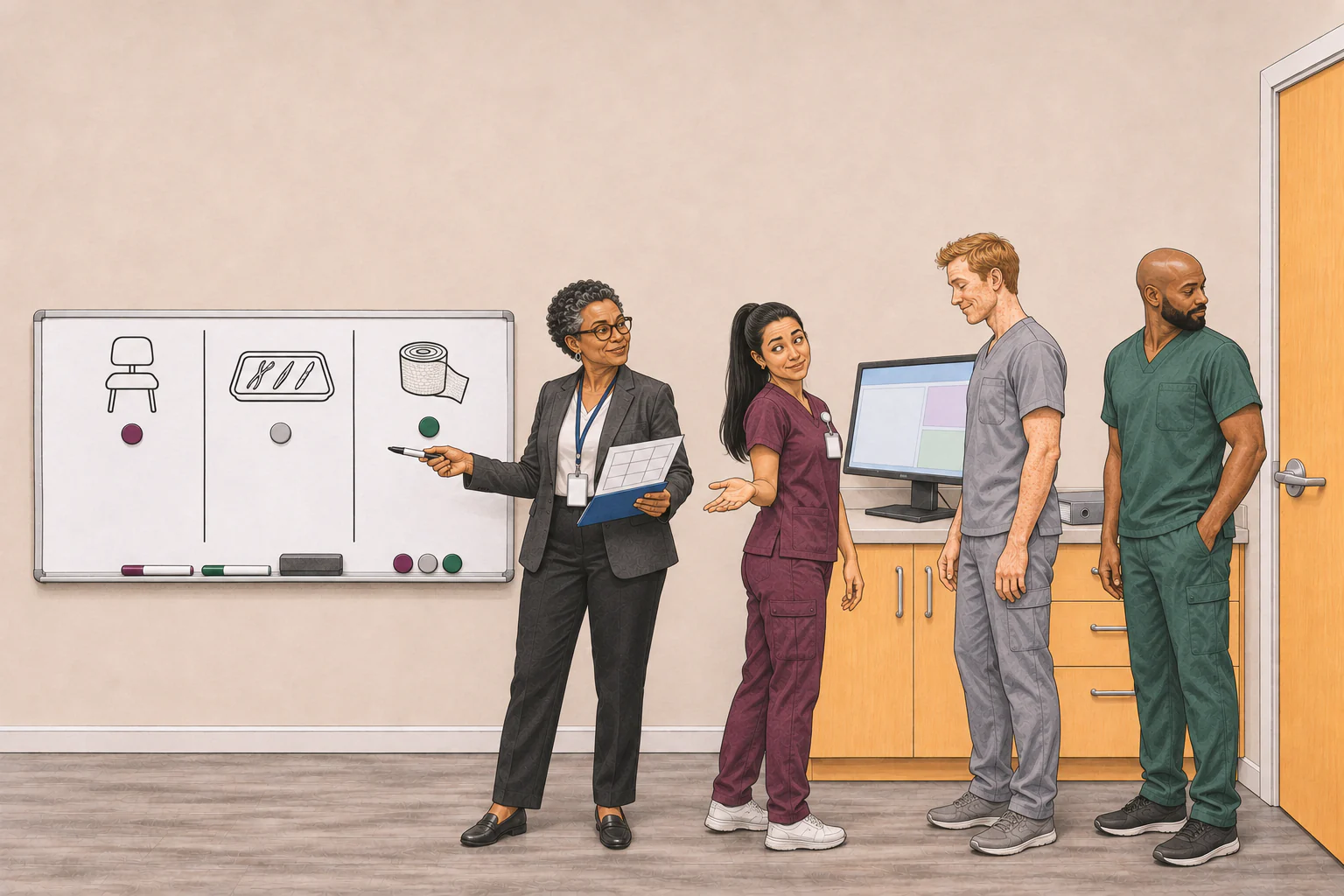 Practice manager:Ana rooms, Ben does trays, Cy does bandages and checkout.Ana (thinking):I room him, then he’s someone else’s.
Stations. Every step has a person, and Mr. Alvarez has three. - The Mediocre ApproachThe poor outcome
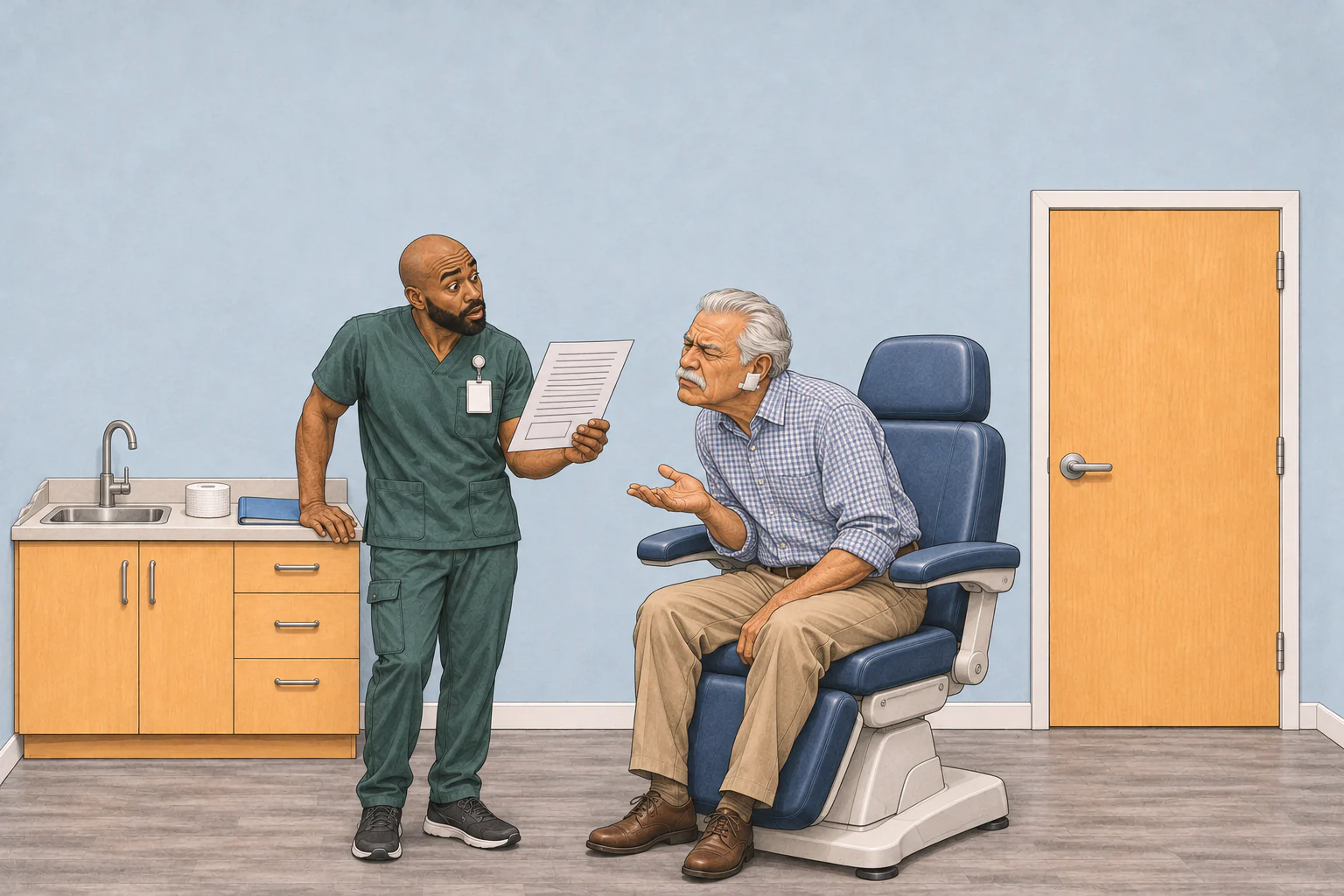 Patient:Sorry, could you say that again? I missed that.Cy (thinking):Hard of hearing? Nobody told me.
1:30, at checkout. Cy meets him for the first time and reads the small-print sheet with his eyes on the page. Mr. Alvarez hears half his wound care and calls the clinic line that evening to ask the rest. Rewind. Same morning, same board, same choice. This time, one signed-off MA gets Mr. Alvarez’s whole day.
- The Exceptional ApproachThe action: one owner, start to finish
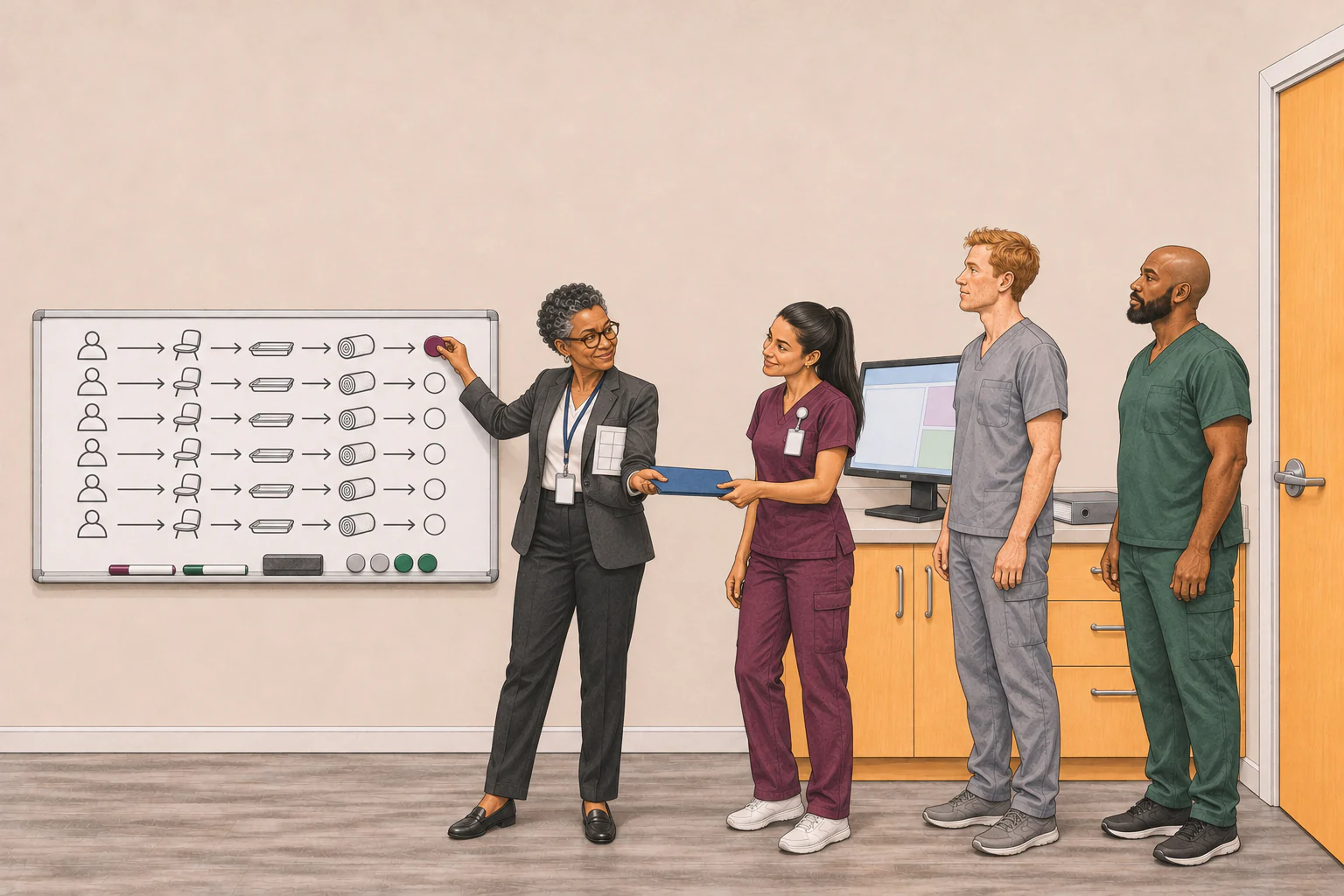 Practice manager:Ana, Mr. Alvarez is yours, start to finish.Ana:I’ll meet him at the door.
Owners. One signed-off MA carries each patient’s whole day, and the board says who. - The Exceptional ApproachThe exceptional outcome
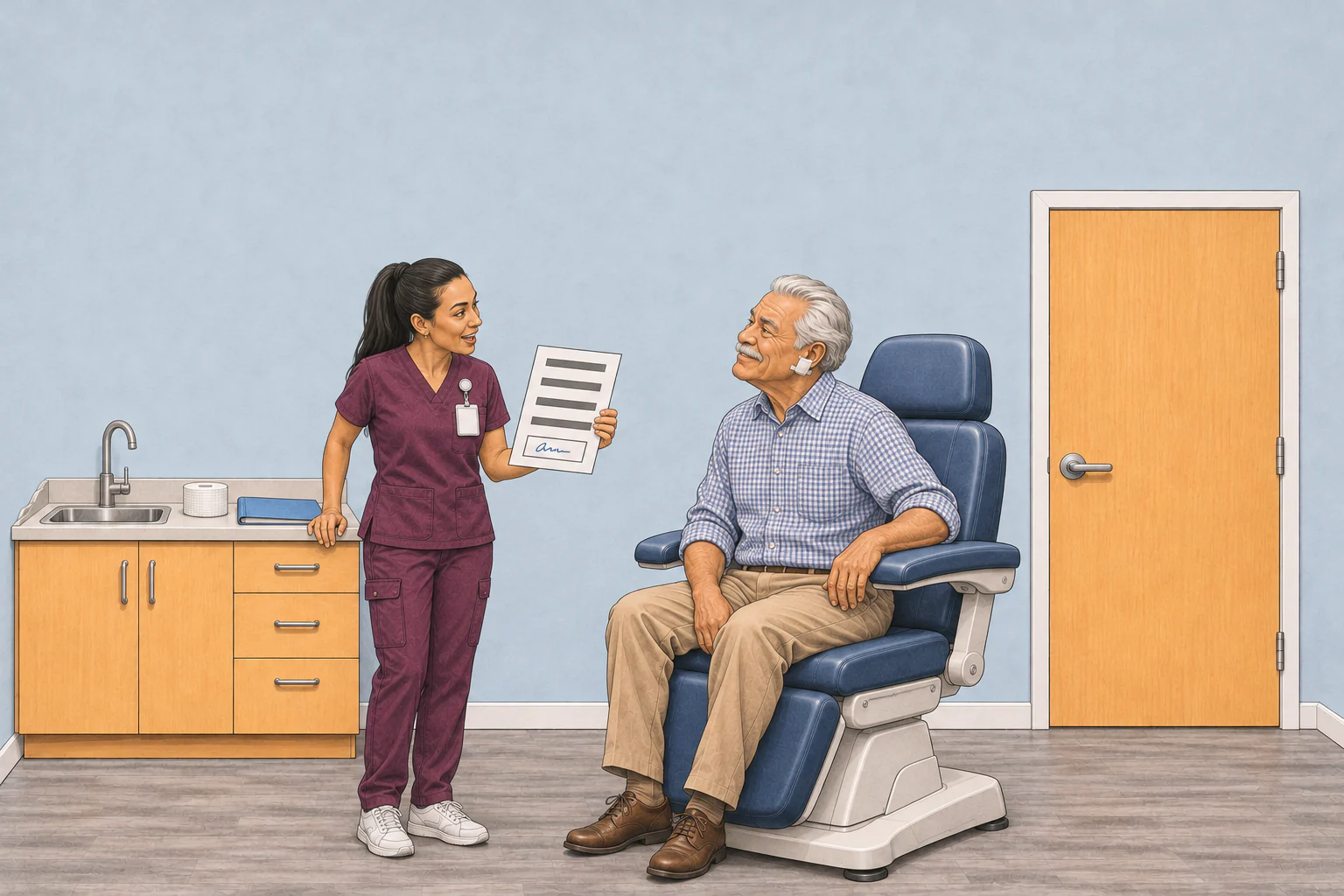 Ana:Large print, as you asked. Can you say the steps back?Patient:I heard every word, and I can read it. Thanks, Ana.
1:30, at checkout. Ana remembers what he told her at rooming: large print, face to face. He says the steps back, and she writes her name in the box.
Example OneAt a glance
The ProblemIt’s 7:15 on a Mohs morning: six patients, three MAs and an empty board. First on the list, Mr. Alvarez is having surgery on his left earlobe. He is hard of hearing and reads best in large print.
The Mediocre ApproachStations: a part each
Action
Fill the board by task.
- Ana rooms, Ben sets trays, Cy does bandages and checkout
- Mr. Alvarez meets three MAs, and none of them has his whole day
Poor outcome
Lost between the stations.
- What he told Ana at rooming never reaches checkout
- He hears half his wound care and calls that evening to ask the rest
The Exceptional ApproachOne owner, start to finish
Action
Fill the board by patient.
- Ana, signed off for every step, owns Mr. Alvarez all day
- At rooming he tells her what helps: large print, face to face
Exceptional outcome
One person, the whole day.
- She teaches Dr. Okafor’s sheet in large print, and he says the steps back
- Her name goes in the “Your assistant today” box
Example Two: Every Step Ticked, One Line Blank
- The Problem
Friday afternoon. Jade’s sign-off card shows the senior MA’s “Observed” tick beside every procedure-day step, from rooming to the dressing. The clinical approval lines are still blank.
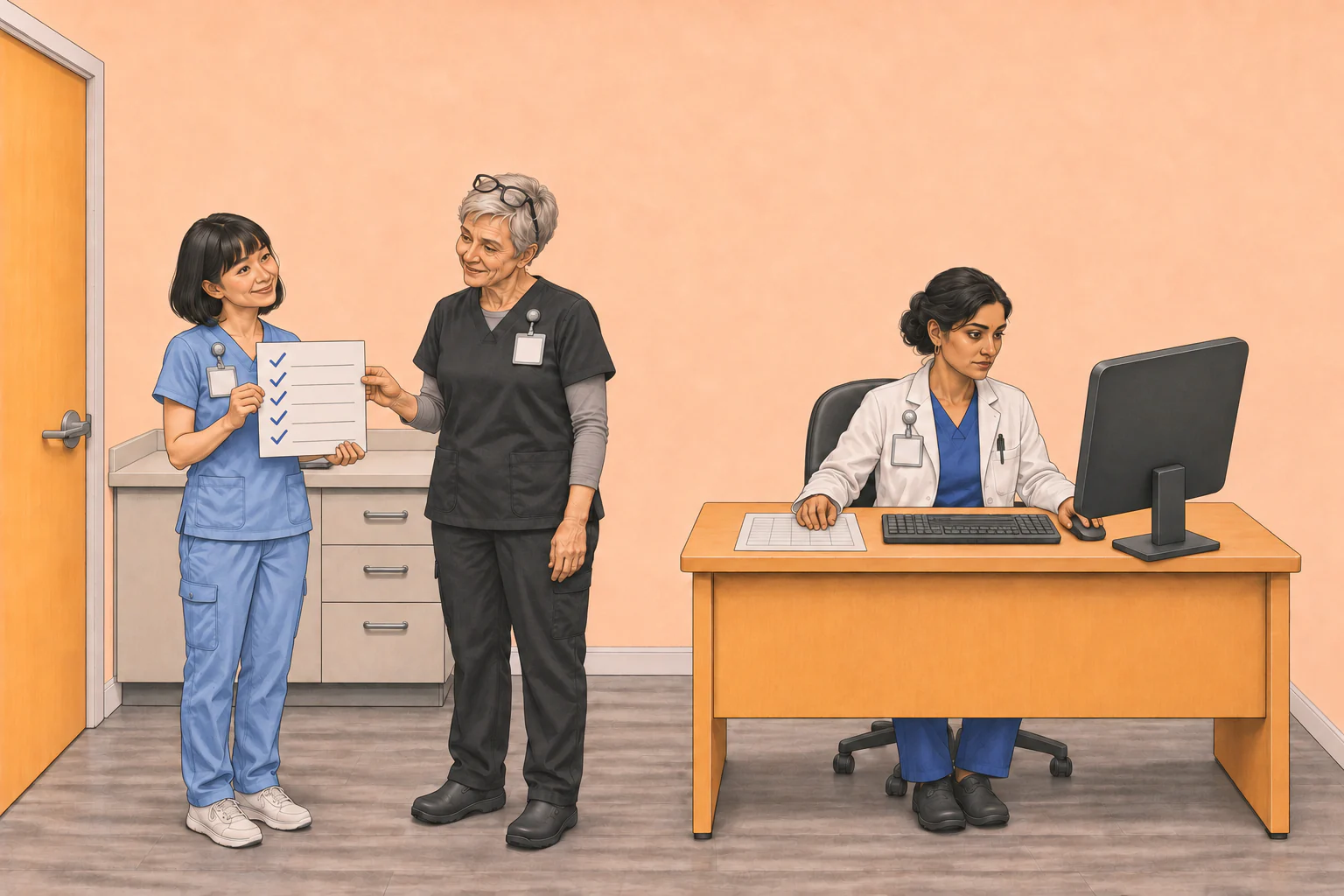 Jade:Every step’s ticked. When do I get my own patient?Senior MA (thinking):She’s ready. The clinical approval isn’t mine to sign.
Coached and watched. The last step isn’t the senior MA’s to give, and the doctor who can give it is right here. - The Mediocre ApproachThe action
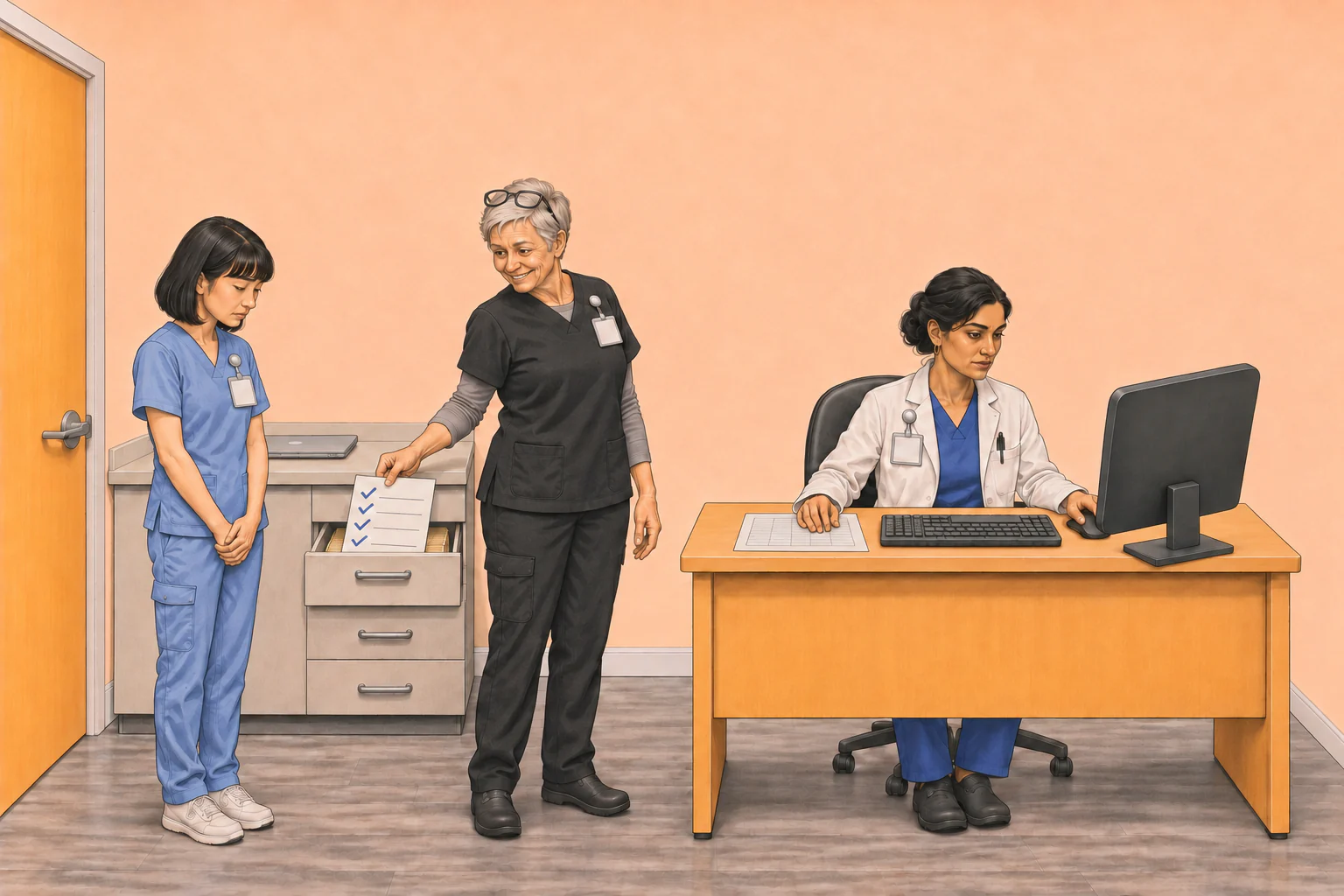 Senior MA:Soon. Keep running trays for now.Jade (thinking):Soon when?
Put off. No next step, no date, and nobody takes the card to the doctor. - The Mediocre ApproachThe poor outcome
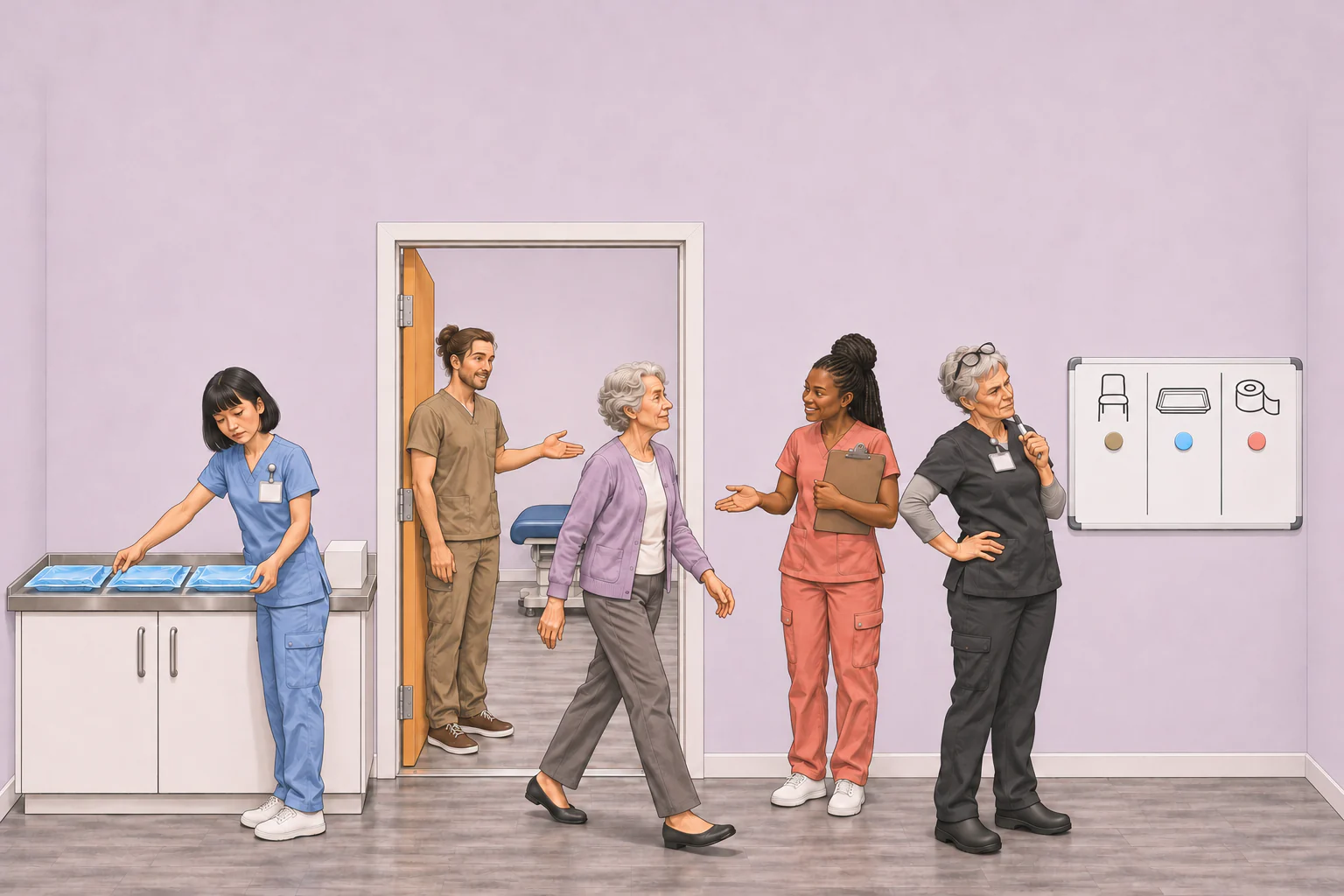 Senior MA:We’re short an owner again today.Jade (thinking):Trays again. I guess I’m the tray person.
Six weeks later. Jade still sets trays all day for other people’s patients, and with one owner short, patients are split between stations again. Rewind. Same Friday, same card, same question. This time, the last step goes to the clinician who can approve it.
- The Exceptional ApproachThe action: coached, approved, then owned
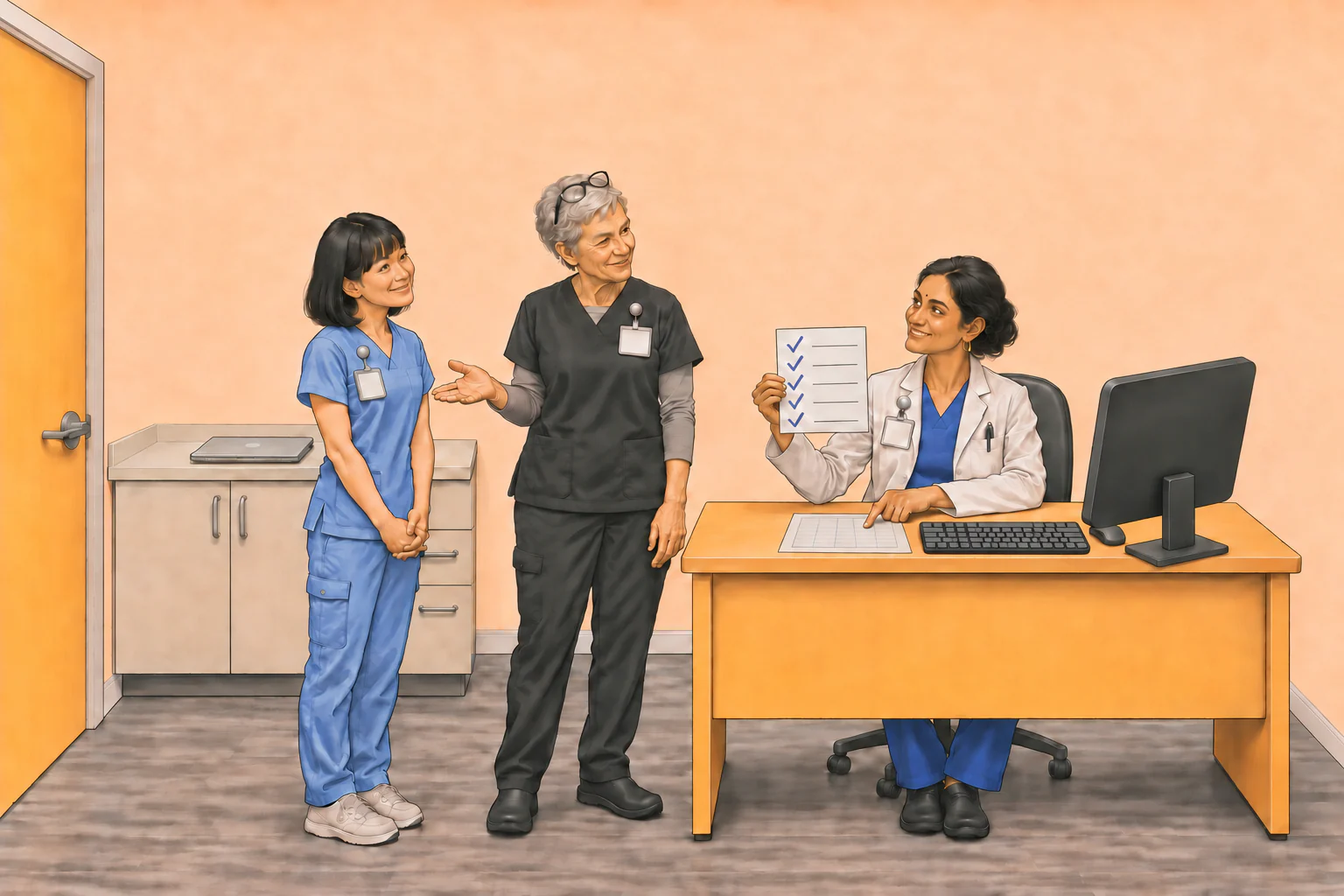 Senior MA:Every step’s observed. Will you watch her clinical steps?Dr. Shah:Tuesday, Mr. Brooks is yours. I’ll watch every step.
To the right person. The senior MA coached and watched. Dr. Shah, the supervising physician, sets a day to supervise a whole visit herself. - The Exceptional ApproachThe exceptional outcome
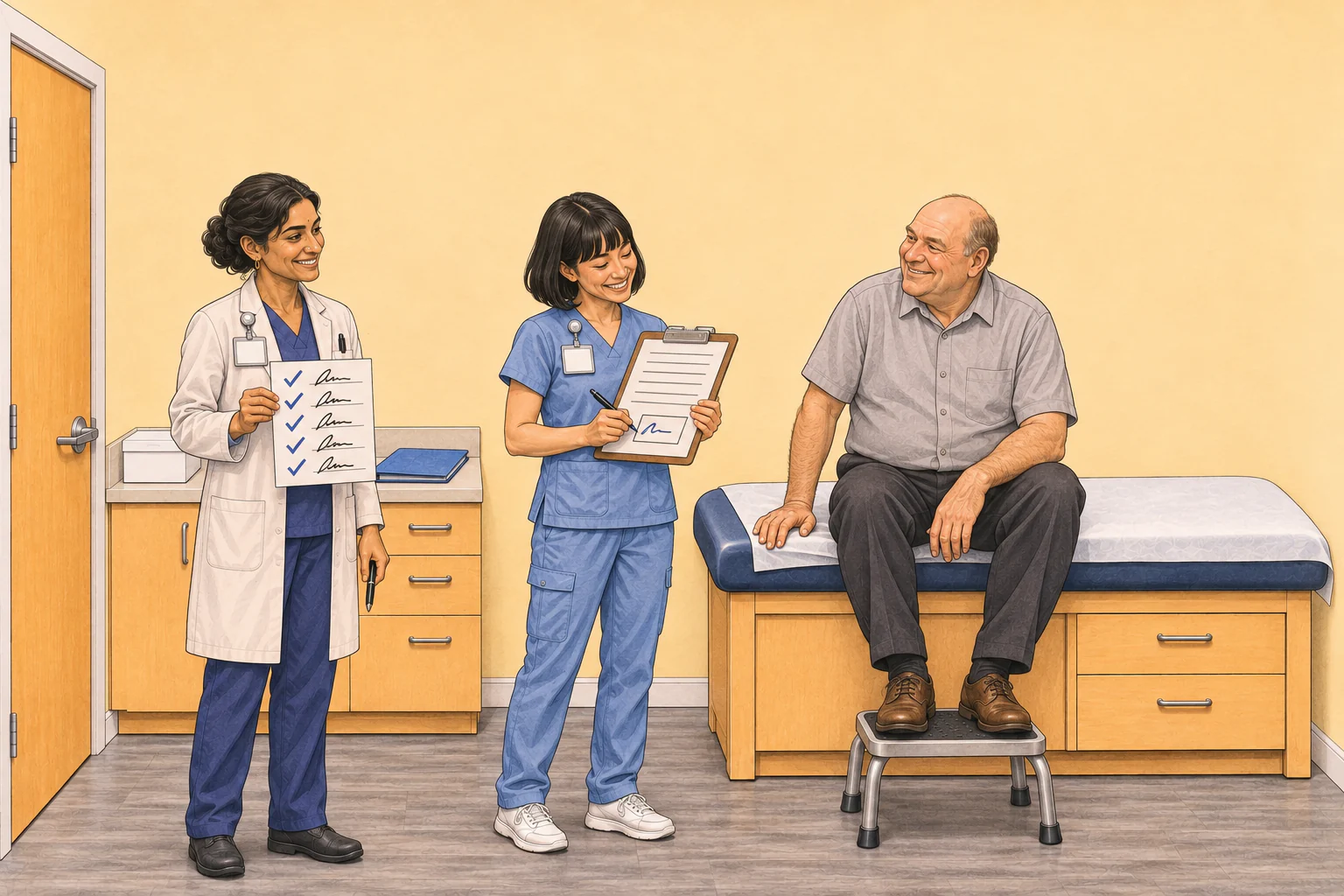 Dr. Shah:Every step, done right. Approved.Jade (thinking):My name, on my patient.Patient:Thank you, Jade.
Tuesday, after the dressing. Dr. Shah watched every step and signed the approval lines. Then Jade wrote her name on a patient’s sheet for the first time.
Example TwoAt a glance
The ProblemFriday afternoon. Jade’s sign-off card shows the senior MA’s “Observed” tick beside every procedure-day step. The clinical approval lines are blank, and Jade asks when she gets her own patient.
The Mediocre ApproachCoached, then parked
Action
Put it off.
- “Soon. Keep running trays for now”
- The card goes in a drawer, and nobody takes it to the doctor
Poor outcome
Trays all day.
- Six weeks later, Jade still sets trays for other people’s patients
- One owner short, patients are split between stations again
The Exceptional ApproachCoached, approved, then owned
Action
Take the last step to the right person.
- The senior MA brings the card to Dr. Shah, the supervising physician
- Dr. Shah sets a day to supervise Jade through a whole visit
Exceptional outcome
Approved, then signed.
- Dr. Shah signs the approval lines after watching every step
- Then Jade writes her name on a patient’s sheet for the first time
Your clinic
More Whole Pieces to Hand to One Person
Same pattern every time: one whole piece, one owner who has been signed off for it, and their name where the patient can see it.
| The whole piece | Who owns it, and who signs them off | Where their name goes |
|---|---|---|
| Patch testing: a patient’s patch test, from placing the patches to the last reading | One MA, approved by the supervising nurse to place and map patches; the clinician reads and explains the results | On the patch map and the patient’s care sheet |
| Light therapy: a patient’s course of phototherapy sessions | One trained MA runs each session on the clinician’s written plan, approved for it by the supervising physician; the clinician sets and changes the dose | On the session log the patient sees at every visit |
| New patients: a new patient’s paperwork, from the booking call to check-in | One front-desk team member, trained and signed off by the practice manager; anything clinical goes to the nurse | On the welcome letter, with the front-desk line |
| Suture removal: the follow-up visit after a procedure | The same MA who owned the procedure day rooms the patient when the schedule allows; the clinician checks the wound | On the visit summary, a second time |
Adapt the piece and the owner to your own team. Anything clinical still goes to a clinician.
Your move
Try It Today
Earn it. Own it. Sign it.
Try it for one week, on your procedure days. No new software, no budget.
- Pick one piece. One Mohs or excision patient each procedure day, from check-in to walking out, with one named MA.
- Draw the edges. Write down what the MA owns, and what stays with the surgeon: the site, the procedure, the wound check and the instructions themselves.
- Check the sign-off. Only an MA whose steps the supervising physician or nurse has approved owns a whole visit. Anyone still learning works under direct supervision.
- Add the name box. Put “Your assistant today” on the aftercare sheet, with the surgeon named as author and the clinic’s monitored line as the number to call.
- Count it on Friday. How many of those patients had one name from check-in to checkout? How many owner changes used the set-order handoff? Keep a tally with no patient details.
Anything urgent still goes straight to the clinician.
A line makes parts. One trained, signed-off person makes the whole piece, and signs it.
Explore the Evidence
13 sources · what each source is, what it found, what it supports here, and its limits
The Hermès story on this page is assembled from five sources, each used for what it shows, and every one of them rests on the house’s own account or on visits it arranged. The one-maker rule and the reason for it are Guillaume de Seynes’s words to a journalist at a company-hosted workshop opening in October 2025 (reference 1); CBS’s December 2024 report, made with the house’s access, describes each bag as one craftsman’s work from start to finish and the maker’s hidden mark (reference 2); Harper’s Bazaar (2021), IGNANT (2019) and Monocle (2023) are magazine reports, the last two of hosted workshop visits (references 3 to 5). These are dated organizational accounts, executive statements and hosted-visit reporting. They show what the house does and says; they do not show that one-person assembly causes Hermès’s quality, profits or staff retention, and no independent measure of defects or of artisans’ satisfaction was used. The sources disagree on the scope of the rule. Most describe one person making each bag from start to finish (references 1 to 4). Only Monocle, at one workshop, describes leather cut in an adjoining room and then delivered to the maker (reference 5); cutting before the maker follows from Monocle’s sequence, but Monocle does not state it as the scope of the rule. Harper’s 15 to 20 hours is the reporter’s figure, and Fulconis, who said the hours to cut and prepare come on top, did not say who does the cutting. So the chapter says one craftsperson assembles the bag and does not settle whether cutting is part of that job. The mark’s format is not described, and no source says the mark is used to route defects back to a maker or to discipline anyone; the chapter treats it as credit and identification only. De Seynes’s two stories are secondhand and kept separate. The repair stories are general and describe no single case. The speech episode was not a repair: the artisan said only that she thought she had made the bag, the source describes a woman, not a customer, and it does not say how the bag was recognised; its date, place and frequency are unknown, and the line about marks resurfacing long afterwards is the journalist’s framing, not his. The school is described only as de Seynes described it in 2025, and the Kelly-first sequence comes from one hosted visit in 2019. The chapter says that makers earn harder work in stages; it does not claim that every maker passed through the school. Visiting reporters described workshops without clocks or quotas on view and artisans who organise their own days (references 1 and 2); those are impressions on hosted visits, not audits of workload, and they are not used in the teaching text. The two comic strips are drawings made for this chapter. The first pictures a made-up line of specialists; the second shows an invented, unbranded workshop, bag and people, not a Hermès workshop or artisan. No source describes who decides that a Hermès learner is ready, so the experienced maker who checks the practice stitches is an illustration, and the maker’s mark is never drawn, because no source describes its form. A 2023 French parliamentary written question, citing a press article that was not opened for this chapter, alleged fast imposed cadences and musculoskeletal disorders among leatherworkers at Louis Vuitton and Hermès, and said production had been divided by task for speed (reference 9). It is an unverified allegation from a political source, withdrawn in June 2024 without a ministerial answer; its task-division sentence names both firms together and cannot be assigned to Hermès. It conflicts with the executives’ account and the visitors’ impressions but does not refute them, and the chapter does not describe Hermès workshops as free of pace pressure or strain. The opening line of specialists is hypothetical. It illustrates the alternative de Seynes described and depicts no real company. The health care studies come from other settings and are kept apart. The handoff study (reference 6) compared hospitals before and after a structured handoff program for resident doctors caring for children: it is not a randomized trial, only six of its nine sites improved significantly on their own, and it shows a designed handoff did better than the usual one, not that removing handoffs is better. The doctor-continuity review (reference 7) gathers observational studies, so it shows an association with lower mortality, not proof, and it measured continuity across visits, not one staff member across a procedure day. The midwife review (reference 8) tests a bundled model of care, so its effects cannot be credited to continuity alone; its authors write that the mechanisms are undetermined, the absolute differences are small, it may make little or no difference to preterm birth, it is very uncertain about baby loss, and its 2016 estimates are superseded. None of these studies concerns medical assistants or dermatology. The closest dermatology evidence is about phone calls to Mohs surgery patients (references 10 to 13). In two randomized trials of 104 patients each, a call before surgery did not reduce anxiety or raise satisfaction, and a call after surgery did not change satisfaction, which was near the top of the scale either way; a later trial found an added pre-visit call did not improve preparedness, though fewer called patients were dissatisfied with the education; a two-centre study that was not randomized found high ratings for surgeons’ evening calls, and 7% of uncalled patients rang with issues a call could have handled. These studies tested calls, not one assistant carrying a patient, so they neither support nor rule out the clinic design on this page. No source tested a named medical assistant who owns a procedure patient’s visit. The procedure-day owner, the sign-off card with clinical approval before independent work, the “Your assistant today” box and the set-order handoff are the research author’s proposed adaptation, loosely inspired by Hermès; the handoff borrows only the general logic of structured handoffs, which were tested with resident doctors. What a medical assistant may do (dressings, aftercare teaching, phone follow-up) depends on state law and the clinic’s written delegation, which each clinic must confirm itself; nothing here is legal advice or an approved clinical protocol. The two clinic examples, the extra ideas and the one-week experiment are illustrations of the mechanism, written for this chapter with fictional people, not observed events or tested interventions. Their measures count whether the design happened, not whether patients did better. Status shows how each source was read: HTML (web page), ABS (abstract) or FULL (full text or the complete official document).
| Source | Type and context | Key finding | What it supports here | Material limitation |
|---|---|---|---|---|
| [1] · HTMLMaisey S. ‘Scarcity is not a goal for us’: Hermès executive VP Guillaume de Seynes on secrets to the maison’s success. The National, 2025 | Magazine interview Guillaume de Seynes, a family member and executive vice president, speaking to a journalist at a company-hosted workshop opening, October 2025 | One person makes each piece, because that is where the craft lies; the alternative, people kept on handles or edges all day, is a direction the house has decided against; a personal mark on each bag makes every bag identifiable; the house has stories of artisans, now working in repair, mending bags they made, and, separately, at a speech by Axel Dumas an artisan told a woman holding a rare violet crocodile bag that she thought she had made it; the house school is an 18-month course, recognised by France’s education ministry, that ends in a CAP diploma, in three six-month stages (basic gestures, one model, generally the Kelly, then the workshop); the reporter described strict quality standards alongside artisans who organise their own days | The one-maker rule and its reason (summary, sections 1 and 2, card 1), the mark (section 2, card 4), the repair and recognition stories (section 2) and the staged school (summary, section 2, card 3) | The company’s own account, from a family executive at an event the house hosted. The two stories are secondhand and kept separate: the repair stories describe no single case; the speech episode was not a repair, the artisan said only that she thought she had made the bag, the source describes a woman, not a customer, and does not say how the bag was recognised; date, place and frequency are unknown, and the line about marks resurfacing long afterwards is the journalist’s framing. The note on artisans’ days is a reporter’s impression on a hosted visit, not an audit of workload. De Seynes also said trainees have a permanent job after 12 months; that detail is not used |
| [2] · HTMLAlfonsi S, Chasan A, et al. Hermès artistic director Pierre-Alexis Dumas on why a Birkin bag is “costly” rather than “expensive.” CBS News, 60 Minutes, 2024 | Broadcast news report 60 Minutes, December 2024, made with access the house arranged | For a century, one craftsman has made each bag from start to finish; artisans sign the bags once they are finished, with a hidden mark that Hermès uses to authenticate them; Thierry Hermès began selling made-to-measure harnesses in Paris in 1837; the reporter noticed no clocks or quotas in the workshop | The one-maker rule and the mark (summary, section 2, the comparison, card 4), and the founding (section 2) | The reporter’s wording, based on company access; it does not say whether “start to finish” includes cutting, and the sources differ on that (references 3 to 5); the mark’s format is not described; the absence of clocks or quotas is a visitor’s impression, not an audit of workload |
| [3] · HTMLChernikoff L. The Cultural Endurance of the Mighty, Mighty Birkin. Harper’s Bazaar, 2021 | Magazine feature Harper’s Bazaar, March 2021, read in its Singapore edition, quoting Catherine Fulconis, managing director of leather goods and saddlery since 2015 | The credo “One craftsman, one bag”, which the magazine glosses as one craftsperson seeing each bag through, beginning to end; the reporter put the making of each bag at 15 to 20 hours, and Fulconis added that the hours to cut and prepare the leather come on top; Fulconis also said the house will not hurry its work and that quality guides it in everything | The credo, the hours for one maker and the separate cutting hours (section 2, card 2), and the quality line (section 2, card 4) | The 15 to 20 hours is the reporter’s figure, in a Birkin context, and only the remark about added cutting and preparation hours is Fulconis’s own; the source does not say who does the cutting or mention a cutting room; Fulconis’s words are a statement of the house’s values, not evidence of quality |
| [4] · HTMLGualandris D. An Exclusive Look at the Incredible Craftsmanship Behind the Iconic Hermès Bags. IGNANT, 2019 | Design-magazine feature A hosted press visit to the Pantin workshop, November 2019, with an artisan guide | New makers master the Kelly first, because its assembly covers 99% of the techniques used in making the bags; complex bags and difficult skins are assigned only once it is perfected; one person makes each Hermès bag, “every aspect from start to finish” | Earning the work in stages (summary, section 2, card 3) | One hosted visit in 2019, guided by the house; it does not define whether cutting is part of “start to finish” |
| [5] · HTMLMonocle. Hermès is at the forefront of a movement to uphold France’s leather-working traditions. Monocle, 2023 | Magazine feature A hosted visit to the Maroquinerie de Louviers in Normandy, November 2023 | Each workshop has a cutting room next door; the cut leather goes to one craftsperson, who assembles the item from start to finish (“un homme un sac”) | The edges of the maker’s piece (section 2, the comparison, card 2) | One site on one hosted visit. Cutting before the maker follows from Monocle’s sequence, but Monocle does not state it as the scope of the rule, and references 1 to 4 describe “start to finish” without separating cutting; the question is not settled by these sources and must not be generalised. Read from a saved copy; the live page refused a fresh request |
| [6] · ABSStarmer AJ, Spector ND, Srivastava R, et al. Changes in medical errors after implementation of a handoff program. N Engl J Med 2014 | Prospective before-and-after intervention study Resident doctors handing over hospitalized children in nine hospitals; 10,740 admissions | After the I-PASS handoff program, the medical-error rate fell from 24.5 to 18.8 per 100 admissions (23%) and preventable adverse events from 4.7 to 3.3 per 100 admissions (30%); six of nine sites showed significant reductions | Results card 3; the general idea behind the set-order handoff in the clinic | Before-and-after rates as reported in the abstract, not a randomized trial, and only six of nine sites improved significantly on their own; resident physicians in hospitals, not medical assistants or dermatology; it shows a designed handoff did better than the usual one, not that removing handoffs is better; read as the abstract |
| [7] · ABSPereira Gray DJ, Sidaway-Lee K, White E, Thorne A, Evans PH. Continuity of care with doctors: a matter of life and death? A systematic review of continuity of care and mortality. BMJ Open 2018 | Systematic review without meta-analysis 22 observational studies published from 1996 to 2017, in nine countries | 18 of the 22 studies (81.8%) reported significantly lower mortality with greater continuity of care, with generalist and specialist doctors; the results could not be pooled | Results card 1 | Every included study was observational, so this is an association, not proof that continuity lowers deaths; continuity between patient and doctor across visits, not one staff member across a procedure day; doctors, not medical assistants; read as the abstract |
| [8] · FULLSandall J, Fernandez Turienzo C, Devane D, et al. Midwife continuity of care models versus other models of care for childbearing women. Cochrane Database Syst Rev 2024 | Cochrane systematic review of randomized trials 17 trials with 18,533 women, mostly at lower risk of complications, in the UK, Ireland, Australia, Canada and China; evidence to August 2022 | Compared with other models of care, midwife continuity models likely increase spontaneous vaginal birth (66% to 70%) and likely reduce caesarean birth (16% to 15%) and instrumental birth (14% to 13%), all moderate certainty, and may reduce episiotomy (low certainty); preterm birth may differ little or not at all (6% in both; low certainty); the authors are very uncertain about effects on regional pain relief in labour, the loss of a baby at 24 weeks or later, and newborn death (very low certainty); women’s reported experiences were generally more positive (narrative synthesis) | Results card 2 | A bundled model of care (who leads it, its philosophy and its setting) as well as continuity, so the effects cannot be credited to continuity alone; the authors write that “the mechanisms are undetermined” and call for research on whether benefits come from “the continuity model, the philosophy of care, or the strength and quality of the relationship”. Absolute differences are small, and experience outcomes were not pooled. The 2016 version’s preterm-birth and baby-loss estimates are superseded and not used; for preterm birth the estimate shifted from a benefit to possibly little or no difference. Several review authors are trial authors, and the review describes steps so that none assessed their own trial. Childbearing women, not dermatology. Read through the abstract and the full text’s discussion and implications, not every analysis |
| [9] · FULLAssemblée nationale. Question écrite n° 13191: Conditions de travail et pénibilité dans les ateliers de maroquinerie de luxe. 2023 | Parliamentary written question, in French Asked by opposition deputy Martine Etienne (La France insoumise, NUPES group), published 21 November 2023 | Citing a recent Alternatives Économiques article, it said leatherworkers at Louis Vuitton and Hermès are pressed to make goods quickly, with imposed cadences causing musculoskeletal disorders such as carpal tunnel syndrome and tendinitis, and that management had rationalised production and divided it by task for speed; it was withdrawn on 11 June 2024 at the end of the mandate, with no ministerial answer | Counterevidence, kept here only; not used in the chapter text | An allegation in a political source, not an investigation or audit, and not established as fact; the underlying press article was not opened; the task-division sentence names both firms together, so it cannot be assigned to Hermès specifically; it conflicts with the executives’ account and visitors’ impressions (references 1 and 2) but does not refute them; no company or ministry response is on record |
| [10] · ABSSobanko JF, Da Silva D, Chiesa Fuxench ZC, et al. Preoperative telephone consultation does not decrease patient anxiety before Mohs micrographic surgery. J Am Acad Dermatol 2017 | Randomized trial 104 patients scheduled for same-day consultation and Mohs surgery at a US academic centre | Patients randomized to an educational phone call the week before, or to no call, reported similar increased anxiety and high satisfaction; the call neither eased anxiety nor raised satisfaction | Context for the clinic design (calls in Mohs care); not used in the chapter text | A pre-visit call by the practice, not one assistant carrying a patient; one centre; prior surgery and self-education were not controlled; read as the abstract |
| [11] · ABSTaylor SL, Quan EY, Lockhart ERS, et al. A comparison of preoperative telephone call versus mailed educational materials on patient-reported outcomes in Mohs micrographic surgery. Dermatol Surg 2024 | Randomized trial 208 Mohs surgery patients, all mailed an education packet, about half also called | No difference in how prepared patients felt; fewer called patients were “somewhat” or “not satisfied” with the education | Context for the clinic design (calls in Mohs care); not used in the chapter text | A call added to mailed materials, not continuity of one assistant; a single academic centre; read as the abstract |
| [12] · ABSVance S, Fontecilla N, Samie FH, et al. Effect of postoperative telephone calls on patient satisfaction and scar satisfaction after Mohs micrographic surgery. Dermatol Surg 2019 | Randomized single-blinded survey study 104 Mohs surgery patients at one centre | Satisfaction at suture removal was 4.90 with a postoperative call and 4.88 without, on a 5-point scale (p = .80); scar scores 3.37 against 3.81 (p = .31); results were similar at three months | Context for the clinic design (calls in Mohs care); not used in the chapter text | Satisfaction near the top of the scale leaves little room to detect change; who made the call is not stated in the abstract; safety outcomes such as missed complications were not tested; read as the abstract |
| [13] · ABSHafiji J, Salmon P, Hussain W. Patient satisfaction with post-operative telephone calls after Mohs micrographic surgery: a New Zealand and U.K. experience. Br J Dermatol 2012 | Prospective controlled questionnaire study, not randomized Mohs surgery patients at two centres in New Zealand and the UK, June to September 2011; the operating surgeon called the study group on the evening of surgery | Median rating of the follow-up service 10 against 9 on a 10-point scale; 7% of control patients rang the surgeon with issues the call could readily have handled; more UK than New Zealand patients said a nurse-led call would satisfy them equally (94% against 66%) | Context for the clinic design (calls in Mohs care); not used in the chapter text | Not randomized; calls by the operating surgeon, not by medical assistants; satisfaction near the ceiling; read as the abstract |
References
- Maisey S. “‘Scarcity is not a goal for us’: Hermes executive VP Guillaume de Seynes on secrets to the maison’s success.” The National (Abu Dhabi). 14 October 2025. thenationalnews.com
- Alfonsi S, Chasan A, Karzis M, Kerbstat K. “Hermès artistic director Pierre-Alexis Dumas on why a Birkin bag is ‘costly’ rather than ‘expensive.’” CBS News, 60 Minutes. 15 December 2024. cbsnews.com
- Chernikoff L. “The Cultural Endurance of the Mighty, Mighty Birkin.” Harper’s Bazaar (Singapore edition). 29 March 2021. harpersbazaar.com.sg
- Gualandris D. “An Exclusive Look at the Incredible Craftsmanship Behind the Iconic Hermès Bags.” IGNANT. 5 November 2019. ignant.com
- Monocle. “Hermès is at the forefront of a movement to uphold France’s leather-working traditions.” Monocle. 15 November 2023. monocle.com
- Starmer AJ, Spector ND, Srivastava R, et al. Changes in medical errors after implementation of a handoff program. N Engl J Med. 2014;371(19):1803–1812. PubMed 25372088
- Pereira Gray DJ, Sidaway-Lee K, White E, Thorne A, Evans PH. Continuity of care with doctors: a matter of life and death? A systematic review of continuity of care and mortality. BMJ Open. 2018;8:e021161. PubMed 29959146
- Sandall J, Fernandez Turienzo C, Devane D, Soltani H, Gillespie P, Gates S, Jones LV, Shennan AH, Rayment-Jones H. Midwife continuity of care models versus other models of care for childbearing women. Cochrane Database Syst Rev. 2024;4:CD004667. doi.org/10.1002/14651858.CD004667.pub6
- Assemblée nationale (16th legislature). Question écrite n° 13191, Mme Martine Etienne: “Conditions de travail et pénibilité dans les ateliers de maroquinerie de luxe.” Journal officiel, 21 November 2023, p. 10450; withdrawn 11 June 2024. questions.assemblee-nationale.fr
- Sobanko JF, Da Silva D, Chiesa Fuxench ZC, et al. Preoperative telephone consultation does not decrease patient anxiety before Mohs micrographic surgery. J Am Acad Dermatol. 2017;76(3):519–526. doi.org/10.1016/j.jaad.2016.09.027 · PubMed 27923500
- Taylor SL, Quan EY, Lockhart ERS, et al. A comparison of preoperative telephone call versus mailed educational materials on patient-reported outcomes in Mohs micrographic surgery. Dermatol Surg. 2024;50(4):337–340. doi.org/10.1097/DSS.0000000000004086 · PubMed 38232345
- Vance S, Fontecilla N, Samie FH, et al. Effect of postoperative telephone calls on patient satisfaction and scar satisfaction after Mohs micrographic surgery. Dermatol Surg. 2019;45(12):1459–1464. doi.org/10.1097/DSS.0000000000001913 · PubMed 30908363
- Hafiji J, Salmon P, Hussain W. Patient satisfaction with post-operative telephone calls after Mohs micrographic surgery: a New Zealand and U.K. experience. Br J Dermatol. 2012;167(3):570–574. doi.org/10.1111/j.1365-2133.2012.11011.x · PubMed 22524509
Explore the evidence · Try it today · Read the Hermès Daily Brief · More lessons from The Exceptional Private Practice