Lessons from Disney Parks · for dermatology practices
Safety First. Speed Last. Settled Before the Rush.
In a 2026 account of Walt Disney World’s first-day class, new cast members learn five keys to weigh in every decision. Safety leads the list, and Efficiency comes last on purpose. Your clinic can settle its own order before the rush, so anyone on the team can make the right call without stopping to ask.
What you’ll take away
- The problem
- When being safe, being kind and staying on time pull apart in a rush, each person guesses what matters most, so the same moment gets handled three different ways.
- What to remember
- Settle what wins before the rush: safety first, the schedule last, and courtesy, welcome and a calm visit side by side in between.
- What to do differently
- Teach the order on a new hire’s first day, put it in every role’s own words, say it in the huddle, and thank people out loud when they let the clock lose.
30-Second Summary
- In a rush, good goals collide. Be safe, be kind, keep things looking right, stay on time: when they pull apart and nobody has said which wins, each person guesses, or stops to ask.
- Disney settles the order on day one. In a 2026 account of Traditions at Walt Disney World, the first-day class for new cast members, Disney introduces five keys to weigh in every decision: Safety, Courtesy, Inclusion, Show and Efficiency.1
- Safety first. Efficiency last, on purpose. Tokyo Disney Resort’s operator puts guests’ and cast members’ safety ahead of everything else.2 In Mickey Visit’s 2026 account of the class, Efficiency sits at the end on purpose. Courtesy, Inclusion and Show sit in between, with Inclusion at the heart.1
- Then the order shows up at work. New hires walk Magic Kingdom spotting the keys in other people’s work, and cast members use the keys to compliment each other.1 At Tokyo Disney Resort, cast members mop spills standing up, which makes it less likely that a guest trips over someone crouching out of sight. It looks less polite, and they do it on purpose: safety outranks courtesy and show.2
- In your clinic: put patient safety first and the schedule last, with courtesy, welcome and a calm visit side by side in between. Teach it on day one, put it in every role’s words, and thank people when the clock loses.
The Problem
What Goes Wrong When Nobody Has Settled What Wins
Picture a new attendant at an invented theme park on a packed summer afternoon. She has been told three things: be polite to every guest, keep the park looking perfect and keep her line moving.
Then a guest drops a soda. It splashes across the walkway where hundreds of people are walking, most of them looking up at the rides.
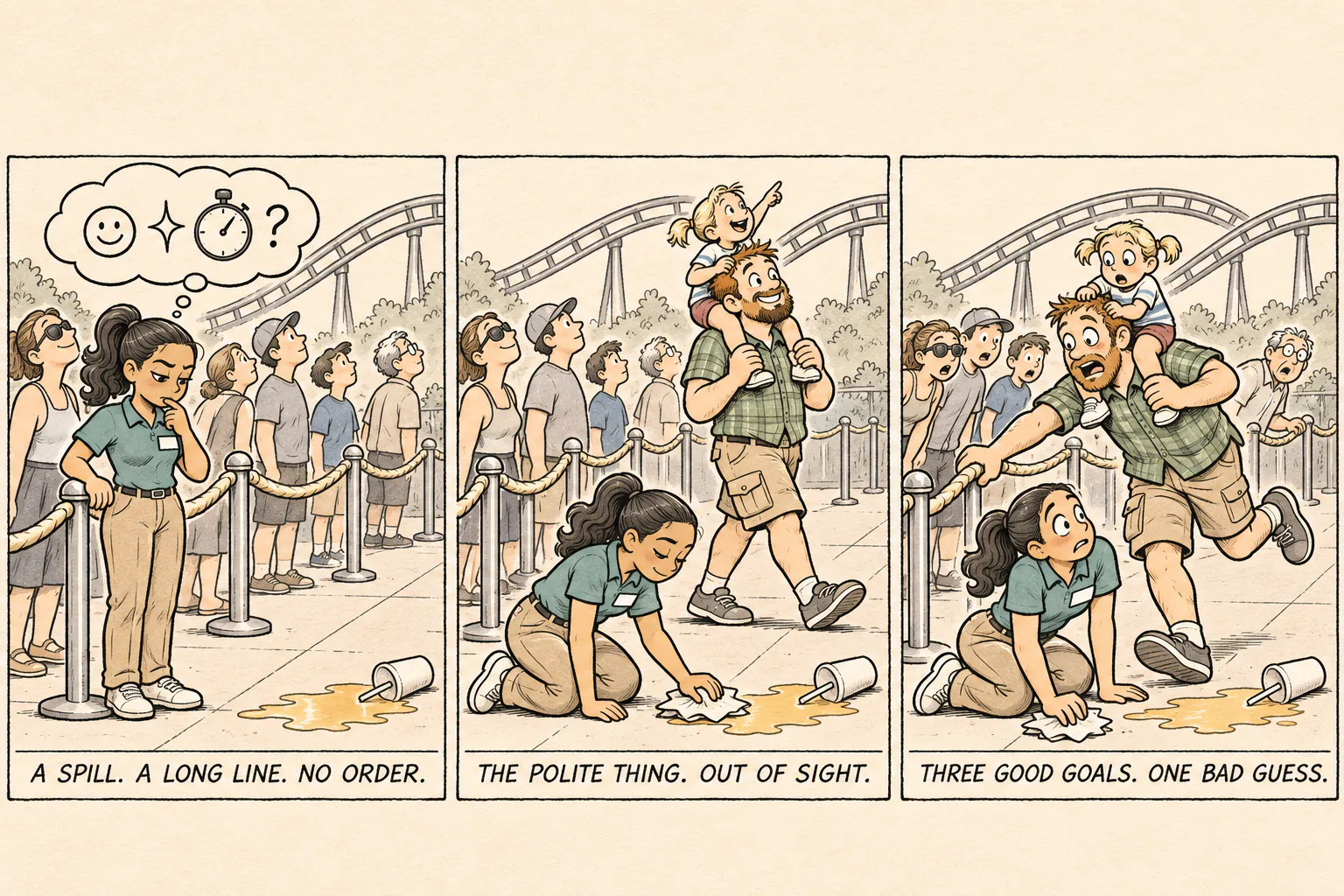
Which goal wins? Nobody told her, so she guesses. She kneels to wipe it up neatly, the polite thing to do. Down there, she is almost invisible. A father with a toddler on his shoulders, eyes on the rides, stumbles over her, and her line stalls while she works.
At another spot, another attendant radios a supervisor and waits for an answer while the spill spreads. A third leaves it, because the line comes first. Same spill, three answers, and none of them settled in advance.
Nobody here is careless. Each attendant chose a good goal. What’s missing is the order: which good goal wins when two of them collide, agreed before the rush, so nobody has to guess in it.
The Exceptional Solution
Disney’s Answer: Settle the Order on Day One
Disney hands its cast members the order before their first rush. Every new cast member in Disney Experiences, the Disney division that includes the parks, starts with a first-day class called Traditions, taught by fellow cast members who serve two-year terms as facilitators.1 In September 2026, a facilitator walked Gavin Doyle of the fan publication Mickey Visit through that day at Walt Disney World. Here is what he described:1
Five keys, weighed in every decision. Traditions introduces five keys that every decision should weigh: Safety, Courtesy, Inclusion, Show and Efficiency.1
Safety at the top. Doyle’s note beside Safety: cast members won’t put guests, or themselves, at risk.1 Tokyo Disney Resort’s operator is blunter in its code of conduct: for guests and cast members alike, safety “comes before anything else.”2
Efficiency at the end, on purpose. Efficiency covers the size of the company and its daily volume. In Doyle’s account, it “is specifically at the end” and “shouldn’t be prioritized above any of the other keys.”1
The heart in between. Courtesy, Inclusion and Show sit between the two ends. Beside Inclusion, the list reads “Heart of everything Disney does.”1
The same keys in every job. Each key gets more specific in each role’s training, but the themes stay the same everywhere, so every job decides in one unified way.1
Spot them, then say them. After the keys are introduced, new hires walk Magic Kingdom looking for examples of the keys at work, then talk about what they saw back in class.1 Leaders told Doyle the keys aren’t values left on a break-room wall: people may point to them when weighing a decision, and they shape how cast members compliment each other.1
The same first day aims to let new cast members make good calls on their own, without checking with a manager each time.1 A clash between two good goals is exactly the moment that would otherwise mean a call to the manager. With the order settled, the answer is already known.
The Order on the Floor
Tokyo Disney Resort shows what that looks like in ordinary work. Oriental Land Co., which runs the resort under license from Disney, says every cast member there decides and acts by the Five Keys, a code of conduct it describes as common to all Disney theme parks.2
Its example is a spilled drink. Cast members mop it up standing, with their feet, instead of crouching down. The point is accident prevention: a visitor absorbed in the park can easily miss someone low to the ground. The company admits that mopping with your feet “may seem unmannerly.” It is deliberate, it says: cast members put “safety before courtesy or show.”2
It’s the spill from our first story, settled before it ever happened. No guessing and no radio call, and everyone walking by can see which key won.
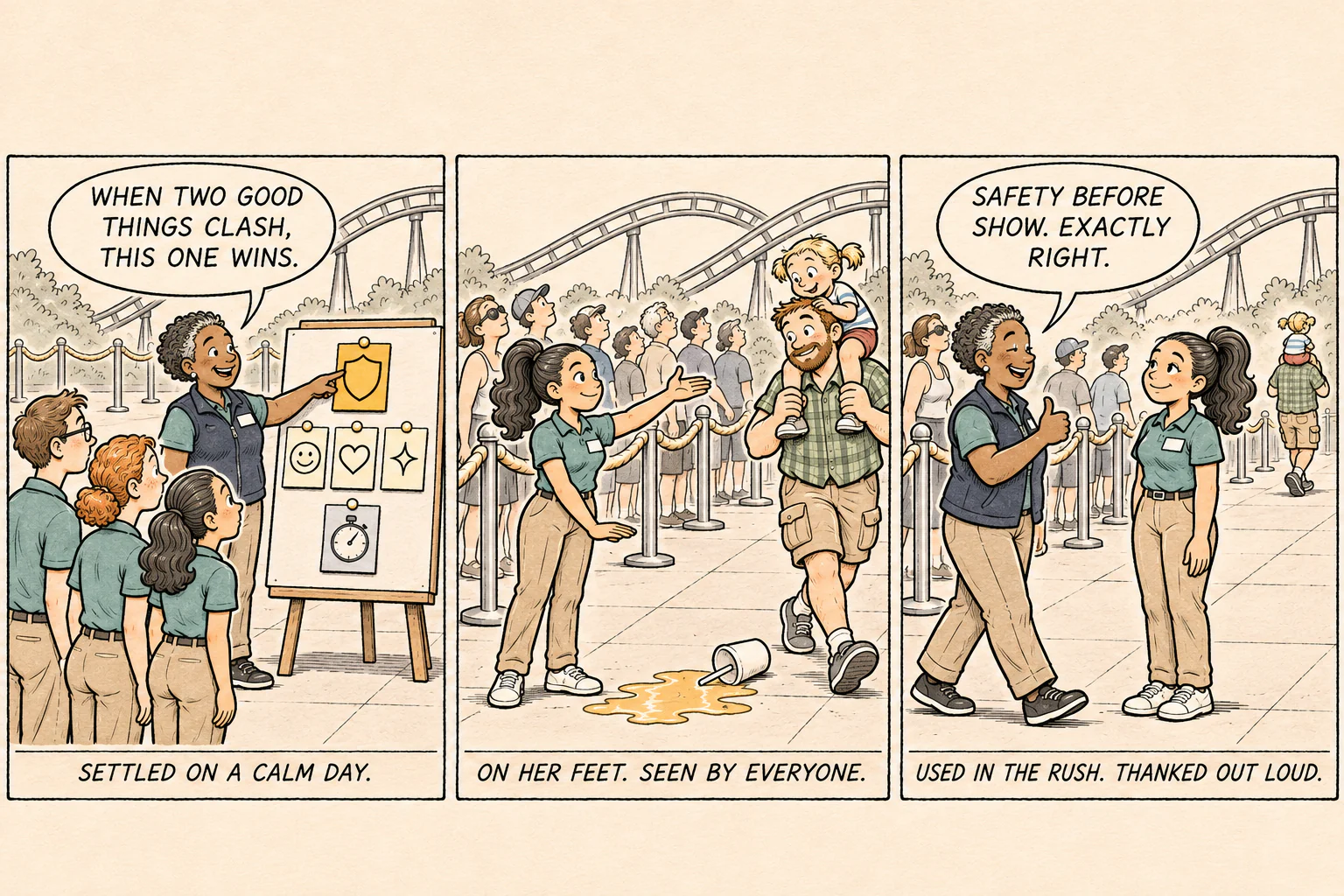
The ProblemA drink spills across a crowded walkway. The nearest attendant has three good goals at once: be polite, keep the park looking perfect and keep her line moving.
The Mediocre ApproachNo order: everyone guesses
Action
Pick a goal on the spot.
- She kneels to wipe it up neatly, out of sight
- Others radio and wait, or leave it for the line
Poor outcome
Three answers to one spill.
- A guest looking up at the rides stumbles over her
- Nobody knows which call was right
The Exceptional ApproachDisney’s answer: the order, settled on day one
Action
Safety first, on the spot.
- Five keys, taught in the first-day class1
- She stays on her feet, guards the spill and waves guests around it
Exceptional outcome
One answer, seen by everyone.
- Guests can see her and step around, so a trip is less likely
- At Tokyo Disney Resort, spills are mopped standing up for that reason: safety outranks courtesy and show2
What Set Disney Apart
The difference wasn’t a nicer list of values. It was what Disney did with the order:
Settled on a calm day. The keys come in the first-day class, before a new cast member works a single rush.1
Fixed at both ends. Safety leads the list, and Tokyo’s operator puts it ahead of everything else. Efficiency comes last, on purpose.1, 2
Said out loud. Cast members compliment each other in the language of the keys, and at Disneyland Resort they can send an official message recognizing a peer who upheld the safety key, copied to that person’s leader.1, 3
The attendant in our first story had three good goals and no order. Disney’s cast members walk in with the order already settled.
The mechanism
Why It Works
A short list sounds simple. It works because each part does a different job: deciding in calm takes the debate out of the rush, fixing the two ends makes the hard calls easy, a visible trade shows the order is real, one shared language reaches every role, and saying it out loud keeps it alive.
Tap or click a card to see why it works.
-
Decide it on a calm day.
A choice made early isn’t argued later.1
Why it works
- First day, first lesson. The keys come in Traditions, the class every new cast member starts with.1
- No time to debate in a rush. When a spill and a line collide, there are seconds, not minutes. An order agreed in advance is already the answer.
- Fewer calls to the manager. The first day aims to let new cast members make good calls on their own, without checking with a manager each time.1
-
Why it works
- Safety at the top. Tokyo Disney Resort’s code of conduct puts safety ahead of everything else, for guests and cast members alike.2
- Speed at the bottom. In the 2026 account, Efficiency is never to be put ahead of the other keys.1
- No ladder in the middle. Courtesy, Inclusion and Show don’t need ranking against each other. Each one already beats the clock.1
-
Let the order show.
Even when it looks less polished.2
Why it works
- Seen, not just stated. Tokyo Disney Resort’s cast members mop spills standing up, where guests can see them.2
- A cost, named out loud. The company admits it can look impolite, and does it anyway: safety outranks courtesy and show.2
- Everyone sees which key won. A trade that everyone can watch answers the question before anyone has to ask it.
-
One order, every role.
The same keys, in each job’s own words.1
Why it works
- Specific to the job. Each key gets more specific in each role’s training.1
- The same themes everywhere. The themes don’t change from job to job, so decisions follow one unified approach.1
- Learned by spotting. New hires walk Magic Kingdom looking for the keys in other people’s work, then talk it over in class.1
-
Why it works
- Not a poster. Leaders told Doyle the keys are used in real decisions, not left as values on a break-room wall.1
- Compliments with a key in them. The keys frame how cast members compliment each other.1
- A formal thank-you for safety. At Disneyland Resort, a cast member can recognize a peer who upheld the safety key, with an official message that also reaches the peer’s leader, or with a safety celebration.3
The evidence
The Evidence: The Same Keys at Three Resorts
Three Disney resorts show the same keys at work. Walt Disney World teaches them on the first day,1 Tokyo Disney Resort shows the order in everyday work,2 and Disneyland Resort gives cast members a formal way to recognize each other for the safety key.3 Flip each card for the result and the lesson to take home.
Tap or click a card to flip it.
-
Day one when new Disney cast members learn the five keys, in a first-day class called Traditions
- The class: Five keys, weighed in every decision.
- The walk: New hires spot the keys at work in Magic Kingdom.
Exceptional results1
Day one when new cast members learn the five keys
- Traditions is the first-day class for every new cast member in Disney Experiences, the Disney division that includes the parks.
- Each role’s training then makes every key specific to the job, with the same themes everywhere.
Valuable lesson: Teach what wins before you teach the job.
Source: Doyle, Mickey Visit 2026 · evidence row 1
-
Standing how Tokyo Disney Resort cast members mop up a spilled drink, instead of crouching down
- The rule: Safety goes ahead of everything else.
- The moment: A spill is mopped with the feet, in full view.
Exceptional results2
Feet, not knees how a spill is mopped up at Tokyo Disney Resort
- Standing keeps cast members where busy guests can see them, so a guest is less likely to trip over someone crouching.
- The company says it can look impolite, and does it on purpose: safety outranks courtesy and show.
Valuable lesson: Let the order show in everyday work, even when it looks less polished.
-
Official recognition Disneyland Resort cast members can give a peer who upheld the safety key
- The key: A cast member upholds the safety key.
- The thanks: A peer sends an official message to them and their leader.
Exceptional results3
Copied to the leader an official message recognizing a peer for the safety key
- A Disneyland Resort cast member can send it when a peer upholds the safety key.
- They can also host a safety celebration.
Valuable lesson: Thank people by name when they choose safety over speed.
Source: Disneyland Resort, Safety is a Core Value · evidence row 3
Your dermatology clinic
Bringing It Home to Your Dermatology Clinic
Your clinic has its own spills: a pale patient when you’re already behind, a worried caller while four lines blink, a wet floor in the middle of a check-in. In each one, good goals collide: keep the patient safe, be kind, keep the visit calm, stay on time. If nobody has settled which wins, each person guesses, alone, in the rush.
Write the order once: patient safety first. Courtesy, welcome and a calm visit together in the middle, not ranked against each other. The schedule last, on purpose. Courtesy is warmth, respect and explaining what’s happening. Welcome is a warm greeting, the patient’s preferred name and help offered before it’s asked for. A calm visit means a calm room, no surprises and clear next steps.
Put the floor underneath: some things are never traded, so they aren’t in the order at all: a qualified interpreter, disability accommodations, privacy, the required clinical checks, and your emergency, infection-control and procedure protocols. Your compliance lead confirms the list.
Keep safety clinical, and in role: safety means patient safety. Anyone who is unsure stays with the patient and calls a nurse or clinician. The order settles clashes between nonclinical priorities; it never asks anyone to make a clinical call outside their role, and a disagreement about a required check goes up your clinic’s escalation path.
Teach it on the first morning: before a new hire learns the schedule screen, they learn the order, with a few examples from your own clinic.
Say it in each role’s words: the front desk: “A wet floor beats a smooth check-in.” The MA: “A pale patient beats the next room.” The scheduler: “A worried caller beats the hold queue.”
Thank it out loud: in the morning huddle, name one moment from yesterday when someone let the clock lose for the right reason: “That was safety over schedule. Exactly right.”
Here’s how that plays out in two everyday moments. Each one starts with the problem, follows the mediocre approach to its outcome, then rewinds to the same moment, this time with the order settled.
Example One: Coffee on the Floor, a Patient at the Counter
- The Problem
The front desk is halfway through checking in a new patient when a cup of coffee tips over by the door. A patient leaving after Mohs surgery, a thick bandage over his left brow, is walking straight toward it.
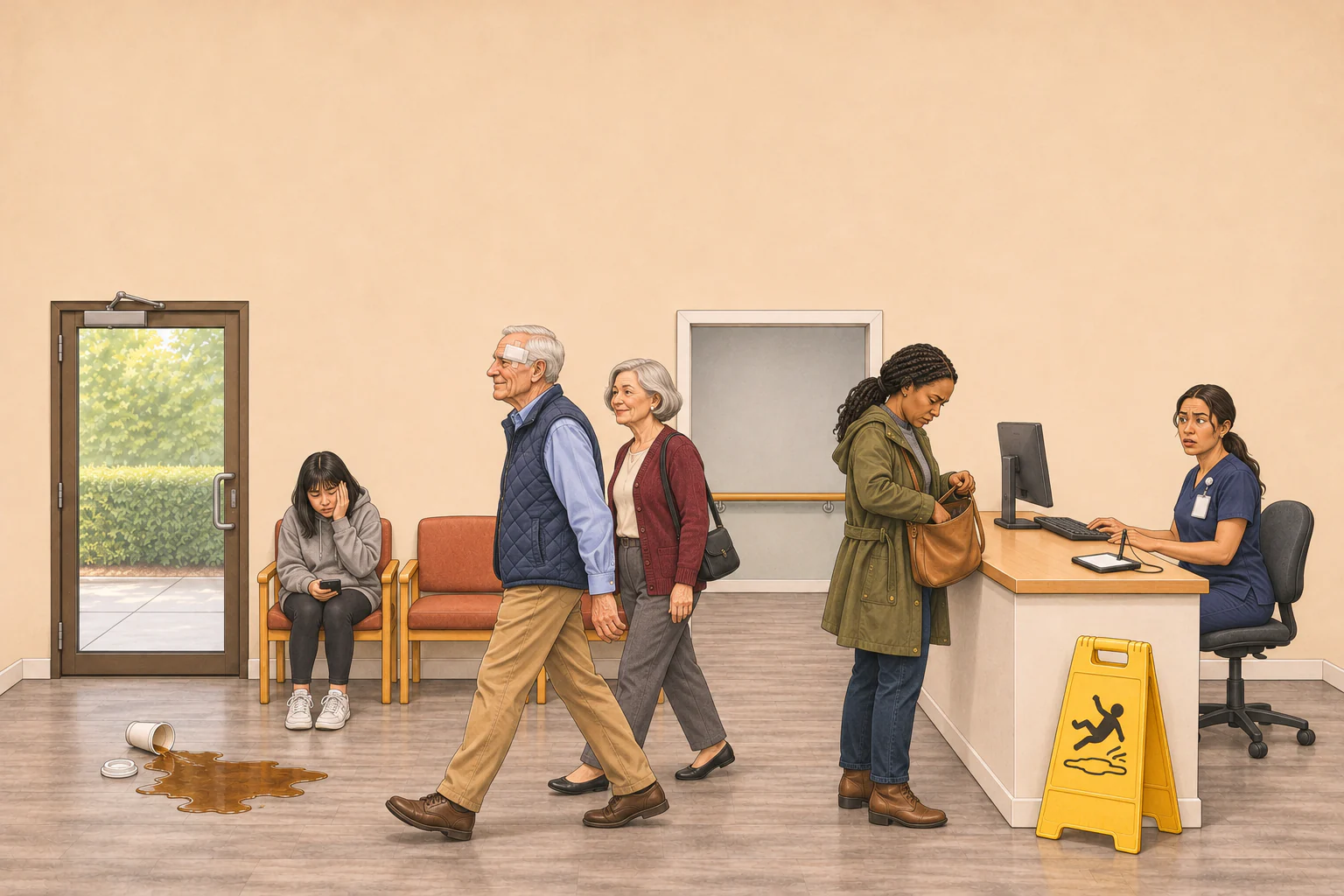 Patient:My new insurance card is in here somewhere…Front desk (thinking):Coffee by the door. Do I stop mid-check-in?
Two good goals, one moment. Finish a courteous check-in, or deal with the floor. Nobody has slipped yet, so this is the cheapest moment to choose. - The Mediocre ApproachThe action
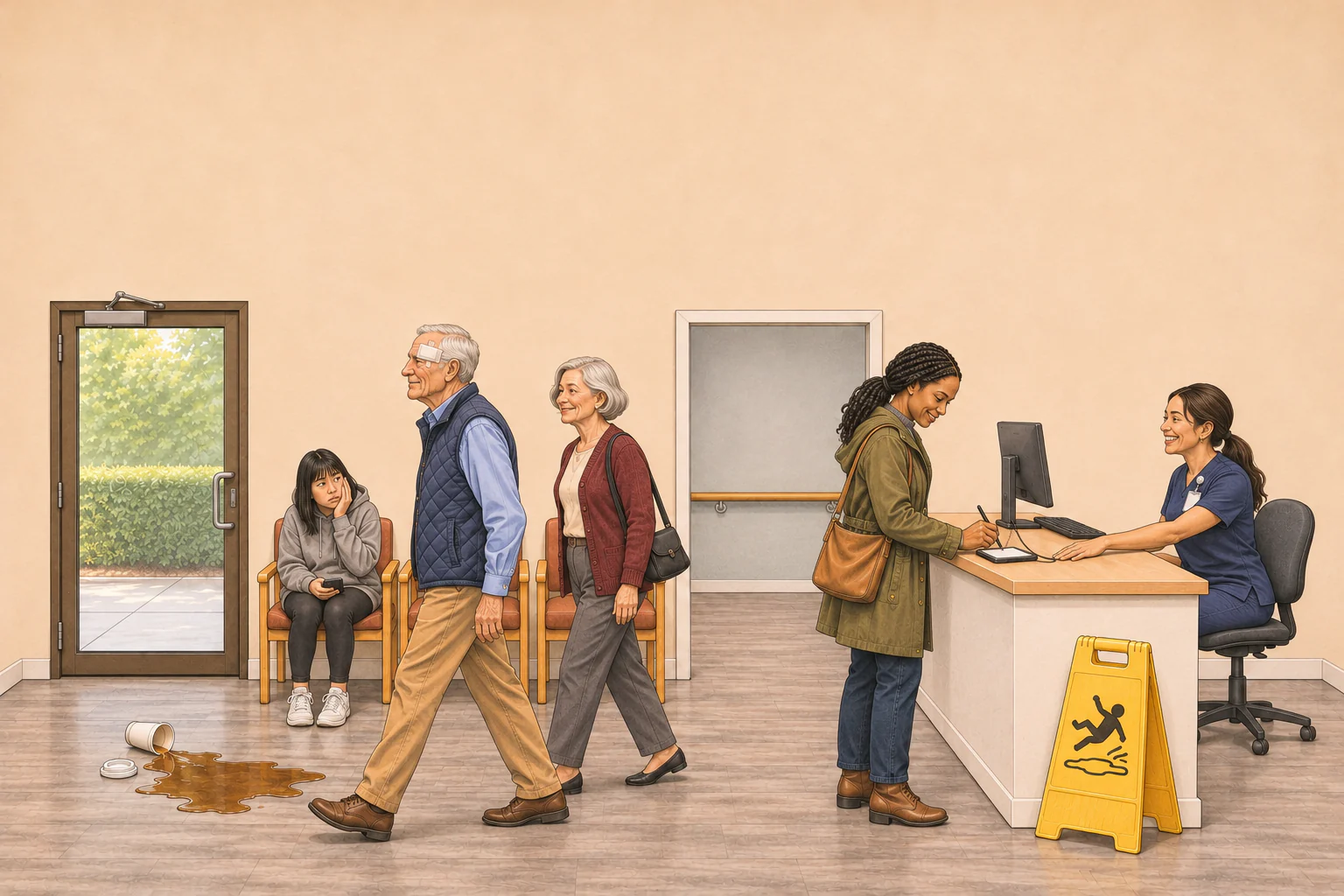 Front desk:Almost done! Just sign right here.Front desk (thinking):Walking away would be rude. I’ll get it after.
Courtesy wins by default. The check-in stays smooth, and the coffee stays on the floor. - The Mediocre ApproachThe poor outcome
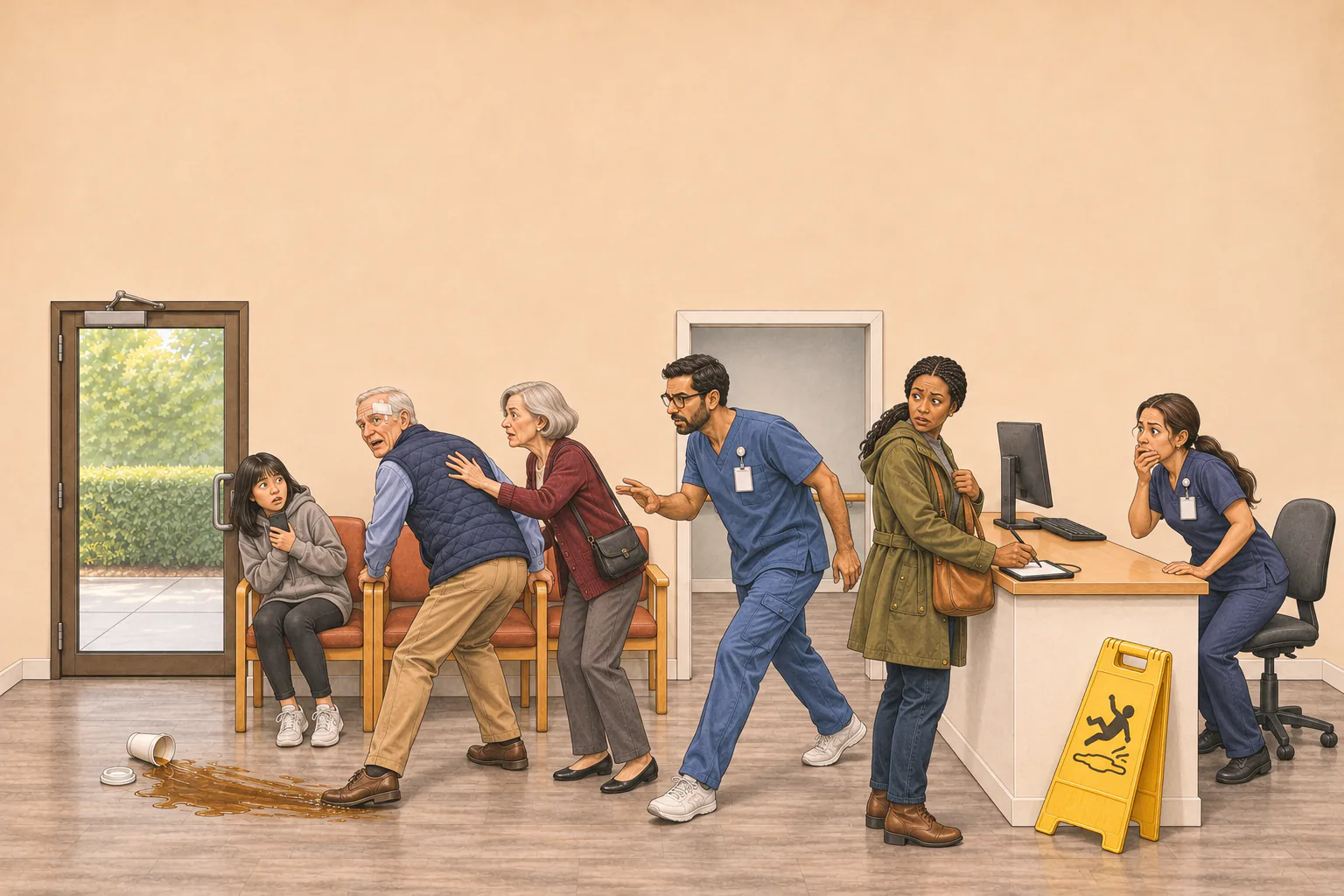 Nurse:I’m a nurse here. Let me check on you.Mohs patient:I never saw it.Front desk (thinking):I saw that coffee. I should have stopped.
Seconds later. He catches himself on a chair. A nurse comes to check on him, the check-in waits anyway, and the coffee is still on the floor. Rewind. Same patient, same moment, same problem. This time, the order was settled before the rush.
- The Exceptional ApproachThe action: settled in advance
 Front desk:Excuse me one moment. Wet floor.Front desk:Sir, come around this side, please.Patient:Go ahead. I found my card.
Safety first, so she doesn’t need to ask anyone. She excuses herself, guards the spill and steers him around it. The check-in waits a minute. - The Exceptional ApproachThe exceptional outcome
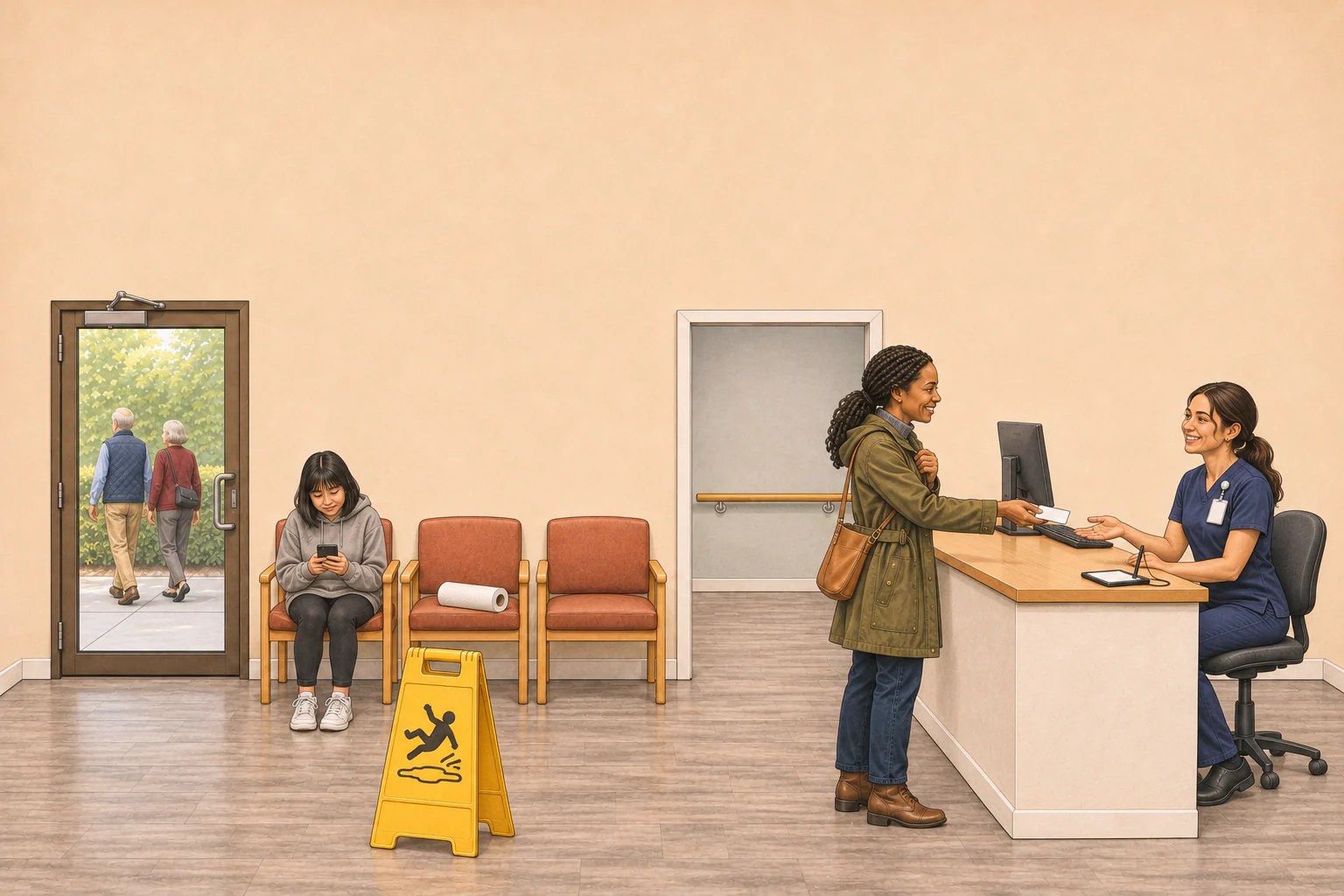 Front desk:Thanks for waiting. Now, that insurance card.Patient:Here. I’d want you to do the same for me.
Two minutes later. The floor is dry, he walks out on his own two feet, and the check-in finishes with a thank-you.
Example OneAt a glance
The ProblemThe front desk is halfway through checking in a new patient when coffee spills by the door. A patient leaving after Mohs surgery, a thick bandage over his left brow, is walking toward it.
The Mediocre ApproachNo order: courtesy wins by default
Action
Finish the check-in first.
- “Almost done! Just sign right here”
- The spill waits until the check-in is done
Poor outcome
A near fall.
- He slips and catches himself on a chair
- A nurse checks on him, and the check-in waits anyway
The Exceptional ApproachSettled in advance: safety comes first
Action
Excuse yourself and guard the spill.
- “Excuse me one moment”: the wet-floor sign goes down
- She steers him around it, then wipes it up
Exceptional outcome
Everyone leaves on their feet.
- The floor is dry in two minutes
- The check-in finishes with a thank-you
Example Two: “Is It Quick?”
- The Problem
A scheduler is booking a patient’s first Mohs surgery, and four calls are holding. The patient asks, “Is it quick? I have to be back at work by eleven.”
 Patient (on the phone):Is it quick? I have to be back at work by eleven.Scheduler (thinking):Four on hold… just book it.
A worried question, four lights blinking. The next two minutes decide what kind of surgery day this patient will have. - The Mediocre ApproachThe action
 Scheduler:Oh, it’s pretty quick! You’re set for eight.Scheduler (thinking):Next call.
Speed wins by default. The call ends fast, and her question gets a guess. - The Mediocre ApproachThe poor outcome
 Patient:Nobody said it could take all day! I have a meeting at eleven.Mohs nurse:The lab is still processing your first stage.Mohs nurse (thinking):This should have been one phone call.
Surgery day, 10:40. The lab is still processing her first stage. She was told it would be quick, so she promised work she’d be back by eleven. Now she is upset, and the team spends its time calming her down. Rewind. Same patient, same moment, same problem. This time, the order was settled before the rush.
- The Exceptional ApproachThe action: settled in advance
 Scheduler:Let me take two minutes. Please set aside the whole day.Patient (on the phone):The whole day? Then I’ll take it off.Coworker:I’ve got line two.
The schedule comes last, so the queue can wait two minutes. A coworker picks up the holding lines while the scheduler asks her to set aside the day and says the Mohs team will answer her medical questions. - The Exceptional ApproachThe exceptional outcome
 Mohs nurse:The lab is still processing your first stage.Patient:No rush. I cleared my whole day.
Surgery day, 10:40. The lab is still processing her first stage. She was told to set aside the day, so she cleared it. Now she is relaxed, and the team can focus on her care.
Example TwoAt a glance
The ProblemA scheduler is booking a patient’s first Mohs surgery while four calls are holding. The patient asks, “Is it quick? I have to be back at work by eleven.”
The Mediocre ApproachNo order: the queue wins by default
Action
Book it fast, guess the answer.
- “Oh, it’s pretty quick!”
- She hangs up for the next call
Poor outcome
A rushed, upset surgery day.
- Told it was quick, she promises work she’ll be back by eleven
- At 10:40 the lab is still working; she is upset, and the team spends its time calming her down
The Exceptional ApproachSettled in advance: the schedule comes last
Action
Take two minutes, share the lines.
- A coworker picks up the holding calls
- “Please set aside the whole day”: the Mohs team will answer the medical questions
Exceptional outcome
A calm surgery day.
- Told to set aside the day, she clears it and brings a book
- At 10:40 the lab is still working; she is relaxed, and the team can focus on her care
Your clinic
More Moments When Good Goals Collide
Same order every time: patient safety first, courtesy, welcome and a calm visit together, and the schedule last.
| When goals collide | Which wins, and who acts | Settled before they move on |
|---|---|---|
| After a biopsy: the MA is ten minutes behind, and the patient looks pale and says she feels lightheaded | Safety first. The MA stays with her, promptly calls the nurse or clinician the way your clinic’s protocol says and messages the desk: “I’m with a patient in Room 4” | A nurse or clinician is with her, following your clinic’s protocol |
| At the window: a patient who needs an interpreter arrives twelve minutes late for a skin check | The interpreter is the floor, never traded. The front desk connects one, explains the options warmly and checks with the clinician’s team | She knows, in her own language, whether she’ll be seen today or soon |
| On the phone: a caller says her new rash is spreading fast, and the next opening is three weeks out | Safety first. The scheduler doesn’t judge the rash; she sends it to the nurse line while the caller is still on the phone | The caller knows when the nurse will call her back |
| Morning huddle: the schedule is double-booked, and everyone knows the day will run late | The lead MA says it before the first patient: “Safety first, schedule last, and everything in between beats the clock” | Everyone starts the day with the same order |
| End of the day: an MA stayed with a faint patient, and the afternoon ran twenty minutes late | The dermatologist thanks her at the next huddle: “That was safety over schedule. Exactly right.” | Said out loud, with no patient details |
Adapt the words to your team. Anything clinical still goes to a clinician.
Your move
Try It Today
Safety first. Schedule last. Settled before the rush.
Try it for one week, with one card and one huddle. It costs a few minutes on Monday morning.
- Write the order on one card. Patient safety first; courtesy, welcome and a calm visit side by side; the schedule last. Underneath, the floor that is never traded, confirmed by your compliance lead.
- Teach it Monday morning. In the huddle, walk through two moments from your own clinic and ask the team which key wins in each.
- Put it in each role’s words. The front desk, MAs, schedulers and billing each write one line, such as “A wet floor beats a smooth check-in.”
- Thank it out loud. When someone lets the clock lose for the right reason, say so at the next huddle: “That was safety over schedule.”
- Check it on Friday. Ask for one moment the order made easy and one it left unclear, with no patient details. Then fix the card.
Anything urgent still goes straight to the clinician.
In the rush, nobody has time to decide what matters. Decide it on a calm day, and let the clock come last.
Explore the Evidence
8 sources · what each source is, what it found, what it supports here, and its limits
The Disney story on this page is assembled from three sources about the parks, each used for what it shows. The day-one class, the five keys as listed, the wording beside Safety and Efficiency, the aim of deciding without asking a manager, the role-by-role training, the Magic Kingdom walk and the leaders’ remarks all come from one first-hand report: Gavin Doyle’s September 2026 account in the fan publication Mickey Visit (reference 1). Doyle discloses that Disney hosted the visit for media, so Disney controlled access and presentation. What he describes is a Disney facilitator’s walkthrough of the Traditions curriculum at Walt Disney World, given to visiting media; it is not a live new-hire class. The facilitator’s words are paraphrased by the reporter, and the order of the keys is the order he lists. That Efficiency sits at the end on purpose is the reporter’s summary of what a trainer said. It is not a quotation from a Disney document and not an official worldwide rule, and it is the only position other than Safety that any source describes as deliberate. The aim of letting new cast members decide on their own, without checking with a manager each time, was stated in a different segment of the day from the keys; linking the two is this chapter’s reading. The leaders’ statements about using the keys in decisions and compliments are Disney’s own account. No internal Disney training document was opened. Safety first, and the standing-mop example, come from the official code-of-conduct page of Oriental Land Co. (reference 2), which runs Tokyo Disney Resort under license from Disney. It describes Tokyo practice, written by the company about itself, and the practice was not observed. Its statement that every Disney theme park shares the Five Keys was not checked park by park, and no source found the standing-mop technique at any other Disney park. The same page puts Inclusion at the center of the keys, presents efficiency as the payoff of attention to safety, courtesy and show, together with teamwork, and does not number the keys or rank Courtesy, Inclusion and Show against each other. That absence is not proof that no internal ranking exists. This chapter therefore teaches safety first, efficiency last and the middle keys side by side, and never a five-place Disney ranking. Disneyland Resort’s own safety page (reference 3) shows that its peer-recognition program exists; it does not say how often it is used or what it achieves. No study tests the Five Keys, and nothing here shows that the keys, or any single practice, caused a Disney result. The three results cards report practices, not outcomes. Research on the underlying idea is kept here and was not used in the teaching narrative. A 1994 survey of California anesthesiologists (reference 4) found that about half of respondents had seen production pressure lead to what they believed were unsafe actions; it is self-reported, covers respondents only and was read as an abstract. An observational study in manufacturing plants (reference 5) linked differences in safety climate between work groups to how supervisors applied procedures under competing demands such as safety versus productivity, with more formalized procedures going with less of that difference; it did not test a ranked list or any other intervention, its sample is the independent reviewer’s reading of the Methods, and the parent research read the abstract only. Two reviews of deliberate efforts to change safety climate are more cautious. One found few studies, most reporting better climate survey scores afterward, a process measure, not injuries (reference 6). The other, a Campbell review of 100 studies, found modest effects on accidents at work for safety climate interventions, rated that evidence insufficient or limited, and found that removing hazards at the source worked better (reference 7). Neither establishes any effect at Disney or in dermatology. Counterevidence: in December 2009, OSHA cited Walt Disney World after a July 2009 monorail collision killed a worker, and proposed $44,000 in penalties (reference 8). Those penalties were proposed, the final outcome was not found, and the release is a historical agency statement, not a current compliance assessment. It is a reminder that an order for front-line choices does not replace equipment, procedures and controls. The park scene that opens the chapter is hypothetical. The two comic strips sketch an invented, unbranded park; they do not depict Disney, its cast members, costumes or parks, and the board, the trainer and her thanks are illustration, not reported events. No source here tested any of this in a dermatology clinic. The clinic order, the fixed floor, the two clinic examples, the extra ideas and the one-week experiment are proposed adaptations written for this chapter with fictional people. They are illustrations of the mechanism, not observed events, tested interventions or legal guidance; the fixed-floor list should be confirmed by the clinic’s compliance lead, and anything clinical stays with clinicians under the clinic’s own protocols and escalation path. Status shows how each source was read: HTML (web page), ABS (abstract) or FULL (full text, selected sections).
| Source | Type and context | Key finding | What it supports here | Material limitation |
|---|---|---|---|---|
| [1] · HTMLDoyle G. Disney Rules For New Cast Members Revealed During Backstage Visit. Mickey Visit, 2026 | First-hand report A fan publication’s founder describes a Disney facilitator’s walkthrough of the Traditions curriculum at Walt Disney World, given to media at a hosted event | Traditions is the global day-one orientation for Disney Experiences cast members, led by cast-member facilitators on two-year terms. It presents five keys to weigh in every decision, listed Safety, Courtesy, Inclusion (called the heart of all that Disney does), Show and Efficiency. Safety means not putting guests or oneself at risk. Efficiency, covering the company’s scale and daily volume, is placed last on purpose and is not to be put above the other keys. Facilitators aim to let new hires make good calls without going to a manager each time. Each key becomes more specific in role training while the themes stay the same. New hires look for the keys at work in Magic Kingdom and discuss what they saw. Leaders say the keys are used in real decisions and shape how cast members compliment each other | The source case: summary, sections 2 and 3, the comparison, mechanism cards 1, 2, 4 and 5, and results card 1 | Hosted media event, so Disney controlled access and presentation; a walkthrough given to media, not a live new-hire class; the facilitator’s words are paraphrased and the order of the keys is as the reporter lists it; Efficiency last is the reporter’s summary of a trainer, not a quoted Disney document or an official worldwide rule; the no-manager aim comes from a different segment of the day, and linking it to the keys is this chapter’s reading; leaders’ remarks are Disney’s own account; one resort, September 2026 |
| [2] · HTMLOriental Land Co. Code of Conduct: The Five Keys (Tokyo Disney Resort) | Operator’s published code of conduct The company that operates Tokyo Disneyland and Tokyo DisneySea, licensed by Disney Enterprises | Every Tokyo Disney Resort cast member decides and acts by the Five Keys, which the company calls a code of conduct common to all Disney theme parks. Safety is the top priority, ahead of everything else, for guests and cast members alike. Cast members clean up spilled drinks standing, using their feet rather than squatting, because guests absorbed in the park may not notice someone crouching; the company grants this can look impolite and says it is deliberate, putting safety ahead of courtesy and show. Inclusion sits at the center of the keys. Efficiency is presented as the payoff of attention to safety, courtesy and show, together with teamwork. The keys are not numbered, and Courtesy, Inclusion and Show are not ranked against each other | Safety first and the standing-mop example: summary, section 2, the comparison, mechanism cards 2 and 3, and results card 2 | Tokyo Disney Resort only; a licensee, not The Walt Disney Company; the company describing itself, practice not observed; its statement that all Disney theme parks share the keys was not checked park by park; no source found the standing-mop technique at other Disney parks; explicit only that safety comes first; the absence of ranking language for the middle keys is not proof that no internal ranking exists |
| [3] · HTMLDisneyland Resort. Disneyland Resort: Safety is a Core Value. Disney Experiences, 2024 (updated 2026) | Company web page Disneyland Resort describing its cast safety programs | Disneyland names the same five keys as core values for its cast members. A cast member can recognize a peer who upheld the safety key, with an official message that goes to that peer and to the peer’s leader, or can host a safety celebration. There is also an anonymous phone line for safety concerns | Thanking the safety key out loud: summary, section 2, mechanism card 5 and results card 3 | The company describing its own programs; shows that they exist, not how often they are used or what they achieve; Disneyland Resort only |
| [4] · ABSGaba DM, Howard SK, Jump B. Production pressure in the work environment: California anesthesiologists’ attitudes and experiences. Anesthesiology 1994 | Mailed survey 647 California members of the American Society of Anesthesiologists; 47% returned surveys | About half of those who answered (49%) had seen production pressure lead an anesthesiologist to act in a way they believed was unsafe | Background on the problem, kept here; not used in the teaching narrative | Abstract only; self-report; respondents only; published 1994, with the survey year not given in the abstract; anesthesiology, not dermatology |
| [5] · ABSZohar D, Luria G. A multilevel model of safety climate: cross-level relationships between organization and group-level climates. J Appl Psychol 2005 | Observational multilevel field study Manufacturing: 3,952 production workers in 401 work groups nested in 36 plants, per the independent reviewer’s reading of the Methods | Safety climate at the plant level and the work-group level broadly matched. Work groups still differed in a meaningful way, and the difference traced to how much leeway supervisors took in applying formal procedures when demands such as safety and productivity competed. Where the organization’s climate was stronger and procedures more formal, groups differed less, though those effects were smaller | Background on why leaders’ choices under pressure matter, kept here; not used in the teaching narrative | An association, not a test of a ranked list or any other intervention; manufacturing, not health care; the parent research read the abstract only, and the sample is the reviewer’s reading, not the author’s; the abstract’s mention of one organization describes where the group-level differences were seen, not the whole sample |
| [6] · ABSLee J, Huang YH, Cheung JH, Chen Z, Shaw WS. A systematic review of the safety climate intervention literature: past trends and future directions. J Occup Health Psychol 2019 | Systematic review 19 articles on safety climate interventions, screened from 384 titles, across industries | Few studies have tested specific ways to change safety climate. Ten of the 19 used before-and-after designs without full randomization. Every intervention relied on communication or education and training, often alongside safety leadership. In 17 of the 19, safety climate scores were significantly better afterward | Counterevidence and context, kept here: deliberate efforts to change what staff believe comes first are thinly studied | Abstract only; the outcome is safety climate survey scores (a process measure), not injuries; many uncontrolled designs; does not establish any effect at Disney or in dermatology |
| [7] · FULLDyreborg J, Lipscomb HJ, Nielsen K, et al. Safety interventions for the prevention of accidents at work: a systematic review. Campbell Syst Rev 2022 | Campbell systematic review 100 intervention studies on preventing accidents at work, across industries | Safety climate interventions, such as leaders talking about safety, had modest effects on accidents. The evidence for efforts aimed at changing safety climate was rated insufficient or limited. Interventions that remove the hazard itself worked better. Publication bias could not be assessed | Counterevidence, kept here: changing what people believe comes first has modest, thinly evidenced effects on accidents, and removing hazards at the source works better | Selected sections of the full text read (conclusions, plain-language summary and safety climate results), not the whole review; occupational accidents, not outpatient health care; heterogeneous studies; does not establish any effect at Disney or in dermatology |
| [8] · HTMLU.S. Department of Labor, OSHA. OSHA cites Walt Disney World following monorail collision. News release, 23 December 2009 | Regulator’s news release U.S. Occupational Safety and Health Administration, about Walt Disney World | In July 2009, a worker died in a collision between two monorail trains during a track switch; the release says two track switch beams had not been locked in place or powered. OSHA cited one serious violation tied to the crash, plus two repeat violations and one other serious violation that were not. Its assistant secretary said proper procedures at Disney could have stopped the crash. OSHA proposed $44,000 in penalties in all, $7,000 of it for the crash-related violation, and the company could comply, meet with OSHA or contest | Counterevidence, kept here: a fatal failure in equipment and procedures, which an order for front-line choices does not address on its own (see also reference 7) | Proposed penalties, not a final adjudication, and the final outcome was not found; a historical 2009 agency statement, not a current compliance assessment; read in a browser, as the government page refused automated access |
References
- Doyle G. “Disney Rules For New Cast Members Revealed During Backstage Visit.” Mickey Visit. 20 September 2026. mickeyvisit.com
- Oriental Land Co. “Code of Conduct: The Five Keys (Tokyo Disney Resort).” OLC Sustainability, Guests’ Safety and Security at Theme Parks. Undated; accessed 10 November 2026. olc.co.jp
- Disneyland Resort. “Disneyland Resort: Safety is a Core Value.” Disney Experiences. 10 May 2024; updated 18 September 2026. disneyexperiences.com
- Gaba DM, Howard SK, Jump B. Production pressure in the work environment: California anesthesiologists’ attitudes and experiences. Anesthesiology. 1994;81(2):488–500. doi.org/10.1097/00000542-199408000-00028 · PubMed 8053599
- Zohar D, Luria G. A multilevel model of safety climate: cross-level relationships between organization and group-level climates. J Appl Psychol. 2005;90(4):616–628. doi.org/10.1037/0021-9010.90.4.616 · PubMed 16060782
- Lee J, Huang YH, Cheung JH, Chen Z, Shaw WS. A systematic review of the safety climate intervention literature: past trends and future directions. J Occup Health Psychol. 2019;24(1):66–91. doi.org/10.1037/ocp0000113 · PubMed 29697992
- Dyreborg J, Lipscomb HJ, Nielsen K, et al. Safety interventions for the prevention of accidents at work: a systematic review. Campbell Syst Rev. 2022;18(2):e1234. doi.org/10.1002/cl2.1234 · PMC9159701
- U.S. Department of Labor, Occupational Safety and Health Administration. “US Department of Labor’s OSHA cites Walt Disney World following monorail collision and issues recommendation letter following actor’s death.” News release 09-1554-ATL. 23 December 2009. dol.gov
Explore the evidence · Try it today · Read the Disney Parks Daily Brief · More lessons from The Exceptional Private Practice