Lessons from Costco · for dermatology practices
Keep One Small Promise. Fix the Work, Not the Promise.
Costco’s hot dog and soda combo has cost $1.50 for about forty years. When the hot dog was losing money, a former CEO recalls, the answer was to find another way: the price stayed, and Costco began making its own hot dogs. Your clinic can keep one small promise the same way.
What you’ll take away
- The problem
- When a promise gets expensive, the easy fix is to quietly let it slip, and people learn that nothing you promise is sure.
- What to remember
- Keep one small promise people can check, every single time. When it gets hard, change how the work is done, never the promise.
- What to do differently
- Promise every biopsy patient a call by a set day, track it on a log, and fix the workflow when volume rises. A ready result never waits for that day.
30-Second Summary
- One small promise, kept for about forty years. Costco’s hot dog and soda combo has cost $1.50 since the mid-1980s.1, 2
- When it got hard, the price stayed. Former CEO Craig Jelinek recalled telling Jim Sinegal that Costco could not keep selling the hot dog for $1.50, because it was losing money. The answer he got: “Figure it out.”3
- So Costco changed the work. Jelinek said Costco built its own hot dog plant, later added a second near Chicago, and kept the price.3 In 2024, the new finance chief used his first earnings call to confirm that “the $1.50 hotdog price is safe.”4
- Keeping counts more than exceeding. In experiments, people judged a broken promise worse than a kept one, but doing more than promised earned no extra credit. College students were no happier when a partner solved 15 puzzles instead of the 10 promised.5
- In your clinic: promise every biopsy patient a call by a set day, keep it every time on a tracked log, and when volume rises, fix the workflow, never the promise. A ready result goes to the patient as soon as the clinician directs.
The Problem
What Goes Wrong When a Promise Bends Every Time It Gets Hard
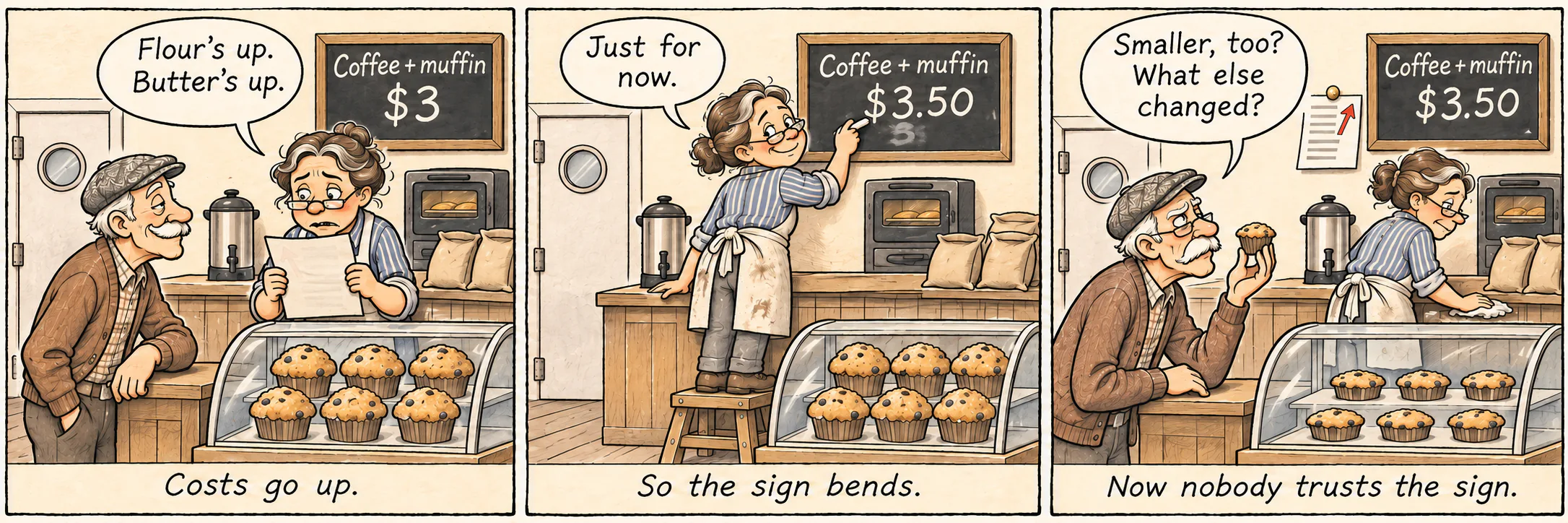
Picture a neighborhood bakery with a small sign by the register: coffee and a muffin, $3. The regulars know it by heart.
Then flour and butter cost more. The owner changes the sign to $3.50, just for now. A few months later the muffins are a little smaller. Nobody announces anything.
Each change makes sense on its own. But the regulars notice, and they stop trusting the sign. Next time they wonder what else has quietly changed. A promise that bends whenever it gets hard stops being a promise.
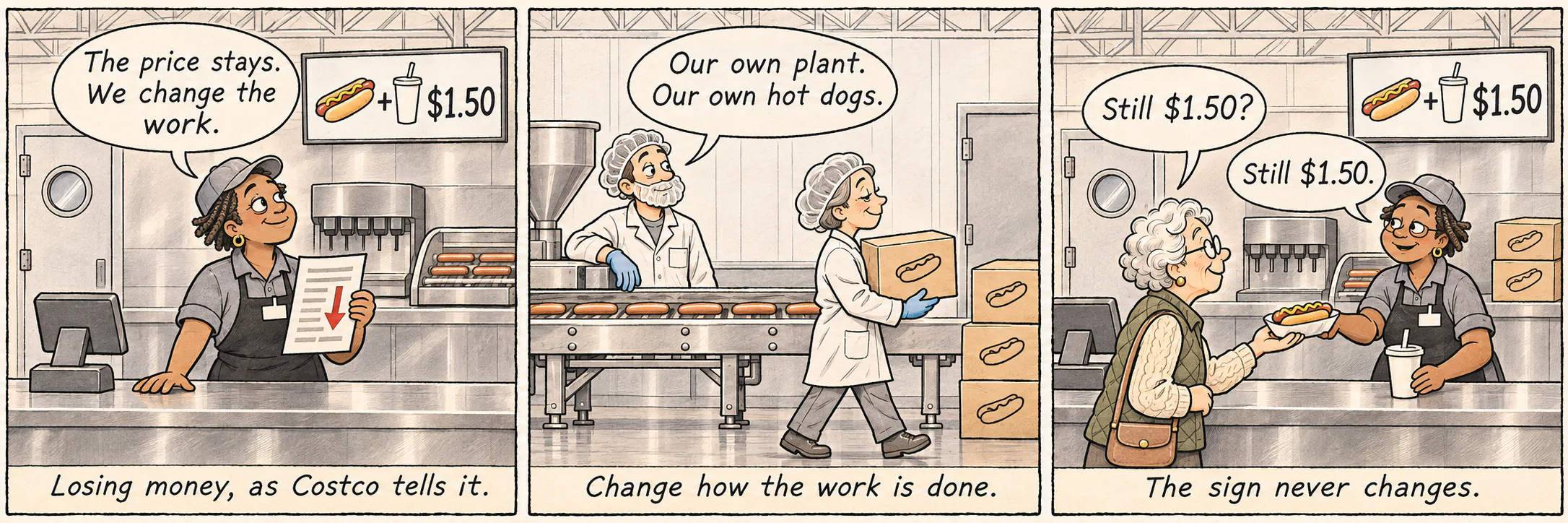
Costco reached the same moment with its hot dog. In an April 2018 talk to a local chamber of commerce, then-CEO Craig Jelinek recalled going to Jim Sinegal and telling him they could not keep selling the hot dog for “a buck fifty,” because Costco was losing money.3
Jelinek himself thought a $1.75 hot dog would still have sold, so a higher price would hardly have hurt.3 The easy fix was right there.
The Exceptional Solution
Costco’s Answer: Keep the Price, Change the Work
Sinegal’s answer, as Jelinek told it, was short: “Figure it out.”3 The price was off the table. The work behind it was not.
Here is how Costco kept the promise, as the people who ran it describe it:
Hold the promise. Jelinek called it discipline: being told the price could not go up is what pushed Costco to find another way.3
Change how the work is done. Jelinek said Costco opened a plant of its own for its Kirkland Signature hot dogs and, as hot dog sales grew, added a second near Chicago.1, 3, 6 Customers saw the same $1.50. What changed was behind the counter.
Change only what the promise needs. On a 2024 earnings call, CEO Ron Vachris said Costco takes on making its own products “as the need arises.” Costco built its chicken plant when suppliers could not keep up and no partner would grow with it, and he said Costco does not take on that work just because it can.4
The hot dog and soda still cost $1.50, about forty years after the price was set.1, 2
The ProblemThe $1.50 hot dog is losing money.
The Mediocre ApproachRaise the price
Poor outcome
The promise is gone.
- The one price everyone could check has changed
- The costly work behind it stays the same
What Made It Stick
Three things keep the promise in plain view:
A promise anyone can check. Jelinek said the point was the mindset the price creates: say Costco, and people picture the $1.50 hot dog.3
A story the company still tells. In 2024, CEO Ron Vachris explained Costco’s own meat plants by pointing to “the infamous story” of the $1.50 hot dog and Coke.4
Said again, plainly. In his first earnings call as CFO, Gary Millerchip used his opening remarks to settle recent press speculation: “the $1.50 hotdog price is safe.”4
The bakery in our first story changed its sign. Costco changed how its hot dogs were made, and the sign never changed.
The mechanism
Why It Works
A $1.50 hot dog sounds like a small thing. That is the point. Each part does a different job: being small makes the promise easy to check, the fixed price forces better work, keeping it counts for more than beating it, and saying it again keeps everyone sure.
Tap or click a card to see why it works.
-
Small enough to check.
One item, one price, anyone can see it.3
-
A fixed price forces a better process.
No price rise, so the work had to change.3
Why it works
- No price rise. As Jelinek recalled it, Sinegal’s answer took a higher price off the table.3
- The discipline. Jelinek said being told the price could not rise is what led Costco to make its own hot dogs.3
- The fix is behind the counter. Customers saw the same $1.50. What changed was how the hot dogs were made, in Costco’s own plants.3
-
Change only what the promise needs.
Fix the part that is breaking, not everything.4
Why it works
- When the need comes. Vachris said Costco takes on making its own products when a need comes up.4
- When partners can’t. He said Costco built its chicken plant when suppliers could not keep up and no partner would grow with it.4
- Not for its own sake. He said Costco does not make things itself just because it can.4
-
Keeping counts more than exceeding.
A broken promise costs you. An extra barely registers.5
Why it works
- Broken hurts. In experiments by Ayelet Gneezy and Nicholas Epley, people judged a broken promise worse than a kept one.5
- Extra goes unnoticed. In a concert-ticket scenario, worse seats than promised lowered ratings, but better seats didn’t raise satisfaction.5
- So spend effort on reliability. Put your energy into never breaking the promise, not into occasional extras.
-
Say it again, plainly.
When people wonder, restate it.4
Why it works
- To clear up doubt. In 2024, Costco’s new CFO used his first earnings call to settle press speculation and confirm the price.4
- A story people repeat. The CEO retold the hot dog and Coke story to explain why Costco runs its own plants.4
- Plain words. One flat sentence saying the price is safe leaves nothing to guess about.4
The evidence
The Results, and Where Else It Works
Psychologists have tested what a kept promise is worth.5 And health care has its own small promise that patients can check: “We’ll let you know your results.” Researchers have counted how often it slips, and what goes with keeping it.7, 8 Flip each card for the result and the lesson to take home.
Tap or click a card to flip it.
-
$1.50 for a hot dog and soda at Costco’s US food courts: the same price for about forty years
- The promise: One item, one price, since the mid-1980s.
- The fix: When it got costly, Costco changed how the hot dogs were made.
$1.50 → $1.50 for a hot dog and soda: mid-1980s vs about forty years later
- The price has not moved in about forty years.
- In 2024, the CFO confirmed the price is safe.
Valuable lesson: Choose a promise small enough to keep every single time.
Source: Fortune, 2025 · NPR, 2024 · evidence row 1 · evidence row 2 · evidence row 4
-
15 = 10 puzzles: to college students, a partner who promised 10 and solved 15 earned no more thanks than one who solved exactly 10
- The promise: A partner promised to solve 10 puzzles.
- What students felt: Fifteen made them no happier than ten.
Exceptional results5
15 = 10 puzzles solved: the extra five earned no extra thanks
- College students were no happier when a partner did more than promised.
- They didn’t even see the extra effort.
- A broken promise was judged worse than a kept one.
Valuable lesson: Spend your effort keeping the promise, not beating it.
Source: Chicago Booth Review, 2014 · evidence row 5
-
1 in 14 abnormal test results in 23 US primary care practices had no record that the patient was told
- The promise: An abnormal result reaches the patient.
- What was found: Some had no record that the patient was ever told.
Exceptional results7
About 1 in 14 abnormal results with no record the patient was told
- From none at some practices to about one in four at others.
- Practices with stronger systems for handling results missed fewer.
Valuable lesson: Give every result an owner and a log until the patient has heard.
Source: Casalino et al., Arch Intern Med 2009 · evidence row 7
-
3 to 5 days sooner for tracked skin biopsy orders to reach every step, including telling the patient, in one health system
- The tracking: Each biopsy order was tagged and followed electronically.
- The steps: From the report reaching the doctor to the patient being told.
Exceptional results8
3 to 5 days sooner tracked vs untracked skin biopsy orders, through every step
- Tracked orders reached each step, through telling the patient, more often and sooner.
- The steps ran from the report reaching the doctor to the case being closed.
Valuable lesson: Follow every specimen until the patient has heard.
Your dermatology clinic
Bringing It Home to Your Dermatology Clinic
Your clinic makes small promises all day. The one patients wait on hardest is “We’ll let you know about your biopsy.” In a survey at three US academic melanoma clinics, speed was what patients cared about most, and two in three preferred a phone call from their physician.9 At an Irish dermatology clinic, 73% of patients rated the speed of results “very important.”10
Choose one promise patients can check: the practice manager and the medical director pick one small, concrete promise about the service. For a Monday biopsy, it might be: “You’ll hear from us by Thursday at the latest. If the lab isn’t done, we’ll still call Thursday to tell you and give you a new date.” It promises contact, not a result, a price or an outcome.
Make it the latest day, never a waiting day: a ready result goes to the patient as soon as the clinician directs, whatever the promised day. Anything the lab flags as urgent goes to the clinician at once. Write the promise to fit how results really reach your patients: if your portal releases them automatically, say so, and tell patients how to reach you if a result appears first. Never delay or block portal access to protect the call.11, 12
Say it the same way, every time: the clinician gives the promise during the biopsy consent, and the MA writes the date on the after-visit summary and reads it back. The consent form records how the patient prefers to hear, as the melanoma-clinic researchers recommend.9
Keep it every time, on a log: a named results coordinator, often an MA or a nurse, keeps a pending-biopsy log: every specimen, its owner and its latest contact date. Each week, count two things: patients contacted by the promised day, and the time from the clinician’s sign-off to the patient hearing.
When it gets hard, fix the back office: when a busy Monday puts Thursday at risk, keep Thursday and change the work. Protect a daily results hour, open a task when a pathology report posts, cross-train a second MA on the log, and agree on status wording the clinician has approved. Add capacity or remove waste, rather than asking the same people to stay late.
Say it again when people change: every new MA, manager and physician hears the promise, who owns it and where the log is, in the first week.
Here’s how that plays out in two everyday moments. Each one starts with the problem, follows the mediocre approach to its outcome, then rewinds to the same moment for the exceptional approach: the promise kept, with the work changed to keep it.
Example One: Thursday, and No Report Yet
- The Problem
It’s Thursday afternoon, the day a biopsy patient was promised a call. The results coordinator checks the log: the lab report isn’t back yet.
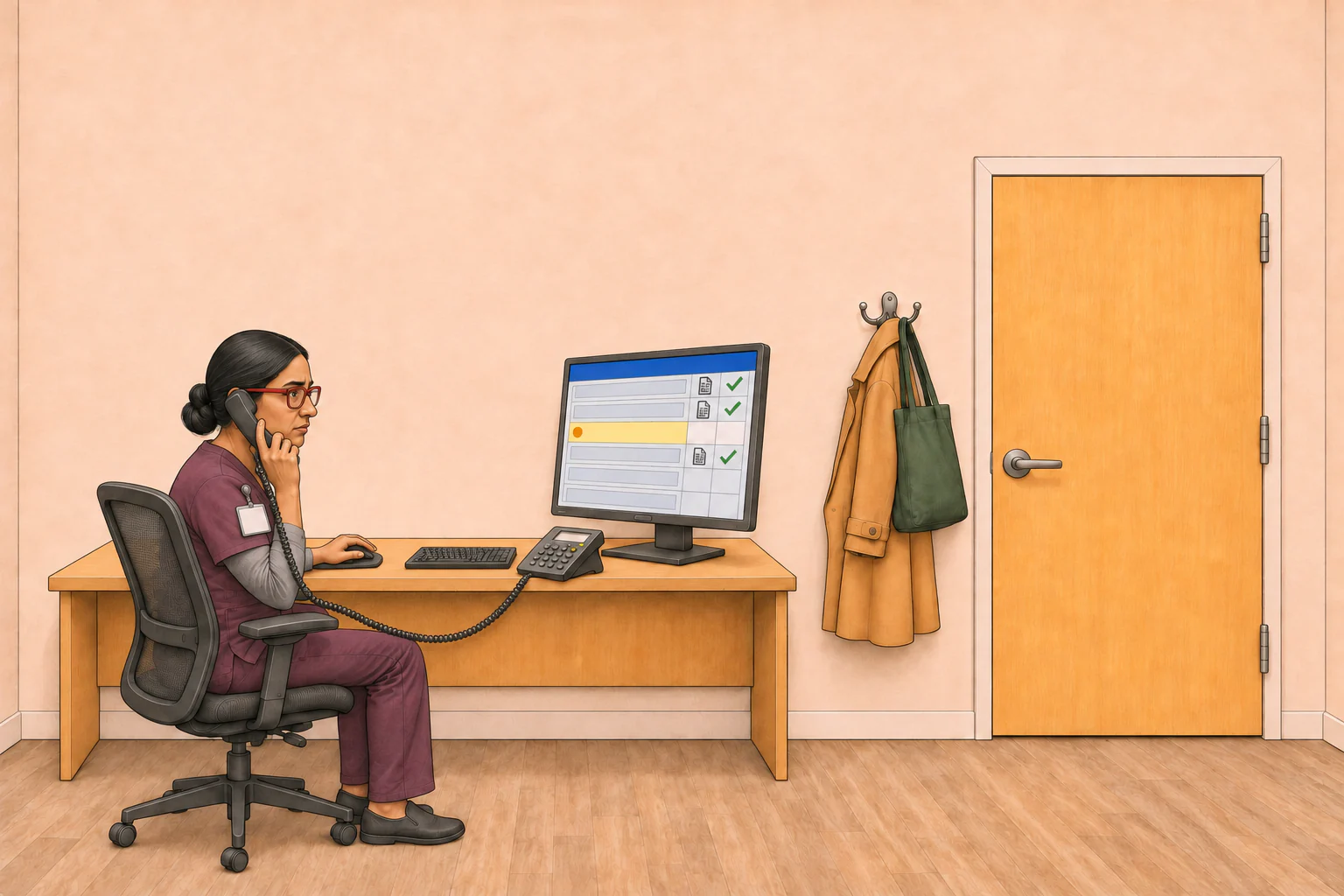 Results coordinator (on the phone):Still pending at the lab? Okay, thanks.Results coordinator (thinking):He was promised a call today.
Promise day, no report. The lab needs more time, but the call can still happen today. That was the promise. - The Mediocre ApproachThe action
 Results coordinator (thinking):No result, nothing to tell him.Results coordinator:I’ll call him when the report’s in.
Wait for the news. With nothing to report, the call waits too, and Thursday ends in silence. - The Mediocre ApproachThe poor outcome
 Patient (on the phone):You said Thursday. Nobody called. Is something wrong?Front desk:Let me find out who has your biopsy.
Monday morning. The silence sounded like bad news. Now he’s worried, the front desk is hunting for answers, and the call still has to be made. Rewind. Same patient, same Thursday, same missing report. This time, the promise is kept.
- The Exceptional ApproachThe action: call anyway
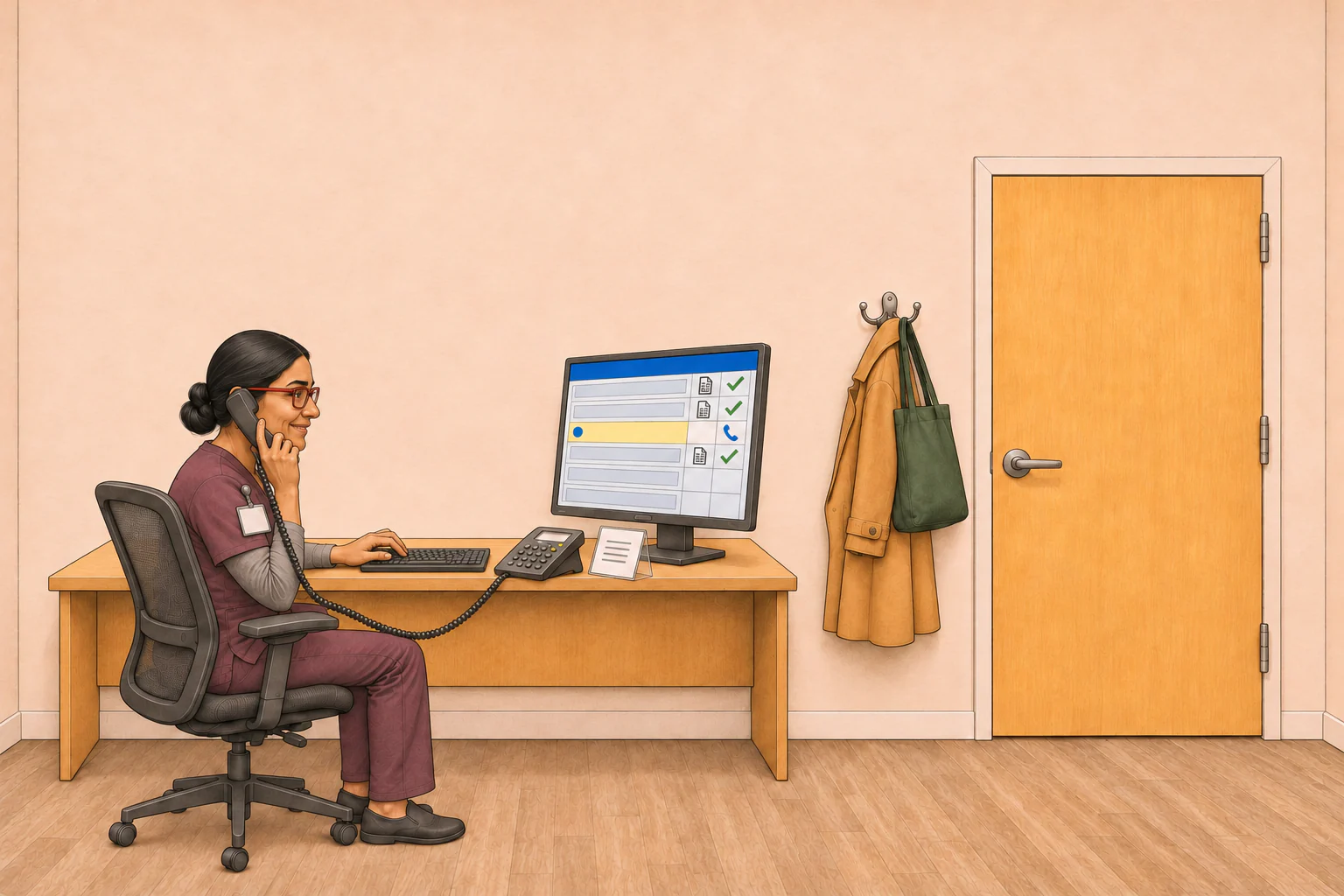 Results coordinator (on the phone):Calling as promised. The lab needs a few more days.Results coordinator (on the phone):We’ll call by Wednesday, sooner if it’s ready.
Keep the promise anyway. The promise was a call by Thursday, not a result. She calls with the clinician’s approved words and writes a new latest date on the log. - The Exceptional ApproachThe exceptional outcome
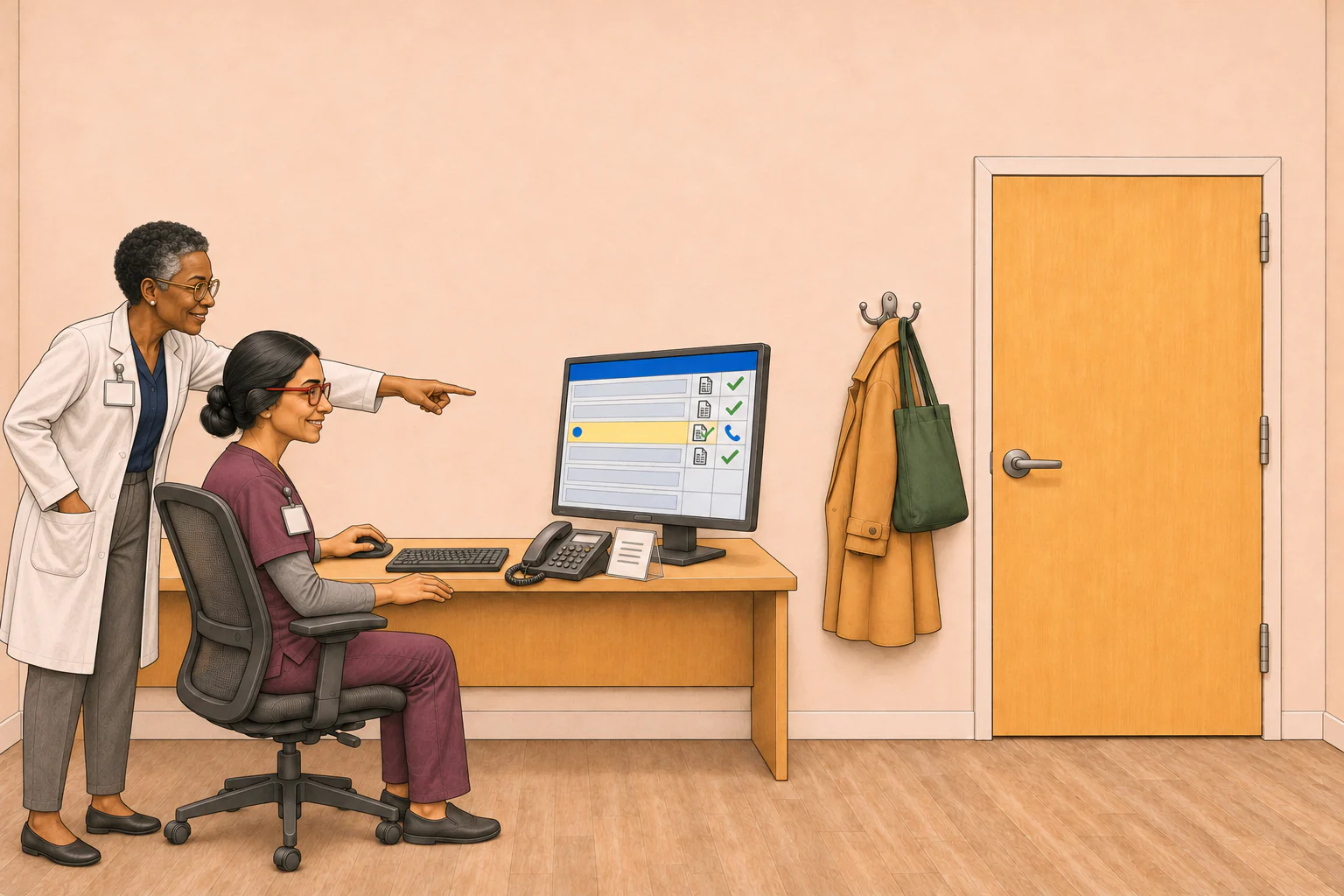 Dermatologist:Signed. He hears today.Results coordinator:Logged for today, a day early.
Tuesday. The report comes in. The dermatologist signs it and directs that he hear today, a day before the new date. The promised day was the latest day, never a reason to wait.
Example OneAt a glance
The ProblemOn Thursday, the day a biopsy patient was promised a call, the lab report still isn’t back.
The Mediocre ApproachWait for the news
Action
Call when there’s a result.
- No report, so no call
- Thursday passes in silence
Poor outcome
Silence sounds like bad news.
- On Monday the patient calls in, worried
- The front desk hunts for answers, and the call still has to be made
The Exceptional ApproachThe promise kept: call anyway
Action
Call on the promised day.
- “Calling as promised. The lab needs a few more days”
- A new latest date goes on the log
Exceptional outcome
Calm, and no waiting.
- Signed Tuesday, and the dermatologist wants him told that day
- No worried call, no hunting for answers
Example Two: A Monday Full of Biopsies
- The Problem
At Tuesday’s huddle, the results log shows a packed Monday of biopsies: more calls due by Thursday than one results coordinator can make in her day.
 Practice manager (thinking):Every one of them was promised.Results coordinator:Monday was huge. I can’t make all those calls alone.
Caught two days early. Thursday hasn’t come yet, so there’s still time to change the work instead of the promise. - The Mediocre ApproachThe action
 Practice manager:We’ll all stay late Thursday and push through.Results coordinator (thinking):Again? That’s every Monday lately.
Power through. Everyone will stay late on Thursday. The promise survives the week, and the work stays exactly as it was. - The Mediocre ApproachThe poor outcome
 Results coordinator (on the phone):Sorry to call so late. This is the clinic.MA (thinking):Same thing next week.
Thursday, seven o’clock. Every call gets made, by two tired people after hours. Nothing about the work changed, so next Monday will be just as hard. Rewind. Same huddle, same packed log. This time, the team fixes the work, not the promise.
- The Exceptional ApproachThe action: fix the back office
 Medical director:Thursday stays. Let’s change the work, not the hours.Practice manager:Results hour at one, every day. Kim learns the log.
Keep Thursday, fix the back office. The team protects a daily results hour and cross-trains a second MA on the log, so the work fits the promise. - The Exceptional ApproachThe exceptional outcome
 Results coordinator:Every Monday patient has had their update.MA:And we’re out on time.
Thursday, four o’clock. Every Monday patient has had the promised update by Thursday, inside working hours. The results hour stays for next Monday too.
Example TwoAt a glance
The ProblemAfter a packed Monday of biopsies, Tuesday’s huddle finds more calls due by Thursday than one results coordinator can make in her day.
The Mediocre ApproachPower through
Action
Stay late on Thursday.
- “We’ll all stay late Thursday and push through”
- The work itself stays the same
Poor outcome
Kept, at the team’s expense.
- Calls made after hours by two tired people
- Next Monday will be just as hard
The Exceptional ApproachThe promise kept: fix the back office
Action
Keep Thursday, change the work.
- A protected results hour every day
- A second MA cross-trained on the log
Exceptional outcome
Kept, inside the workday.
- Every Monday patient gets the promised update by Thursday
- The team goes home on time, and the new hour stays
Your clinic
More Ways to Keep the Promise
Same pattern every time: one promise patients can check, a named owner, and a back office built to keep it.
| What happens | Who answers, and how | Kept before it moves on |
|---|---|---|
| At the biopsy: the patient asks, “When will I hear?” | The MA repeats the promise the clinician gave, in the same words as always, writes the latest date on the after-visit summary and records how the patient prefers to hear | The patient leaves knowing the latest day, and whom to call if a result shows up in the portal first |
| Before the promised day: a patient reads a result in the portal and calls, confused | The front desk passes the call to the results coordinator, who checks with the clinician and arranges the clinician’s explanation or a prompt clinician call | The patient gets an answer that day, from the right person, and is never told to wait for Thursday |
| Days early: a pathology report posts on Monday, three days before the promised call | The results coordinator sends it to the dermatologist that day, and the dermatologist decides how and when the patient hears | The patient hears as soon as the dermatologist directs; the promised day plays no part |
| In the first week: a new MA, manager or physician starts | The practice manager explains the promise, who owns it and where the log is | The new person can name the promise, its owner and the log |
| At the monthly review: the log shows a handful of patients reached after the promised day | The practice manager and the results coordinator trace each miss to its cause, such as a send-out that never reached the log | One fix is in place before next month, and nobody is blamed for a broken process |
| Writing the handout: someone suggests, “Results in three days, or your next visit is free” | The practice manager rewrites it as a contact promise and sends it to the compliance lead | The handout promises a call by a set day, with no price, freebie or outcome attached |
Adapt the promise and its owner to your own team. Anything clinical still goes to a clinician.
Your move
Try It Today
Promise it. Keep it. Fix the work, never the promise.
Try it for one week, with one promise. No new software and no budget: a log, an owner and a team that keeps its word.
- Pick one promise. For example: “You’ll hear from us by Thursday at the latest. If the lab isn’t done, we’ll still call to tell you and give you a new date.”
- Fit it to how results reach patients. The practice manager and the clinician lead check whether your portal releases results automatically, and write the words to match.
- Say it the same way at every biopsy. Put the date on the after-visit summary, and record how each patient prefers to hear.
- Keep a log. Every specimen gets an owner and a latest contact date. Count patients contacted by the promised day, and the days from the clinician’s sign-off to the patient hearing.
- On Friday, fix one thing in the back office. Treat every miss as a process problem, and change one piece of the work, never the promise.
Anything urgent still goes straight to the clinician, and a ready result never waits for the promised day.
Costco’s price has held at $1.50 for about forty years. Keep your one small promise just as surely: fix the work, never the promise.
Explore the Evidence
15 sources · what each source is, what it found, what it supports here, and its limits
The Costco story on this page is assembled from separate sources, each used for what it shows. The price comes from independent news reports that agree on the decades but differ by a year on the start (references 1, 2 and 14). The page therefore says “since the mid-1980s” and “about forty years”, and the price described is the US food-court hot dog and soda combo, in reporting from 2024 and 2025. The hot dog conversation is one person’s memory. Craig Jelinek, then Costco’s CEO, told it at an Issaquah Chamber of Commerce luncheon on 12 April 2018, and 425 Business printed excerpts on 18 April (reference 3). The conversation has no date and no other witness account was found, so the page gives no date. The story was told for effect, Sinegal’s reply as recalled was profane, and the page quotes only its last three words. The live 425 Business page was rate-limited when it was rechecked, so the independent reviewer read a preserved copy whose hash was verified. The plants are also Jelinek’s account. Where the first plant was is not settled: the Los Angeles location in brackets in the 425 Business text is the editor’s addition, not Jelinek’s words; Fortune says “outside Los Angeles”, USA TODAY “a plant in California” and Wikipedia Tracy, California, with the second plant in Morris, Illinois (references 1, 3, 6 and 14). The page gives no year for the move in-house. Jelinek also said Costco still earns “a fair return” at $1.50; other reporting calls the combo a loss leader, so whether it makes money is disputed, and the page does not say. His remark that a $1.75 price would still sell is his opinion, not a measured estimate of demand. Ron Vachris’s and Gary Millerchip’s words come from a third-party transcript of the 30 May 2024 earnings call, not the company’s official record (reference 4). Costco’s own annual report (reference 13) is kept here for the record and is not used in the teaching text: it shows member renewal of 92.3% in the US and Canada at the end of fiscal 2026, but renewal is a company-wide, trailing measure (renewals seven to eighteen months before the reporting date), not a food-court measure, and nothing in these sources measures whether the hot dog affects renewal or spending; Costco’s results have many causes. Fees of $5,907 million against net income of $9,226 million is a ratio of 64.0%, not a share of profit. The promise research (reference 5) is one 2014 set of experiments by Ayelet Gneezy and Nicholas Epley with mostly student and online samples; the puzzle study had 60 undergraduates in a laboratory. It was read through Chicago Booth Review’s summary of its own faculty’s research, not the full paper, and no replication was found. The authors “postulate” that the pattern extends to business; extending it to patients is this chapter’s inference, and it says nothing about the order or timing in which clinical results reach patients. Casalino and colleagues (reference 7) report an association in US primary care, among adults aged 50 to 69, from data before 2009, read as the abstract; it does not show that the processes caused the difference, and its published erratum corrects author contributions, not results. Rajan and colleagues (reference 8) compared tracked with untracked skin biopsy orders in one US health system in 2016 to 2017, using radio-frequency tags; the design is observational, so the page treats the result as an association, although the authors write that tracking “considerably improved” timeliness, and it does not show that a hand-kept log saves 3 to 5 days. The two surveys of how patients want biopsy results (references 9 and 10) are small and were read as abstracts. The US survey was of English-speaking adults at three academic melanoma clinics in 2012 to 2013, before wide portal use, so preferences may have shifted; 40.5% said they would want a different method if the result were malignant. The Irish survey covers one centre in 2025, and 59% of its patients said the method they would choose turns on whether the news is normal or not. The federal guidance (references 11, 12 and 15) is the regulator’s stated view in information-blocking FAQs dated 2021 to 2022 and last updated in September 2025. It is fact-specific and United States only, state law was not researched, and it is not legal advice. It also says patients may see results in parallel with the ordering clinician, that a clinician’s own good-faith judgment about one particular patient can fall inside the Preventing Harm exception, that honoring a patient’s own wish to see results later is probably not interference, and that a hold state law requires probably is not either, if it lasts only as long as needed. Whether a given clinic’s record system can honor such requests was not researched. Any release policy belongs with the clinic’s clinician leaders and compliance lead, never with a service promise. The bakery scene that opens the chapter, its comic strip and the price rise in the first comparison are hypothetical. The food-court comic strip draws Jelinek’s account and the long-held price (references 1 to 3) in an invented, unbranded setting: its supervisor, plant workers, customer and their words are invented, and it shows no real person, no plant location and no claim about profit. No source here tested Costco’s practices, or a contact promise, in a dermatology clinic. The two clinic examples, the extra ideas and the one-week experiment are illustrations of the mechanism, written for this chapter with fictional people, not observed events or tested interventions, and their counts (such as contacted by the promised day) are process measures. Status shows how each source was read: HTML (web page, filing or published transcript) or ABS (abstract).
| Source | Type and context | Key finding | What it supports here | Material limitation |
|---|---|---|---|---|
| [1] · HTMLIvanova I. Costco CFO promises the hot dog and drink combo will never cost more than $1.50. Fortune, 2025 (first published 2024) | News article Fortune; a September 2025 version of a story first published in June 2024 | Dates the $1.50 combo to the mid-1980s; places Costco’s first hot dog plant near Los Angeles | The price held for about forty years (summary, sections 2 and 4, results card 1); Costco’s own plant (section 2) | Start year differs by a year between sources, so the page says “the mid-1980s”; the plant’s location is not settled; draws partly on earlier reporting |
| [2] · HTMLTreisman R. Costco hot dogs have cost $1.50 since the 1980s. Here’s why prices aren’t changing. NPR, 2024 | News article NPR, June 2024 | The $1.50 price dates to the mid-1980s | The price held for about forty years (summary, sections 2 and 4, results card 1) | Secondary reporting; outlets differ by a year on when the price began |
| [3] · HTMLMatthews T. Costco CEO Craig Jelinek on Shareholders, Costco.com, and Hot Dogs. 425 Business, 2018 | Excerpts of an executive’s talk Then-CEO Craig Jelinek at an Issaquah Chamber of Commerce luncheon, 12 April 2018, printed by 425 Business on 18 April | Jelinek recalled telling Jim Sinegal the hot dog could not stay at $1.50 because Costco was losing money, and Sinegal telling him to find a way; Costco built its own plant for Kirkland Signature hot dogs and later a second one near Chicago; the discipline of not raising the price led to making them in-house; in his view a $1.75 price would still have sold; the point, he said, was the mindset the price creates | The problem, the solution and its comparison, mechanism cards 1 and 2, the summary, the food-court comic strip | One person’s undated recollection, told for effect years later, with no other witness account found; printed excerpts, not a full transcript; the original reply is profane and only its last three words are quoted; the Los Angeles location is an editor’s bracket; his statement that the combo earns a fair return is disputed by other reporting and is not used in the teaching; the $1.75 remark is opinion, not a measured demand estimate; a preserved, hash-verified copy was read because the live page was rate-limited |
| [4] · HTMLCostco Wholesale Q3 fiscal 2024 earnings call transcript, 30 May 2024. The Motley Fool | Earnings call transcript Costco’s third-quarter fiscal 2024 call, transcribed by The Motley Fool | CFO Gary Millerchip, in his first call as CFO, used his opening remarks to end media speculation by confirming the $1.50 combo price; CEO Ron Vachris said Costco moves into making its own products when a need comes up, pointing to the hot dog and Coke story as an example; Costco built its chicken plant when suppliers could not keep up and no partner would grow with it; Costco does not integrate just because it can | Section 2 and its comparison, mechanism cards 3 and 5, results card 1, the summary | A third-party transcript, not the company’s official record; executives’ own statements |
| [5] · HTMLPhillips DJ. Don’t bother doing more than you promised. Chicago Booth Review, 2014 | University research summary Chicago Booth Review’s account of experiments by Ayelet Gneezy and Nicholas Epley, published in 2014 | Broken promises were judged worse than kept ones, but exceeded promises were not judged better than kept ones; in a concert-ticket scenario, worse seats than promised lowered ratings and better seats did not raise satisfaction; in a lab study, 60 undergraduates were no happier when a partner who promised to solve 10 puzzles solved 15 instead of 10, and did not perceive the extra effort | The summary, mechanism card 4, results card 2 | Mostly student and online samples; the puzzle study was 60 undergraduates in a laboratory; read through the institution’s summary of its own faculty’s research, not the full paper; no replication found; the authors “postulate” an extension to business, and the extension to patients is this chapter’s inference; says nothing about the order or timing of clinical result communication |
| [6] · HTMLGuynn J. How Costco’s inflation-proof $1.50 hot dog deal became an icon. USA TODAY, via The Spokesman-Review, 2025 | News feature USA TODAY, republished by The Spokesman-Review, November 2025 | Costco built a plant in California to make its hot dogs | Costco’s own plant (section 2) | Secondary reporting; its wording of the plant’s location differs from other sources |
| [7] · ABSCasalino LP, et al. Frequency of failure to inform patients of clinically significant outpatient test results. Arch Intern Med, 2009 | Record review 23 US primary care practices; records of 5,434 randomly selected patients aged 50 to 69 | 135 of 1,889 abnormal results (7.1%) were apparently not communicated to the patient or not documented; the rate ranged from 0% to 26.2% by practice; higher scores for result-management processes went with lower failure rates (odds ratio 0.68, unit not stated in the abstract); partly electronic records went with higher rates | Results card 3 | An association, not proof that the processes caused the difference; primary care, adults 50 to 69, data from before 2009; read as the abstract; the published erratum corrects author contributions, not results |
| [8] · ABSRajan SS, et al. Technology-based closed-loop tracking for improving communication and follow-up of pathology results. J Patient Saf, 2022 | Comparison of tracked and untracked orders 48,515 skin biopsy orders from 20 dermatology providers and 8 labs in one US health system, 2016 to 2017 | Orders tracked with radio-frequency (RFID) tags reached all five milestones (provider receipt, provider review, patient notification, follow-up scheduling and case closure) at higher rates and 3 to 5 days sooner | Results card 4 | Observational, so treated here as an association, although the authors write that tracking “considerably improved” timeliness; one health system and one tracking technology; does not show that a hand-kept log saves 3 to 5 days; read as the abstract |
| [9] · ABSChoudhry A, et al. Patients’ preferences for biopsy result notification in an era of electronic messaging methods. JAMA Dermatol, 2015 | Patient and physician survey 301 patients at the melanoma clinics of UCSF, Penn and Duke, July 2012 to July 2013, and 47 physicians | 67.1% of patients preferred a telephone call from their physician for biopsy results; speed was the most important consideration (51.7% wanted the most rapid method); 40.5% would want a different method if the result were malignant; the authors recommend recording notification preference on the biopsy consent form | Section 5: what patients want, and recording preference at consent | English-speaking adults at academic melanoma clinics; surveyed before wide portal use and before the federal information-blocking rules, so preferences may have shifted; read as the abstract |
| [10] · ABSConlon OJ, Kearney N, Alani A. Patient and clinician perspectives on test result communication in dermatology. Ir J Med Sci, 2026 | Patient and clinician surveys 100 dermatology outpatients and 25 clinicians at one Irish centre, May to June 2025 | 73% of patients rated speed of result communication “very important”; 59% said the method they would choose turns on whether the news is normal or not | Section 5: what patients want | One centre, a small sample, outside the US; read as the abstract |
| [11] · HTMLOffice of the National Coordinator for Health IT. Information blocking FAQ IB.FAQ22.1.2021MAR (delays). HealthIT.gov, updated 2025 | Federal regulatory guidance ONC information-blocking FAQ, last updated 12 September 2025 | A clinic-wide rule that holds back lab results, even briefly, so the ordering clinician can look first or tell the patient in person would probably count as interference; a hold that state law requires probably would not, if it lasts only as long as needed | Section 5: never delay portal access to protect the call | Guidance, not regulation text; fact-specific; United States only; state law not researched; not legal advice |
| [12] · HTMLOffice of the National Coordinator for Health IT. Information blocking FAQ IB.FAQ33.1.2021JAN (blanket delays). HealthIT.gov, updated 2025 | Federal regulatory guidance ONC information-blocking FAQ, last updated 14 September 2025 | A blanket hold of several days on every result falls outside the Preventing Harm exception; a clinician’s own good-faith judgment about one particular patient can fall inside it | Section 5: never delay portal access to protect the call | Guidance, not regulation text; fact-specific; United States only; not legal advice |
| [13] · HTMLCostco Wholesale Corporation. Form 10-K for the fiscal year ended 30 August 2026. SEC EDGAR, 2026 | Company annual report Costco’s regulatory filing for fiscal 2026, filed 7 October 2026 | Member renewal of 92.3% in the US and Canada and 89.8% worldwide at the end of fiscal 2026, unchanged from fiscal 2025; membership fees $5,907 million, net income $9,226 million and net sales $297,247 million; Ron Vachris listed as President and CEO | Kept for the record as company context (and for Ron Vachris as the current CEO); not cited in the chapter text | Company-reported; renewal is a company-wide trailing measure, not specific to the food court; nothing here measures whether the hot dog affects renewal; fees against net income (64.0%) is a ratio, not a share of profit |
| [14] · HTMLWikipedia contributors. Costco hot dog. Wikipedia, accessed 10 November 2026 | Encyclopedia entry A tertiary, editable source | Gives its own start year; names plants in Tracy, California, and Morris, Illinois | Kept for the record to show where sources disagree; not cited in the chapter text | Tertiary and editable; used only to document disagreement, never as proof of a plant’s location |
| [15] · HTMLOffice of the National Coordinator for Health IT. Information blocking FAQ IB.FAQ45.1.2022FEB (patient-requested delays). HealthIT.gov, updated 2025 | Federal regulatory guidance ONC information-blocking FAQ, last updated 12 September 2025 | Honoring a patient’s own wish to see results later would probably not count as interference; the regulator weighs whether patient and provider settled when or on what condition, and whether the wait ran longer than needed | Kept for the record: any release policy, including honoring a patient’s request to wait for the call, goes to the clinic’s compliance lead; not cited in the chapter text | Guidance; fact-specific; whether a given clinic’s record system can honor such requests was not researched; not legal advice |
References
- Ivanova I. “Costco CFO promises the hot dog and drink combo will never cost more than $1.50.” Fortune. 26 September 2025 (first published 1 June 2024). fortune.com
- Treisman R. “Costco hot dogs have cost $1.50 since the 1980s. Here’s why prices aren’t changing.” NPR. 4 June 2024. npr.org
- Matthews T. “Costco CEO Craig Jelinek on Shareholders, Costco.com, and Hot Dogs.” 425 Business. 18 April 2018. 425business.com
- Costco Wholesale (COST) Q3 2024 earnings call transcript, 30 May 2024. The Motley Fool. fool.com
- Phillips DJ. “Don’t bother doing more than you promised.” Chicago Booth Review. 17 November 2014. chicagobooth.edu
- Guynn J. “How Costco’s inflation-proof $1.50 hot dog deal became an icon.” USA TODAY, via The Spokesman-Review. 19 November 2025. spokesman.com
- Casalino LP, et al. Frequency of failure to inform patients of clinically significant outpatient test results. Arch Intern Med. 2009. PubMed 19546413
- Rajan SS, Baldwin JL, Giardina TD, Singh H, et al. Technology-based closed-loop tracking for improving communication and follow-up of pathology results. J Patient Saf. 2022;18(1):e262-e266. doi.org/10.1097/PTS.0000000000000759 · PubMed 32804871
- Choudhry A, Hong J, Chong K, Jiang B, et al. Patients’ preferences for biopsy result notification in an era of electronic messaging methods. JAMA Dermatol. 2015;151(5):513-521. doi.org/10.1001/jamadermatol.2014.5634 · PubMed 25831475
- Conlon OJ, Kearney N, Alani A. Patient and clinician perspectives on test result communication in dermatology. Ir J Med Sci. 2026;195(1):145-148. doi.org/10.1007/s11845-025-04154-5 · PubMed 41201726
- Office of the National Coordinator for Health Information Technology (ASTP/ONC). “When would a delay in fulfilling a request for access, exchange, or use of EHI be considered an interference under the information blocking regulation?” FAQ IB.FAQ22.1.2021MAR. Last updated 12 September 2025. healthit.gov
- Office of the National Coordinator for Health Information Technology (ASTP/ONC). “Would the Preventing Harm Exception cover a ‘blanket’ several day delay on the release of laboratory or other test results?” FAQ IB.FAQ33.1.2021JAN. Last updated 14 September 2025. healthit.gov
- Costco Wholesale Corporation. Form 10-K for the fiscal year ended 30 August 2026. Filed 7 October 2026. US Securities and Exchange Commission, EDGAR. sec.gov
- Wikipedia contributors. “Costco hot dog.” Wikipedia. Accessed 10 November 2026. en.wikipedia.org
- Office of the National Coordinator for Health Information Technology (ASTP/ONC). “Can an actor grant a patient’s request to delay the release of a patient’s test result(s) without implicating the information blocking regulations?” FAQ IB.FAQ45.1.2022FEB. Last updated 12 September 2025. healthit.gov
Explore the evidence · Try it today · Read the Costco Daily Brief · More lessons from The Exceptional Private Practice