Show the Plate, Check the Plate: What The Cheesecake Factory Can Teach Your Clinic
In Atul Gawande’s 2012 account, each kitchen station showed a photo of the finished plate, and the kitchen manager checked the real plate before a server picked it up. Here are three ways to bring that to a dermatology clinic.
What you’ll take away
- The problem
- The same task comes out differently depending on who did it, and gaps show up late: a tray missing an item or a packet missing a report, found only when the next person needs it.
- What to remember
- Show people what ready looks like where they work, and check the real result while the fix is still simple.
- What to do differently
- Photograph a correct setup, check against it before the dermatologist goes in, and when something is off, say what’s right before naming exactly what needs fixing.
In a busy clinic, the same task can come out differently depending on who did it. One MA sets the biopsy tray one way and another sets it a little differently, so the dermatologist finds the missing item only after walking into the room. A referral packet goes out without the pathology report, and the receiving office calls back. Each person did the task; what was missing was a shared picture of what finished looks like, and a look at the result before it moved on. The fix is to show what ready looks like where the work is done, and to check the real result while the fix is still simple. A Cheesecake Factory kitchen shows how.
The cook says: “I know it by heart.”
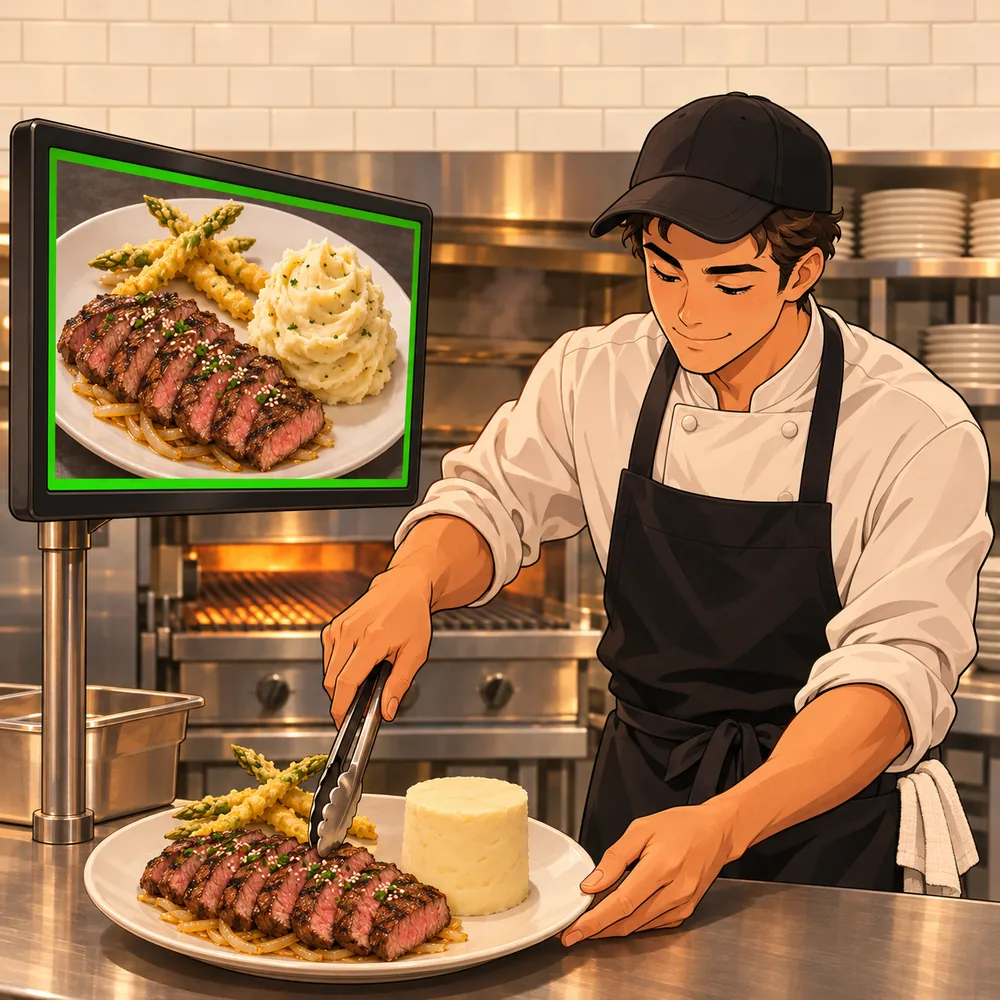
Shown. Each order came up with its recipe and a photo of the finished plate.
The kitchen manager says: “Steak’s perfect. But the tower’s too tight.”

Checked. Before pickup, the kitchen manager checked the real plate: praise first, then one exact fix.
The kitchen manager says: “Now it’s ready.”

Fixed. The cook fluffed the same potatoes, and only then did the plate go out.
The Cheesecake Factory’s menu runs to more than 250 items, and the company says they are made fresh and from scratch in each restaurant. Its cheesecakes and other baked desserts come from its own bakeries.1, 2 Its 2025 annual report describes detailed operating procedures, standards and controls, with systems for recipe management and kitchen order orchestration.2 With a menu that big, the hard part is not writing good recipes. It is getting the same plate from many cooks, shift after shift.
Each station showed the finished plate. In the kitchen Atul Gawande described in his 2012 New Yorker article, the screen at each station brought up every order with its recipe, ingredients on the left and steps on the right, and a photo of how the finished plate should look. A timer counted down to a target time; the order’s background turned from green to yellow as it neared the target and red once it ran late.3
The standard was exact about the result and left the craft to the cook. Gawande noticed that the recipe fixed the ingredients and the finished look, not every motion. An experienced cook he watched finished dishes without consulting the recipe; he said he had them memorized.3 The picture was there for anyone who needed it, and skill got the plate there.
Then the kitchen manager checked the real plate. When a steak dish was ready for pickup, the kitchen manager stopped at the pass to look at it. He praised the steak, the grill marks and the garnish, then said the mashed potatoes were packed too tight, and the cook fluffed them up with a fork before the plate went out.3 Gawande described a one-to-ten scale for plates: a nine was near-perfect, an eight needed one or two corrections, a seven needed three, and a six was redone.3
He corrected like a coach, and the oversight stayed tight. He praised as often as he corrected but did not hesitate to correct; he “tried to be a coach more than a policeman,” and “the oversight is tight,” Gawande wrote.3 Managers also scanned the screens for stations piling up red orders and decided whether a cook needed a nudge or an extra pair of hands.3 In its 2025 annual report, the company says its restaurant general managers and executive kitchen managers average more than 15 years with the company.2
What set this kitchen apart was the combination, not any one tool. Recipes, timers and a last look before food goes out are familiar ideas. Here each one was exact, and they worked as one system: a photo defined done at every station, the screen showed which orders were running late, and a kitchen manager checked the real plate and named exactly what to fix before a server took it. Compare an informal handoff, where each cook carries their own idea of done and a plate leaves when its cook says it is ready. In this kitchen, done was defined, visible and checked.
Principles of Excellence
- Show the finished plate where the work happens. Each order came up at the station with its recipe and a photo of the finished plate.3
- Fix the result, and trust the cook’s skill. The recipe set the ingredients and the finished look; experienced cooks brought the judgment to get there.3
- Make the pace visible, and decide when to help. Orders turned yellow near their target time and red once late; managers watched for red and judged whether a station needed a nudge or an extra pair of hands.3
- Check the real plate before it goes out. The kitchen manager at the pass looked before pickup and scored the plate: one or two corrections, or a redo.3
- Correct like a coach, and keep oversight tight. He praised as often as he corrected and named exactly what to fix, from a too-tight potato tower to a half-inch border.3
3 Exceptional Practices for your Clinic
- Photograph what ready looks like. In Gawande’s account, each order came up at the station with a photo of the finished plate, so every cook worked to the same picture, even those who knew it by heart. Do the same for the setups your team repeats all day: for each common procedure, such as a shave biopsy or an excision, photograph the setup the dermatologist has approved for that procedure, tray and room, and post it where the setup happens, inside the cabinet door or on the room’s tablet. A photo shows at a glance what a list takes a paragraph to say.
- Check at the pass, before the dermatologist walks in. The kitchen manager looked at the real plate before a server took it, while the fix was still simple. Give the procedure room the same moment: the lead MA compares the tray and room with the photo just before the dermatologist goes in. Agree in advance what counts as a simple fix and what means starting over, the way the kitchen’s scale separated one or two corrections from a redo: a missing gauze pack gets grabbed; a tray set for the wrong procedure gets reset.
- Say what’s right, then name exactly what to fix. “Gentlemen, this steak is perfect,” the kitchen manager told the cooks. “But the tower is too tight.” The cook fluffed the same potatoes before the plate went out. When your check finds a gap, name what is right first, then each specific fix it needs, and let the person who set it up make them: “The tray looks great; we still need the suture kit.” Starting with what’s right makes the correction easy to hear; naming it exactly shows the standard.
Explore the Evidence Further
Explore the Evidence Further. All 8 sources, with methods, findings and clinic applications
Eight sources, grouped by kind of evidence: the company’s own accounts and a 2012 article about one of its kitchens, hospital studies of handoffs and checklists, and a review of feedback on professional practice. Each row gives the design and its main limits, the key finding, why it matters and a way to apply it. Study names link to the original sources, and the full references close this section. None of these sources tested these practices in a dermatology clinic, so each application is our proposal.
The Cheesecake Factory: company accounts and a 2012 article
| Study or source | Setting, design and sample | Key finding | Why it matters | How to Apply It to Your Derm Clinic |
|---|---|---|---|---|
| The Cheesecake Factory, “About Us: Made from Scratch”1 | Company webpage: The company’s current About Us page, describing its own food. No outcome data. | With more than 250 items on the menu, the company says it makes things fresh and from scratch in each restaurant. | A large menu made from scratch in many kitchens is hard to keep consistent; the standard has to reach every plate. | Proposed: start with the setup your team repeats most, where one shared picture saves the most questions. |
| The Cheesecake Factory Incorporated, 2025 Form 10-K2 | Annual report: The company’s report for fiscal 2025, describing its own operations. No independent measurement of results. | Detailed operating procedures, standards, controls, food line management systems and cooking methods; systems for recipe management and kitchen order orchestration; training in person and online; restaurant general managers and executive kitchen managers averaging more than 15 years with the company; two company bakeries produce its cheesecakes and other baked desserts. | The standard is written down and built into the kitchen’s systems, and the people who check it have long experience. | Proposed: build the standard into tools people already use, the cabinet door or the room tablet, and give the check to someone experienced. |
| Gawande, “Big Med”3 | Magazine article: A 2012 New Yorker article describing a visit to one of the company’s kitchens; the visit date is not given. A description, not a measurement. The illustration strip draws its steak example; the people, kitchen and dialogue are drawn for this brief, and the plate is simplified. | Station screens showed each order’s recipe with a photo of the finished plate and a timer whose background turned yellow near the target and red once late; managers watched for red and decided whether a station needed a nudge or an extra pair of hands. An experienced cook worked from memory. A kitchen manager checked plates at the pass before pickup and scored them from one to ten: an eight needed one or two corrections; a six was redone. He praised a steak, its grill marks and garnish, then had the cook loosen the mashed potatoes, and tried to be a coach more than a policeman. | The standard is visible where the work happens, and a practiced eye checks the real result while the fix is still simple, starting with what is right. | Proposed: photograph ready, check at the pass before the dermatologist goes in, and say what’s right before naming each fix. |
Health care: a handoff program
| Study or source | Setting, design and sample | Key finding | Why it matters | How to Apply It to Your Derm Clinic |
|---|---|---|---|---|
| Starmer and colleagues, “Changes in medical errors after implementation of a handoff program”4 | Before-and-after study, nine hospitals: Pediatric inpatient units; 10,740 admissions; a multifaceted handoff program (I-PASS); no randomized comparison; significant error reductions at six of the nine sites. | Medical errors fell from 24.5 to 18.8 per 100 admissions, and preventable adverse events from 4.7 to 3.3. Oral handoffs took about the same time (2.4 and 2.5 minutes per patient). | A shared handoff program was followed by fewer errors without slowing the handoff down. | Proposed: write down what a complete setup or packet contains, from the receiver’s side, and teach it. |
Health care: surgical checklists, including a study that found no change
| Study or source | Setting, design and sample | Key finding | Why it matters | How to Apply It to Your Derm Clinic |
|---|---|---|---|---|
| de Vries and colleagues, “Effect of a comprehensive surgical safety system on patient outcomes”5 | Controlled before-and-after study: Six hospitals with high standards of care, compared with five control hospitals; a checklist covering the whole surgical pathway; 3,760 and 3,820 patients; not randomized. | Patients with one or more complications fell from 15.4% to 10.6%, and total complications from 27.3 to 16.7 per 100 patients. Outcomes did not change in the control hospitals. | Checks placed along the whole path, not only at the end, were followed by fewer complications. | Proposed: check where a gap can still be fixed: before the dermatologist enters, not after. |
| Haynes and colleagues, “A surgical safety checklist to reduce morbidity and mortality in a global population”6 | Before-and-after study, eight hospitals: Noncardiac surgery in eight hospitals; 3,733 and 3,955 patients; a checklist program; no randomized comparison. | Inpatient complications fell from 11.0% to 7.0%, and deaths from 1.5% to 0.8%. | A shared checklist program was followed by fewer complications and deaths. | Proposed: keep the check short and shared, so every MA works to the same picture. |
| Urbach and colleagues, “Introduction of surgical safety checklists in Ontario, Canada”7 | Natural experiment, 101 hospitals: Checklist adoption across Ontario’s hospitals; 109,341 procedures before and 106,370 after. | No significant change: adjusted deaths 0.71% and 0.65%, complications 3.86% and 3.82%. | Adopting a checklist did not, by itself, change outcomes, so a written standard alone is not the whole answer. | Proposed: a posted standard is not enough; someone has to look at the real setup and fix what is off. |
Feedback on professional practice
| Study or source | Setting, design and sample | Key finding | Why it matters | How to Apply It to Your Derm Clinic |
|---|---|---|---|---|
| Ivers and colleagues, “Audit and feedback: effects on professional practice”8 | Systematic review of randomized trials: 292 studies of audit and feedback; outcomes measured professional practice, not patient outcomes; many programs combined feedback with other interventions; searches through 2020. | Across 177 studies, feedback improved desired practice by 6.2 percentage points on average (weighted mean; the median was 2.7). | Looking at the work and sharing what you find helps people improve, by a modest amount. | Proposed: make feedback specific and immediate: what is right, then each specific fix. |
Across all eight sources:
- None tested a kitchen-style photo standard or check in a dermatology clinic.
- The kitchen details come from Gawande’s 2012 article about one kitchen, and the company material is its own account; they describe practices, not measured results.
- The hospital studies tested multifaceted programs, mostly by comparing before and after without randomization, and the largest found no significant change.
- The feedback review measured professional practice, not patient outcomes.
Principles of Excellence: related evidence from other settings
The main text explains the company’s practice in plain English. These sources describe it, or study related ideas in hospitals; none measured the company’s results.
| Point in the brief | Related evidence |
|---|---|
| Show the finished plate where the work happens. | The station screens Gawande described in 2012 (magazine article).3 Recipe management systems the company reports today (company account).2 |
| Fix the result, and trust the cook’s skill. | Recipes precise about the result, with skill supplying the rest (magazine article).3 Training in person and online (company account).2 |
| Make the pace visible, and decide when to help. | The order timer and the managers’ watch for stations running late (magazine article).3 |
| Check the real plate before it goes out. | The manager’s check and one-to-ten scale (magazine article).3 Checks along the whole surgical path were followed by fewer complications (controlled before-and-after study).5 Adopting a checklist alone did not change outcomes in Ontario (natural experiment).7 |
| Correct like a coach, and keep oversight tight. | Praise as often as correction, with tight oversight (magazine article).3 Audit and feedback improved professional practice modestly (systematic review).8 |
Our clinic suggestions: proposed, not tested
The three practices and today’s action are our suggestions for a dermatology practice, not a tested program.
| Suggestion | What it draws on |
|---|---|
| Photograph what ready looks like: a dermatologist-approved photo of each common procedure’s setup, posted where the setup happens. | The station photo of the finished plate, there for every cook (2012 article).3 A shared handoff program was followed by fewer errors (before-and-after study).4 The photo shows the approved setup for a procedure the dermatologist has already planned; it does not choose the procedure, the medication or the device. |
| Check at the pass: the lead MA compares the setup with the photo before the dermatologist goes in. | The kitchen manager’s check of the real plate before pickup, and his fix-or-redo scale (2012 article).3 Checks along the whole surgical path (controlled study).5 |
| Say what’s right, then name exactly what to fix: specific praise, then each specific correction, fixed on the spot by the person who did the work. | The steak and potato correction, and the manager’s coaching (2012 article).3 Audit and feedback improved practice modestly (systematic review).8 |
| Try it today: one setup, one photo, one week of checks. | No study tested this one-week trial; it applies the same pattern. |
Sources
- The Cheesecake Factory. “About Us: Made from Scratch.” Company website, undated page. thecheesecakefactory.com
- The Cheesecake Factory Incorporated. Form 10-K for the fiscal year ended December 30, 2025. U.S. Securities and Exchange Commission. sec.gov
- Gawande A. “Big Med.” The New Yorker, August 6, 2012 (print edition of August 13 & 20, 2012). newyorker.com
- Starmer AJ, et al. Changes in medical errors after implementation of a handoff program. N Engl J Med. 2014;371:1803–1812. doi.org
- de Vries EN, et al. Effect of a comprehensive surgical safety system on patient outcomes. N Engl J Med. 2010;363:1928–1937. doi.org
- Haynes AB, et al. A surgical safety checklist to reduce morbidity and mortality in a global population. N Engl J Med. 2009;360:491–499. doi.org
- Urbach DR, et al. Introduction of surgical safety checklists in Ontario, Canada. N Engl J Med. 2014;370:1029–1038. doi.org
- Ivers N, et al. Audit and feedback: effects on professional practice. Cochrane Database Syst Rev. 2025;3:CD000259. doi.org