How the Blue Angels Made Debriefing a Habit
Four ways to review every clinic session as a team: check the work against a record, start with the leader, and leave with one fix.
What you’ll take away
- The problem
- Clinic days end and everyone goes home, so the same small misses come back, because nobody compares what was meant to happen with what did.
- What to remember
- Review every session as a whole team, against a record: the leader names their own miss first, everyone who saw something speaks, and each point ends in a fix.
- What to do differently
- Hold a short debrief for each clinic session or Mohs day. Put the plan beside a de-identified log, let the physician go first, invite each role, and write one fix with an owner and a check date.
Most clinic days end without anyone looking back. On a Mohs day, the afternoon runs late. The histotech thinks the slides backed up over lunch. The surgeon thinks the case order was off. The front desk heard patients asking why they were still waiting. Then the last patient leaves, everyone heads for the parking lot, and the next Mohs day runs late the same way. Nobody was careless. Nobody compared what was meant to happen with what did. A team gets better when it looks back at the work together, every time, and leaves with a fix. At their 1995 winter training in El Centro, the US Navy’s Blue Angels showed what that looks like.
The leader says: “I’ll start. My first turn came in late.”
A pilot says: “Then I’m next. I was wide on the same turn.”
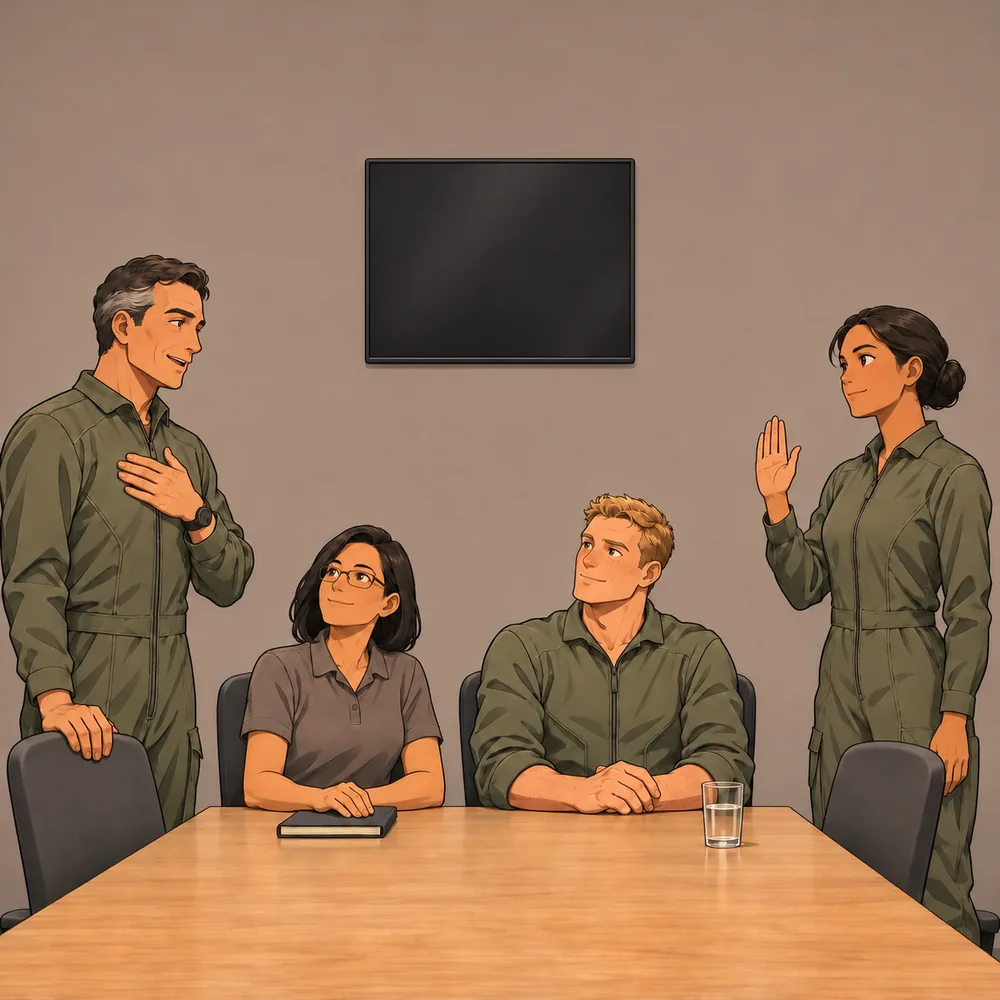
The leader goes first. In the debrief Carroll watched, each pilot named their own errors, and the leader went first.
The leader says: “Freeze it there. See the gap?”
A pilot says: “That’s mine. I was a beat slow.”
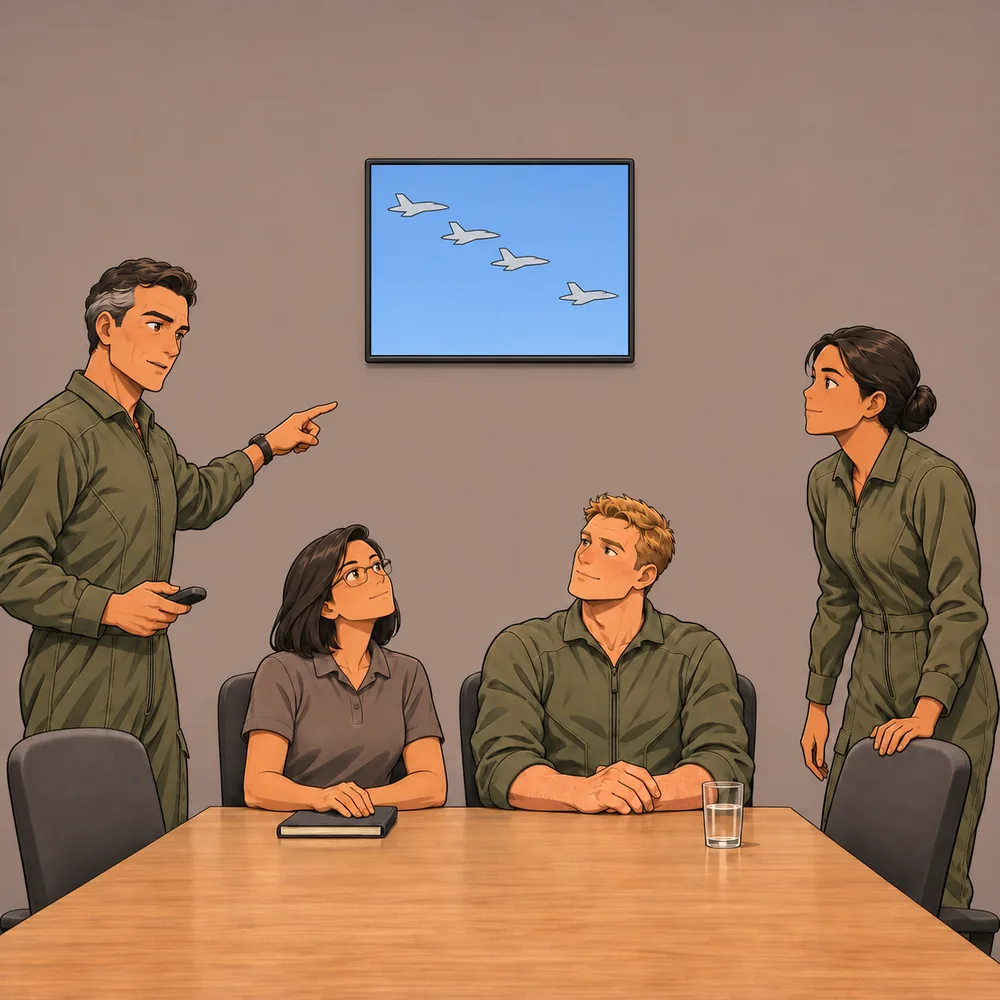
The record settles it. The replay stops on small flaws most spectators would never notice.
The ground observer says: “From the ground, the join-up looked wide.”
A pilot says: “I’ll fix it on the next flight.”
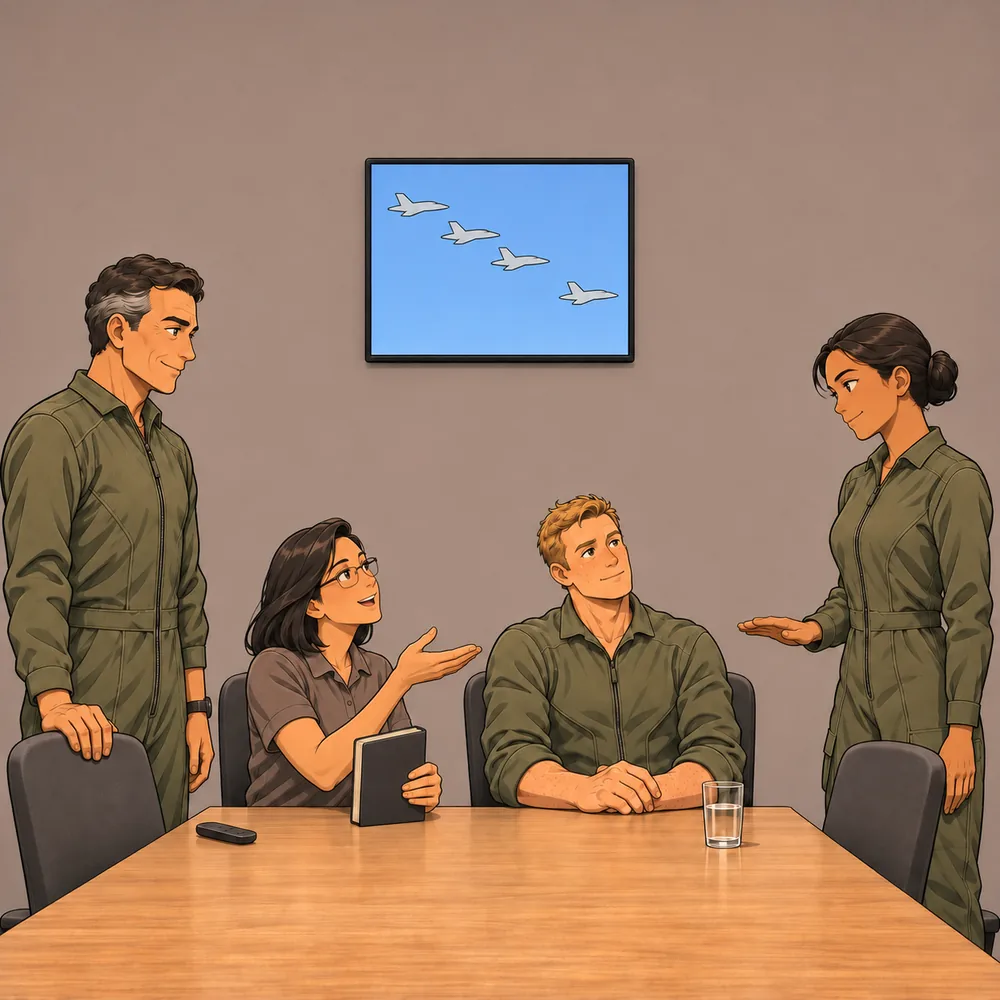
Every point ends in a fix. Pilots and ground observers can both raise a flaw, and the pilot commits to fixing it.
In the winter of 1995, a reporter from AOPA Pilot magazine visited the Blue Angels at their winter training base in El Centro. The team flew two practice shows a day, on six days of each week. Each flight ended in a detailed debriefing, and then the same cycle repeated with the day’s second flight.1
Every mistake was on the table. The reporter watched the pilots pick every flight apart, point by point, and talk openly about every error, with rank and ego set aside.1 Lt. Ryan Scholl, the team’s narrator that year, told the magazine that no one held back. Pilots and ground observers alike could raise “safeties,” the team’s word for anything that fell short of the standard. By tradition, each speaker finished the same way: a promise to fix it, and a word that they were happy to be there.1
The debrief worked from a record, not from memory. In 1995 the team’s observers recorded the practice shows on video for the pilots to study at the following debrief.1 Writer Ward Carroll, who watched one show up close with the team, followed the pilots back to the ready room afterward. There the pilots called out their own errors from the show, and their leader, the Boss, went first. Then came the video, from the moment the pilots walked out to their jets, stopped again and again to pick apart small flaws in their timing. Most of what they caught, Carroll noted, an ordinary spectator would never notice.2
The routine is demanding, and its parts work together. At El Centro in 1995, two flights a day meant two debriefs a day, on smooth days as well as rough ones. Naming your own mistake in front of the people you fly with takes nerve, and so does watching tape of a flight that felt fine. Each part covers a gap in the others. The tape shows what really happened. The standard says what should have happened. In the debrief Carroll saw, the leader’s errors came first, so nobody else’s were the only ones on the table. And the promise to fix each point turns the whole conversation toward the next flight.
Principles of Excellence
- Every flight gets a debrief. At 1995 winter training in El Centro, a detailed debriefing followed each practice flight: two flights a day, on six days of each week.1
- The record decides what happened. In 1995 the team’s observers videotaped practice shows for the debrief, and in Carroll’s account the replay was paused on flaws most spectators would miss.1, 2
- The leader goes first. In the debrief Carroll watched, the pilots called out their own errors, and the Boss went first. The 1995 reporter saw mistakes discussed openly, whatever a pilot’s rank.1, 2
- Everyone with a view speaks. Ground observers as well as pilots could raise “safeties,” and the team’s narrator said no one held back.1
- Every point ends in a fix. In the 1995 narrator’s account, every speaker closed by promising to fix what had been raised.1
4 Exceptional Practices for your Clinic
- Debrief every session, not just the bad ones. At 1995 winter training in El Centro, the Blue Angels held a detailed debriefing after every practice flight, two a day, on six days of each week. When the review is routine, smooth days get studied too, and calling a debrief never signals that something went wrong. After every Mohs day, the Mohs surgeon leads a short debrief at the whiteboard and invites each role that worked the day to speak. The team chooses a time it can keep, and holds it on easy days as well as hard ones. If a patient is still in the clinic, a named nurse stays with them.
- Put the plan beside a record. In 1995 the team’s observers videotaped practice flights for the debrief, and in Carroll’s account the replay was stopped on flaws most spectators would miss. A record settles what memory argues about, and it shows the small slips nobody noticed at the time. When a Mohs afternoon runs late, the histotech brings the day’s de-identified log of when each stage went to the lab and when the slides came back, listed by time slot and stage, with no names. The team lays it beside the planned schedule before anyone offers a theory.
- Let the physician go first. After the one show Ward Carroll watched with the team, the pilots called out their own errors, and the Boss, their leader, went first. When the leader’s own decisions are reviewed first, the debrief is plainly about the work, not about who ranks highest. When the debrief opens after a Mohs day, the surgeon starts with one of her own decisions: “I’ll go first. I added a case at noon without telling the front desk, and that pushed the afternoon back.” Then she invites each role in turn to say what they saw from their station. If anything could have harmed a patient, file the clinic’s incident report as usual; the debrief can raise it but never replaces that report.
- Hear from everyone who saw it, and leave with one fix. In 1995 the ground observers as well as the pilots could raise “safeties,” and every speaker ended with a promise to fix it. The person with the clearest view is not always the one in charge, and a fix with a name and a date is one the next debrief can check. At the debrief after a general dermatology clinic, the front desk lead says biopsy patients kept stopping at checkout to ask how they would get their results. The team writes one fix on the whiteboard with an owner and a date: the nurse gives each biopsy patient the clinic’s written results instructions before they leave, and the practice manager asks at the next debrief whether it happened.
Explore the Evidence Further
Explore the Evidence Further. All 8 sources, with methods, findings and clinic applications
Eight sources, grouped by kind of evidence: two first-hand accounts of the Blue Angels debrief, the US Army’s after-action review guidance, two reviews of many studies, two hospital studies and one primary-care trial. Each row gives the design and its main caution, the key finding, why it matters and a way to apply it. Study names link to the original sources, and the full references close this section. None of these sources tested a debrief in a dermatology clinic, so every application is our proposal, not a tested intervention.
The Blue Angels debrief: two first-hand accounts
| Study or source | Setting, design and sample | Key finding | Why it matters | How to Apply It to Your Derm Clinic |
|---|---|---|---|---|
| AOPA Pilot, “Blue Angels” (1995)1 | Magazine report from an on-site visit: AOPA Pilot, September 1995, reporting from the team’s winter training at El Centro; no byline on the main article. Full text read. The descriptions of the debrief come from the reporter and from the team narrator, an insider. The account is 31 years old and the practice may have changed since; the article shows nothing about how the debrief runs today. | Two practice shows a day, on six days of each week, with a detailed debriefing after each flight. The reporter describes every flight picked apart point by point, with every mistake discussed openly and rank and ego set aside. The team’s observers videotaped practice shows for use at the following debrief. The narrator, Lt. Ryan Scholl, said no one held back; ground observers and pilots could raise “safeties,” anything not done to standard; and by tradition each speaker closed with a promise to fix it and a word of gladness at being there. | It is the most detailed description of the routine in this set: every flight reviewed, against a filmed record, with every role invited to speak and every point closed with a fix. | Proposed: review every session, with every role invited to raise what fell short, and close each point with who will fix it. |
| Carroll, “What It’s Like Flying With The US Navy’s Elite Blue Angels”2 | First-hand feature: Writer Ward Carroll’s account of one show he watched with the team, on the We Are The Mighty site. The current page carries an October 2020 update date; the year of the original visit is unconfirmed, so it is not given here. Full text read. One observer and one visit; it is the only source in this set for the leader going first. | Back in the ready room the pilots called out their own errors from the show, and the Boss, their leader, went first. A video review followed, beginning with the pilots’ walk out to their jets and paused again and again to critique small timing flaws. Most of the flaws caught were ones an ordinary spectator would not notice. | It shows the leader’s own errors reviewed first, and a record catching what memory and the crowd miss. | Proposed: let the physician name their own miss first, then review a de-identified record together. |
After-action reviews in Army training
| Study or source | Setting, design and sample | Key finding | Why it matters | How to Apply It to Your Derm Clinic |
|---|---|---|---|---|
| Army.mil, “TMD publishes training circular to augment FM and ADP 7-0”3 | Government announcement: US Army announcement, 20 February 2025, of training circular TC 7-0.1, After Action Reviews, presented as new and as the opening title of a planned series. The announcement was read through a fetch tool, with no raw capture; the circular itself was not opened. It describes Army training, not health care. | The guide covers planning, preparing, running and following up after-action reviews. A facilitator recaps events and leads discussion through the moments that mattered, and the follow-up can include retraining straight away, updated standard procedures and lessons written down. | It treats follow-up as part of the review itself, not an afterthought. | Proposed: end each debrief with a fix that has an owner and a check date, and check it at the next debrief. |
Do debriefs help? Two reviews of many studies
| Study or source | Setting, design and sample | Key finding | Why it matters | How to Apply It to Your Derm Clinic |
|---|---|---|---|---|
| Tannenbaum and Cerasoli, Human Factors 20134 | Meta-analysis: Pooled 46 samples (2,136 participants) from experimental and quasi-experimental studies, published and unpublished. Read at abstract level; study quality, heterogeneity and how the authors turned the effect into a percentage were not seen. Outcomes are each study’s own performance measures. It supports no patient-outcome or timing conclusion. | Debriefs outperformed control conditions, with a standardized effect of d = 0.67, which the authors estimated at about a quarter better on the pooled study measures. Effects were similar for teams and individuals, simulated and real settings, and medical and nonmedical samples. | Reviewing the work after doing it helped across many kinds of teams and settings. | Proposed: make the debrief a routine, not something saved for bad days. |
| Keiser and Arthur, Journal of Applied Psychology 20215 | Meta-analysis: Pooled 61 studies (107 effect sizes; 3,499 individuals in 915 teams) on training outcomes, with no corrections for measurement artifacts. Read at abstract level. Its moderator findings are pooled across studies, not a test of clinic debriefs, and the abstract says nothing about how long a debrief should be. | After-action reviews improved training outcomes (d = 0.79). Two features helped consistently: alignment, in the authors’ term, and “objective performance review media,” such as video. Self-led reviews aligned to the team were among the strongest combinations. More structure helped in military samples but made little difference in health care samples. | It supports reviewing against a record rather than memory. | Proposed: bring a de-identified record, such as stage times or a tracking log, and look at it before anyone offers a theory. |
Debriefing in hospitals: resuscitation and the operating room
| Study or source | Setting, design and sample | Key finding | Why it matters | How to Apply It to Your Derm Clinic |
|---|---|---|---|---|
| Couper and Perkins, Current Opinion in Critical Care 20136 | Narrative review: Non-systematic review of debriefing after cardiac resuscitation. Read at abstract level. The evidence is largely before-and-after. Delayed debriefs usually came with objective data, so the effect of the delay cannot be separated from the effect of the data. There is no head-to-head comparison of timing and nothing on outpatient clinics. | Evidence for immediate (“hot”) debriefing was described as “scant.” Delayed (“cold”) debriefing, which usually drew on objective data about the resuscitation, for example data from the defibrillator or video of the event, was linked with better care processes and patient results. The authors concluded that “the optimal delivery method remains unclear.” | It shows objective data at the heart of the better-supported clinical debriefs, and it leaves the best way and time to debrief open. | Proposed: review against objective data, and set the debrief time to suit your own team; this review does not favor one time of day for a clinic. |
| McElroy and colleagues, Journal of Surgical Research 20247 | Qualitative interview study: Reflexive thematic analysis of interviews with forty people who work in operating rooms (14 nurses, 7 anaesthetic technicians, 7 anaesthetists, 12 surgeons) at one children’s hospital in Auckland. Read at abstract level. Staff perceptions, not measured outcomes. | Staff described psychological safety as something a debrief needs in order to work, and something it builds. They valued leadership in debriefs, but also described ways leadership can keep hierarchies in place. | How the leader uses the role can open the floor or close it. | Proposed: have the physician name their own miss first, then invite each role to say what they saw; a team may choose to hear its newest member first. |
A debrief program in primary care
| Study or source | Setting, design and sample | Key finding | Why it matters | How to Apply It to Your Derm Clinic |
|---|---|---|---|---|
| Hysong and colleagues, BJGP Open 20218 | Non-randomised controlled trial: 34 VA primary-care teams at four medical centres received monthly feedback reports on coordination plus structured debriefings for seven months, compared with 34 control teams matched on administrative data. Full text read. Monthly debriefs were bundled with the feedback reports; the setting is primary care, not dermatology. The authors note that staff belonging to more than one team may have biased the results toward no difference. The exposure comparison was a follow-up analysis, and exposure was not assigned. | Overall, coordination in the program teams did not improve significantly more than in the matched control teams. In follow-up analyses, teams that took part in more of the debriefings showed significantly larger gains than teams that took part in fewer, and the authors judged that holding debriefs consistently mattered more than how much of the team attended each one. | It is the closest outpatient test in this set. Its overall result was null, and the exposure finding is observational. | Proposed: keep a regular slot for the debrief, so it happens even when not everyone can attend. |
Across all eight sources:
- None tested a debrief in a dermatology clinic; every clinic application here is our proposal.
- The two Blue Angels accounts are first-hand but historical: one 1995 magazine visit to winter training and one writer’s visit to one show (page updated October 2020; original year unconfirmed). Neither shows how the debrief runs today, and the leader-first detail rests on Carroll’s account alone.
- The measured effects are on performance, training and care-process measures within each study. The one outpatient program’s overall result was null.
- No source here settles when a debrief should be held, and the resuscitation review leaves the best way to deliver one open.
- Most research sources were read at abstract level; the primary-care trial was read in full.
Principles of Excellence: related evidence from other settings
The main text explains the Blue Angels’ practice in plain English. These sources describe it or study related ideas elsewhere; none measured the Blue Angels’ results.
| Point in the brief | Related evidence |
|---|---|
| Every flight gets a debrief. | The 1995 winter-training schedule and debrief routine (magazine report from an on-site visit).1 Debriefs beat comparison conditions on the pooled study measures (meta-analysis of 46 samples, 2,136 participants, d = 0.67; abstract only).4 |
| The record decides what happened. | Observers videotaped practices for the debrief (magazine report).1 The paused video review (first-hand feature, one visit).2 An objective record such as video consistently helped after-action reviews (meta-analysis of training outcomes, abstract only).5 |
| The leader goes first. | Pilots called out their own errors, the Boss first (first-hand feature; the only source for this detail).2 Mistakes discussed whatever a pilot’s rank (magazine report).1 Operating-room staff described leadership that can open debriefs or keep hierarchy in place (qualitative interviews, one hospital, abstract only).7 |
| Everyone with a view speaks. | Ground observers and pilots could raise “safeties” (team narrator quoted in a magazine report).1 |
| Every point ends in a fix. | Each speaker closed with a promise to fix it (team narrator quoted in a magazine report).1 Follow-up, for example retraining and updated procedures (Army announcement of a training circular).3 |
Our clinic suggestions: proposed, not tested
The four practices and today’s action are our suggestions for a dermatology practice, not a tested program.
| Suggestion | What it draws on |
|---|---|
| Debrief every session: a short debrief after every Mohs day, led by the surgeon with each role invited to speak, on easy days as well as hard ones, at a time the team chooses, with a named nurse covering any patient still in the clinic. | The 1995 debrief after every practice flight (magazine report).1 Debriefs beat comparison conditions on the pooled study measures (meta-analysis of 46 samples, 2,136 participants, d = 0.67; abstract only).4 In primary care, a monthly feedback-and-debrief program did not beat matched control teams overall; teams that debriefed more often improved more (non-randomised trial; observational follow-up).8 No source here favors a time of day. |
| Put the plan beside a record: a de-identified log of stage times laid beside the planned schedule before anyone offers a theory. | Filmed practices and the paused replay (magazine report; first-hand feature).1, 2 An objective record such as video consistently helped after-action reviews (meta-analysis of training outcomes, abstract only).5 The clinic scene is an illustration, not a documented case. |
| Let the physician go first: the surgeon names one of her own decisions, then invites each role in turn; any possible patient harm still goes through the incident report. | Pilots called out their own errors, the Boss first (first-hand feature, one visit).2 Leadership can open debriefs or keep hierarchy in place (qualitative interviews, abstract only).7 |
| Hear from everyone and leave with one fix: the front desk lead raises a checkout pattern; one fix goes on the board with an owner and a date and is checked at the next debrief. | Ground observers and pilots could raise “safeties,” and each speaker promised to fix it (magazine report).1 Follow-up after a review (Army announcement).3 The single-fix rule is our simplification; the Blue Angels accounts describe a fix for each point raised. |
| One action today: one session debriefed, the leader first, plan against log, and one fix with an owner and a check date. | No study tested this one-day trial; it applies the same pattern. |
Sources
- Blue Angels. AOPA Pilot. September 1995 (web version dated 5 September 1995; no byline shown for the main article). aopa.org
- Carroll W. What It’s Like Flying With The US Navy’s Elite Blue Angels. We Are The Mighty. Page updated October 2020. wearethemighty.com
- Training Management Directorate, Combined Arms Center-Training. TMD publishes training circular to augment FM and ADP 7-0. Army.mil. 20 February 2025. army.mil
- Tannenbaum SI, Cerasoli CP. Do team and individual debriefs enhance performance? A meta-analysis. Human Factors. 2013;55(1):231-245. doi:10.1177/0018720812448394. PubMed · doi.org
- Keiser NL, Arthur W Jr. A meta-analysis of the effectiveness of the after-action review (or debrief) and factors that influence its effectiveness. Journal of Applied Psychology. 2021 (online 2020). doi:10.1037/apl0000821. PubMed · doi.org
- Couper K, Perkins GD. Debriefing after resuscitation. Current Opinion in Critical Care. 2013;19(3):188-194. PubMed
- McElroy C, Skegg E, Mudgway M, Murray N, Holmes L, Weller J, Hamill J. Psychological safety and hierarchy in operating room debriefing: reflexive thematic analysis. Journal of Surgical Research. 2024;295:567-573. PubMed
- Hysong SJ, Amspoker AB, Hughes AM, et al. Improving team coordination in primary-care settings via multifaceted team-based feedback: a non-randomised controlled trial study. BJGP Open. 2021;5(2). doi:10.3399/BJGPO.2020.0185. PMC · PubMed