Lessons from the Blue Angels · for dermatology practices
Debrief Every Flight. Leave With One Fix.
At their 1995 winter training, the US Navy’s Blue Angels flew two practice shows a day and held a detailed debrief after every one, with the flight on film and each person ending by promising a fix. Your clinic can end every session the same way.
What you’ll take away
- The problem
- When a team reviews its work only after something goes wrong, and only from memory, the small misses of ordinary days go unnamed and come back tomorrow.
- What to remember
- Debrief every flight and leave with one fix: after the work, the whole team holds what happened up against a record, owns its misses with the leader first, and picks one change to check.
- What to do differently
- Hold a short debrief after every session, good days too. Bring a de-identified record, let the lead name a miss first, invite each role, and leave with one fix, an owner and a check date.
30-Second Summary
- At their 1995 winter training, the Blue Angels debriefed every practice flight, not just the bad ones. The team flew two practice shows a day on six days of each week, and a detailed debrief followed each one.1
- They held the flight up against a record. In 1995, the team’s designated observers filmed the practice shows for the debrief that followed.1 In the one debrief that writer Ward Carroll watched, the video ran from the walk to the jets and was frozen on small flaws most spectators would never see.2
- The pilots owned their misses. After the show Carroll watched, the pilots called out their own errors, the Boss first.2 In 1995, ground observers as well as pilots could raise anything not flown to standard, and each person ended by promising to fix what they raised.1
- Research finds debriefs help. In a large pooled review of debriefs, the authors estimated that people who debriefed did about a quarter better on the pooled study measures than those who didn’t.3 In a review of 61 studies of after-action reviews in training, an objective record such as video consistently helped.4
- In your clinic: after every session, good days too, bring a de-identified record, let the lead name a miss first, invite each role to speak, and leave with one fix that someone owns.
The Problem
What Goes Wrong When a Team Only Talks After Trouble
Picture a flight team climbing down from their jets after a practice show. Nothing went badly wrong. A few moments were a little off: one turn started a beat late, one jet drifted slightly out of line, one pilot waited a moment on another.
Everyone is tired. “Good flight, everyone,” someone says, and the team heads off. The flight was filmed, but nobody watches the tape. Each pilot carries home a slightly different memory of the flight. Nobody carries home a fix.
At the next practice, the same jet drifts out of line in the same place. When the team finally does sit down together, it is after a show that went badly, and the talk turns to who.
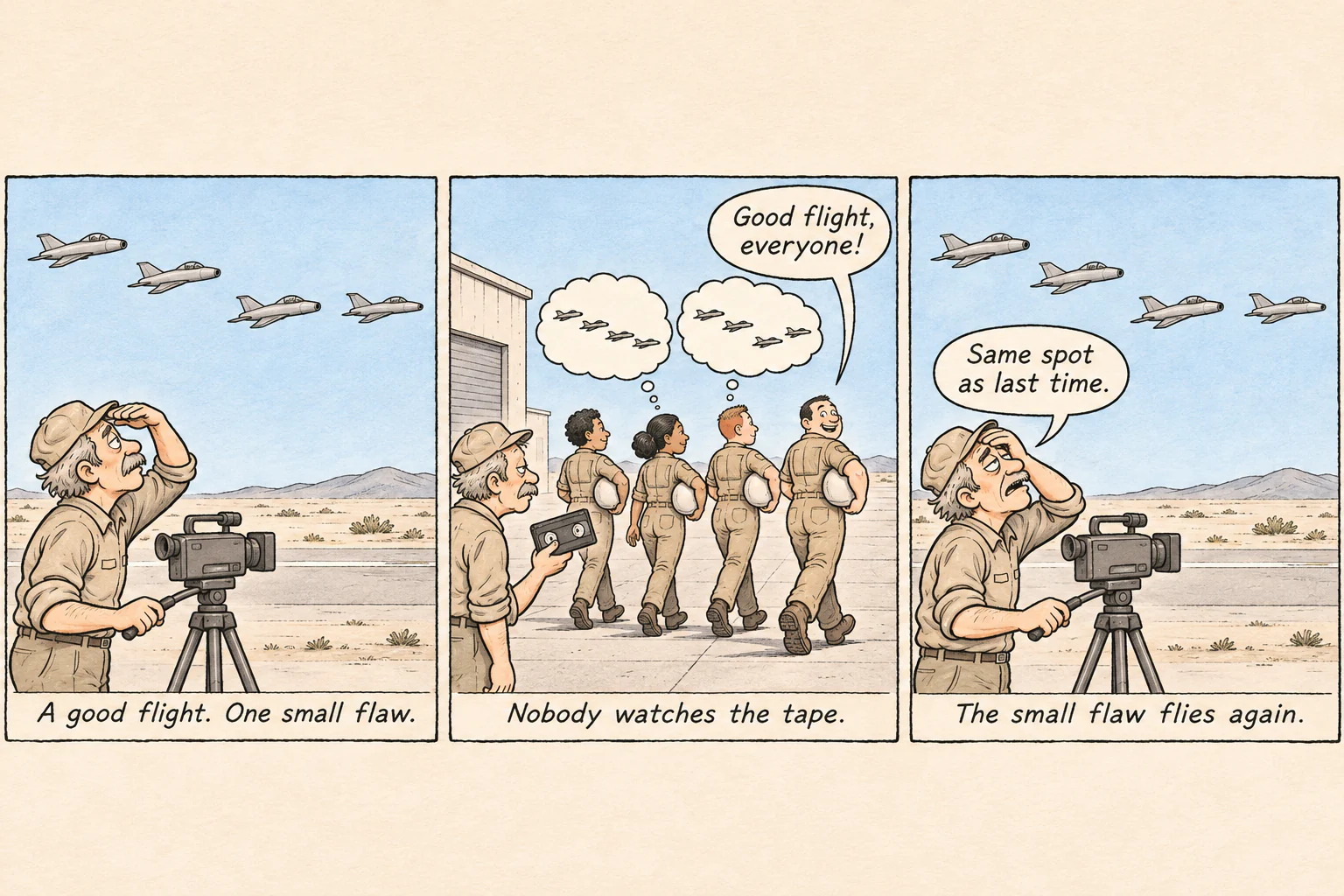
Nobody here is careless. They are busy, and a good flight doesn’t seem to need a meeting. But the small misses of an ordinary day are the cheapest ones to fix, and only a team that looks will see them. A team that reviews its work only after trouble never sees its ordinary misses while they are small.
The Blue Angels showed another way. At their 1995 winter training in El Centro, a review followed every practice flight.
The Exceptional Solution
The Blue Angels’ Answer in 1995: Every Practice Flight Ended in a Debrief
In 1995, AOPA Pilot magazine reported from the team’s winter training at El Centro, California. The team flew two practice shows a day on six days of each week: no fewer than 120 practice shows before the season opened. After each flight came a detailed debrief, and then it all began again with the day’s second flight.1
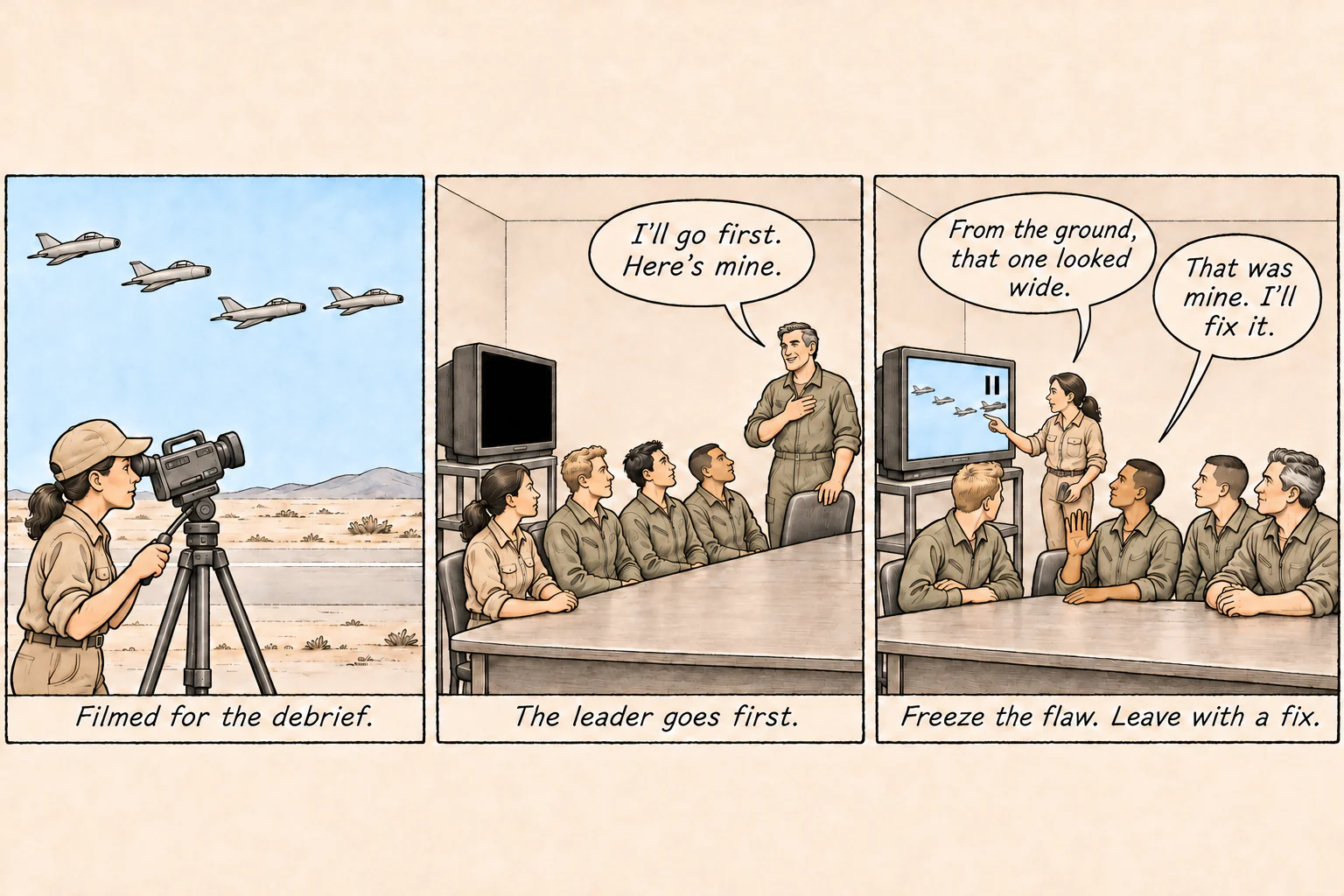
Writer Ward Carroll, who spent time with the team, described the debrief after the one show he watched.2 The two visits saw different days, so each move below says which visit it comes from. Side by side, five moves stand out:
Debrief every flight. In 1995 the debrief was part of the day, not a reaction to a bad one. At winter training in El Centro it followed each practice flight, twice a day.1
Bring a record, not just memory. In 1995 the team’s designated observers filmed the practice shows for the debrief that followed.1 In the debrief Carroll watched, the video review began with the pilots walking out to their jets, and the playback was frozen to pick apart small flaws in timing. Most of the faults they flagged were ones an ordinary spectator would never notice.2
Own your misses, leader first. After the show he watched, Carroll wrote, the pilots called themselves out in the ready room on their own errors, and the Boss, the team’s leader, went first.2 The 1995 writer described each flight picked apart in fine detail, with every mistake talked through openly, “without regard to rank or ego.”1
Everyone who saw it can speak. The 1995 team narrator, Lt. Ryan Scholl, said everyone spoke freely in the debriefs. Ground observers as well as pilots could raise anything that was not flown to standard.1
End with a fix. By tradition, the narrator said, each person finished by saying “I can fix that,” and that they were glad to be there.1
The ProblemA practice flight is over. Most of it went to plan, and a few small moments ran slightly out of time, too small for anyone in the crowd to notice.
The Mediocre ApproachReview only after trouble
Action
Call it a good flight.
- Nobody watches the tape
- Each person keeps their own memory of the flight
Poor outcome
The small flaws fly again.
- Nobody owns them, so nobody fixes them
- The talk waits for a bad day
The Exceptional ApproachThe Blue Angels’ answer, from two visits
Action
Sit down, own it, watch it.
What Each Debrief Leaves Behind
A debrief after every flight gives the team three things a good day alone never does:
Small flaws, caught small. Most of the faults flagged in the debrief Carroll watched were ones an ordinary spectator would never notice.2
One shared record. The film shows what happened, so the talk is about the flight, not about whose memory wins.1, 2
A promise to fix. In 1995, each person’s turn ended with a commitment to fix what they had raised.1
The flight team in our first story went home with nothing to fix. At their 1995 winter training, the Blue Angels ended each practice flight with a record, their misses named out loud and a promise to fix them.
The mechanism
Why It Works
A debrief is easy to skip and easy to do badly. Each part of this one does a different job: the routine catches ordinary misses, the record settles what happened, the leader going first sets the tone, every voice adds what one seat can’t see, and the fix turns talk into change.
Tap or click a card to see why it works.
-
Every flight, not just bad ones.
A habit, not an inquest.1
Why it works
- Built into the day. At the 1995 winter training, a detailed debrief followed every practice flight, twice a day.1
- Small misses get their turn. When the review happens every time, ordinary misses are talked about while they are still small.
- Debriefs pay off. In a large pooled review, the authors estimated that people who debriefed did about a quarter better on the pooled study measures than those who didn’t.3
-
Why it works
- Filmed for the debrief. In 1995, the team’s designated observers filmed the practice shows for the debrief that followed.1
- Frozen on the flaw. In Carroll’s account, the playback stopped on small timing flaws that spectators would never see.2
- Training research agrees. Across 61 studies of after-action reviews in training, an objective record of the performance, such as video, consistently helped the reviews work better.4
-
The leader goes first.
In the debrief Carroll watched, the Boss went first.2
Why it works
- The Boss first. In the debrief Carroll watched, the pilots called out their own errors, starting with the team’s leader.2
- Every mistake on the table. The 1995 writer saw each mistake talked through openly, whoever had made it.1
- It sets the tone. The first miss on the table belongs to the person in charge, so nobody else has to go first.
-
Everyone who saw it speaks.
Each seat sees something different.1
Why it works
- Not just the pilots. In 1995, ground observers as well as pilots could raise anything not flown to standard.1
- A view from the ground. Someone watching from the ground can see what a pilot in the air cannot.
- The team runs it. In the same 61 training studies, reviews a team ran itself, about its own performance, were among the strongest combinations.4
-
Why it works
- A commitment, out loud. In 1995, each person’s turn ended with a promise to fix what they had raised.1
- Then follow-up. The US Army’s 2025 guide to after-action reviews treats follow-up as part of the review: retraining at once, rewriting standard procedures and writing down what was learned.5
- A lesson counts once something changes. A fix with an owner is the part of the debrief that reaches tomorrow.
The evidence
The Evidence, and Where Else It Works
The US Army calls its version an after-action review. In February 2025 it published a training circular, TC 7-0.1, a step-by-step guide to planning, running and following up these reviews.5 Researchers have studied debriefs and after-action reviews across many fields, and two large reviews have pooled the results.3, 4 Flip each card for the result and the lesson to take home.
Tap or click a card to flip it.
-
Many study samples, pooled to test whether debriefs help teams and individuals
- The debrief: Teams or individuals went back over their own performance.
- The comparison: How they did, against similar groups who did not debrief.
Exceptional results3
About a quarter better on the pooled study measures with a debrief
- The authors estimated that people who debriefed did about a quarter better than those who didn’t.
- The gain looked alike for teams and individuals, in simulations and in real work, in medicine and outside it.
Valuable lesson: Make the debrief part of every working day, not a reaction to a bad one.
Source: Tannenbaum and Cerasoli, Human Factors 2013 · evidence row 3
-
61 studies of after-action reviews in training, pooled to find what makes a review work
- The review: A team or a person went back over a performance after it ended.
- What helped: The features shared by the reviews that worked best.
Exceptional results4
2 features that consistently made reviews work better
- A record: an objective account of what happened, such as video, not just memory.
- A match: the team reviews the team’s performance, and a person reviews their own.
- Reviews a team ran itself, about its own work, were among the strongest.
Valuable lesson: Bring a record to every debrief, and let the team review its own work.
Source: Keiser and Arthur, J Appl Psychol 2021 · evidence row 4
Your dermatology clinic
Bringing It Home to Your Dermatology Clinic
Every clinic session is a flight of its own: a schedule planned in the morning, and a day that unfolds a little differently. It’s tempting to end it the way the flight team in our first story did, with everyone heading for the door. The misses of a morning clinic or a Mohs day are small, and they are the cheapest ones to fix.
Every session, good days too: pick a slot your team can keep, such as the end of each session or first thing the next morning, and hold it every time. Start after the last patient has left, or with a named person staying with anyone still in clinic. On a smooth day, ask what went right, and why, so you can keep it.
Bring a record, not just memories: before anyone gives an opinion, look at a de-identified record of the session: check-in, rooming and checkout times from the schedule, stage and turnover times from the Mohs log, or the count of messages still open at five. No patient names on the screen or the board.
The lead goes first: the lead clinician opens by naming one of their own decisions that made the session harder. Then the lead invites each role to say what they saw: front desk, medical assistants, nurses, the histotech and the schedulers. Some teams like to hear the newest person first.
Keep it about the process: ask what in the setup let the miss happen, not who dropped it. A concern about one person’s conduct goes to a private talk with the manager, not the debrief.
Anything clinical goes to the clinician: a nurse or the physician screens open patient messages for anything urgent before the debrief starts. A patient-safety event still goes through your incident report, and a fix that touches a clinical step is approved by the lead clinician before anyone changes it.
Leave with one fix: pick the one change that matters most. Write it down with an owner and a check date, and open the next huddle with one question: “Did the fix happen?”
Here’s how that plays out in two everyday moments. Each one starts with the problem, follows the mediocre approach to its outcome, then rewinds to the same moment for the exceptional approach: the whole team, a record, and one fix.
Example One: A Late Morning, and Nobody Agrees Why
- The Problem
The morning clinic ran forty minutes behind. The last morning patient has left, the afternoon starts at one, and everyone has a different idea of why.
 Dermatologist:Forty minutes behind. Again.MA (thinking):Was that my rooming?Front desk (thinking):Everyone checked in on time.
Between sessions. The last morning patient has gone and the afternoon starts at one, so there is time to look at what happened before it starts. - The Mediocre ApproachThe action
 Dermatologist:Rough morning. Let’s all just move faster this afternoon.MA (thinking):Faster? I was waiting on rooms.Front desk (thinking):Not my place to say.
A verdict from memory. No record, no owner, just “move faster”. - The Mediocre ApproachThe poor outcome
 Front desk (on the phone):The doctor’s running about forty minutes late.MA (thinking):Same as this morning.
The afternoon, same story. Another add-on patient goes in unannounced at two, and by three the clinic is forty minutes behind again. Rewind. Same team, same moment, same session. This time, they debrief.
- The Exceptional ApproachThe action: debrief with the record
 Dermatologist:I’ll go first. I squeezed in two add-ons.MA:The times jump right at 10:30.Front desk:Tell me each add-on. I’ll book a held slot.
A few minutes, with the record. The doctor names her own miss first, the times show where it backed up, and she signs off on one fix with an owner and a check at five. - The Exceptional ApproachThe exceptional outcome
 Front desk:Your add-on at two went in the held slot. Nobody else waited.Dermatologist:On time. We’ll check it at five.
The afternoon, to plan. The add-on at two goes into the held slot, and at three nobody is waiting. At five, the team checks the fix.
Example OneAt a glance
The ProblemThe morning clinic ran forty minutes behind. The last morning patient has left, the afternoon starts at one, and everyone has a different idea of why.
The Mediocre ApproachA verdict from memory
Action
Skip the review.
- “Let’s all just move faster this afternoon”
- No record, no owner, no fix
Poor outcome
The same backup, again.
- An unannounced add-on at two backs up the rooms
- By three the clinic is forty minutes behind, and the MA wonders if it was her
The Exceptional ApproachDebrief between sessions, with the record
Action
Lead first, record open, one fix.
- The dermatologist names her own miss: two add-on patients the desk never heard about
- The rooming times show where it backed up, and with the doctor’s sign-off the desk takes one fix: every add-on goes into a held slot
Exceptional outcome
An afternoon that runs to plan.
- The afternoon add-on goes into the held slot, and at three nobody is waiting
- At five, the team checks the fix and keeps it
Example Two: A Smooth Day, and One Thing Only the Desk Saw
- The Problem
Friday, 5:15. The cosmetic consult clinic ran on time and the last patient has gone. But at checkout, two consult patients were surprised by the consult fee, and only the front-desk lead saw it.
 Practice manager:On time all day. Nice work, everyone.Front-desk lead (thinking):Two fee surprises at checkout…
A smooth day, on the surface. One person knows about a small miss, and the team is still in the room. - The Mediocre ApproachThe action
 Practice manager:Smooth day. No need to debrief. See you Monday!Front-desk lead (thinking):Just two patients. Not worth keeping everyone.
Nothing went wrong, so nothing to say. The miss goes home in one head. - The Mediocre ApproachThe poor outcome
 Patient:Nobody told me there was a fee for this.Front-desk lead (thinking):That’s the third one.Practice manager:I’m so sorry. Let me look into it.
The next week. Another consult patient learns about the fee at checkout. Now it’s a dispute and a refund request, and a patient who may not come back. Rewind. Same team, same moment, same session. This time, they debrief.
- The Exceptional ApproachThe action: debrief with the record
 Practice manager:Smooth days count too. What did each of you see?Front-desk lead:Two patients learned the fee at checkout.Scheduler:No booking mentions the fee. I’ll say it on every call.
A debrief on a good day. Every role speaks, the booking notes show the gap, and one fix leaves with an owner, checked at Monday’s huddle. - The Exceptional ApproachThe exceptional outcome
 Patient:They told me about the fee when I booked.Front-desk lead (thinking):No surprise this time.
The next week. Monday’s huddle checked the fix, and the next consult patient already knows the fee when she checks out.
Example TwoAt a glance
The ProblemThe Friday cosmetic consult clinic ran on time. At checkout, two consult patients were surprised by the consult fee, and only the front-desk lead saw it.
The Mediocre ApproachDebrief only after trouble
Action
Smooth day, no debrief.
- “No need to debrief. See you Monday!”
- The front-desk lead keeps it to herself
Poor outcome
A bigger surprise next week.
- Another consult patient disputes the fee at checkout
- The manager handles a refund request instead of a fix
The Exceptional ApproachDebrief the good days too
Action
Ask every role.
- “Smooth days count too. What did each of you see?”
- The booking notes show the fee in none of the day’s bookings, so the scheduler takes one fix
Exceptional outcome
No surprise at checkout.
- Monday’s huddle checks that the fee was mentioned on every booking call
- The next consult patient already knows the fee
Your clinic
More Sessions Worth a Debrief
Same pattern every time: the whole team, a record of what happened, and one fix that someone owns and checks.
| What happened | The record, and who answers | The one fix, and its check |
|---|---|---|
| On a Mohs day: room turnovers between stages felt slow | The histotech brings the log of stage and turnover times, and the Mohs surgeon walks it with the nurse | One change to the turnover, such as setting the next room while slides are read, checked on the next Mohs day |
| In the phone room: thirty voicemails still open at five | A nurse screens them for anything urgent first; then the manager brings the call log by hour | One change to the setup, such as staggered lunches so two people cover the phones, with Friday’s count as the check |
| On a smooth day: every patient was seen on time | The front-desk lead asks, “What went right today, and why?” | The reason is written down as a practice to keep, such as new-patient forms finished before arrival |
| With a new teammate: the newest MA hasn’t spoken in two weeks of debriefs | The lead clinician names a miss of their own, then asks her first: “What did you see from your station that we missed?” | Her answer gets an owner and a check date, like any other fix |
| The next morning: yesterday’s fix is on the board | The manager opens the huddle: “Did the fix happen?” | Marked done, not done or dropped before the first patient arrives |
Adapt the record and the owner to your own team. Anything clinical still goes to a clinician.
Your move
Try It Today
Debrief every session. Bring the record. Leave with one fix.
Try it for one week. No new software and no budget: a whiteboard, a record you already have and a few minutes after each session.
- Pick your slot. The end of each session, or first thing the next morning, and keep the same slot all week. Start after the last patient has left, or with a named person staying with anyone still in clinic.
- Bring one record. De-identified times from the schedule or the Mohs log, or the count of messages still open. No patient names on the board.
- The lead goes first. The lead clinician names one of their own decisions that made the session harder, then hands the floor to the team.
- Invite each role. Front desk, MA, nurse, histotech and scheduler: “What did you see that the rest of us missed?” Some teams start with the newest person. Ask about the process, never about a person.
- Leave with one fix. Write it down with an owner and a check date, and open the next huddle with “Did the fix happen?” A fix that touches a clinical step waits for the lead clinician’s approval.
Anything urgent still goes straight to the clinician.
At the Blue Angels’ 1995 winter training, a practice flight wasn’t over until the debrief was done. Neither is your clinic session.
Explore the Evidence
8 sources · what each source is, what it found, what it supports here, and its limits
The Blue Angels story on this page rests on two independent visits, each used for what it shows. A 1995 AOPA Pilot feature (reference 1), reported from the team’s winter training at El Centro, California, is the source for the practice schedule, the debrief after each flight, the observers’ videotape, the description of every mistake discussed openly regardless of rank, and the team narrator’s account of who could speak and how each turn ended. It is thirty-one years old and the main article carries no byline. The rank-and-ego wording is the writer’s characterization of that visit, not a general statement about how rank or mistakes are handled on the team. The closing words come from the narrator, a team member, describing the tradition in 1995; this chapter does not claim the same words are used today. Writer Ward Carroll’s firsthand account (reference 2) describes one debrief after one show: the pilots calling out their own errors with the leader first, and the frozen-frame video review. The current page carries an October 2020 update date; the original publication year and the year of the visit are not confirmed, so the page gives neither. The leader-first detail rests on this single account. No official Navy description of the debrief was used, and no reviewed account here says how the debrief runs today. Nothing here measures what the debrief, or any one practice, changed for the team. The opening scene of a flight team that skips its review, the problem strip and the mediocre side of the source-case comparison are hypothetical. The solution strip is a composite sketch of moves the 1995 report and Carroll describe; its people, room, aircraft, the small flaw and every line of its dialogue are invented, and it quotes no one. The research is kept apart from the case. The two meta-analyses (references 3 and 4) were read as abstracts. Their numbers describe different study sets and different outcome families, and are not combined: reference 3 pooled 46 samples (2,136 participants) and reported a standardized effect of d = 0.67. Its abstract also converts that effect to an approximate percentage without saying how, so this page uses only the authors’ estimate in plain words, about a quarter better on the pooled study measures, and never a percentage, a gain in job performance or a patient outcome. Reference 4 is a meta-analysis without corrections for measurement error, covering 61 studies on training criteria (overall d = 0.79); its findings about objective review media, matching the review to the level of the work and self-led team reviews are meta-analytic findings about combinations of features, not one test of a clinic debrief, and its abstract says nothing about how long a debrief should last. Neither tested patient outcomes, and neither says when a debrief should be held. The Army material (reference 5) is an announcement of a training circular, read through a web-fetch tool; the circular itself was not opened. It is doctrine, not a measured result. Three sources are used only here. In resuscitation research (reference 6), evidence for immediate debriefs was scant, the later debriefs with better results usually came with objective data, so the effect of delay cannot be separated from the effect of the data, and the reviewers leave the best way to deliver a debrief open. The best time to hold a debrief is unknown: this chapter does not favor an end-of-session slot over a next-morning one, or the reverse; either is a local scheduling choice. An interview study of forty operating-room staff at one children’s hospital (reference 7) found that staff saw psychological safety as both a condition for debriefing and something debriefing builds, and that ideas about leadership can also keep hierarchies in place; it reports perceptions, not measured effects, and it is one reason a team may choose to hear its newest person early, once the leader has gone first. In Veterans Affairs primary care (reference 8), seven months of monthly feedback reports plus structured debriefings did not improve team coordination significantly more than in matched teams; teams that attended more debriefings improved more in an exploratory, unassigned comparison. That program bundled feedback with debriefs, ran monthly and was not in dermatology, and it says nothing about when to hold a clinic debrief. No source here tested a debrief in a dermatology clinic. The clinic rule, the two clinic examples, the extra ideas and the one-week experiment are proposed local adaptations, written for this chapter with fictional people; they are illustrations of the mechanism, not observed events or tested interventions. The short length, the single fix, the owner and the check date are this chapter’s choices, not findings from the sources. Status shows how each source was read: HTML (web page), ABS (abstract) or FULL (full text).
| Source | Type and context | Key finding | What it supports here | Material limitation |
|---|---|---|---|---|
| [1] · HTMLAOPA Pilot. Blue Angels. September 1995 | Magazine feature from an on-site visit AOPA Pilot, on a 1995 visit to the team’s winter training at El Centro, California | Two practice shows a day on six days of each week, and at least 120 before opening day, with a detailed debrief after each flight; the team’s designated observers filmed the practice shows for the debrief that followed; the writer described each flight picked apart in fine detail, with mistakes talked through openly regardless of rank; the team narrator, Lt. Ryan Scholl, said pilots and ground observers alike could raise anything not flown to standard, and that by tradition each person ended by committing to fix it | The debrief after every flight, the record, owning misses, every voice and ending with a fix (summary, sections 1 to 3) | Thirty-one years old, and the practice may have changed; no byline on the main article; the rank-and-ego wording is the writer’s characterization of the 1995 visit, not a general statement about how the team treats rank or mistakes; the narrator is a team member describing his own team; the closing words are not claimed to be used today |
| [2] · HTMLCarroll W. What It’s Like Flying With The US Navy’s Elite Blue Angels. We Are The Mighty | First-person feature from an embedded visit Writer Ward Carroll, a Navy veteran, on a military-lifestyle site | In the ready room after one show, the pilots called out their own errors, the Boss first; a video review followed, from the walk to the jets, with playback frozen on small timing flaws, most of them invisible to an ordinary spectator | Leader first, and the record (summary, sections 1 to 3, mechanism cards 2 and 3) | One observer’s account of one show; the current page carries an October 2020 update date, and neither the original publication year nor the year of the visit is confirmed, so no year is given; the leader-first detail rests on this single account |
| [3] · ABSTannenbaum SI, Cerasoli CP. Do team and individual debriefs enhance performance? A meta-analysis. Human Factors 2013 | Meta-analysis Published and unpublished experimental and quasi-experimental studies of team and individual debriefs | 46 samples, 2,136 participants; debriefed groups outperformed comparison groups, a standardized effect of d = 0.67, which the authors also express as an approximate percentage; the gain looked alike whether the debriefs were for teams or individuals, in simulations or real work, and in medical or nonmedical groups | Results card 1, the summary, mechanism card 1 and section 4 | Read as the abstract only; the abstract does not say how its percentage was derived, so the page gives only the plain gloss of about a quarter better on the pooled study measures, never a percentage or a gain in job performance; study quality varies and heterogeneity was not seen; pooled studies, not a test of a clinic debrief, of timing or of patient outcomes |
| [4] · ABSKeiser NL, Arthur W Jr. A meta-analysis of the effectiveness of the after-action review (or debrief) and factors that influence its effectiveness. J Appl Psychol 2021 | Meta-analysis without artifact corrections After-action reviews (debriefs), measured mostly on training criteria | 61 studies (107 effect sizes; 3,499 individuals in 915 teams); overall d = 0.79 on training criteria; matching the review to the level of the work and reviewing against an objective record of performance, such as video, consistently helped; reviews a team led itself, about its own performance, were among the strongest combinations; a tightly structured review did better than a loose one in military samples, and about the same in health care | Results card 2, the summary, mechanism cards 2 and 4, and section 4 | Read as the abstract only; no corrections for measurement error; training criteria, not patient outcomes; combinations of features are meta-analytic findings, not one test of a clinic debrief; nothing on how long a debrief should last |
| [5] · HTMLTraining Management Directorate, Combined Arms Center-Training. TMD publishes training circular to augment FM and ADP 7-0. Army.mil, 2025 | Government doctrine announcement US Army, on army.mil | In February 2025 the Army announced TC 7-0.1, After Action Reviews, a guide that covers how to plan, prepare, run and follow up a review; it describes a facilitator who sums up events and steers the talk to the moments that mattered, and follow-up, for example retraining at once, rewriting standard procedures and writing down what was learned | Section 4 and mechanism card 5: follow-up as part of the review | The announcement was read, not the circular; read through a web-fetch tool, with no raw capture; the announcement presents the circular as new, the first of a series; doctrine, not a measured result; any clinic version is this chapter’s proposal |
| [6] · ABSCouper K, Perkins GD. Debriefing after resuscitation. Curr Opin Crit Care 2013 | Narrative review Debriefing after resuscitation (cardiac arrest) | Evidence for immediate (“hot”) debriefing was scant; later (“cold”) debriefing, which usually drew on objective records such as data downloaded from the defibrillator or video, was linked with better care processes and patient results; the authors conclude that the “optimal delivery method remains unclear” | Explore the Evidence only: the best timing and format for a debrief are not settled | Read as the abstract only; resuscitation, not outpatient care; largely before-and-after evidence; delay is bundled with objective data, so their effects cannot be separated; no head-to-head comparison; no support for any particular clinic debrief time, and this chapter recommends none |
| [7] · ABSMcElroy C, Skegg E, Mudgway M, et al. Psychological safety and hierarchy in operating room debriefing: reflexive thematic analysis. J Surg Res 2024 | Qualitative interview study Forty people who work in operating rooms (14 nurses, 7 anaesthetic technicians, 7 anaesthetists, 12 surgeons) at one children’s hospital in Auckland | Staff described psychological safety as both a condition for debriefing and something debriefing builds; they valued leadership, and also described ideas about leadership that keep hierarchies in place | Explore the Evidence only: a counterweight to the leader-first step | Read as the abstract only; one hospital; staff perceptions, not measured effects on patients or performance |
| [8] · FULLHysong SJ, Amspoker AB, Hughes AM, et al. Improving team coordination in primary-care settings via multifaceted team-based feedback: a non-randomised controlled trial study. BJGP Open 2021 | Non-randomised controlled trial 34 primary-care teams at four Veterans Affairs medical centres, compared with 34 similar teams matched on administrative data | Seven months of monthly feedback reports on coordination (for example, on-time appointment starts) plus structured debriefings: the program teams did no better than the matched teams by a significant margin; in exploratory follow-up analyses, teams that attended more of the debriefings improved more than teams that attended fewer, and the authors concluded that debriefing regularly mattered more than how much of the team attended | Explore the Evidence only: the closest outpatient evidence, with a null overall result | Monthly debriefs bundled with feedback reports; VA primary care, not dermatology; attendance was not assigned, so teams that kept attending may differ in other ways; the authors note that membership in several teams may have pushed results toward no difference; no inference about when to hold a clinic debrief |
References
- “Blue Angels.” AOPA Pilot. September 1995 (web version dated 5 September 1995). aopa.org
- Carroll W. “What It’s Like Flying With The US Navy’s Elite Blue Angels.” We Are The Mighty. Page updated October 2020; original publication year not confirmed. wearethemighty.com
- Tannenbaum SI, Cerasoli CP. Do team and individual debriefs enhance performance? A meta-analysis. Hum Factors. 2013;55(1):231–245. doi.org/10.1177/0018720812448394 · PubMed 23516804
- Keiser NL, Arthur W Jr. A meta-analysis of the effectiveness of the after-action review (or debrief) and factors that influence its effectiveness. J Appl Psychol. 2021 (online 2020). doi.org/10.1037/apl0000821 · PubMed 32852990
- Training Management Directorate, Combined Arms Center-Training. “TMD publishes training circular to augment FM and ADP 7-0.” Army.mil. 20 February 2025. army.mil/article/283214
- Couper K, Perkins GD. Debriefing after resuscitation. Curr Opin Crit Care. 2013;19(3):188–194. PubMed 23426138
- McElroy C, Skegg E, Mudgway M, Murray N, Holmes L, Weller J, Hamill J. Psychological safety and hierarchy in operating room debriefing: reflexive thematic analysis. J Surg Res. 2024;295:567–573. PubMed 38086257
- Hysong SJ, Amspoker AB, Hughes AM, et al. Improving team coordination in primary-care settings via multifaceted team-based feedback: a non-randomised controlled trial study. BJGP Open. 2021;5(2). doi.org/10.3399/BJGPO.2020.0185 · PubMed 33563700
Explore the evidence · Try it today · Read the Blue Angels Daily Brief · More lessons from The Exceptional Private Practice