Adam Grant’s Callers Met the Student They Helped. Your Team Can, Too.
Three ways to connect the people patients rarely thank, from the scheduler to the histology technician, with the person their work helped.
What you’ll take away
- The problem
- The scheduler, biller, histology technician and medical assistant rarely see the patient their work helped. A manager can say it matters, but the person helped is rarely there.
- What to remember
- Let staff meet the person their work helped. The person helped carries the message; the leader sets it up, then steps back.
- What to do differently
- If a patient wants to, and with written consent, bring them in private to the few staff who handled their care, let those staff ask their own questions, and keep the leader’s part to one sentence.
The people who make a good result possible often never see it. The histology technician (histotech) cuts and stains tissue all morning on a Mohs day. The biller spends weeks on a prior authorization. The scheduler finds an earlier slot. The medical assistant (MA) sets up the room before the first patient arrives. The patient thanks the surgeon at the door, and the news that reaches the team behind the scenes is more often a problem: a denied claim, a missing label. A manager can tell them their work matters. Adam Grant’s research points to a different messenger: the person the work helped.
The caller says: “How did the scholarship change things for you?”
The student says: “It’s why I’m still in school.”

Meet the person. The callers ask their own questions, and the student answers in his own words.
The student says: “Every call helps someone like me.”

The leader sets it up, then steps back. The manager gathered the group, let the student do the talking, and closed with one line: “Remember him on your next call.”
The caller says: “Hi, I’m calling about the student scholarship fund.”
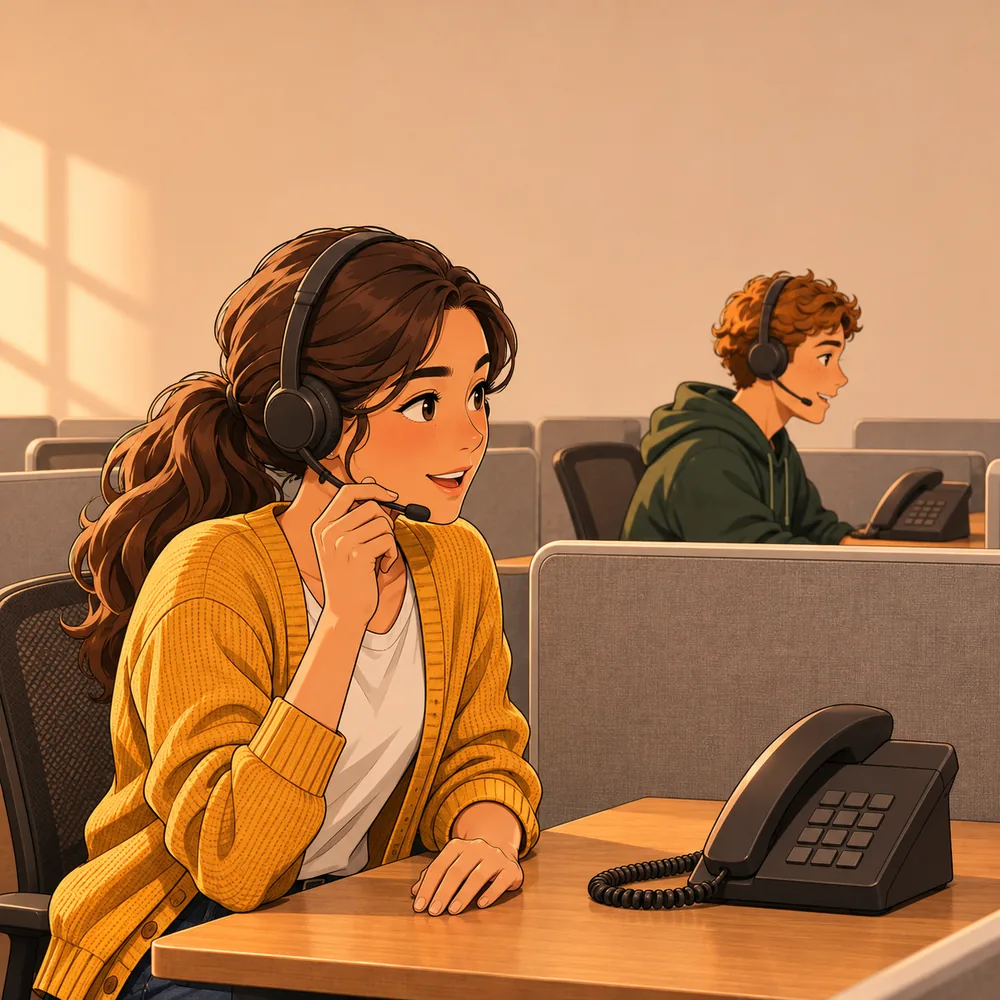
Back on the phones. She makes the next call with one real student in mind.
Adam Grant’s idea started with people who never met the readers of their work. In his telling, about two hundred office staff made the Let’s Go travel guides, and no editor ever dealt with a reader. He recalls that when he studied those teams for his undergraduate thesis, the steadiest sign of a successful team was a belief that its work helped others.1, 2 Later, he and his colleagues studied a university call center where paid student callers phoned alumni for donations, a job Knowledge at Wharton described as poorly paid and full of rejection, with high turnover and often low morale.1 Managers had already tried inspiring speeches about what the donations paid for. Grant’s verdict: “the right message, but the wrong source.”2
So the team brought in the person the calls helped. In a study published in 2007, a manager gathered small groups of callers in a break room for 10 minutes. Callers in both session groups first read a one-page letter from a scholarship student.3 Then 17 of the 39 callers met the student himself for about five minutes and asked their own questions about his classes, how he got the scholarship and his plans. Twelve read the letter without meeting him, and ten had no session. The manager closed by reminding callers that “this is someone you’re supporting.”3 The letter group had the same manager and the same time in the room, so the meeting was what differed between those two groups. Who met him depended on whether a caller’s shift fell when he was there.3
A month later, among the callers who met the student, the work looked different. In a one-week window, their average phone time had risen from 107.55 to 260.73 minutes, and the money they raised from $185.94 to $503.22: 2.42 times their own earlier minutes and 2.71 times their own earlier money.3, 1 Callers who only read his letter barely changed, and neither the letter-only group nor the no-session group changed significantly.3 Stories on paper can help too. In a separate small randomized study Grant published in 2008, a different group of callers read and discussed two real stories by scholarship students in a 20-minute session, and a month later their weekly pledges and money had more than doubled.4
Who says it matters too. In a later field study of 60 fundraisers, Grant and David Hofmann had two leaders and then a scholarship student each give a talk of about 10 minutes on why the work mattered. Only the student’s talk was linked to more money raised.6 In their laboratory follow-ups, the same inspiring message did more coming from someone presented as a beneficiary than from a leader, and suspicion of the leader explained the gap.6 The leader still has a part: in another call-center study by Grant, meeting beneficiaries strengthened the effect of leaders’ inspiring vision.7
The parts work together. The meeting makes the person real; callers who only read the same letter barely changed. The person helped makes the message believable. The leader does the quieter, harder work: finding the right person, gathering the few people who did the work, framing the purpose in a sentence and then staying out of the way. The aim isn’t a better speech about why the work matters. It’s letting the people who did the work see for themselves.
Principles of Excellence
- Start with the people farthest from the end. Grant’s idea began with editors who never met a reader and callers who never met a student their calls had helped.1, 2
- Meet the person. In Grant’s 2007 study, among the callers who met the scholarship student and asked their own questions, weekly money raised a month later was 2.71 times their own earlier level; callers who only read his letter barely changed.3
- Let the person helped say it. In Grant and Hofmann’s field study, a scholarship student’s talk was linked to more money raised; two leaders’ talks were not. In their lab studies, suspicion of the leader explained the gap.6
- The leader sets it up, then steps back. In the 2007 study a manager gathered the callers and closed with one line; the student did the talking. In a later Grant study, meeting beneficiaries also strengthened the effect of leaders’ inspiring vision.3, 7
3 Exceptional Practices for your Clinic
- Bring the patient to the few people who did the work, and let them ask. In Grant’s 2007 study, callers who met the scholarship student in a small group asked their own questions, while callers who only read the same letter barely changed. In Grant’s 2013 account, John Deere invited farmers buying their first tractor to the factory, where the employees who built it presented each buyer with a gold key. Answering the questions staff actually have turns a file into a person. When a patient mentions at checkout that their biologic was finally approved after an appeal, the front desk passes that on to the practice manager through the clinic’s authorized channel. Later, through the same channel, the manager asks whether the patient would like to come in for ten minutes to meet the two billers who worked the appeal; saying no changes nothing about their care. If the patient agrees, written consent names who they will meet and what is shared. In a private room, the billers ask their own questions, and nobody else is there.
- Let the patient say it, and keep the leader’s part to one sentence. In Grant and Hofmann’s field study, only the scholarship student’s talk, not the two leaders’, was linked to more money raised, and in the lab, suspicion of the leader explained the gap. The same words land differently from the person they helped. When a dermatologist hears a patient say the early appointment for a changing spot made all the difference, the dermatologist passes it to the practice manager through the clinic’s authorized channel. Later, through that channel, the manager asks whether the patient would like to meet the two schedulers who booked it under the clinician-written triage rule; saying no changes nothing about their care. With written consent, the ten-minute huddle is held in a private room: the dermatologist who saw the patient says one sentence about why early visits matter, then steps back. The patient does the talking.
- When the patient can’t come, read real stories together. In Grant’s 2007 study, callers who only read one letter barely changed, but in his 2008 study, a different group of callers read and discussed two real stories by scholarship students, and a month later their pledges and money had more than doubled. Talking it over as a group gives people time to picture the person. The histotech cuts and stains every Mohs layer but never meets the patient. When two Mohs patients write to say what finishing in one day meant, the practice manager asks each, through the clinic’s authorized channel, whether they would like to share the note with their surgical team; saying no changes nothing about their care. With both patients’ written consent, the surgeon brings the notes to the next Mohs-morning huddle, held in private. The histotech and MAs who worked those cases read each one with the surgeon and talk about it for five minutes.
Explore the Evidence Further
Explore the Evidence Further. All 13 sources, with methods, findings, limits and clinic applications
Thirteen sources, grouped by kind of evidence: Grant’s call-center experiments, studies of who delivers the message, Grant’s own accounts of where the idea came from and of companies he described, studies in health care settings, and findings that complicate the story. Each row gives the design and its main limits, the key finding, why it matters and a way to apply it. Study names link to the original sources, and the full references close this section. None of these sources studied a dermatology clinic, or histology technicians, billers, schedulers or medical assistants, so every application is our proposal, not a tested intervention.
Meeting the person, and reading their stories: Grant’s call-center experiments
| Study or source | Setting, design and sample | Key finding | Why it matters | How to Apply It to Your Derm Clinic |
|---|---|---|---|---|
| Grant and colleagues, “Impact and the art of motivation maintenance” (Experiment 1)3 | Field experiment, partly randomized: 39 paid callers (21 men, 18 women; average tenure 9.17 months) at one U.S. university fundraising call center; published 2007; full text read. The 17 contact callers were those whose shifts fell in one of four slots when the student was present; callers in other slots were randomly split between a letter group (12) and no session (10). One beneficiary, one site. Phone time and money were measured in one-week windows, two weeks before and one month after. The contact group’s paired tests used 16 of its 17 callers, and variation was large (standard deviations of $267.70 before and $294.70 after on weekly donations). | In a 10-minute break-room session, both session groups read the student’s one-page letter for five minutes; the contact group then spent about five minutes asking him about his classes, his scholarship and his plans, and the manager closed by asking callers to keep him in mind during their calls. The letter group had the same manager attention and time. Among the callers who met the student, raw weekly averages went from 107.55 to 260.73 phone minutes and from $185.94 to $503.22 raised, which the paper reports as 2.42 times the minutes and 2.71 times the money (multiples of that group’s own before levels). The letter group (143.29 to 147.05 minutes; $251.67 to $254.18) and the no-session group (119.73 to 178.93 minutes; $231.63 to $261.00) showed no significant change in these small groups. These are raw group averages, not a randomized between-group effect. | It is the anchor study: the same letter, with and without the person, in one call center. | Proposed: bring the person in and let staff ask their own questions, rather than passing one letter around. |
| Grant, “Employees without a cause”5 | Quasi-experiment: 45 paid undergraduate callers at a large Midwestern public university; published 2008; full text read. The 23 callers on one Wednesday shift met an anthropology graduate student whose fellowship their donations had funded; the other 22 were controls. Grant writes that this assignment “does not qualify as random.” The whole interaction lasted 15 minutes. One-week windows just before and a month later. One beneficiary, one site, college-student callers and very large variation; Grant notes that the design mixed who delivered the message with how it was delivered. | The contact group’s raw weekly donations went from $411.74 to $2,083.52, about 406% more (5.06 times the before level), and pledges from 149.09 to 364.32; the controls went from $454.55 to $619.77, a change that was not significant. Variation after the visit was very large (standard deviation $1,725.76). This is the study behind the 406% example in Grant’s popular chapter. It is a within-group gain in one small, non-randomized study, not a randomized effect and not a forecast for a clinic. | A second, separate contact study in the same kind of setting pointed the same way. | Proposed: keep the visit short and real: one person the work helped, and the staff’s own questions. |
| Grant, “The significance of task significance” (Experiments 1 to 3)4 | Randomized field experiments: One U.S. university call center and one Midwestern community recreation center; published 2008; full text read. Experiment 1: 33 paid callers assigned by drawing names, 12 of them to the scholarship-story group, in a 20-minute session with five minutes to read and five to discuss each story; the paper reports power of only .40 and .41 for the key tests. Experiment 2: 32 lifeguards. Experiment 3: 34 new callers. Stories, not meetings; small groups; same author as the other call-center studies. | Callers who read and discussed two real stories written by scholarship students raised weekly pledges from 9.08 to 23.00 and weekly money from $1,288.33 to $3,130.83 a month later; callers who read two stories about the personal benefits of the job, or nothing, showed no significant change. Lifeguards who read four stories about other lifeguards’ rescues raised their voluntarily worked weekly hours from 7.06 to 10.11 (about 43%) and supervisor-rated helping from 3.81 to 4.62 (about 21%), while the comparison group showed no significant change. Among new callers, conscientiousness and prosocial values changed how much the intervention helped. | Written stories, read and discussed together, also helped. This was not a head-to-head test against meeting the person. | Proposed: when a meeting isn’t possible, read two or more real, consented stories together and talk about them. |
Who says it: beneficiaries and leaders
| Study or source | Setting, design and sample | Key finding | Why it matters | How to Apply It to Your Derm Clinic |
|---|---|---|---|---|
| Grant and Hofmann, “Outsourcing inspiration”6 | Field quasi-experiment and laboratory experiments: Study 1: 60 fundraisers at a university call center in the southeastern United States, tracked daily for three months; published 2011; full text read. Two leaders spoke first and a scholarship student always spoke after both, each for about 10 minutes, so speaker and timing overlap. Speakers chose shifts by availability, with no random assignment of individuals, and the authors note that fundraisers on the student’s shift may have been more committed. Studies 2 and 3: student participants on editing and marketing tasks in the lab. | In the statistical model, the student’s message predicted higher dollars raised (estimate 496.53) and the leaders’ did not. The 18 fundraisers who heard the student went from an average of $2,459.44 in the two weeks before to $9,704.58 in the two weeks after; those who did not hear him showed no significant change. In Grant and Hofmann’s lab studies, when the speaker was presented as a beneficiary rather than a leader, the same inspiring message lifted both task performance and citizenship performance, and suspicion of the leader explained the difference; the advantage held for messages about helping others but not for messages about achievement. | Who carries the message matters, not only what it says. | Proposed: let the patient do the talking, with the leader’s part kept to a sentence. |
| Grant, “Leading with meaning”7 | Quasi-experiment and survey (abstract only): Call-center employees, plus a separate survey of government employees; published 2012. Only the abstract was read; sample sizes, methods and effect sizes were not seen. Same author. | Beneficiary contact strengthened the effects of leaders’ inspiring vision on call-center employees’ sales and revenue; the survey supported a model running through perceived prosocial impact. | The leader and the person helped can work together: the leader frames the purpose, and the beneficiary makes it real. | Proposed: open with one sentence on purpose from a leader, then hand over to the patient. |
Grant’s own accounts: where the idea came from, and companies he described
| Study or source | Setting, design and sample | Key finding | Why it matters | How to Apply It to Your Derm Clinic |
|---|---|---|---|---|
| Knowledge at Wharton, “Putting a Face to a Name”1 | Business school article: Knowledge at Wharton, 17 February 2010; a popular account with no sample sizes. The live page refused automated access, so the full text was read from an archived copy. | Grant’s recollection of the Let’s Go travel guides, where about two hundred office staff produced the guides and no editor dealt with readers. The article describes the call-center job as poorly paid, with frequent rejection, high turnover and often low morale, and reports the same weekly money figures as the 2007 paper for the callers who met the student ($185.94 to $503.22). | It shows the problem the research set out to solve: people cut off from the end of their work. | Proposed: start with the roles that never see a patient, such as the histotech and the biller. |
| Grant, “Work and the art of motivation maintenance”2 | Author’s chapter: Grant’s first-person popular chapter, an author-posted manuscript from about 2013; read in full. It describes the callers as randomly divided into three groups; the 2007 paper shows the contact group was formed by shift timing, and the paper governs here. | As Grant recalls it, his undergraduate thesis on the Let’s Go editorial teams found that the steadiest sign of a successful team was a belief that its work helped others; this origin story is his own retrospective account, not an experiment or an independently checked history. At the call center, he writes, most callers quit within two months, and in his view the managers’ message was sound but came from the wrong messenger. He also writes that the team repeated the call-center result five times; that count is his own account and is not documented in the papers read, and the one example he gives matches the 2008 paper above. | It is the origin of the lesson in Grant’s own words: change the messenger, not the message. | Proposed: replace the manager’s speech with the person helped. |
| Grant, “Outsource inspiration”8 | Author’s manuscript: Grant’s practitioner chapter manuscript, about 2013; read in full. The company examples are his accounts, with no outcome data and no confirmation that they continue today. | Grant describes Medtronic’s annual holiday party, where six patients tell how its products changed their lives while senior leaders describe the mission, and John Deere inviting farmers buying their first tractor to the factory, where the employees who built it presented a gold key. | It shows what the practice looked like inside companies: the people helped met the people who did the work, with leaders beside them. | Proposed: match the patient to the specific people who did the work, not the whole staff. |
Health care settings: signs, a nurse trial and patient photos
| Study or source | Setting, design and sample | Key finding | Why it matters | How to Apply It to Your Derm Clinic |
|---|---|---|---|---|
| Grant and Hofmann, “It’s not all about me”9 | Field experiments: One U.S. hospital; published 2011; full text read. Experiment 1: 66 soap and gel dispensers used by physicians and nurses were randomly assigned one of three signs for two weeks, measured as the percentage of product used by weight per dispenser, not the share of staff who cleaned their hands. Experiment 2, nine months later: four matched pairs of inpatient units, with covert trained observers recording 322 hand-hygiene opportunities before and 245 after, over two-week periods. No infection or mortality outcome. The authors name the two-week length as a key limitation and note that such effects often fade. | With the patient sign, the share of each dispenser’s product used rose from 37.25% to 54.18% (22 dispensers); the personal sign (35.49% to 33.98%) and the control sign (38.24% to 40.13%) did not raise it. On patient-sign units, observed hand hygiene rose from 80.69% to 89.20% (8.51 percentage points, about 10.5% relative); on personal-sign units it stayed flat (80.00% to 79.71%). The authors summarize these as relative gains above 45% and above 10%. This is framing, not contact with a patient. | In a health care setting, a reminder that named the patient changed behavior where one about the worker did not. | Proposed: keep the patient in view in everyday reminders, alongside, never instead of, the sterilization protocol, two-identifier labeling and time-outs. |
| Bellé, “Experimental evidence on the relationship between public service motivation and job performance”10 | Randomized field experiment: 90 nurses randomly selected from 249 volunteers at a large Italian public hospital and randomly assigned, 30 per group, to control, beneficiary contact or self-persuasion; spring 2011; published 2013; full paper read; independent of Grant’s group. The nurses assembled surgical kits, outside normal hours, for a humanitarian project in a former war zone. In the contact group, three health practitioners from that area spoke at the kickoff for roughly 15 minutes, and at least one worked alongside the nurses through the six-day shift. The beneficiaries were health practitioners, not patients, and the groups worked in different calendar weeks. | Compared with control, the contact group worked 238.73 vs 145.96 minutes (about 64% more), assembled 254.83 vs 123.40 kits (2.07 times), assembled 0.92 vs 0.80 kits per minute (about 15% more) and assembled 5.80% vs 8.70% of kits wrongly (2.9 percentage points, about a third fewer). These are between-group comparisons, and productivity and errors are different outcomes. Effects were larger for nurses with higher public service motivation, and a rise in that motivation partly explained the gains. | It is the closest tested case to making something for people you never see, run by a researcher outside Grant’s group. | Proposed: for behind-the-scenes roles, start small and watch: here the people met were practitioners on a humanitarian project, not patients. |
| Turner and Hadas-Halpern, “The effects of including a patient’s photograph to the radiographic examination”11 | Conference abstract: RSNA 2008 abstract from one tertiary-care hospital; 15 radiologists; photographs added for 267 CT patients (1,137 CT exams); questionnaire data and no statistics; not a peer-reviewed full paper. Read in full. | Radiologists said the photos made them feel more empathy and read more carefully. Three months later, 30 selected photo-group cases with incidental findings were reread blind and without photos; in 80% of those rereads, the radiologists left the findings out of their reports. The photos also carried clinical clues, for example visible signs of disease, so empathy cannot be separated from extra clinical clues. The outcome was reporting of incidental findings, not diagnostic accuracy. | It is a medical example of people who read the work without meeting the patient, and it shows how hard such effects are to pin down. | Proposed: do not attach patient photos to lab or billing files to create this effect; photos are patient information and need their own privacy review. |
What complicates the story
| Study or source | Setting, design and sample | Key finding | Why it matters | How to Apply It to Your Derm Clinic |
|---|---|---|---|---|
| Siciliano and Thompson, “A field experiment on the impact of beneficiary contact on federal employee perceptions of prosocial impact and social worth”12 | Cluster-randomized field experiment (abstract only): U.S. federal employees; published online 2021; independent of Grant’s group. Abstract only, so the sample size and any performance outcomes were not seen. | Beneficiary contact had a small positive effect on social worth (feeling valued) and none on perceived prosocial impact. The authors note that earlier work had focused on undergraduates, call-center workers and volunteers. This is not a test of performance and not proof that contact never helps. | An independent randomized test in public employees found little change in how much impact people felt. | Proposed: try it with one team first and ask staff what changed, rather than assuming it will work everywhere. |
| Bolino and Grant, “The bright side of being prosocial at work, and the dark side, too”13 | Narrative review: Academy of Management Annals, 2016; co-written by Grant; a narrative, not quantitative, review whose dark-side sections are largely a research agenda. Read in full. | Caregivers in close contact with patients may feel more sadness and distress; the review cites Klimecki and Singer’s view that seeing others suffer while being unable to help drives compassion fatigue. A sense of helping others can also be used to justify unwise or unethical acts, and people tend to overestimate their own impact. Perceived impact was strongest in studies where leaders set out how the work benefited others and beneficiaries supplied personal examples. | Contact can cost something, and a good story must never excuse a bad process. | Proposed: choose outcomes the team helped bring about, never use a sad outcome to motivate, and never use a story to justify a shortcut. |
Across all thirteen sources:
- None studied a dermatology clinic, or histology technicians, billers, schedulers or medical assistants.
- The three call-center contact studies (39, 45 and 60 callers) were small, run by Grant and colleagues at university call centers, and none randomly assigned individual callers to meet the beneficiary.
- The call-center gains are raw changes within small groups, with large variation, measured in one-week windows about a month later; the hospital tests lasted two weeks. None is a forecast for a clinic.
- Formats were never compared head to head: callers who only read one letter showed no significant change in 2007, a separate group who read and discussed two stories improved in 2008, and the 2008 contact study could not separate who spoke from how.
- Independent tests are mixed: nurses worked longer and made fewer errors after meeting the practitioners who would use their kits, while federal employees’ sense of impact did not change.
- The company examples are Grant’s 2013 accounts, with no outcome data.
Principles of Excellence: related evidence from other settings
The main text explains Grant’s findings in plain English. These sources describe or test them; none measured a dermatology clinic.
| Point in the brief | Related evidence |
|---|---|
| Start with the people farthest from the end. | Grant’s own account of the Let’s Go editors and the call center (business school article; author’s chapter).1, 2 |
| Meet the person. | Meeting the student versus reading his letter (field experiment, partly randomized; 39 callers).3 A separate 15-minute visit (quasi-experiment, not randomized; 45 callers).5 Two written stories read and discussed (randomized field experiment; 12 callers in the story group).4 |
| Let the person helped say it. | A student’s talk versus two leaders’ talks (field quasi-experiment; speaker and timing overlap) and suspicion of leaders (laboratory experiments).6 Grant’s account of the messenger problem (author’s chapter).2 |
| The leader sets it up, then steps back. | The manager’s role in the 2007 session (field experiment).3 Beneficiary contact strengthened leaders’ vision (quasi-experiment, abstract only).7 Leaders and beneficiaries together (narrative review).13 Medtronic (Grant’s 2013 account, no outcome data).8 |
Our clinic suggestions: proposed, not tested
The three practices and today’s action are our suggestions for a dermatology practice, not a tested program. All of them keep the same safety rules: taking part is the patient’s choice, and saying no changes nothing about their care; every request, note and consent goes through the clinic’s authorized channel, and meetings are private; written consent that names what is shared and with whom; only the staff who had a role in that patient’s care; no ask at a vulnerable moment or by the treating clinician; clinicians disclose diagnoses, and nonclinical staff follow clinician-written rules.
| Suggestion | What it draws on |
|---|---|
| Bring the patient to the few people who did the work: a voluntary, private ten-minute visit with the billers who worked an appeal, who ask their own questions. | Meeting the student versus his letter (field experiment, partly randomized).3 John Deere’s gold key (Grant’s account, no outcome data).8 The clinic scene is an illustration, not a documented case. |
| Let the patient say it: one sentence from the dermatologist who saw the patient, then the patient, by choice and in private, speaks to the two schedulers who booked the visit. | Student versus leaders (field quasi-experiment; laboratory experiments).6 Beneficiary contact with leaders’ vision (quasi-experiment, abstract only).7 |
| Read real stories together: two consented Mohs patient notes, read and discussed by the histotech, surgeon and MAs who worked those cases. | Two written stories read and discussed (randomized field experiment, low reported power).4 Callers who only read one letter (field experiment).3 The nearest tested back-office case involved practitioners, not patients (randomized field experiment).10 |
| One action today: note who behind the scenes made a good result happen and send it through the clinic’s authorized channel, so the practice manager can later ask the patient, in writing, whether they would like to share it. | No study tested this one-day step; it applies the same pattern. Contact can bring distress, so choose outcomes the team helped bring about (narrative review).13 |
Sources
- Knowledge at Wharton Staff. Putting a Face to a Name: The Art of Motivating Employees. Knowledge at Wharton. 17 February 2010. knowledge.wharton.upenn.edu
- Grant AM. Work and the art of motivation maintenance. In: Gernsbacher M, ed. Psychology and the Real World. 2nd ed. Worth Publishers (forthcoming at time of posting). Author-posted manuscript, c. 2013. Author-posted manuscript (faculty.wharton.upenn.edu)
- Grant AM, Campbell EM, Chen G, Cottone K, Lapedis D, Lee K. Impact and the art of motivation maintenance: the effects of contact with beneficiaries on persistence behavior. Organ Behav Hum Decis Process. 2007;103(1):53-67. Author-hosted PDF (faculty.wharton.upenn.edu)
- Grant AM. The significance of task significance: job performance effects, relational mechanisms, and boundary conditions. J Appl Psychol. 2008;93(1):108-124. doi:10.1037/0021-9010.93.1.108. Full text (selfdeterminationtheory.org)
- Grant AM. Employees without a cause: the motivational effects of prosocial impact in public service. Int Public Manag J. 2008;11(1):48-66. doi:10.1080/10967490801887905. Author-hosted PDF (faculty.wharton.upenn.edu)
- Grant AM, Hofmann DA. Outsourcing inspiration: the performance effects of ideological messages from leaders and beneficiaries. Organ Behav Hum Decis Process. 2011;116:173-187. Author-hosted PDF (faculty.wharton.upenn.edu)
- Grant AM. Leading with meaning: beneficiary contact, prosocial impact, and the performance effects of transformational leadership. Acad Manage J. 2012;55(2):458-476. doi:10.5465/amj.2010.0588. doi.org
- Grant AM. Outsource inspiration. Manuscript for Dutton JE, Spreitzer GM, eds. Putting Positive Leadership in Action. Author-posted manuscript, c. 2013. Author-posted manuscript (faculty.wharton.upenn.edu)
- Grant AM, Hofmann DA. It’s not all about me: motivating hand hygiene among health care professionals by focusing on patients. Psychol Sci. 2011;22(12):1494-1499. doi:10.1177/0956797611419172. Full text (iacmr.org)
- Bellé N. Experimental evidence on the relationship between public service motivation and job performance. Public Adm Rev. 2013;73(1):143-153. doi:10.1111/j.1540-6210.2012.02621.x. Author’s teaching page copy (unibocconi.it)
- Turner Y, Hadas-Halpern I. The effects of including a patient’s photograph to the radiographic examination. RSNA 2008 Scientific Assembly, abstract SSM12-03. Presented 3 December 2008. archive.rsna.org
- Siciliano MD, Thompson JR. A field experiment on the impact of beneficiary contact on federal employee perceptions of prosocial impact and social worth. Int Public Manag J. 2022;25(1). Published online 2021. doi:10.1080/10967494.2021.1887985. doi.org
- Bolino MC, Grant AM. The bright side of being prosocial at work, and the dark side, too: a review and agenda for research on other-oriented motives, behavior, and impact in organizations. Acad Manag Ann. 2016;10(1). doi:10.1080/19416520.2016.1153260. Author-hosted PDF (faculty.wharton.upenn.edu)